Writing an Argumentative,
Research-Based Body Paragraph
Created by Lauren Blackwell
1
Navigation
Use the navigation tools below to move throughout this
presentation. Just “clicking” may not send you in the right
direction.
2
Takes you back one slide.
Takes you back to the first slide.
Moves you forward to the next slide.
Welcome!
This unit is designed for high-school English Language Arts
students.
This unit will explain essential terminology and the process of
writing an argumentative, research-based body paragraph in
about 20 minutes.
After completing this unit, you will take a post-test on the
material covered in the following slides.
3
Why are we doing this anyway?
The ability to argue effectively is a skill needed in any aspect of
life.
The information in this unit discusses essential skills that will be
useful for any career.
The ability to create an effective argument is required by the state
of South Carolina and the College and Career Readiness Standards.
4
What do you need to know before we
start?
1. All papers have a beginning, a middle, and an end.
2. Introduction paragraphs (beginning) are used to introduce the
topic.
3. Body paragraphs (middle) are used to explain the topic in more
detail.
4. Conclusion paragraphs (end) are used to recap the important
details in the paper and conclude any final thoughts.
5. Thesis statements can be found at the end of your
introduction paragraph and state the main idea of your paper.
5
After completing this unit you can say…
1. I can define key terms used within an argumentative, research-
based body paragraph.
2. I can identify the process of creating and explaining an topic
sentence.
3. I can define and explain the two different types of research.
4. I can identify the process of creating a counterargument and
refutation.
5. I can identify the process of concluding a body paragraph.
6. I can identify the process of organizing an argumentative,
research-based body paragraph.
6
Throughout this unit…
• Key terms will be in underlined.
• Examples will be in bold.
• There will be practice questions throughout.
• If you answer the practice questions correctly, you will move on to the
next portion.
• If you answer the practice questions incorrectly, you will be taken back
to the slide where you can find the right answer.
• Once you are ready to try the practice question again, click on the
to return to the question and try again.
7
Are you ready?
Let’s start with Key Vocabulary Terms!
Part 1 of 6
8
Body Paragraphs
•A well-written body paragraph is 8-10 sentences.
•Body paragraphs build upon the claims made in
the introductory paragraph (Brizee, 2013).
•Body paragraphs provide focused reasoning that
helps prove the thesis statement (Brizee, 2013).
9
Key Vocabulary
Body Paragraphs
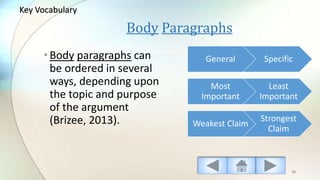
•Body paragraphs can
be ordered in several
ways, depending upon
the topic and purpose
of the argument
(Brizee, 2013).
10
Key Vocabulary
Most
Important
Least
Important
General Specific
Weakest Claim
Strongest
Claim
Transitions
•Transitions are words or phrases that help carry a
thought from one sentence to another, from one
idea to another, or from one paragraph to another
(Weber & Stolley, 2011).
•Transitions link sentences and paragraphs
together smoothly so that there are no abrupt
jumps or breaks between ideas (Weber & Stolley,
2011).
11
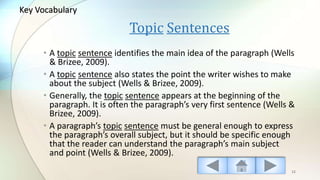
Key Vocabulary
Topic Sentences
• A topic sentence identifies the main idea of the paragraph (Wells
& Brizee, 2009).
• A topic sentence also states the point the writer wishes to make
about the subject (Wells & Brizee, 2009).
• Generally, the topic sentence appears at the beginning of the
paragraph. It is often the paragraph’s very first sentence (Wells &
Brizee, 2009).
• A paragraph’s topic sentence must be general enough to express
the paragraph’s overall subject, but it should be specific enough
that the reader can understand the paragraph’s main subject
and point (Wells & Brizee, 2009).
12
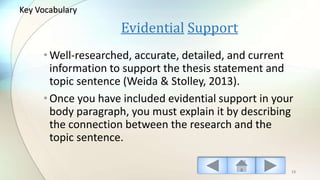
Key Vocabulary
Evidential Support
•Well-researched, accurate, detailed, and current
information to support the thesis statement and
topic sentence (Weida & Stolley, 2013).
•Once you have included evidential support in your
body paragraph, you must explain it by describing
the connection between the research and the
topic sentence.
13
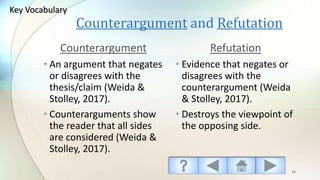
Key Vocabulary
Counterargument and Refutation
Counterargument
• An argument that negates
or disagrees with the
thesis/claim (Weida &
Stolley, 2017).
• Counterarguments show
the reader that all sides
are considered (Weida &
Stolley, 2017).
Refutation
• Evidence that negates or
disagrees with the
counterargument (Weida
& Stolley, 2017).
• Destroys the viewpoint of
the opposing side.
14
Key Vocabulary
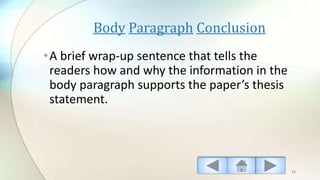
Body Paragraph Conclusion
•A brief wrap-up sentence that tells the
readers how and why the information in the
body paragraph supports the paper’s thesis
statement.
15
TRUE OR FALSE
A counterargument negates or disagrees with the
thesis/claim.
16
A
B
TRUE
FALSE
Correct!
The counterargument disagrees with the thesis/claim to help show your
readers that you have considered all sides of your argument.
17
Moving on…
The creation process of an effective topic sentence.
Part 2 of 6
18
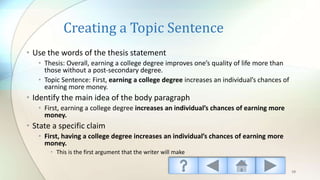
Creating a Topic Sentence
• Use the words of the thesis statement
• Thesis: Overall, earning a college degree improves one’s quality of life more than
those without a post-secondary degree.
• Topic Sentence: First, earning a college degree increases an individual’s chances of
earning more money.
• Identify the main idea of the body paragraph
• First, earning a college degree increases an individual’s chances of earning more
money.
• State a specific claim
• First, having a college degree increases an individual’s chances of earning more
money.
• This is the first argument that the writer will make
19
TRUE OR FALSE
An effective topic sentence does not include the
words of the thesis statement.
20
A
B
TRUE
FALSE
Correct!
The topic sentence must use the words of the thesis to offer
organization and simple understanding for your reader!
21
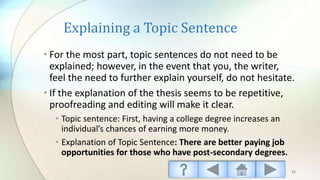
Explaining a Topic Sentence
• For the most part, topic sentences do not need to be
explained; however, in the event that you, the writer,
feel the need to further explain yourself, do not hesitate.
• If the explanation of the thesis seems to be repetitive,
proofreading and editing will make it clear.
• Topic sentence: First, having a college degree increases an
individual’s chances of earning more money.
• Explanation of Topic Sentence: There are better paying job
opportunities for those who have post-secondary degrees.
22
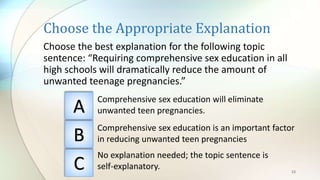
Choose the Appropriate Explanation
Choose the best explanation for the following topic
sentence: “Requiring comprehensive sex education in all
high schools will dramatically reduce the amount of
unwanted teenage pregnancies.”
23
A
B
C
Comprehensive sex education will eliminate
unwanted teen pregnancies.
Comprehensive sex education is an important factor
in reducing unwanted teen pregnancies
No explanation needed; the topic sentence is
self-explanatory.
Correct!
No explanation is needed because the topic sentence provided was
clear and concise for all readers.
24
Next…
The Two Types of Evidential Support
Part 3 of 6
25
Evidential Support
•There are two types of evidential support
one can use in an argumentative, research-
based body paragraph:
•Primary Resources
•Secondary Resources
26
Primary Resources
• Anecdotes or stories from experience
• Research the writer has conducted such as interviews,
experiments, surveys, or personal experience (Weida &
Stolley, 2013)
• According to the survey the class took at the beginning of
this unit, 52.84% of the class thought a carefully worded
thesis statement that goes after the topic sentence was an
appropriate type of evidential support.
• This research came from a self-generated survey.
• One’s own data is always the strongest evidence when tempting to
persuade the reader.
27
Secondary Resources
• Facts or information about the topic
• Research gained from various texts that were supplied and
complied by others such as books, periodicals, and websites
(Weida & Stolley, 2013)
• According to the College Board, “In 2015, the percentage of full-time
year-round workers age 35 to 44 earning $100,000 or more ranged
from 2% of those without a high school diploma and 5% of high school
graduates to 25% of those whose highest attainment was a bachelor’s
degree and 38% of advanced degree holders” (2017).
• This research comes from a validated source, which focuses on post-secondary
education. This research was used as evidence to prove the topic sentence.
28
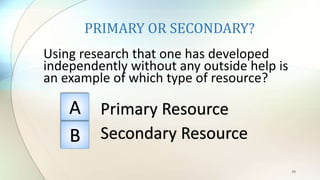
PRIMARY OR SECONDARY?
Using research that one has developed
independently without any outside help is
an example of which type of resource?
29
A
B
Primary Resource
Secondary Resource
Correct!
Primary resources are created by the author cited.
30
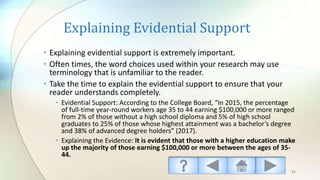
Explaining Evidential Support
• Explaining evidential support is extremely important.
• Often times, the word choices used within your research may use
terminology that is unfamiliar to the reader.
• Take the time to explain the evidential support to ensure that your
reader understands completely.
• Evidential Support: According to the College Board, “In 2015, the percentage
of full-time year-round workers age 35 to 44 earning $100,000 or more ranged
from 2% of those without a high school diploma and 5% of high school
graduates to 25% of those whose highest attainment was a bachelor’s degree
and 38% of advanced degree holders” (2017).
• Explaining the Evidence: It is evident that those with a higher education make
up the majority of those earning $100,000 or more between the ages of 35-
44.
31
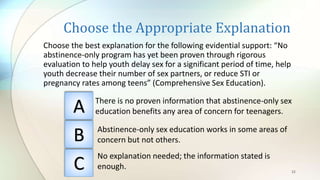
Choose the Appropriate Explanation
Choose the best explanation for the following evidential support: “No
abstinence-only program has yet been proven through rigorous
evaluation to help youth delay sex for a significant period of time, help
youth decrease their number of sex partners, or reduce STI or
pregnancy rates among teens” (Comprehensive Sex Education).
32
A
B
C
There is no proven information that abstinence-only sex
education benefits any area of concern for teenagers.
Abstinence-only sex education works in some areas of
concern but not others.
No explanation needed; the information stated is
enough.
Correct!
This choice offers a thorough explanation of the data provided, while
the other options offer less than supportive options for the claim.
33
Moving Forward
Counterarguments and Refutations
Part 4 of 6
34
Counterargument
•Negate Claim
•It is understood that to become a web
designer, real estate agent, or chef, one does
not have to have any type of college degree.
• When the writer includes a counterargument, it
shows the reader that both sides the argument
have been considered (Weida & Stolley, 2017).
35
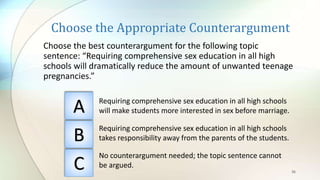
Choose the Appropriate Counterargument
Choose the best counterargument for the following topic
sentence: “Requiring comprehensive sex education in all high
schools will dramatically reduce the amount of unwanted teenage
pregnancies.”
36
A
B
C
Requiring comprehensive sex education in all high schools
will make students more interested in sex before marriage.
Requiring comprehensive sex education in all high schools
takes responsibility away from the parents of the students.
No counterargument needed; the topic sentence cannot
be argued.
Correct!
This choice offers a counterargument that is closely connected to the
topic sentence where the other is more off-topic.
37
Refutation
•Negate the counterargument
• On the other hand, one cannot become a teacher, an
accountant, a doctor, or an engineer without a post-
secondary degree. These options offer a more
financially stable life.
• After a counterargument has been offered, the writer
must offer a refutation (or rebuttal) that DESTROYS the
counterargument.
38
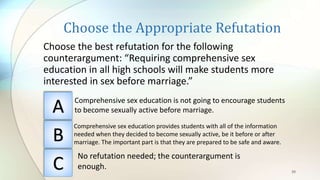
Choose the Appropriate Refutation
Choose the best refutation for the following
counterargument: “Requiring comprehensive sex
education in all high schools will make students more
interested in sex before marriage.”
39
A
B
C
Comprehensive sex education is not going to encourage students
to become sexually active before marriage.
Comprehensive sex education provides students with all of the information
needed when they decided to become sexually active, be it before or after
marriage. The important part is that they are prepared to be safe and aware.
No refutation needed; the counterargument is
enough.
Correct!
This choice refutes the counterargument perfectly. It leaves no doubt for
the reader to
40
Next up…
Concluding a Body Paragraph
Part 5 of 6
Watch the following video to learn about body paragraph
conclusions.
41
42
Video
TRUE OR FALSE
Concluding a body paragraph is a necessary part of
writing an argumentative, research-based body
paragraph.
43
A
B
True
False
Correct!
Concluding your body paragraph leaves your reading feeling satisfied
with the information provided.
44
Finally…
Incorporating all pieces of the body paragraph into a
cohesive unit.
Part 6 of 6
45
Transition:
First,
46
Topic sentence:
First, having a college degree increases an
individual’s chances of earning more money.
47
Explaining the Topic Sentence:
First, having a college degree increases an
individual’s chances of earning more money. There
are better paying job opportunities for those who
have post-secondary degrees.
48
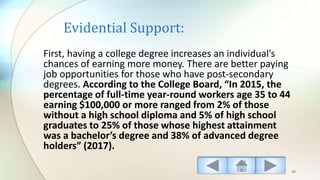
Evidential Support:
First, having a college degree increases an individual’s
chances of earning more money. There are better paying
job opportunities for those who have post-secondary
degrees. According to the College Board, “In 2015, the
percentage of full-time year-round workers age 35 to 44
earning $100,000 or more ranged from 2% of those
without a high school diploma and 5% of high school
graduates to 25% of those whose highest attainment
was a bachelor’s degree and 38% of advanced degree
holders” (2017).
49
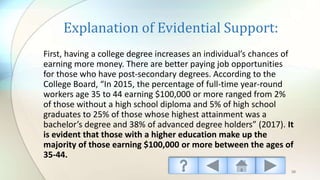
Explanation of Evidential Support:
First, having a college degree increases an individual’s chances of
earning more money. There are better paying job opportunities
for those who have post-secondary degrees. According to the
College Board, “In 2015, the percentage of full-time year-round
workers age 35 to 44 earning $100,000 or more ranged from 2%
of those without a high school diploma and 5% of high school
graduates to 25% of those whose highest attainment was a
bachelor’s degree and 38% of advanced degree holders” (2017). It
is evident that those with a higher education make up the
majority of those earning $100,000 or more between the ages of
35-44.
50
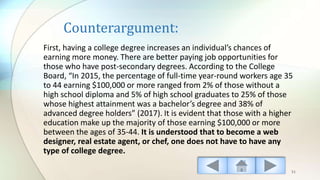
Counterargument:
First, having a college degree increases an individual’s chances of
earning more money. There are better paying job opportunities for
those who have post-secondary degrees. According to the College
Board, “In 2015, the percentage of full-time year-round workers age 35
to 44 earning $100,000 or more ranged from 2% of those without a
high school diploma and 5% of high school graduates to 25% of those
whose highest attainment was a bachelor’s degree and 38% of
advanced degree holders” (2017). It is evident that those with a higher
education make up the majority of those earning $100,000 or more
between the ages of 35-44. It is understood that to become a web
designer, real estate agent, or chef, one does not have to have any
type of college degree.
51
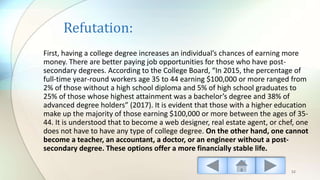
Refutation:
First, having a college degree increases an individual’s chances of earning more
money. There are better paying job opportunities for those who have post-
secondary degrees. According to the College Board, “In 2015, the percentage of
full-time year-round workers age 35 to 44 earning $100,000 or more ranged from
2% of those without a high school diploma and 5% of high school graduates to
25% of those whose highest attainment was a bachelor’s degree and 38% of
advanced degree holders” (2017). It is evident that those with a higher education
make up the majority of those earning $100,000 or more between the ages of 35-
44. It is understood that to become a web designer, real estate agent, or chef, one
does not have to have any type of college degree. On the other hand, one cannot
become a teacher, an accountant, a doctor, or an engineer without a post-
secondary degree. These options offer a more financially stable life.
52
Body Paragraph Conclusion:
First, having a college degree increases an individual’s chances of earning more money.
There are better paying job opportunities for those who have post-secondary degrees.
According to the College Board, “In 2015, the percentage of full-time year-round
workers age 35 to 44 earning $100,000 or more ranged from 2% of those without a high
school diploma and 5% of high school graduates to 25% of those whose highest
attainment was a bachelor’s degree and 38% of advanced degree holders” (2017). It is
evident that those with a higher education make up the majority of those earning
$100,000 or more between the ages of 35-44. It is understood that to become a web
designer, real estate agent, or chef, one does not have to have any type of college
degree. On the other hand, one cannot become a teacher, an accountant, a doctor, or
an engineer without a post-secondary degree. These options offer a more financially
stable life. The more education one has, the more career opportunities and financial
stability one can achieve.
53
What Comes Next?
Which step comes after the explanation of the
topic sentence and the use of evidential support?
54
A
B
C
Refutation
Counterargument
Explanation of Evidential Support (if needed)
Correct!
Including an explanation of your evidence is necessary after you state
your research.
55
Post-Test
Click here to take the posttest.

56
References
Baker, J., Brizee, A., & Angeli, E. (n.d.). Essay Writing. Retrieved November 11, 2017, from https://owl.english.purdue.edu/owl/owlprint/685/
Brizee, A. (2013, February 24). Body Paragraphs. Retrieved November 10, 2017, from https://owl.english.purdue.edu/owl/resource/724/02/
Carney C, McGehee D, Harland H, Weiss M, and Raby M. Using Naturalistic Driving Data to Assess the Prevalence of Environment Factors and Driver Behaviors in Teen
Driver Crashes. AAA Foundation for Traffic Safety. March 2015.
College Education Linked to Higher Pay, Job Security, Healthier Behaviors and More Civic Involvement: New College Board Report. (2017, January 09). Retrieved November
11, 2017, from https://www.collegeboard.org/releases/2016/college-education-linked-to-hgher-pay-job-security-healthier-behaviors-and-more-civic-involvement
“Comprehensive Sex Education: Research and Results.” Advocatesforyouth.org, Advocates for Youth, Sept. 2009, www.advocatesforyouth.org/publications/1487.
McKnight, R. (2017, January 10). South Carolina General Assembly. Retrieved November 19, 2017, from http://scstatehouse.gov/sess122_2017-2018/bills/3050.htm
[Time4Writing]. (2010, November 4). Closing or Concluding Sentences – Time4Writing.com. [Video File]. Retrieved November 11, 2017 from
https://www.youtube.com/watch?v=3gaI9g6bdd4
Weber, R., & Stolley, K. (2011, February 02). Transitional Devices. Retrieved November 10, 2017, from https://owl.english.purdue.edu/owl/resource/574/02/
Weida, S., & Stolley, K. (2017, June 16). Organizing Your Argument. Retrieved November 11, 2017, from https://owl.english.purdue.edu/owl/resource/588/03/
Weida, S., & Stolley, K. (2013, March 11). Using Research and Evidence. Retrieved November 10, 2017, from https://owl.english.purdue.edu/owl/resource/588/02/
Wells, J. M. (2009, August 7). 1.1: Topic Sentences (A. Brizee, Ed.). Retrieved November 11, 2017, from https://owl.english.purdue.edu/engagement/2/1/29/
57
Thank You!
Have a great day!
58

Writing an Argumentative, Research-Based Body Paragraph

  • 1.
    Writing an Argumentative, Research-BasedBody Paragraph Created by Lauren Blackwell 1
  • 2.
    Navigation Use the navigationtools below to move throughout this presentation. Just “clicking” may not send you in the right direction. 2 Takes you back one slide. Takes you back to the first slide. Moves you forward to the next slide.
  • 3.
    Welcome! This unit isdesigned for high-school English Language Arts students. This unit will explain essential terminology and the process of writing an argumentative, research-based body paragraph in about 20 minutes. After completing this unit, you will take a post-test on the material covered in the following slides. 3
  • 4.
    Why are wedoing this anyway? The ability to argue effectively is a skill needed in any aspect of life. The information in this unit discusses essential skills that will be useful for any career. The ability to create an effective argument is required by the state of South Carolina and the College and Career Readiness Standards. 4
  • 5.
    What do youneed to know before we start? 1. All papers have a beginning, a middle, and an end. 2. Introduction paragraphs (beginning) are used to introduce the topic. 3. Body paragraphs (middle) are used to explain the topic in more detail. 4. Conclusion paragraphs (end) are used to recap the important details in the paper and conclude any final thoughts. 5. Thesis statements can be found at the end of your introduction paragraph and state the main idea of your paper. 5
  • 6.
    After completing thisunit you can say… 1. I can define key terms used within an argumentative, research- based body paragraph. 2. I can identify the process of creating and explaining an topic sentence. 3. I can define and explain the two different types of research. 4. I can identify the process of creating a counterargument and refutation. 5. I can identify the process of concluding a body paragraph. 6. I can identify the process of organizing an argumentative, research-based body paragraph. 6
  • 7.
    Throughout this unit… •Key terms will be in underlined. • Examples will be in bold. • There will be practice questions throughout. • If you answer the practice questions correctly, you will move on to the next portion. • If you answer the practice questions incorrectly, you will be taken back to the slide where you can find the right answer. • Once you are ready to try the practice question again, click on the to return to the question and try again. 7
  • 8.
    Are you ready? Let’sstart with Key Vocabulary Terms! Part 1 of 6 8
  • 9.
    Body Paragraphs •A well-writtenbody paragraph is 8-10 sentences. •Body paragraphs build upon the claims made in the introductory paragraph (Brizee, 2013). •Body paragraphs provide focused reasoning that helps prove the thesis statement (Brizee, 2013). 9 Key Vocabulary
  • 10.
    Body Paragraphs •Body paragraphscan be ordered in several ways, depending upon the topic and purpose of the argument (Brizee, 2013). 10 Key Vocabulary Most Important Least Important General Specific Weakest Claim Strongest Claim
  • 11.
    Transitions •Transitions are wordsor phrases that help carry a thought from one sentence to another, from one idea to another, or from one paragraph to another (Weber & Stolley, 2011). •Transitions link sentences and paragraphs together smoothly so that there are no abrupt jumps or breaks between ideas (Weber & Stolley, 2011). 11 Key Vocabulary
  • 12.
    Topic Sentences • Atopic sentence identifies the main idea of the paragraph (Wells & Brizee, 2009). • A topic sentence also states the point the writer wishes to make about the subject (Wells & Brizee, 2009). • Generally, the topic sentence appears at the beginning of the paragraph. It is often the paragraph’s very first sentence (Wells & Brizee, 2009). • A paragraph’s topic sentence must be general enough to express the paragraph’s overall subject, but it should be specific enough that the reader can understand the paragraph’s main subject and point (Wells & Brizee, 2009). 12 Key Vocabulary
  • 13.
    Evidential Support •Well-researched, accurate,detailed, and current information to support the thesis statement and topic sentence (Weida & Stolley, 2013). •Once you have included evidential support in your body paragraph, you must explain it by describing the connection between the research and the topic sentence. 13 Key Vocabulary
  • 14.
    Counterargument and Refutation Counterargument •An argument that negates or disagrees with the thesis/claim (Weida & Stolley, 2017). • Counterarguments show the reader that all sides are considered (Weida & Stolley, 2017). Refutation • Evidence that negates or disagrees with the counterargument (Weida & Stolley, 2017). • Destroys the viewpoint of the opposing side. 14 Key Vocabulary
  • 15.
    Body Paragraph Conclusion •Abrief wrap-up sentence that tells the readers how and why the information in the body paragraph supports the paper’s thesis statement. 15
  • 16.
    TRUE OR FALSE Acounterargument negates or disagrees with the thesis/claim. 16 A B TRUE FALSE
  • 17.
    Correct! The counterargument disagreeswith the thesis/claim to help show your readers that you have considered all sides of your argument. 17
  • 18.
    Moving on… The creationprocess of an effective topic sentence. Part 2 of 6 18
  • 19.
    Creating a TopicSentence • Use the words of the thesis statement • Thesis: Overall, earning a college degree improves one’s quality of life more than those without a post-secondary degree. • Topic Sentence: First, earning a college degree increases an individual’s chances of earning more money. • Identify the main idea of the body paragraph • First, earning a college degree increases an individual’s chances of earning more money. • State a specific claim • First, having a college degree increases an individual’s chances of earning more money. • This is the first argument that the writer will make 19
  • 20.
    TRUE OR FALSE Aneffective topic sentence does not include the words of the thesis statement. 20 A B TRUE FALSE
  • 21.
    Correct! The topic sentencemust use the words of the thesis to offer organization and simple understanding for your reader! 21
  • 22.
    Explaining a TopicSentence • For the most part, topic sentences do not need to be explained; however, in the event that you, the writer, feel the need to further explain yourself, do not hesitate. • If the explanation of the thesis seems to be repetitive, proofreading and editing will make it clear. • Topic sentence: First, having a college degree increases an individual’s chances of earning more money. • Explanation of Topic Sentence: There are better paying job opportunities for those who have post-secondary degrees. 22
  • 23.
    Choose the AppropriateExplanation Choose the best explanation for the following topic sentence: “Requiring comprehensive sex education in all high schools will dramatically reduce the amount of unwanted teenage pregnancies.” 23 A B C Comprehensive sex education will eliminate unwanted teen pregnancies. Comprehensive sex education is an important factor in reducing unwanted teen pregnancies No explanation needed; the topic sentence is self-explanatory.
  • 24.
    Correct! No explanation isneeded because the topic sentence provided was clear and concise for all readers. 24
  • 25.
    Next… The Two Typesof Evidential Support Part 3 of 6 25
  • 26.
    Evidential Support •There aretwo types of evidential support one can use in an argumentative, research- based body paragraph: •Primary Resources •Secondary Resources 26
  • 27.
    Primary Resources • Anecdotesor stories from experience • Research the writer has conducted such as interviews, experiments, surveys, or personal experience (Weida & Stolley, 2013) • According to the survey the class took at the beginning of this unit, 52.84% of the class thought a carefully worded thesis statement that goes after the topic sentence was an appropriate type of evidential support. • This research came from a self-generated survey. • One’s own data is always the strongest evidence when tempting to persuade the reader. 27
  • 28.
    Secondary Resources • Factsor information about the topic • Research gained from various texts that were supplied and complied by others such as books, periodicals, and websites (Weida & Stolley, 2013) • According to the College Board, “In 2015, the percentage of full-time year-round workers age 35 to 44 earning $100,000 or more ranged from 2% of those without a high school diploma and 5% of high school graduates to 25% of those whose highest attainment was a bachelor’s degree and 38% of advanced degree holders” (2017). • This research comes from a validated source, which focuses on post-secondary education. This research was used as evidence to prove the topic sentence. 28
  • 29.
    PRIMARY OR SECONDARY? Usingresearch that one has developed independently without any outside help is an example of which type of resource? 29 A B Primary Resource Secondary Resource
  • 30.
    Correct! Primary resources arecreated by the author cited. 30
  • 31.
    Explaining Evidential Support •Explaining evidential support is extremely important. • Often times, the word choices used within your research may use terminology that is unfamiliar to the reader. • Take the time to explain the evidential support to ensure that your reader understands completely. • Evidential Support: According to the College Board, “In 2015, the percentage of full-time year-round workers age 35 to 44 earning $100,000 or more ranged from 2% of those without a high school diploma and 5% of high school graduates to 25% of those whose highest attainment was a bachelor’s degree and 38% of advanced degree holders” (2017). • Explaining the Evidence: It is evident that those with a higher education make up the majority of those earning $100,000 or more between the ages of 35- 44. 31
  • 32.
    Choose the AppropriateExplanation Choose the best explanation for the following evidential support: “No abstinence-only program has yet been proven through rigorous evaluation to help youth delay sex for a significant period of time, help youth decrease their number of sex partners, or reduce STI or pregnancy rates among teens” (Comprehensive Sex Education). 32 A B C There is no proven information that abstinence-only sex education benefits any area of concern for teenagers. Abstinence-only sex education works in some areas of concern but not others. No explanation needed; the information stated is enough.
  • 33.
    Correct! This choice offersa thorough explanation of the data provided, while the other options offer less than supportive options for the claim. 33
  • 34.
    Moving Forward Counterarguments andRefutations Part 4 of 6 34
  • 35.
    Counterargument •Negate Claim •It isunderstood that to become a web designer, real estate agent, or chef, one does not have to have any type of college degree. • When the writer includes a counterargument, it shows the reader that both sides the argument have been considered (Weida & Stolley, 2017). 35
  • 36.
    Choose the AppropriateCounterargument Choose the best counterargument for the following topic sentence: “Requiring comprehensive sex education in all high schools will dramatically reduce the amount of unwanted teenage pregnancies.” 36 A B C Requiring comprehensive sex education in all high schools will make students more interested in sex before marriage. Requiring comprehensive sex education in all high schools takes responsibility away from the parents of the students. No counterargument needed; the topic sentence cannot be argued.
  • 37.
    Correct! This choice offersa counterargument that is closely connected to the topic sentence where the other is more off-topic. 37
  • 38.
    Refutation •Negate the counterargument •On the other hand, one cannot become a teacher, an accountant, a doctor, or an engineer without a post- secondary degree. These options offer a more financially stable life. • After a counterargument has been offered, the writer must offer a refutation (or rebuttal) that DESTROYS the counterargument. 38
  • 39.
    Choose the AppropriateRefutation Choose the best refutation for the following counterargument: “Requiring comprehensive sex education in all high schools will make students more interested in sex before marriage.” 39 A B C Comprehensive sex education is not going to encourage students to become sexually active before marriage. Comprehensive sex education provides students with all of the information needed when they decided to become sexually active, be it before or after marriage. The important part is that they are prepared to be safe and aware. No refutation needed; the counterargument is enough.
  • 40.
    Correct! This choice refutesthe counterargument perfectly. It leaves no doubt for the reader to 40
  • 41.
    Next up… Concluding aBody Paragraph Part 5 of 6 Watch the following video to learn about body paragraph conclusions. 41
  • 42.
  • 43.
    TRUE OR FALSE Concludinga body paragraph is a necessary part of writing an argumentative, research-based body paragraph. 43 A B True False
  • 44.
    Correct! Concluding your bodyparagraph leaves your reading feeling satisfied with the information provided. 44
  • 45.
    Finally… Incorporating all piecesof the body paragraph into a cohesive unit. Part 6 of 6 45
  • 46.
  • 47.
    Topic sentence: First, havinga college degree increases an individual’s chances of earning more money. 47
  • 48.
    Explaining the TopicSentence: First, having a college degree increases an individual’s chances of earning more money. There are better paying job opportunities for those who have post-secondary degrees. 48
  • 49.
    Evidential Support: First, havinga college degree increases an individual’s chances of earning more money. There are better paying job opportunities for those who have post-secondary degrees. According to the College Board, “In 2015, the percentage of full-time year-round workers age 35 to 44 earning $100,000 or more ranged from 2% of those without a high school diploma and 5% of high school graduates to 25% of those whose highest attainment was a bachelor’s degree and 38% of advanced degree holders” (2017). 49
  • 50.
    Explanation of EvidentialSupport: First, having a college degree increases an individual’s chances of earning more money. There are better paying job opportunities for those who have post-secondary degrees. According to the College Board, “In 2015, the percentage of full-time year-round workers age 35 to 44 earning $100,000 or more ranged from 2% of those without a high school diploma and 5% of high school graduates to 25% of those whose highest attainment was a bachelor’s degree and 38% of advanced degree holders” (2017). It is evident that those with a higher education make up the majority of those earning $100,000 or more between the ages of 35-44. 50
  • 51.
    Counterargument: First, having acollege degree increases an individual’s chances of earning more money. There are better paying job opportunities for those who have post-secondary degrees. According to the College Board, “In 2015, the percentage of full-time year-round workers age 35 to 44 earning $100,000 or more ranged from 2% of those without a high school diploma and 5% of high school graduates to 25% of those whose highest attainment was a bachelor’s degree and 38% of advanced degree holders” (2017). It is evident that those with a higher education make up the majority of those earning $100,000 or more between the ages of 35-44. It is understood that to become a web designer, real estate agent, or chef, one does not have to have any type of college degree. 51
  • 52.
    Refutation: First, having acollege degree increases an individual’s chances of earning more money. There are better paying job opportunities for those who have post- secondary degrees. According to the College Board, “In 2015, the percentage of full-time year-round workers age 35 to 44 earning $100,000 or more ranged from 2% of those without a high school diploma and 5% of high school graduates to 25% of those whose highest attainment was a bachelor’s degree and 38% of advanced degree holders” (2017). It is evident that those with a higher education make up the majority of those earning $100,000 or more between the ages of 35- 44. It is understood that to become a web designer, real estate agent, or chef, one does not have to have any type of college degree. On the other hand, one cannot become a teacher, an accountant, a doctor, or an engineer without a post- secondary degree. These options offer a more financially stable life. 52
  • 53.
    Body Paragraph Conclusion: First,having a college degree increases an individual’s chances of earning more money. There are better paying job opportunities for those who have post-secondary degrees. According to the College Board, “In 2015, the percentage of full-time year-round workers age 35 to 44 earning $100,000 or more ranged from 2% of those without a high school diploma and 5% of high school graduates to 25% of those whose highest attainment was a bachelor’s degree and 38% of advanced degree holders” (2017). It is evident that those with a higher education make up the majority of those earning $100,000 or more between the ages of 35-44. It is understood that to become a web designer, real estate agent, or chef, one does not have to have any type of college degree. On the other hand, one cannot become a teacher, an accountant, a doctor, or an engineer without a post-secondary degree. These options offer a more financially stable life. The more education one has, the more career opportunities and financial stability one can achieve. 53
  • 54.
    What Comes Next? Whichstep comes after the explanation of the topic sentence and the use of evidential support? 54 A B C Refutation Counterargument Explanation of Evidential Support (if needed)
  • 55.
    Correct! Including an explanationof your evidence is necessary after you state your research. 55
  • 56.
    Post-Test Click here totake the posttest. 56
  • 57.
    References Baker, J., Brizee,A., & Angeli, E. (n.d.). Essay Writing. Retrieved November 11, 2017, from https://owl.english.purdue.edu/owl/owlprint/685/ Brizee, A. (2013, February 24). Body Paragraphs. Retrieved November 10, 2017, from https://owl.english.purdue.edu/owl/resource/724/02/ Carney C, McGehee D, Harland H, Weiss M, and Raby M. Using Naturalistic Driving Data to Assess the Prevalence of Environment Factors and Driver Behaviors in Teen Driver Crashes. AAA Foundation for Traffic Safety. March 2015. College Education Linked to Higher Pay, Job Security, Healthier Behaviors and More Civic Involvement: New College Board Report. (2017, January 09). Retrieved November 11, 2017, from https://www.collegeboard.org/releases/2016/college-education-linked-to-hgher-pay-job-security-healthier-behaviors-and-more-civic-involvement “Comprehensive Sex Education: Research and Results.” Advocatesforyouth.org, Advocates for Youth, Sept. 2009, www.advocatesforyouth.org/publications/1487. McKnight, R. (2017, January 10). South Carolina General Assembly. Retrieved November 19, 2017, from http://scstatehouse.gov/sess122_2017-2018/bills/3050.htm [Time4Writing]. (2010, November 4). Closing or Concluding Sentences – Time4Writing.com. [Video File]. Retrieved November 11, 2017 from https://www.youtube.com/watch?v=3gaI9g6bdd4 Weber, R., & Stolley, K. (2011, February 02). Transitional Devices. Retrieved November 10, 2017, from https://owl.english.purdue.edu/owl/resource/574/02/ Weida, S., & Stolley, K. (2017, June 16). Organizing Your Argument. Retrieved November 11, 2017, from https://owl.english.purdue.edu/owl/resource/588/03/ Weida, S., & Stolley, K. (2013, March 11). Using Research and Evidence. Retrieved November 10, 2017, from https://owl.english.purdue.edu/owl/resource/588/02/ Wells, J. M. (2009, August 7). 1.1: Topic Sentences (A. Brizee, Ed.). Retrieved November 11, 2017, from https://owl.english.purdue.edu/engagement/2/1/29/ 57
  • 58.
    Thank You! Have agreat day! 58