Writing Academic
Texts
The Pre-writing Process
2
Throwback Time
1. What are your thoughts on writing?
2. Do you find writing easy or hard? What
makes writing easy? What makes it
hard?
3. Do you follow a process when you
write? Can you describe your writing
process? If you follow a writing process,
which step in that process do you think
is the hardest?
3
Let’s have fun!
4
•MENTION
•RELATE
•EXHAUST
THE PROCESS
OF WRITING
5
Please read and follow
each of the steps on
page 32.
6
What are
these steps?
7
Steps in
Choosing a Topic
Clustering
Brainstorming
Freewriting
Brainstorming
• It aims to generate as many topics as
you can in 10 to 15 minutes for the
random topics to become a focused
topic.
1
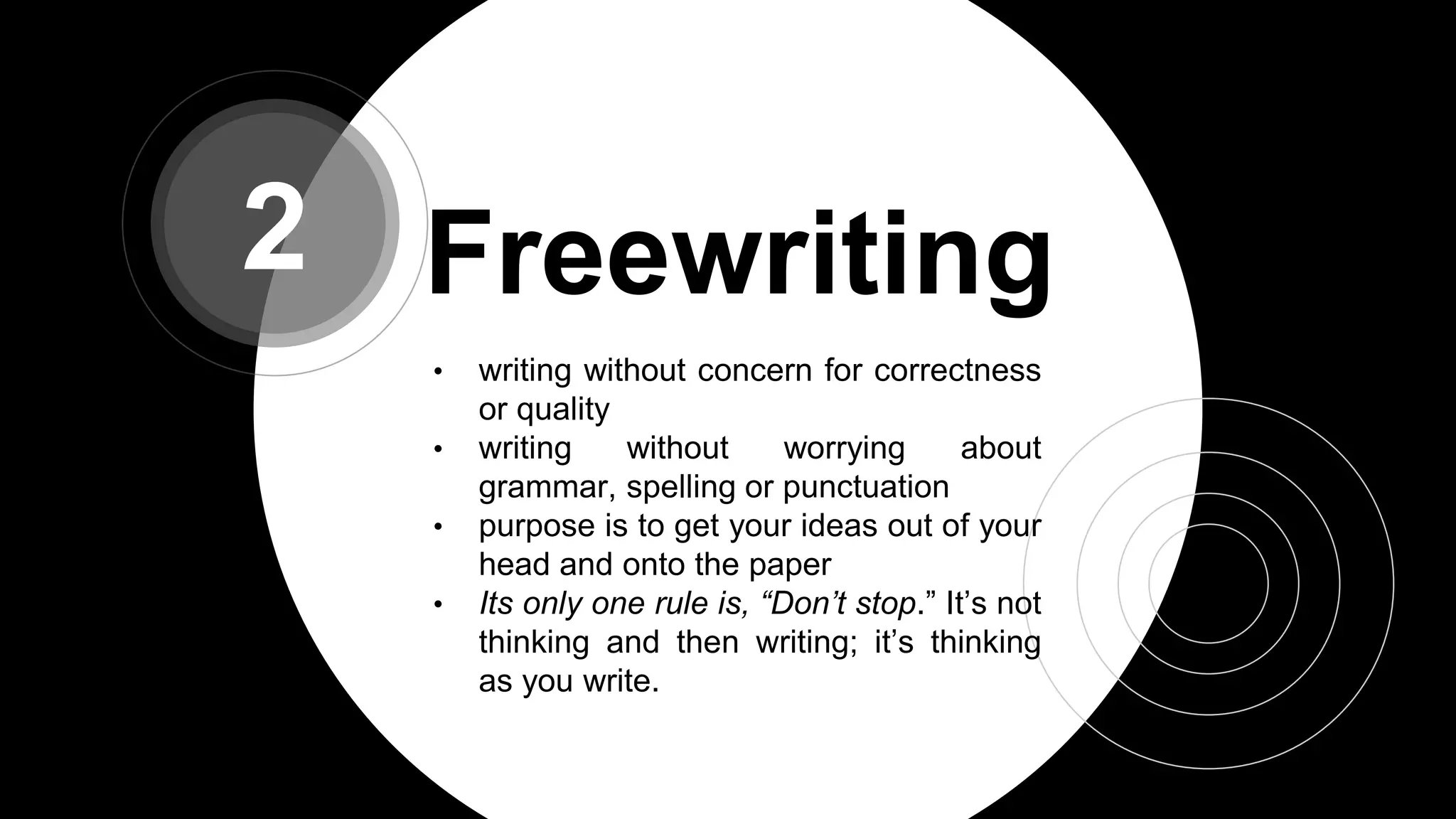
Freewriting2
• writing without concern for correctness
or quality
• writing without worrying about
grammar, spelling or punctuation
• purpose is to get your ideas out of your
head and onto the paper
• Its only one rule is, “Don’t stop.” It’s not
thinking and then writing; it’s thinking
as you write.
“
I can’t think of anything to say so I am just going to
keep on putting these words on the paper until my
brain starts working and then I can get to work on this
paper that I’m not very excited about because it’s a
research paper and I’d rather stick toothpicks in my
eyeballs than do research paper especially one on
Eskimos like my teacher said because I don’t know
much about Eskimos although I had an Eskimo pie
once and liked it, but I get this picture of Eskimos in
parkas and round ice igloos that you always see in
cartoons and I wonder if that’s really the way they live,
maybe that’s what I should write about—the kinds of
houses Eskimos live in That would be a good idea and
I wonder if they ever eat Eskimo pies…
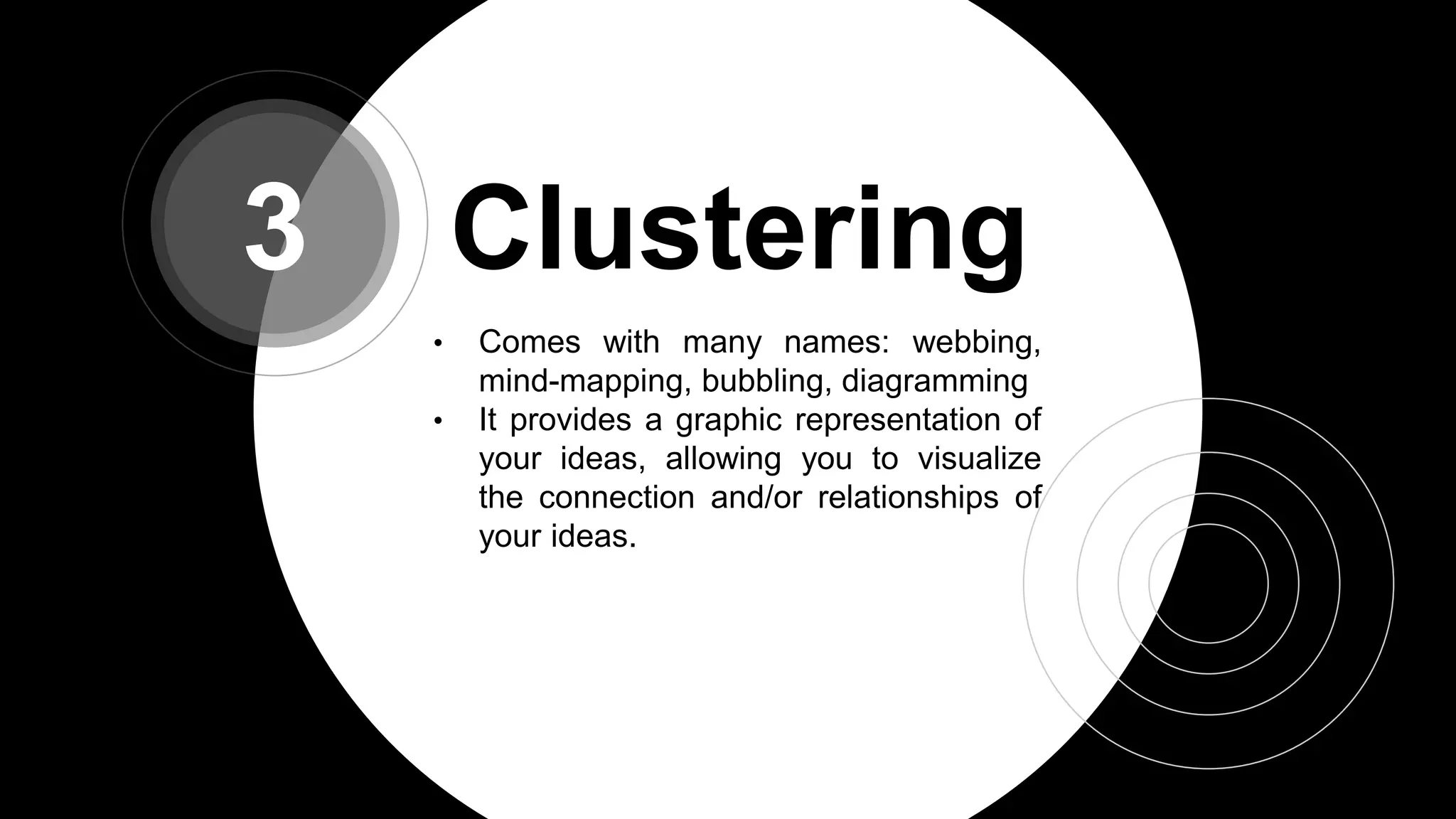
Clustering3
• Comes with many names: webbing,
mind-mapping, bubbling, diagramming
• It provides a graphic representation of
your ideas, allowing you to visualize
the connection and/or relationships of
your ideas.
Ex.
ACRONYM - KEYWORDS
13
A AUDIENCE
U UNDERSTANDING
D DEMOGRAPHICS
I INTEREST
E ENVIRONMENT
N NEEDS
C CUSTOMIZATION
E EXPECTATIONS
Audience analysis:
Checklist
14
1. Who are your readers?
2. Are they familiar with the topic or subject?
3. How much do they know about your topic?
4. How much background do you need to provide?
5. Are they experts, knowledgeable on the subject, or have a vague idea
of what the topic is about?
6. What are their interest and how could you relate your topic to their
interests?
7. What is their general attitude toward your topic? Are they against, for,
or neutral about your topic?
8. Do they have beliefs (cultural, religious, political) that you may have
to consider in writing your paper?
9. Do they have misconceptions and biases that you have to address?
10. What are your readers’ expectations from you?
15
Thanks!
Any questions?
You can find me at
○ @Ailyn A. Duenas
○ ailynduenas@gmail.com

Writing academic texts the pre writing process

  • 1.
  • 2.
  • 3.
    Throwback Time 1. Whatare your thoughts on writing? 2. Do you find writing easy or hard? What makes writing easy? What makes it hard? 3. Do you follow a process when you write? Can you describe your writing process? If you follow a writing process, which step in that process do you think is the hardest? 3
  • 4.
  • 5.
  • 6.
    Please read andfollow each of the steps on page 32. 6
  • 7.
    What are these steps? 7 Stepsin Choosing a Topic Clustering Brainstorming Freewriting
  • 8.
    Brainstorming • It aimsto generate as many topics as you can in 10 to 15 minutes for the random topics to become a focused topic. 1
  • 9.
    Freewriting2 • writing withoutconcern for correctness or quality • writing without worrying about grammar, spelling or punctuation • purpose is to get your ideas out of your head and onto the paper • Its only one rule is, “Don’t stop.” It’s not thinking and then writing; it’s thinking as you write.
  • 10.
    “ I can’t thinkof anything to say so I am just going to keep on putting these words on the paper until my brain starts working and then I can get to work on this paper that I’m not very excited about because it’s a research paper and I’d rather stick toothpicks in my eyeballs than do research paper especially one on Eskimos like my teacher said because I don’t know much about Eskimos although I had an Eskimo pie once and liked it, but I get this picture of Eskimos in parkas and round ice igloos that you always see in cartoons and I wonder if that’s really the way they live, maybe that’s what I should write about—the kinds of houses Eskimos live in That would be a good idea and I wonder if they ever eat Eskimo pies…
  • 11.
    Clustering3 • Comes withmany names: webbing, mind-mapping, bubbling, diagramming • It provides a graphic representation of your ideas, allowing you to visualize the connection and/or relationships of your ideas.
  • 12.
  • 13.
    ACRONYM - KEYWORDS 13 AAUDIENCE U UNDERSTANDING D DEMOGRAPHICS I INTEREST E ENVIRONMENT N NEEDS C CUSTOMIZATION E EXPECTATIONS
  • 14.
    Audience analysis: Checklist 14 1. Whoare your readers? 2. Are they familiar with the topic or subject? 3. How much do they know about your topic? 4. How much background do you need to provide? 5. Are they experts, knowledgeable on the subject, or have a vague idea of what the topic is about? 6. What are their interest and how could you relate your topic to their interests? 7. What is their general attitude toward your topic? Are they against, for, or neutral about your topic? 8. Do they have beliefs (cultural, religious, political) that you may have to consider in writing your paper? 9. Do they have misconceptions and biases that you have to address? 10. What are your readers’ expectations from you?
  • 15.
    15 Thanks! Any questions? You canfind me at ○ @Ailyn A. Duenas ○ ailynduenas@gmail.com