Writing a
University Essay
A quick guide
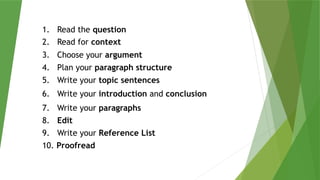
1. Read the question
2. Read for context
3. Choose your argument
4. Plan your paragraph structure
5. Write your topic sentences
6. Write your introduction and conclusion
7. Write your paragraphs
8. Edit
9. Write your Reference List
10. Proofread
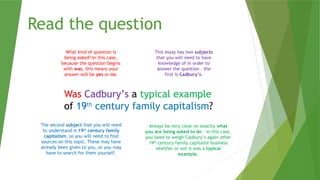
Read the question
Was Cadbury’s a typical example
of 19th
century family capitalism?
What kind of question is
being asked? In this case,
because the question begins
with was, this means your
answer will be yes or no.
This essay has two subjects
that you will need to have
knowledge of in order to
answer the question – the
first is Cadbury’s.
Always be very clear on exactly what
you are being asked to do – in this case,
you need to weigh Cadbury’s again other
19th
century family capitalist business
whether or not it was a typical
example.
The second subject that you will need
to understand is 19th
century family
capitalism, so you will need to find
sources on this topic. These may have
already been given to you, or you may
have to search for them yourself.
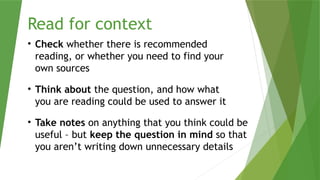
Read for context
• Check whether there is recommended
reading, or whether you need to find your
own sources
• Think about the question, and how what
you are reading could be used to answer it
• Take notes on anything that you think could be
useful – but keep the question in mind so that
you aren’t writing down unnecessary details
Choose your argument
• This is your answer to the question, so make sure
you are 100% clear on what kind of answer you are
being asked for. Is it a yes/no question? Or are you
being asked to compare two things and decide which
is more important?
• Take a side, even if you don’t have a strong opinion
on the topic – you need to prove that you can argue
a position clearly and persuasively. Above all, don’t
sit on the fence!
Plan your structure
• Prioritise: You probably won’t have space to cover
everything, so you will need to choose the points that you
think are the most convincing.
• Order: Try to put your points in the order that makes the
most sense. If you have a point that you think is more
persuasive than the others, you might want to use it in the
last paragraph (before the conclusion).
• Choose your points: Each paragraph will need to address
one key point. Make sure that all of your points are
separate, and that you will not be covering the same topic
in separate paragraphs.
Write your topic sentences
A good topic sentence does two things:
1. Summarises the main point of your paragraph.
2. Directly answers the question.
One reason why Cadbury’s cannot be considered a typical
example of 19th
century family capitalism is due to the
unusually benevolent treatment of their employees.
You need to have one of these for each paragraph, and it should
always be the first sentence. You don’t need to put references
in your topic sentence – save these for later in the paragraph.
Write your intro & conclusion
A good introduction has four main sections:
Context:
• Gives background information on the subject(s) of the essay
• States why the question is important
• Cites at least one reference
Aim:
• Re-states the question in your own words
• Does not attempt to answer the question
Argument statement:
• States your position (the answer to the question)
• Lists your three main points and why they support your answer
Structure outline:
• Lists the order in which you will structure your paragraphs
Write your intro & conclusion
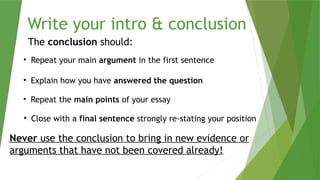
The conclusion should:
• Repeat your main argument in the first sentence
• Explain how you have answered the question
• Repeat the main points of your essay
• Close with a final sentence strongly re-stating your position
Never use the conclusion to bring in new evidence or
arguments that have not been covered already!
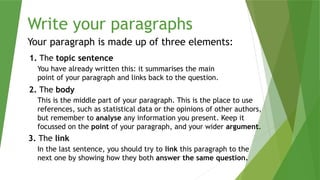
Write your paragraphs
Your paragraph is made up of three elements:
1. The topic sentence
2. The body
3. The link
You have already written this: it summarises the main
point of your paragraph and links back to the question.
This is the middle part of your paragraph. This is the place to use
references, such as statistical data or the opinions of other authors,
but remember to analyse any information you present. Keep it
focussed on the point of your paragraph, and your wider argument.
In the last sentence, you should try to link this paragraph to the
next one by showing how they both answer the same question.
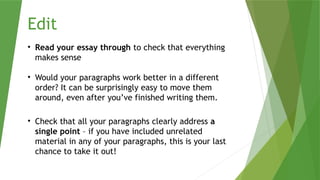
Edit
• Read your essay through to check that everything
makes sense
• Would your paragraphs work better in a different
order? It can be surprisingly easy to move them
around, even after you’ve finished writing them.
• Check that all your paragraphs clearly address a
single point – if you have included unrelated
material in any of your paragraphs, this is your last
chance to take it out!
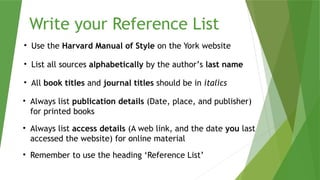
Write your Reference List
• Use the Harvard Manual of Style on the York website
• List all sources alphabetically by the author’s last name
• All book titles and journal titles should be in italics
• Always list publication details (Date, place, and publisher)
for printed books
• Always list access details (A web link, and the date you last
accessed the website) for online material
• Remember to use the heading ‘Reference List’
Proofread
• Check for spelling and grammar mistakes
• Check your in-text references
• Check your Reference List
Remember spell-checkers don’t catch every error. Be clear on
when to use ‘their’/‘there’/‘they’re’, and other common
mistakes that a spell-checker wouldn’t pick up on.
Make sure everything is formatted correctly, and that page
numbers are included for direct quotations. Also check that none
of your references are missing – this can lose you a lot of marks!
Triple-check all formatting, and make sure that everything fits
the Harvard guidelines. Make sure all names and titles are spelled
and capitalised correctly.

Writing a University Essay Presentation

  • 1.
  • 2.
    1. Read thequestion 2. Read for context 3. Choose your argument 4. Plan your paragraph structure 5. Write your topic sentences 6. Write your introduction and conclusion 7. Write your paragraphs 8. Edit 9. Write your Reference List 10. Proofread
  • 3.
    Read the question WasCadbury’s a typical example of 19th century family capitalism? What kind of question is being asked? In this case, because the question begins with was, this means your answer will be yes or no. This essay has two subjects that you will need to have knowledge of in order to answer the question – the first is Cadbury’s. Always be very clear on exactly what you are being asked to do – in this case, you need to weigh Cadbury’s again other 19th century family capitalist business whether or not it was a typical example. The second subject that you will need to understand is 19th century family capitalism, so you will need to find sources on this topic. These may have already been given to you, or you may have to search for them yourself.
  • 4.
    Read for context •Check whether there is recommended reading, or whether you need to find your own sources • Think about the question, and how what you are reading could be used to answer it • Take notes on anything that you think could be useful – but keep the question in mind so that you aren’t writing down unnecessary details
  • 5.
    Choose your argument •This is your answer to the question, so make sure you are 100% clear on what kind of answer you are being asked for. Is it a yes/no question? Or are you being asked to compare two things and decide which is more important? • Take a side, even if you don’t have a strong opinion on the topic – you need to prove that you can argue a position clearly and persuasively. Above all, don’t sit on the fence!
  • 6.
    Plan your structure •Prioritise: You probably won’t have space to cover everything, so you will need to choose the points that you think are the most convincing. • Order: Try to put your points in the order that makes the most sense. If you have a point that you think is more persuasive than the others, you might want to use it in the last paragraph (before the conclusion). • Choose your points: Each paragraph will need to address one key point. Make sure that all of your points are separate, and that you will not be covering the same topic in separate paragraphs.
  • 7.
    Write your topicsentences A good topic sentence does two things: 1. Summarises the main point of your paragraph. 2. Directly answers the question. One reason why Cadbury’s cannot be considered a typical example of 19th century family capitalism is due to the unusually benevolent treatment of their employees. You need to have one of these for each paragraph, and it should always be the first sentence. You don’t need to put references in your topic sentence – save these for later in the paragraph.
  • 8.
    Write your intro& conclusion A good introduction has four main sections: Context: • Gives background information on the subject(s) of the essay • States why the question is important • Cites at least one reference Aim: • Re-states the question in your own words • Does not attempt to answer the question Argument statement: • States your position (the answer to the question) • Lists your three main points and why they support your answer Structure outline: • Lists the order in which you will structure your paragraphs
  • 9.
    Write your intro& conclusion The conclusion should: • Repeat your main argument in the first sentence • Explain how you have answered the question • Repeat the main points of your essay • Close with a final sentence strongly re-stating your position Never use the conclusion to bring in new evidence or arguments that have not been covered already!
  • 10.
    Write your paragraphs Yourparagraph is made up of three elements: 1. The topic sentence 2. The body 3. The link You have already written this: it summarises the main point of your paragraph and links back to the question. This is the middle part of your paragraph. This is the place to use references, such as statistical data or the opinions of other authors, but remember to analyse any information you present. Keep it focussed on the point of your paragraph, and your wider argument. In the last sentence, you should try to link this paragraph to the next one by showing how they both answer the same question.
  • 11.
    Edit • Read youressay through to check that everything makes sense • Would your paragraphs work better in a different order? It can be surprisingly easy to move them around, even after you’ve finished writing them. • Check that all your paragraphs clearly address a single point – if you have included unrelated material in any of your paragraphs, this is your last chance to take it out!
  • 12.
    Write your ReferenceList • Use the Harvard Manual of Style on the York website • List all sources alphabetically by the author’s last name • All book titles and journal titles should be in italics • Always list publication details (Date, place, and publisher) for printed books • Always list access details (A web link, and the date you last accessed the website) for online material • Remember to use the heading ‘Reference List’
  • 13.
    Proofread • Check forspelling and grammar mistakes • Check your in-text references • Check your Reference List Remember spell-checkers don’t catch every error. Be clear on when to use ‘their’/‘there’/‘they’re’, and other common mistakes that a spell-checker wouldn’t pick up on. Make sure everything is formatted correctly, and that page numbers are included for direct quotations. Also check that none of your references are missing – this can lose you a lot of marks! Triple-check all formatting, and make sure that everything fits the Harvard guidelines. Make sure all names and titles are spelled and capitalised correctly.