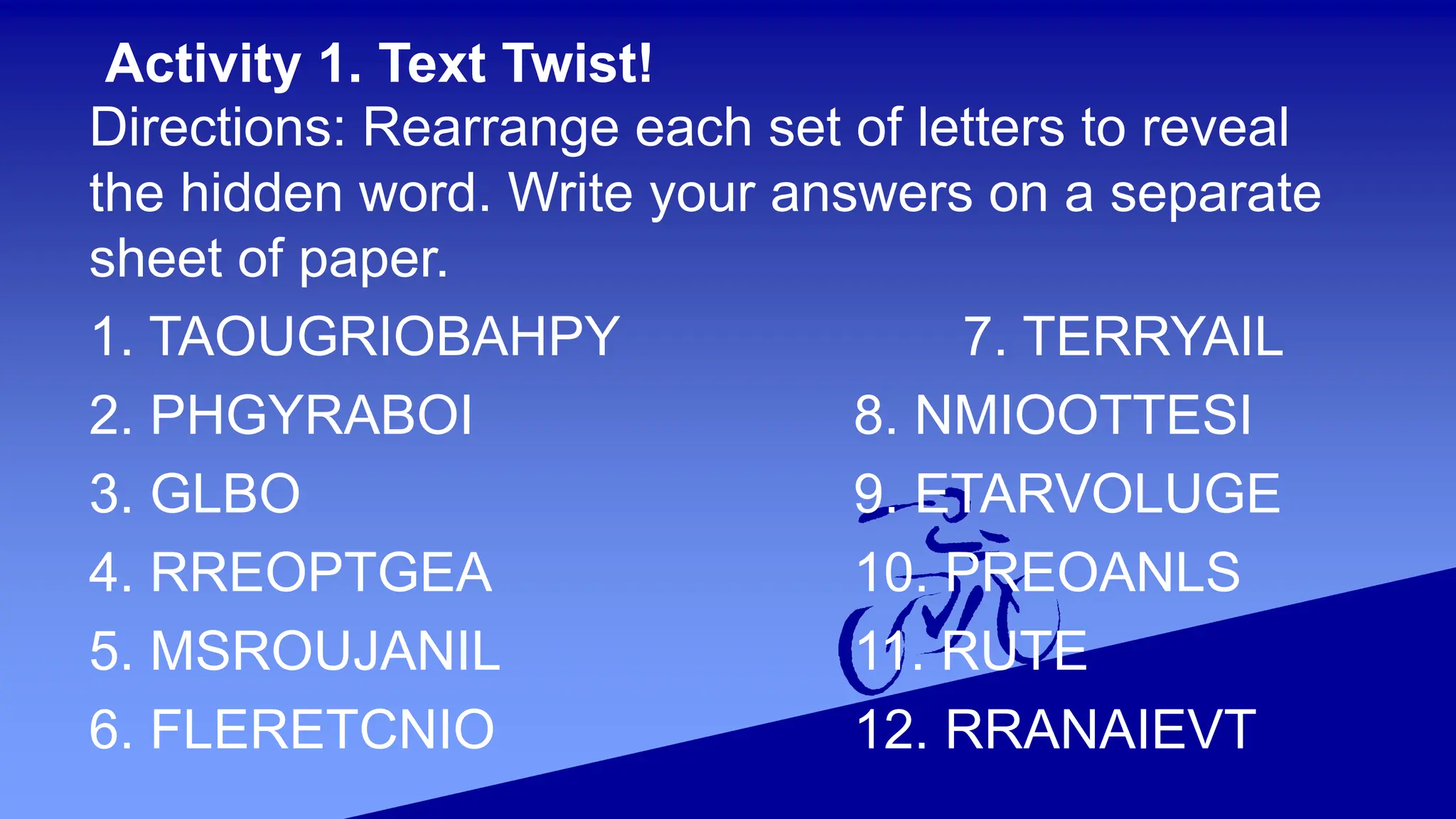
Activity 1. Text Twist!
Directions: Rearrange each set of letters to reveal
the hidden word. Write your answers on a separate
sheet of paper.
1. TAOUGRIOBAHPY 7. TERRYAIL
2. PHGYRABOI 8. NMIOOTTESI
3. GLBO 9. ETARVOLUGE
4. RREOPTGEA 10. PREOANLS
5. MSROUJANIL 11. RUTE
6. FLERETCNIO 12. RRANAIEVT
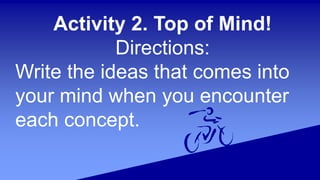
Activity 2. Top of Mind!
Directions:
Write the ideas that comes into
your mind when you encounter
each concept.
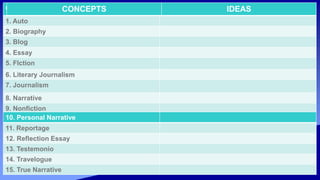
CONCEPTS
1. Auto
2. Biography
3. Blog
4. Essay
5. FIction
6. Literary Journalism
7. Journalism
8. Narrative
9. Nonfiction
CONCEPTS IDEAS
10. Personal Narrative
11. Reportage
12. Reflection Essay
13. Testemonio
14. Travelogue
15. True Narrative
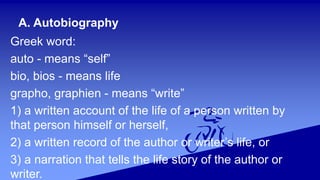
A. Autobiography
Greek word:
auto - means “self”
bio, bios - means life
grapho, graphien - means “write”
1) a written account of the life of a person written by
that person himself or herself,
2) a written record of the author or writer’s life, or
3) a narration that tells the life story of the author or
writer.
Biography
a description or account of a person’s life
story presented through the eyes of
another person. The person who writes
someone else’s life story is called a
biographer. In this genre of writing, the
biographer has to extensive research in
order to tell accurate facts about the
person’s life.
Basics in Writing Autobiography and Biography
1. Jot down all life events and arrange them in a timeline.
Using a timeline makes it easier for you to chronologically
arrange the events. Also, it helps you not to mix up
events that may have similarities with one another.
2. Identify the people involved in each event. Every good
story has interesting characters, friends and foes who
help move the plot along. Knowing the names of the
people involved as well as their roles in each event helps
you in making the story more accurate and real.
3. Determine the best events. The entire life story
will start to get pretty long-winded and you are
going to make some choices about what stories
you are going to include and to discard. Start by
writing the key stories that will be put together to
create an image of your life.
4. For autobiography, write down the story using
the first person point of view pronouns such as “I”.
For biography, write down the story using the third
person point of view pronouns such as
“he/she/they”.
5. Reading the output helps in identifying
strong spots to be retained and weak spots to
be enhanced while rewriting it is the chance
for you to improve and polish the
autobiography/biography.
B. Reportage/ Literary Journalism
- also known as literary journalism reports an event,
history or an actual case based on direct observation,
investigation or thorough research and documentation.
Writers use interviews and reviews in order to look
outside of the straightforward, objective world that
journalism creates. It uses literary practices to capture
the scene or setting of the assignment or the persona of
the person being interviewed. It can often be narrative
or heavily imagistic.
Basics in Writing a Reportage / Literary Journalism
1. Get the facts straight by observing and
researching. Keep all your interview and observation
notes in order not to miss out relevant information.
Take note of all details from smallest ones to biggest
ones.
2. Conduct interviews. First-hand information about
the topic help in describing and detailing the subject
matter.
3. Outline the story. Outlining helps you in
organizing the events according to your style.
4. Use literary elements and devices in writing.
Using the different literary elements helps you
not to leave important elements that enhance the
reportage. Also, the literary devices help you to
make the reportage more dramatic, appealing,
and interesting.
5. End with a point. Your goal is to get your
readers entertained, informed, and
enlightened. Make sure to leave your
reader an important point for them to reflect
from.
C. Personal Narratives
is a person’s true story. The author narrates what
happened to them in a particular event which makes it
autobiographical in nature. A personal narrative is
close to an autobiography; however, they differ in
scope. An autobiography tells the author’s life story
which is composed of several events, while a
personal narrative focuses only on a specific event
that the author wants to share.
Basics in Writing a Personal Narrative
1. Think of an event in your life that you want to share through a
story.
2. Focus on the topic and write down all the details of that event
in order to recall the event well. Remember to use the 5Ws and
1H in identifying details.
3. Organize your ideas according to your own style. Using an
outline helps you in organizing the details.
4. Write the story and use language in expressing what you
really mean to say. You may utilize different devices in order to
successfully show rather than tell the story
D. Travelogue
A travelogue is an account of a
person’s experiences while touring a
place for the pleasure of travel. It
includes vivid descriptions, illustrations,
historical background, and possibly
maps and diagrams.
Basics in Writing a Travelogue
1. Write all the things that you notice like the sceneries,
community, food, culture and others while on travel.
2. Get the facts straight about the place, people, events,
culture, etc. Factual accuracy must be observed so that the
readers will be well-informed.
3. Start with a clear story line. Make sure that the storyline
arouses the curiosity and interest of your target audience.
4. Describe the things that you are going to include in your
travelogue using the different kinds of imagery so that the
readers can also visualize what you witnessed in your travel.
E. Reflection/Reflective Essay
Reflective essays describe an event that happened, then
analyze the meaning and what can be learned from that
experience. What makes an essay insightful is that the
writer analyzes present-day historical occurrences.To paint
a true picture of their past, temperament, and human
characteristics, reflective essays allow the writer to open up
about their thoughts and emotions. They should contain a
vivid summary and description of the experience in order for
the reader to feel the experiences as well. They should also
include an explanation of your feelings, thoughts and
reactions.
Basics in Writing a Reflective Essay
1. Think of what you want to consider as your topic in writing
your reflective essay.
2. Assess your feelings towards your chosen topic. Construct
questions that you will answer based on your experiences.
3. Answer the questions that you selected. Your answers will
be your basis in making a reflective essay.
4. Based on your responses, enhance your reflective essay by
adding other significant elements of writing as well as utilizing
literary devices.
5. Make sure to always have your strong introduction and
conclusion.
F. True Narrative
A true narrative is a story based on real life
experiences or events; however, its form is still
undefined. The narrative must clearly come
from or be based on real life situations and
events or else it will be called a fictional
narrative as it includes fictional embellishments.
The purpose of it is to express a point or
observation.
Basics in Writing a True Narrative
1. Think of an event in your life that you want to share true a
story.
2. Focus on the topic and write down all the details of that
event in order to recall the event well. Remember to use the
5Ws and 1H in identifying details.
3. Organize your ideas according to your own style. Using an
outline helps you to easily organize the details.
4. Write the story and use language in expressing what you
really mean to say. You may utilize different devices in order to
successfully show rather than tell the story
G. Blog
Blog is the abbreviated form of the words “weblog”. It is a
website containing short articles called posts that are
changed regularly. The person who writes blogs on regular
basis is called a blogger. Blogs are different from vlogs. The
former is textual in nature as it is a product of writing, while
the latter refers to video blogging or video log which is a
social media account where a person regularly posts short
videos. Some blogs are written by one person containing
his or her own opinion, interests and experiences, while
others are written by many different people.
Kinds of blog based on the blogger’s field of interest.
Food blogs - blogger who has interests in food writes . A
food blogger goes to different restaurants, food stalls,
snack houses, and others that offer food to eat and write
his or her own food review.
Travel blogs - are written by individuals who loves travel
and blogging. Travel bloggers experience and review
different travel destinations.
Lifestyle blogs - mostly written by women, may focus on
the following but not limited to improving the quality life,
happenings in everyday life, doing interests, and attaining
personal goals.
Basics in Writing a Blog Post
1. Plan your blog post by choosing a topic that is in
line to your interest.
2. Create an outline of the information that you are
going to put in you blog.
3. Craft a headline or a title that is both informative
and captivating to the reader.
4. Conduct a thorough research to check facts and
attain accuracy of databased on the outline that you
crafted.
5. Write your post according to your style and
technique however the properties of a well-written
text: organization, coherence and cohesion,
language use, and mechanics should be considered.
6. Use images to enhance your post, improve its
flow, add humor, and explain complex topics.
7. Read to assess the strength and weakness of your
output. Also, assess on how interesting it is to make
someone else read your work. Rewrite to ensure that
the necessary changes are incorporated.
Testimonio
Through literature, it is an oral or written
autobiographical story known as "testimonial
literature." The word "testimonio" refers to a genre
of writing thatcomes from Latin America dealing
with human rights abuse experiences. However, its
definition changed as time passed by. A testimonio
is generally defined as a first-person narration of
socially significant experiences in which the
narrative voice is that of a typical or extraordinary
Basics in Writing a Testimonio
1. Describe the problem. Write a short description or
the background of your problem to inform the reader
about what you are going through.
2. Tell the pros and cons. Share the effects, both
good and bad, of having the problems. Tell the things
that you did to solve your problems.
3. The closing of the testimonial. Tell what you have
learned from the problem and what you want the
readers to learn from you and from the experience.
Meet me, know me!
Directions: Construct your
autobiography using the guide that you
have accomplished earlier. Write your
autobiography on a separate sheet of
paper. The rubric that follows will be
used to assess your output. (40 points)
Activity 4: Read and Critique! (50 points)
Trivia: Did you know that Benguet is a native
term which refers to a lake where water does
not drain?
The name “Benguet” was once limited to the
area of what is now the La Trinidad Valley, which
was well-cultivated with rice, sweet potatoes,
gabi, and sugar cane by its original settlers. The
natives there were generally Ibaloys.
When you read a selection it is very important to
understand how your senses work. Your
understanding of images will play a key role in
appreciating the text.
A. Directions: Write 5 words/phrases that appeal to
your senses (sight, smell, hearing, taste, touch).
1. _____________________________________
2. _____________________________________
3. _____________________________________
4. _____________________________________
5. _____________________________________
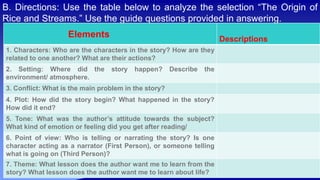
B. Directions: Use the table below to analyze the selection “The Origin of
Rice and Streams.” Use the guide questions provided in answering.
Elements Descriptions
1. Characters: Who are the characters in the story? How are they
related to one another? What are their actions?
2. Setting: Where did the story happen? Describe the
environment/ atmosphere.
3. Conflict: What is the main problem in the story?
4. Plot: How did the story begin? What happened in the story?
How did it end?
5. Tone: What was the author’s attitude towards the subject?
What kind of emotion or feeling did you get after reading/
6. Point of view: Who is telling or narrating the story? Is one
character acting as a narrator (First Person), or someone telling
what is going on (Third Person)?
7. Theme: What lesson does the author want me to learn from the
story? What lesson does the author want me to learn about life?

creative nonfiction discussion1.pptx

  • 1.
    Activity 1. TextTwist! Directions: Rearrange each set of letters to reveal the hidden word. Write your answers on a separate sheet of paper. 1. TAOUGRIOBAHPY 7. TERRYAIL 2. PHGYRABOI 8. NMIOOTTESI 3. GLBO 9. ETARVOLUGE 4. RREOPTGEA 10. PREOANLS 5. MSROUJANIL 11. RUTE 6. FLERETCNIO 12. RRANAIEVT
  • 2.
    Activity 2. Topof Mind! Directions: Write the ideas that comes into your mind when you encounter each concept.
  • 3.
    CONCEPTS 1. Auto 2. Biography 3.Blog 4. Essay 5. FIction 6. Literary Journalism 7. Journalism 8. Narrative 9. Nonfiction CONCEPTS IDEAS 10. Personal Narrative 11. Reportage 12. Reflection Essay 13. Testemonio 14. Travelogue 15. True Narrative
  • 4.
    A. Autobiography Greek word: auto- means “self” bio, bios - means life grapho, graphien - means “write” 1) a written account of the life of a person written by that person himself or herself, 2) a written record of the author or writer’s life, or 3) a narration that tells the life story of the author or writer.
  • 5.
    Biography a description oraccount of a person’s life story presented through the eyes of another person. The person who writes someone else’s life story is called a biographer. In this genre of writing, the biographer has to extensive research in order to tell accurate facts about the person’s life.
  • 6.
    Basics in WritingAutobiography and Biography 1. Jot down all life events and arrange them in a timeline. Using a timeline makes it easier for you to chronologically arrange the events. Also, it helps you not to mix up events that may have similarities with one another. 2. Identify the people involved in each event. Every good story has interesting characters, friends and foes who help move the plot along. Knowing the names of the people involved as well as their roles in each event helps you in making the story more accurate and real.
  • 7.
    3. Determine thebest events. The entire life story will start to get pretty long-winded and you are going to make some choices about what stories you are going to include and to discard. Start by writing the key stories that will be put together to create an image of your life. 4. For autobiography, write down the story using the first person point of view pronouns such as “I”. For biography, write down the story using the third person point of view pronouns such as “he/she/they”.
  • 8.
    5. Reading theoutput helps in identifying strong spots to be retained and weak spots to be enhanced while rewriting it is the chance for you to improve and polish the autobiography/biography.
  • 9.
    B. Reportage/ LiteraryJournalism - also known as literary journalism reports an event, history or an actual case based on direct observation, investigation or thorough research and documentation. Writers use interviews and reviews in order to look outside of the straightforward, objective world that journalism creates. It uses literary practices to capture the scene or setting of the assignment or the persona of the person being interviewed. It can often be narrative or heavily imagistic.
  • 10.
    Basics in Writinga Reportage / Literary Journalism 1. Get the facts straight by observing and researching. Keep all your interview and observation notes in order not to miss out relevant information. Take note of all details from smallest ones to biggest ones. 2. Conduct interviews. First-hand information about the topic help in describing and detailing the subject matter.
  • 11.
    3. Outline thestory. Outlining helps you in organizing the events according to your style. 4. Use literary elements and devices in writing. Using the different literary elements helps you not to leave important elements that enhance the reportage. Also, the literary devices help you to make the reportage more dramatic, appealing, and interesting.
  • 12.
    5. End witha point. Your goal is to get your readers entertained, informed, and enlightened. Make sure to leave your reader an important point for them to reflect from.
  • 13.
    C. Personal Narratives isa person’s true story. The author narrates what happened to them in a particular event which makes it autobiographical in nature. A personal narrative is close to an autobiography; however, they differ in scope. An autobiography tells the author’s life story which is composed of several events, while a personal narrative focuses only on a specific event that the author wants to share.
  • 14.
    Basics in Writinga Personal Narrative 1. Think of an event in your life that you want to share through a story. 2. Focus on the topic and write down all the details of that event in order to recall the event well. Remember to use the 5Ws and 1H in identifying details. 3. Organize your ideas according to your own style. Using an outline helps you in organizing the details. 4. Write the story and use language in expressing what you really mean to say. You may utilize different devices in order to successfully show rather than tell the story
  • 15.
    D. Travelogue A travelogueis an account of a person’s experiences while touring a place for the pleasure of travel. It includes vivid descriptions, illustrations, historical background, and possibly maps and diagrams.
  • 16.
    Basics in Writinga Travelogue 1. Write all the things that you notice like the sceneries, community, food, culture and others while on travel. 2. Get the facts straight about the place, people, events, culture, etc. Factual accuracy must be observed so that the readers will be well-informed. 3. Start with a clear story line. Make sure that the storyline arouses the curiosity and interest of your target audience. 4. Describe the things that you are going to include in your travelogue using the different kinds of imagery so that the readers can also visualize what you witnessed in your travel.
  • 17.
    E. Reflection/Reflective Essay Reflectiveessays describe an event that happened, then analyze the meaning and what can be learned from that experience. What makes an essay insightful is that the writer analyzes present-day historical occurrences.To paint a true picture of their past, temperament, and human characteristics, reflective essays allow the writer to open up about their thoughts and emotions. They should contain a vivid summary and description of the experience in order for the reader to feel the experiences as well. They should also include an explanation of your feelings, thoughts and reactions.
  • 18.
    Basics in Writinga Reflective Essay 1. Think of what you want to consider as your topic in writing your reflective essay. 2. Assess your feelings towards your chosen topic. Construct questions that you will answer based on your experiences. 3. Answer the questions that you selected. Your answers will be your basis in making a reflective essay. 4. Based on your responses, enhance your reflective essay by adding other significant elements of writing as well as utilizing literary devices. 5. Make sure to always have your strong introduction and conclusion.
  • 19.
    F. True Narrative Atrue narrative is a story based on real life experiences or events; however, its form is still undefined. The narrative must clearly come from or be based on real life situations and events or else it will be called a fictional narrative as it includes fictional embellishments. The purpose of it is to express a point or observation.
  • 20.
    Basics in Writinga True Narrative 1. Think of an event in your life that you want to share true a story. 2. Focus on the topic and write down all the details of that event in order to recall the event well. Remember to use the 5Ws and 1H in identifying details. 3. Organize your ideas according to your own style. Using an outline helps you to easily organize the details. 4. Write the story and use language in expressing what you really mean to say. You may utilize different devices in order to successfully show rather than tell the story
  • 21.
    G. Blog Blog isthe abbreviated form of the words “weblog”. It is a website containing short articles called posts that are changed regularly. The person who writes blogs on regular basis is called a blogger. Blogs are different from vlogs. The former is textual in nature as it is a product of writing, while the latter refers to video blogging or video log which is a social media account where a person regularly posts short videos. Some blogs are written by one person containing his or her own opinion, interests and experiences, while others are written by many different people.
  • 22.
    Kinds of blogbased on the blogger’s field of interest. Food blogs - blogger who has interests in food writes . A food blogger goes to different restaurants, food stalls, snack houses, and others that offer food to eat and write his or her own food review. Travel blogs - are written by individuals who loves travel and blogging. Travel bloggers experience and review different travel destinations. Lifestyle blogs - mostly written by women, may focus on the following but not limited to improving the quality life, happenings in everyday life, doing interests, and attaining personal goals.
  • 23.
    Basics in Writinga Blog Post 1. Plan your blog post by choosing a topic that is in line to your interest. 2. Create an outline of the information that you are going to put in you blog. 3. Craft a headline or a title that is both informative and captivating to the reader. 4. Conduct a thorough research to check facts and attain accuracy of databased on the outline that you crafted.
  • 24.
    5. Write yourpost according to your style and technique however the properties of a well-written text: organization, coherence and cohesion, language use, and mechanics should be considered. 6. Use images to enhance your post, improve its flow, add humor, and explain complex topics. 7. Read to assess the strength and weakness of your output. Also, assess on how interesting it is to make someone else read your work. Rewrite to ensure that the necessary changes are incorporated.
  • 25.
    Testimonio Through literature, itis an oral or written autobiographical story known as "testimonial literature." The word "testimonio" refers to a genre of writing thatcomes from Latin America dealing with human rights abuse experiences. However, its definition changed as time passed by. A testimonio is generally defined as a first-person narration of socially significant experiences in which the narrative voice is that of a typical or extraordinary
  • 26.
    Basics in Writinga Testimonio 1. Describe the problem. Write a short description or the background of your problem to inform the reader about what you are going through. 2. Tell the pros and cons. Share the effects, both good and bad, of having the problems. Tell the things that you did to solve your problems. 3. The closing of the testimonial. Tell what you have learned from the problem and what you want the readers to learn from you and from the experience.
  • 27.
    Meet me, knowme! Directions: Construct your autobiography using the guide that you have accomplished earlier. Write your autobiography on a separate sheet of paper. The rubric that follows will be used to assess your output. (40 points)
  • 28.
    Activity 4: Readand Critique! (50 points) Trivia: Did you know that Benguet is a native term which refers to a lake where water does not drain? The name “Benguet” was once limited to the area of what is now the La Trinidad Valley, which was well-cultivated with rice, sweet potatoes, gabi, and sugar cane by its original settlers. The natives there were generally Ibaloys.
  • 29.
    When you reada selection it is very important to understand how your senses work. Your understanding of images will play a key role in appreciating the text. A. Directions: Write 5 words/phrases that appeal to your senses (sight, smell, hearing, taste, touch). 1. _____________________________________ 2. _____________________________________ 3. _____________________________________ 4. _____________________________________ 5. _____________________________________
  • 30.
    B. Directions: Usethe table below to analyze the selection “The Origin of Rice and Streams.” Use the guide questions provided in answering. Elements Descriptions 1. Characters: Who are the characters in the story? How are they related to one another? What are their actions? 2. Setting: Where did the story happen? Describe the environment/ atmosphere. 3. Conflict: What is the main problem in the story? 4. Plot: How did the story begin? What happened in the story? How did it end? 5. Tone: What was the author’s attitude towards the subject? What kind of emotion or feeling did you get after reading/ 6. Point of view: Who is telling or narrating the story? Is one character acting as a narrator (First Person), or someone telling what is going on (Third Person)? 7. Theme: What lesson does the author want me to learn from the story? What lesson does the author want me to learn about life?