Galván Florencia
Language and Written Expression IV
I.S.F.D Nº 41
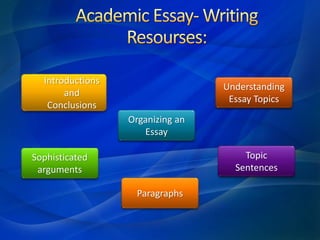
Understanding
Essay Topics
Organizing an
Essay
Introductions
and
Conclusions
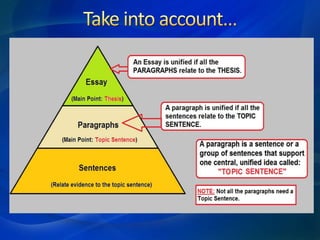
Topic
Sentences
Paragraphs
Sophisticated
arguments
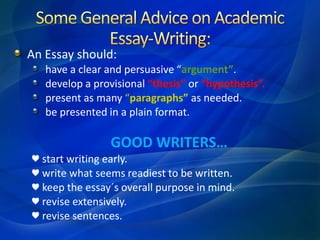
An Essay should:
have a clear and persuasive “argument”.
develop a provisional “thesis” or “hypothesis”.
present as many “paragraphs” as needed.
be presented in a plain format.
GOOD WRITERS…
♥ start writing early.
♥ write what seems readiest to be written.
♥ keep the essay´s overall purpose in mind.
♥ revise extensively.
♥ revise sentences.
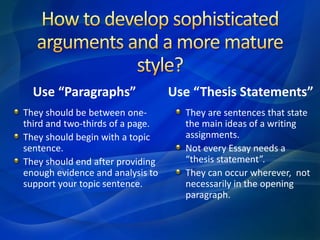
Use “Paragraphs”
They should be between one-
third and two-thirds of a page.
They should begin with a topic
sentence.
They should end after providing
enough evidence and analysis to
support your topic sentence.
Use “Thesis Statements”
They are sentences that state
the main ideas of a writing
assignments.
Not every Essay needs a
“thesis statement”.
They can occur wherever, not
necessarily in the opening
paragraph.
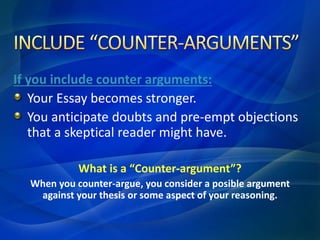
If you include counter arguments:
Your Essay becomes stronger.
You anticipate doubts and pre-empt objections
that a skeptical reader might have.
What is a “Counter-argument”?
When you counter-argue, you consider a posible argument
against your thesis or some aspect of your reasoning.
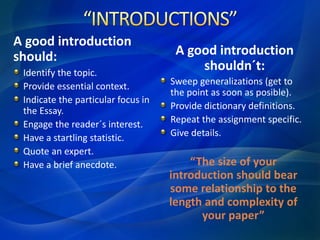
A good introduction
should:
Identify the topic.
Provide essential context.
Indicate the particular focus in
the Essay.
Engage the reader´s interest.
Have a startling statistic.
Quote an expert.
Have a brief anecdote.
A good introduction
shouldn´t:
Sweep generalizations (get to
the point as soon as posible).
Provide dictionary definitions.
Repeat the assignment specific.
Give details.
“The size of your
introduction should bear
some relationship to the
length and complexity of
your paper”
♦ provide a sense of closure.
♦ add stimulus to further thought.
♦ be summarized in fresh language.
♦ involve critical thinking.
♦ include a good last sentence.
“The length of the conclusion should
reflect the length of the Essay”.
You´re NOT being asked just to collect facts,
but to develop and display your power of
reasoning.
Try to..
☻ note the key terms and be sure you
understand their specific meanings.
☻ note which concepts or methods the topic
asks you to use.
☻ ask yourself questions about the specific
topic so you can generate ideas. Then, you
can choose the direction of your research.
☻ formulate a “tentaive thesis argument” at
a fairly early stage.
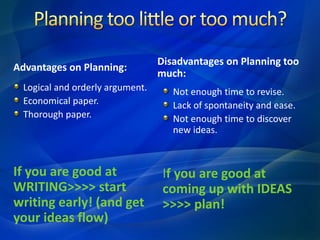
Advantages on Planning:
Logical and orderly argument.
Economical paper.
Thorough paper.
If you are good at
WRITING>>>> start
writing early! (and get
your ideas flow)
Disadvantages on Planning too
much:
Not enough time to revise.
Lack of spontaneity and ease.
Not enough time to discover
new ideas.
If you are good at
coming up with IDEAS
>>>> plan!
PLANNING: The earlier you begin planning, the
better. You must have some idea of where your
argument is headed.
AVOID A COMMON PITFALL: The structure of
an essay should not be determined by the
structure of its sourse material.
WRITE AN ESSAY OUTLINE: It consists on
fragments or full sentences which you write in
the pre-writing stage.
INDEX CARDS: Write down every idea, fact,
quotation or paraphrase on a separate “index
card”. Then, you can mix them into the best
posible order or reduce the outline.
THE COMPUTER: You can use “outline view” in
Word to sort your ideas when you are ready to
start planning.
THE CIRCLE METHOD: You can design ideas onto
a circle diagram so you can see at a glance how
things tie together.
☺ Show connections both within the
paragraph and between paragraphs.
☺ Repeat key words or synonims of them.
☺ Strategic use of pronouns (I, They, This).
☺ Use specialized linking words.
What is “Critical Reading”?
Don´t read looking only for
information.
Do read looking for ways of
thinking about the subject
matter.
WAYS OF THINKING:
○ Determine the thesis.
○ Make judgements about context.
○ Distinguish the kinds of reasoning
the text employs.
○ Examine the evidence.
○ Evaluate what you read.
ASK YOURSELF:
How does this text work?
How is it argued?
How is the evidence used and
interpreted?
How does the text reach its
conclusion?
READ THE TITLE.
THINK ABOUT THE SUBJECT MATTER.
THINK ABOUT THE AUTHOR.
THINK ABOUT THE AUDIENCE.
WHEN WAS IT PUBLISHED?
READ HEADINGS.
WHAT KINDS OF FACTS AND IDEAS ARE YOU
EXPECTED TO RETAIN FROM THIS READING?
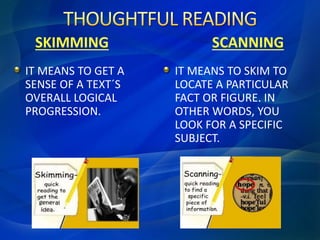
IT MEANS TO GET A
SENSE OF A TEXT´S
OVERALL LOGICAL
PROGRESSION.
IT MEANS TO SKIM TO
LOCATE A PARTICULAR
FACT OR FIGURE. IN
OTHER WORDS, YOU
LOOK FOR A SPECIFIC
SUBJECT.
SKIMMING SCANNING
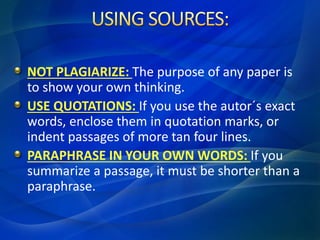
NOT PLAGIARIZE: The purpose of any paper is
to show your own thinking.
USE QUOTATIONS: If you use the autor´s exact
words, enclose them in quotation marks, or
indent passages of more tan four lines.
PARAPHRASE IN YOUR OWN WORDS: If you
summarize a passage, it must be shorter than a
paraphrase.
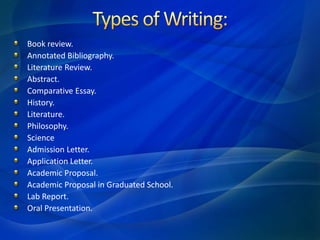
Book review.
Annotated Bibliography.
Literature Review.
Abstract.
Comparative Essay.
History.
Literature.
Philosophy.
Science
Admission Letter.
Application Letter.
Academic Proposal.
Academic Proposal in Graduated School.
Lab Report.
Oral Presentation.
“Writing Advice.” Writing at the University of
Toronto, http://www.writing.utoronto.ca.
“Hardvard College Writing Centre.” Hardvard
University, http://writingcenter.fas.harvard.edu

Learning academic writing

  • 1.
    Galván Florencia Language andWritten Expression IV I.S.F.D Nº 41
  • 2.
  • 3.
    An Essay should: havea clear and persuasive “argument”. develop a provisional “thesis” or “hypothesis”. present as many “paragraphs” as needed. be presented in a plain format. GOOD WRITERS… ♥ start writing early. ♥ write what seems readiest to be written. ♥ keep the essay´s overall purpose in mind. ♥ revise extensively. ♥ revise sentences.
  • 4.
    Use “Paragraphs” They shouldbe between one- third and two-thirds of a page. They should begin with a topic sentence. They should end after providing enough evidence and analysis to support your topic sentence. Use “Thesis Statements” They are sentences that state the main ideas of a writing assignments. Not every Essay needs a “thesis statement”. They can occur wherever, not necessarily in the opening paragraph.
  • 6.
    If you includecounter arguments: Your Essay becomes stronger. You anticipate doubts and pre-empt objections that a skeptical reader might have. What is a “Counter-argument”? When you counter-argue, you consider a posible argument against your thesis or some aspect of your reasoning.
  • 7.
    A good introduction should: Identifythe topic. Provide essential context. Indicate the particular focus in the Essay. Engage the reader´s interest. Have a startling statistic. Quote an expert. Have a brief anecdote. A good introduction shouldn´t: Sweep generalizations (get to the point as soon as posible). Provide dictionary definitions. Repeat the assignment specific. Give details. “The size of your introduction should bear some relationship to the length and complexity of your paper”
  • 8.
    ♦ provide asense of closure. ♦ add stimulus to further thought. ♦ be summarized in fresh language. ♦ involve critical thinking. ♦ include a good last sentence. “The length of the conclusion should reflect the length of the Essay”.
  • 9.
    You´re NOT beingasked just to collect facts, but to develop and display your power of reasoning. Try to.. ☻ note the key terms and be sure you understand their specific meanings. ☻ note which concepts or methods the topic asks you to use. ☻ ask yourself questions about the specific topic so you can generate ideas. Then, you can choose the direction of your research. ☻ formulate a “tentaive thesis argument” at a fairly early stage.
  • 10.
    Advantages on Planning: Logicaland orderly argument. Economical paper. Thorough paper. If you are good at WRITING>>>> start writing early! (and get your ideas flow) Disadvantages on Planning too much: Not enough time to revise. Lack of spontaneity and ease. Not enough time to discover new ideas. If you are good at coming up with IDEAS >>>> plan!
  • 11.
    PLANNING: The earlieryou begin planning, the better. You must have some idea of where your argument is headed. AVOID A COMMON PITFALL: The structure of an essay should not be determined by the structure of its sourse material. WRITE AN ESSAY OUTLINE: It consists on fragments or full sentences which you write in the pre-writing stage.
  • 12.
    INDEX CARDS: Writedown every idea, fact, quotation or paraphrase on a separate “index card”. Then, you can mix them into the best posible order or reduce the outline. THE COMPUTER: You can use “outline view” in Word to sort your ideas when you are ready to start planning. THE CIRCLE METHOD: You can design ideas onto a circle diagram so you can see at a glance how things tie together.
  • 13.
    ☺ Show connectionsboth within the paragraph and between paragraphs. ☺ Repeat key words or synonims of them. ☺ Strategic use of pronouns (I, They, This). ☺ Use specialized linking words.
  • 14.
    What is “CriticalReading”? Don´t read looking only for information. Do read looking for ways of thinking about the subject matter. WAYS OF THINKING: ○ Determine the thesis. ○ Make judgements about context. ○ Distinguish the kinds of reasoning the text employs. ○ Examine the evidence. ○ Evaluate what you read. ASK YOURSELF: How does this text work? How is it argued? How is the evidence used and interpreted? How does the text reach its conclusion?
  • 15.
    READ THE TITLE. THINKABOUT THE SUBJECT MATTER. THINK ABOUT THE AUTHOR. THINK ABOUT THE AUDIENCE. WHEN WAS IT PUBLISHED? READ HEADINGS. WHAT KINDS OF FACTS AND IDEAS ARE YOU EXPECTED TO RETAIN FROM THIS READING?
  • 16.
    IT MEANS TOGET A SENSE OF A TEXT´S OVERALL LOGICAL PROGRESSION. IT MEANS TO SKIM TO LOCATE A PARTICULAR FACT OR FIGURE. IN OTHER WORDS, YOU LOOK FOR A SPECIFIC SUBJECT. SKIMMING SCANNING
  • 18.
    NOT PLAGIARIZE: Thepurpose of any paper is to show your own thinking. USE QUOTATIONS: If you use the autor´s exact words, enclose them in quotation marks, or indent passages of more tan four lines. PARAPHRASE IN YOUR OWN WORDS: If you summarize a passage, it must be shorter than a paraphrase.
  • 19.
    Book review. Annotated Bibliography. LiteratureReview. Abstract. Comparative Essay. History. Literature. Philosophy. Science Admission Letter. Application Letter. Academic Proposal. Academic Proposal in Graduated School. Lab Report. Oral Presentation.
  • 20.
    “Writing Advice.” Writingat the University of Toronto, http://www.writing.utoronto.ca. “Hardvard College Writing Centre.” Hardvard University, http://writingcenter.fas.harvard.edu