Writing
I INTRODUCTION

Writing, method of human intercommunication by means of arbitrary visual
marks forming a system. Writing can be achieved in either limited or full
systems, a full system being one that is capable of expressing unambiguously
any concept that can be formulated in language.
II LIMITED WRITING SYSTEMS

Limited writing systems are generally used for purposes such as keeping
accounts or as mnemonic devices for recalling significant facts or conveying
general meanings. Also called subwriting, limited systems of writing include
picture writing (or pictography), ideography, and the use of marked or
unmarked objects as mnemonic devices. Such systems are characterized by a
high degree of ambiguity because there is no fixed correspondence between
the signs of the writing system and the language represented. For this reason
interpretation of a limited system is usually independent of language. The
purpose of the pictogram, ideogram, or object is to call to mind an image or
impression that is subsequently expressed in language. This is clearly the
procedure involved in the Native American picture writing that can be
“read” easily by practically anyone with no knowledge whatever of Native
American languages. On the other hand, if interpretation of limited writing
systems is attempted without a knowledge of the cultural background of the
writer, the image or impression called to mind by the writing will be
meaningless or misunderstood.
III FULL WRITING SYSTEMS
A full writing system is capable of expressing any concept that can be
formulated in language. Therefore, full writing systems are characterized by
a more or less fixed correspondence between the signs of the writing system
and elements of the language the writing represents. The elements of
language represented, then, can be words, syllables, or phonemes (the
smallest units of speech that distinguish two different utterances in a
language). Thus, writing systems can be categorized as word (or
logographic), syllabic, or alphabetic. Because full writing systems represent
elements of language, knowledge of the language written is required to
understand the meaning intended by the writer. This does not mean that a
writing system is tied to one language. In fact, writing systems are rather
easily transferred from one language to another. This means only that,
unlike a pictographic system, a full system conveys no meaning to the reader
without a knowledge of the underlying language.
IV WORD (OR LOGOGRAM) SYSTEMS

Word writing systems are characterized by many signs called logograms
which represent complete words. Such signs frequently represent a series of
related words, and in many cases, one sign represents several separate and
distinct words. In purely logographic writing, such distinctions usually
remain unresolved and the writing is ambiguous. Certain types of signs,
however, can be used to resolve the ambiguity and assure correct reading of
the logogram. These signs are used as semantic and phonetic indicators and
are often called determinatives and phonetic complements. Determinatives
are signs used to indicate the class or category to which the word
represented by the logogram belongs. Determinatives are logograms
themselves and are not read but serve only to indicate the semantic group,
such as gods, countries, birds, fish, verbs of motion, verbs of building,
objects made of wood, objects made of stone, and so on, to which the
logogram belongs. Phonetic complements are similar in use but more
specific in that they show part or all of the pronunciation of the word that
the logogram represents. In modern alphabetic writing in English, for
example, the logogram “2” is read “two.” When the ordinal number is
referred to, however, the phonetic complement “d” is attached and the
logogram, plus complement “2nd,” is read “second.” In this example, for
the first time, signs are used for purely phonetic (or nonlogographic)
purposes. In other words, the sign functions not to call to mind an idea and
the word associated with it, but to recall a sound which is part of the word
that the logogram being read represents. Originally, phonetic indicators
were chosen from the logograms that have a meaning corresponding to the
desired sound. This device is known as phonetic transfer or, more
commonly, rebus writing. Like determinatives, phonetic indicators are not to
be read but serve only to facilitate the reading of the basic logogram.
Thus far, elements of language are expressed only by logograms. Such
representation is adequate for most nouns and simple verbs, but not
adequate for most adjectives and adverbs, and especially for pronouns and
proper nouns such as personal names. It cannot express all the nuances of
case endings and verbal inflection. A full system of writing, as defined
above, must be capable of expressing all these if they exist in the language.
Without this capability, a purely logographic writing system cannot be
classified as a full system even if it makes use of semantic and phonetic
indicators.
V SYLLABIC SYSTEMS

The principle of phonetic transfer was used to overcome the limitations of
logographic writings. By using signs to represent sounds, in this case,
syllables, words that had no logographic representation could be expressed.
In addition, morphemes, or case endings and verbal inflection, could be
expressed by attaching the signs representing their sounds to the root
logogram. It should be noted that, unlike phonetic indicators, such signs are
to be read and interpreted as elements of the language being written.
The combined logo-syllabic system represents the first system of full writing.
Once a system has reached a full capability of expression, the conflict in its
development is between economy of writing (number of signs required to
write a given utterance), and reduction of ambiguity. The major
disadvantage of a logo-syllabic system is that it requires a very large
number of signs because the number of words in a language is quite large.
Grouping all words with similar meanings under one logogram, or using the
same sign for different words, reduces the number of signs required, but
such a system still needs at least 500 or 600 signs. Furthermore, ambiguity
is very likely unless indicators are used, which means sacrificing the main
advantage of having to use fewer signs per utterance. On the other hand, the
number of signs needed for a purely syllabic system can be less than 100 and
is seldom more than 200. The use of syllabic writing has the further
advantage that the logograms do not have to be interpreted by the reader
because the words are written out unambiguously in the phonetic script. The
disadvantage of syllabic writing is that the system requires, on the average,
more signs to write a given utterance. In its simplest form, a syllabic system
consists only of consonant and vowel signs and signs for simple vowels.
The next step is the reduction of the syllabary, or the list of syllables, to only
consonant and vowel signs, with the vowels undifferentiated. This reduces
the number of signs required to the number of consonant sounds in the
language, but increases the ambiguity in that the correct vowel sounds have
to be supplied by the reader. Because this is syllabic writing the number of
signs required to write a given utterance is the same as that for the simple
syllabic system that expresses each vowel fully. The reduced syllabic system
requires many fewer signs; therefore, each sign can be simpler. Although
this type of writing is considered alphabetic by many people, it is more
accurately called semialphabetic, as it does not indicate each phoneme of
the language separately and unambiguously.
VI ALPHABETIC SYSTEMS

The final step toward fully alphabetic writing is the separation of the
consonant sounds from the vowel sounds, and the separate writing of each.
This requires a few more signs but eliminates the ambiguity of having the
reader supply the vowels. Alphabetic writing requires the greatest number of
signs for a given utterance, but the number of signs required for the system
is small enough so that the signs can still be very simple. Because each sign
represents a phoneme, the word that is intended by the writer is spelled out
explicitly, and no sounds are required to be supplied by the reader. See
Alphabet.
These systems outline the theory and methods of writing, but in actual fact
writing systems do not exist in these pure forms. Elements from one type of
system are almost always found incorporated in another; an example is the
number of logograms used with the modern alphabetic writing system.
VII HISTORY OF WRITING

Writing systems always tended to be conservative, their origins often being
attributed to divine sources. Any change or modification was met with great
hesitation, and even today, attempts to reform spelling or eliminate
inconsistencies in writing conventions meet with strong resistance. Because
of this conservatism major innovations in the structure of a writing system
usually occurred when one people borrowed a system from another people.
The Akkadians, for example, adapted the syllabic portion of the Sumerian
logo-syllabic system to their own language, but retained the logograms, and
used them regularly as a type of shorthand (see Sumerian Language). When
the Hittites borrowed the system from the Akkadians for their own language,
they eliminated most of the polyphonous and homophonous syllabic signs
and many of the Sumerian logograms, but used a number of Akkadian
syllabic spellings as logograms (see Hittite Language).
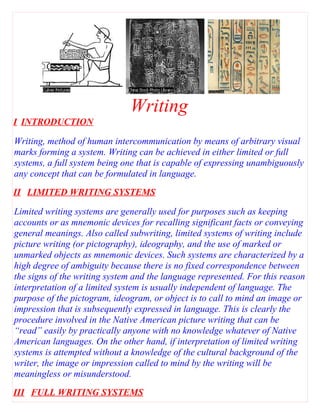
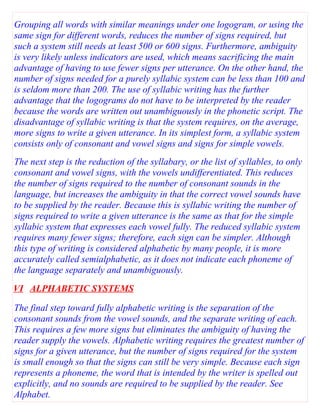
Archaeological discoveries suggest that Egyptian hieroglyphs may be the
oldest form of writing. The earliest evidence of an Egyptian hieroglyphic
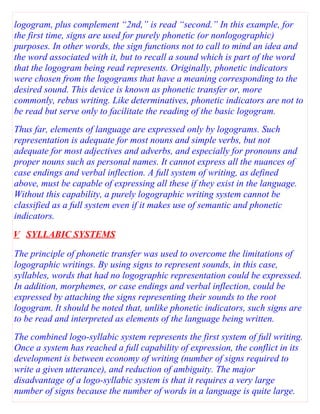
system is believed to be from about 3300 or 3200 BC. The Sumerians of
Mesopotamia also were writing before 3000 BC.
At about the same time, so-called Proto-Elamite writing developed in Elam.
This system has yet to be deciphered, and nothing can be said of its nature at
the present time except that, from the number of signs used, it is logo-
syllabic. Logo-syllabic systems of writing also developed, at a later date, in
the Aegean, in Anatolia, in the Indus Valley, and in China (see Chinese
Language). From these logo-syllabic systems, syllabaries were borrowed by
other peoples to write their own languages. The syllabary in its simplest and
most reduced form (that is, signs for consonant plus any vowel) was
borrowed by the Semitic peoples of Palestine and Syria from the Egyptians,
leaving behind the logograms and more complex syllables of the Egyptian
system, during the last half of the 2nd millennium BC (see Semitic
Languages). This syllabary was almost ready-made because Egyptian
writing had never expressed vowels. The earliest such semialphabetic
writing is found in the so-called Proto-Sinaitic inscriptions, which date back
to about 1500 BC. Another such system, dated to about 1300 BC, was found at
Ugarit on the northern Syrian coast, but in this case the writing was
inscribed on clay in the manner of Mesopotamian cuneiform. Similar writing
systems were developed by the other peoples of this region, and it was from
the Phoenicians that the Greeks borrowed their writing system. The Greeks
took the final step of separating the consonants from the vowels and writing
each separately, thus arriving at full alphabetic writing about 800 BC (see
Greek Language). Alphabetic writing has yet to be improved upon in terms
of the definition of a full writing system.

Writing

  • 1.
    Writing I INTRODUCTION Writing, methodof human intercommunication by means of arbitrary visual marks forming a system. Writing can be achieved in either limited or full systems, a full system being one that is capable of expressing unambiguously any concept that can be formulated in language. II LIMITED WRITING SYSTEMS Limited writing systems are generally used for purposes such as keeping accounts or as mnemonic devices for recalling significant facts or conveying general meanings. Also called subwriting, limited systems of writing include picture writing (or pictography), ideography, and the use of marked or unmarked objects as mnemonic devices. Such systems are characterized by a high degree of ambiguity because there is no fixed correspondence between the signs of the writing system and the language represented. For this reason interpretation of a limited system is usually independent of language. The purpose of the pictogram, ideogram, or object is to call to mind an image or impression that is subsequently expressed in language. This is clearly the procedure involved in the Native American picture writing that can be “read” easily by practically anyone with no knowledge whatever of Native American languages. On the other hand, if interpretation of limited writing systems is attempted without a knowledge of the cultural background of the writer, the image or impression called to mind by the writing will be meaningless or misunderstood. III FULL WRITING SYSTEMS
  • 2.
    A full writingsystem is capable of expressing any concept that can be formulated in language. Therefore, full writing systems are characterized by a more or less fixed correspondence between the signs of the writing system and elements of the language the writing represents. The elements of language represented, then, can be words, syllables, or phonemes (the smallest units of speech that distinguish two different utterances in a language). Thus, writing systems can be categorized as word (or logographic), syllabic, or alphabetic. Because full writing systems represent elements of language, knowledge of the language written is required to understand the meaning intended by the writer. This does not mean that a writing system is tied to one language. In fact, writing systems are rather easily transferred from one language to another. This means only that, unlike a pictographic system, a full system conveys no meaning to the reader without a knowledge of the underlying language. IV WORD (OR LOGOGRAM) SYSTEMS Word writing systems are characterized by many signs called logograms which represent complete words. Such signs frequently represent a series of related words, and in many cases, one sign represents several separate and distinct words. In purely logographic writing, such distinctions usually remain unresolved and the writing is ambiguous. Certain types of signs, however, can be used to resolve the ambiguity and assure correct reading of the logogram. These signs are used as semantic and phonetic indicators and are often called determinatives and phonetic complements. Determinatives are signs used to indicate the class or category to which the word represented by the logogram belongs. Determinatives are logograms themselves and are not read but serve only to indicate the semantic group, such as gods, countries, birds, fish, verbs of motion, verbs of building, objects made of wood, objects made of stone, and so on, to which the logogram belongs. Phonetic complements are similar in use but more specific in that they show part or all of the pronunciation of the word that the logogram represents. In modern alphabetic writing in English, for example, the logogram “2” is read “two.” When the ordinal number is referred to, however, the phonetic complement “d” is attached and the
  • 3.
    logogram, plus complement“2nd,” is read “second.” In this example, for the first time, signs are used for purely phonetic (or nonlogographic) purposes. In other words, the sign functions not to call to mind an idea and the word associated with it, but to recall a sound which is part of the word that the logogram being read represents. Originally, phonetic indicators were chosen from the logograms that have a meaning corresponding to the desired sound. This device is known as phonetic transfer or, more commonly, rebus writing. Like determinatives, phonetic indicators are not to be read but serve only to facilitate the reading of the basic logogram. Thus far, elements of language are expressed only by logograms. Such representation is adequate for most nouns and simple verbs, but not adequate for most adjectives and adverbs, and especially for pronouns and proper nouns such as personal names. It cannot express all the nuances of case endings and verbal inflection. A full system of writing, as defined above, must be capable of expressing all these if they exist in the language. Without this capability, a purely logographic writing system cannot be classified as a full system even if it makes use of semantic and phonetic indicators. V SYLLABIC SYSTEMS The principle of phonetic transfer was used to overcome the limitations of logographic writings. By using signs to represent sounds, in this case, syllables, words that had no logographic representation could be expressed. In addition, morphemes, or case endings and verbal inflection, could be expressed by attaching the signs representing their sounds to the root logogram. It should be noted that, unlike phonetic indicators, such signs are to be read and interpreted as elements of the language being written. The combined logo-syllabic system represents the first system of full writing. Once a system has reached a full capability of expression, the conflict in its development is between economy of writing (number of signs required to write a given utterance), and reduction of ambiguity. The major disadvantage of a logo-syllabic system is that it requires a very large number of signs because the number of words in a language is quite large.
  • 4.
    Grouping all wordswith similar meanings under one logogram, or using the same sign for different words, reduces the number of signs required, but such a system still needs at least 500 or 600 signs. Furthermore, ambiguity is very likely unless indicators are used, which means sacrificing the main advantage of having to use fewer signs per utterance. On the other hand, the number of signs needed for a purely syllabic system can be less than 100 and is seldom more than 200. The use of syllabic writing has the further advantage that the logograms do not have to be interpreted by the reader because the words are written out unambiguously in the phonetic script. The disadvantage of syllabic writing is that the system requires, on the average, more signs to write a given utterance. In its simplest form, a syllabic system consists only of consonant and vowel signs and signs for simple vowels. The next step is the reduction of the syllabary, or the list of syllables, to only consonant and vowel signs, with the vowels undifferentiated. This reduces the number of signs required to the number of consonant sounds in the language, but increases the ambiguity in that the correct vowel sounds have to be supplied by the reader. Because this is syllabic writing the number of signs required to write a given utterance is the same as that for the simple syllabic system that expresses each vowel fully. The reduced syllabic system requires many fewer signs; therefore, each sign can be simpler. Although this type of writing is considered alphabetic by many people, it is more accurately called semialphabetic, as it does not indicate each phoneme of the language separately and unambiguously. VI ALPHABETIC SYSTEMS The final step toward fully alphabetic writing is the separation of the consonant sounds from the vowel sounds, and the separate writing of each. This requires a few more signs but eliminates the ambiguity of having the reader supply the vowels. Alphabetic writing requires the greatest number of signs for a given utterance, but the number of signs required for the system is small enough so that the signs can still be very simple. Because each sign represents a phoneme, the word that is intended by the writer is spelled out explicitly, and no sounds are required to be supplied by the reader. See Alphabet.
  • 5.
    These systems outlinethe theory and methods of writing, but in actual fact writing systems do not exist in these pure forms. Elements from one type of system are almost always found incorporated in another; an example is the number of logograms used with the modern alphabetic writing system. VII HISTORY OF WRITING Writing systems always tended to be conservative, their origins often being attributed to divine sources. Any change or modification was met with great hesitation, and even today, attempts to reform spelling or eliminate inconsistencies in writing conventions meet with strong resistance. Because of this conservatism major innovations in the structure of a writing system usually occurred when one people borrowed a system from another people. The Akkadians, for example, adapted the syllabic portion of the Sumerian logo-syllabic system to their own language, but retained the logograms, and used them regularly as a type of shorthand (see Sumerian Language). When the Hittites borrowed the system from the Akkadians for their own language, they eliminated most of the polyphonous and homophonous syllabic signs and many of the Sumerian logograms, but used a number of Akkadian syllabic spellings as logograms (see Hittite Language). Archaeological discoveries suggest that Egyptian hieroglyphs may be the oldest form of writing. The earliest evidence of an Egyptian hieroglyphic system is believed to be from about 3300 or 3200 BC. The Sumerians of Mesopotamia also were writing before 3000 BC. At about the same time, so-called Proto-Elamite writing developed in Elam. This system has yet to be deciphered, and nothing can be said of its nature at the present time except that, from the number of signs used, it is logo- syllabic. Logo-syllabic systems of writing also developed, at a later date, in the Aegean, in Anatolia, in the Indus Valley, and in China (see Chinese Language). From these logo-syllabic systems, syllabaries were borrowed by other peoples to write their own languages. The syllabary in its simplest and most reduced form (that is, signs for consonant plus any vowel) was borrowed by the Semitic peoples of Palestine and Syria from the Egyptians, leaving behind the logograms and more complex syllables of the Egyptian
  • 6.
    system, during thelast half of the 2nd millennium BC (see Semitic Languages). This syllabary was almost ready-made because Egyptian writing had never expressed vowels. The earliest such semialphabetic writing is found in the so-called Proto-Sinaitic inscriptions, which date back to about 1500 BC. Another such system, dated to about 1300 BC, was found at Ugarit on the northern Syrian coast, but in this case the writing was inscribed on clay in the manner of Mesopotamian cuneiform. Similar writing systems were developed by the other peoples of this region, and it was from the Phoenicians that the Greeks borrowed their writing system. The Greeks took the final step of separating the consonants from the vowels and writing each separately, thus arriving at full alphabetic writing about 800 BC (see Greek Language). Alphabetic writing has yet to be improved upon in terms of the definition of a full writing system.