A Writer’s Paintbrush: Participle Phrases Inspired by Harry Noden
Writer as Artist A writer is an artist, showing the reader the world through new eyes. Brian Jacques, a well-known novelist, says, “ Paint.  That’s the magic word.  Paint pictures with words.  The pictures will appear in the imagination so the person reading it can say, ‘I see that. ’”
When an author lacks a visual eye, writing has no heart and soul: images lie lifeless like cadavers in a morgue.   Compare the following descriptions of the same scene…
Telling: “ It was winter.  Everything was frozen and white with snow.  Snow had fallen from the sky for days.  The weather was horrible.”
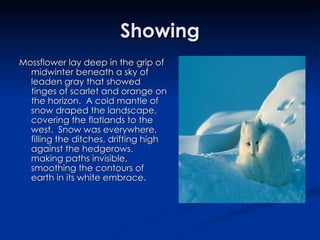
Showing Mossflower lay deep in the grip of midwinter beneath a sky of leaden gray that showed tinges of scarlet and orange on the horizon.  A cold mantle of snow draped the landscape, covering the flatlands to the west.  Snow was everywhere, filling the ditches, drifting high against the hedgerows, making paths invisible, smoothing the contours of earth in its white embrace.
So what’s the difference? Telling  the reader, nothing is left to the imagination: simply stated “it was snowing.” To  show  the reader, give them observable details: “the air was 32 degrees, wind howled in the trees, and frozen precipitation fell from the sky.”  Showing  lets the reader  infer  the facts and  visualize  the scene.
So how do I show, not tell? There are five basic “brushstrokes” that writers can use.  Each brushstroke is a sentence structure that helps readers to see in their minds’ eyes. The first of these is participles.
What is a Participle? The simple definition: an –ing verb tagged on to the beginning or end of a sentence. An example: Hissing, slithering, and coiling , the diamond-scaled snakes attacked their prey. Hissing, slithering, and coiling  are participles which let the reader see the snake vividly.
Participle Phrases Writers can also add participial phrases—a participle along with any modifiers to complete the image. Hissing their forked red tongues and coiling their cold bodies,  the diamond-scaled snakes attacked their prey. This method creates an even more detailed image for the reader.
Earnest Hemingway uses participles Shifting the weight of the line to his left shoulder and kneeling carefully,  he washed his hand in the ocean and held it there,  submerged , for more than a minute,  watching the blood trail away and the steady movement of the water against his hand as the boat moved.
Some student-written examples: “ Flying through the air on the wings of a dream , the Olympic long jumper thrust the weight of his whole body forward.” ~Cathleen Conry
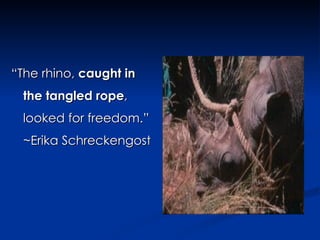
“ The rhino,  caught in the tangled rope , looked for freedom.” ~Erika Schreckengost
“ The clown,  appearing bright and cheerful,  smiled and did his act with unusual certainty for someone who had just killed a man.” ~Christi Flick
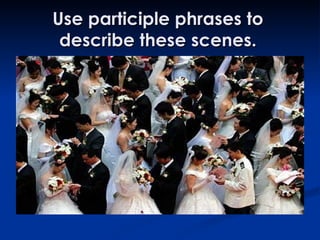
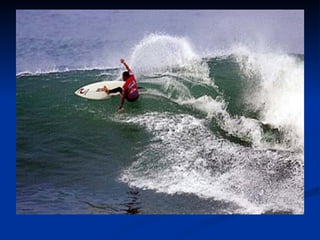
Use participle phrases to describe these scenes.


For more practice: Look for a picture at home: in the newspaper, a magazine, the internet, etc. and write a paragraph describing what is going on in the picture, using participles.

Writers Paintbrush

  • 1.
    A Writer’s Paintbrush:Participle Phrases Inspired by Harry Noden
  • 2.
    Writer as ArtistA writer is an artist, showing the reader the world through new eyes. Brian Jacques, a well-known novelist, says, “ Paint. That’s the magic word. Paint pictures with words. The pictures will appear in the imagination so the person reading it can say, ‘I see that. ’”
  • 3.
    When an authorlacks a visual eye, writing has no heart and soul: images lie lifeless like cadavers in a morgue. Compare the following descriptions of the same scene…
  • 4.
    Telling: “ Itwas winter. Everything was frozen and white with snow. Snow had fallen from the sky for days. The weather was horrible.”
  • 5.
    Showing Mossflower laydeep in the grip of midwinter beneath a sky of leaden gray that showed tinges of scarlet and orange on the horizon. A cold mantle of snow draped the landscape, covering the flatlands to the west. Snow was everywhere, filling the ditches, drifting high against the hedgerows, making paths invisible, smoothing the contours of earth in its white embrace.
  • 6.
    So what’s thedifference? Telling the reader, nothing is left to the imagination: simply stated “it was snowing.” To show the reader, give them observable details: “the air was 32 degrees, wind howled in the trees, and frozen precipitation fell from the sky.” Showing lets the reader infer the facts and visualize the scene.
  • 7.
    So how doI show, not tell? There are five basic “brushstrokes” that writers can use. Each brushstroke is a sentence structure that helps readers to see in their minds’ eyes. The first of these is participles.
  • 8.
    What is aParticiple? The simple definition: an –ing verb tagged on to the beginning or end of a sentence. An example: Hissing, slithering, and coiling , the diamond-scaled snakes attacked their prey. Hissing, slithering, and coiling are participles which let the reader see the snake vividly.
  • 9.
    Participle Phrases Writerscan also add participial phrases—a participle along with any modifiers to complete the image. Hissing their forked red tongues and coiling their cold bodies, the diamond-scaled snakes attacked their prey. This method creates an even more detailed image for the reader.
  • 10.
    Earnest Hemingway usesparticiples Shifting the weight of the line to his left shoulder and kneeling carefully, he washed his hand in the ocean and held it there, submerged , for more than a minute, watching the blood trail away and the steady movement of the water against his hand as the boat moved.
  • 11.
    Some student-written examples:“ Flying through the air on the wings of a dream , the Olympic long jumper thrust the weight of his whole body forward.” ~Cathleen Conry
  • 12.
    “ The rhino, caught in the tangled rope , looked for freedom.” ~Erika Schreckengost
  • 13.
    “ The clown, appearing bright and cheerful, smiled and did his act with unusual certainty for someone who had just killed a man.” ~Christi Flick
  • 14.
    Use participle phrasesto describe these scenes.
  • 15.
  • 16.
  • 17.
  • 18.
  • 19.
    For more practice:Look for a picture at home: in the newspaper, a magazine, the internet, etc. and write a paragraph describing what is going on in the picture, using participles.