Write for
the reading
brain
Cheryl Stephens
email@cherylstephens.com
October 2019
Make it feel easy to understand.
Achieve neurocognitve reading ease
with these practices.
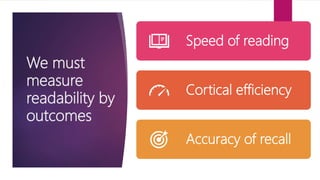
We must
measure
readability by
outcomes
Speed of reading
Cortical efficiency
Accuracy of recall
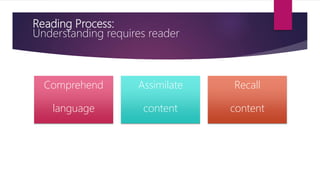
Reading Process:
Understanding requires reader
Comprehend
language
Assimilate
content
Recall
content
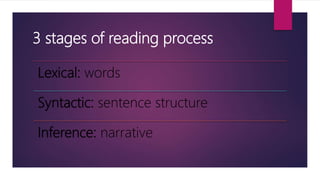
3 stages of reading process
Lexical: words
Syntactic: sentence structure
Inference: narrative
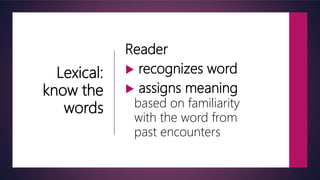
Lexical:
know the
words
Reader
 recognizes word
 assigns meaning
based on familiarity
with the word from
past encounters
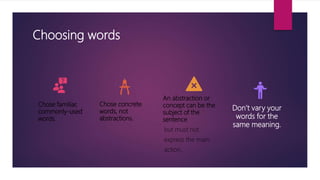
Choosing words
Chose familiar,
commonly-used
words.
Chose concrete
words, not
abstractions.
An abstraction or
concept can be the
subject of the
sentence
but must not
express the main
action.
Don’t vary your
words for the
same meaning.
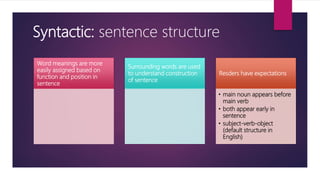
Syntactic: sentence structure
Word meanings are more
easily assigned based on
function and position in
sentence
Surrounding words are used
to understand construction
of sentence
Resders have expectations
• main noun appears before
main verb
• both appear early in
sentence
• subject-verb-object
(default structure in
English)
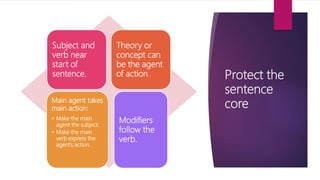
Protect the
sentence
core
Subject and
verb near
start of
sentence.
Theory or
concept can
be the agent
of action.
Main agent takes
main action:
• Make the main
agent the subject.
• Make the main
verb express the
agent’s action.
Modifiers
follow the
verb.
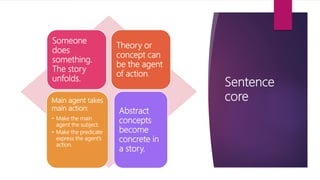
Sentence
core
Someone
does
something.
The story
unfolds.
Theory or
concept can
be the agent
of action.
Main agent takes
main action:
• Make the main
agent the subject.
• Make the predicate
express the agent’s
action.
Abstract
concepts
become
concrete in
a story.
To comprehend, assimilate, and recall
To actually comprehend, assimilate, and
recall written language, readers use
another stage: building inferences
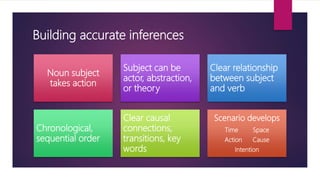
Building accurate inferences
Noun subject
takes action
Subject can be
actor, abstraction,
or theory
Clear relationship
between subject
and verb
Chronological,
sequential order
Clear causal
connections,
transitions, key
words
Scenario develops
Time Space
Action Cause
Intention
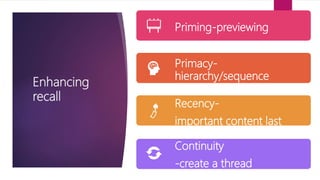
Enhancing
recall
Priming-previewing
Primacy-
hierarchy/sequence
Recency-
important content last
Continuity
-create a thread
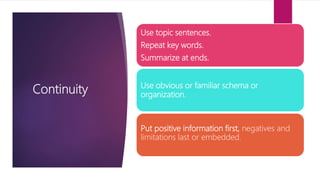
Continuity
Use topic sentences.
Repeat key words.
Summarize at ends.
Use obvious or familiar schema or
organization.
Put positive information first, negatives and
limitations last or embedded.
How to achieve good outcomes
Speed Efficiency Recall
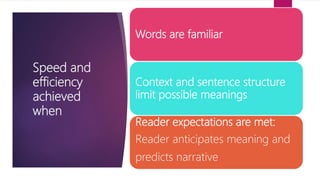
Speed and
efficiency
achieved
when
Words are familiar
Context and sentence structure
limit possible meanings
Reader expectations are met:
Reader anticipates meaning and
predicts narrative
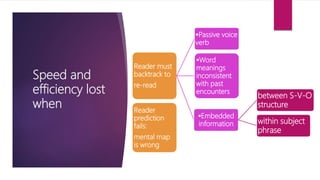
Speed and
efficiency lost
when
Reader must
backtrack to
re-read
Passive voice
verb
Word
meanings
inconsistent
with past
encounters
Embedded
information
between S-V-O
structure
within subject
phrase
Reader
prediction
fails:
mental map
is wrong
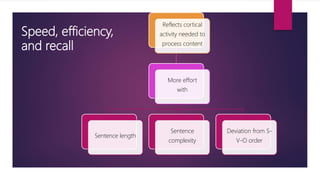
Speed, efficiency,
and recall
Reflects cortical
activity needed to
process content
More effort
with
Sentence length
Sentence
complexity
Deviation from S-
V-O order
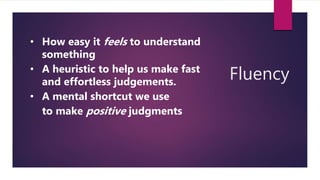
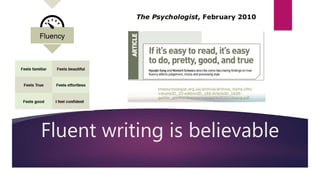
Fluency
• How easy it feels to understand
something
• A heuristic to help us make fast
and effortless judgements.
• A mental shortcut we use
to make positive judgments
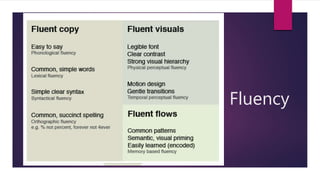
Fluency
Fluent writing is believable
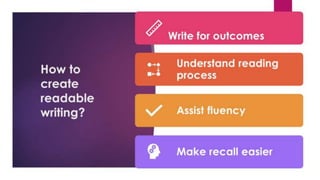
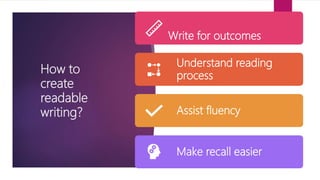
How to
create
readable
writing?
Understand reading
process
Assist fluency
Make recall easier
Write for outcomes

Write for the reader: modern guidelines

Editor's Notes

  • #6 Whenever we encounter new information, our brains immediately try to make sense of it. Once they figure out what we’re seeing in a physical sense, they work to provide personal context and decide if it’s relevant enough to focus on further. The process is instantaneous: we don’t even realize we’ve made a choice in the time our minds have selected one path or another. Our gaze either stops, or we simply keep scanning. Maria Kornikova
  • #10 Use lists when possible. “We are drawn to it intuitively, we process it more efficiently, and we retain it with little effort.” “It spatially organizes the information; and it promises a story that’s finite, whose length has been quantified upfront. Together, these create an easy reading experience, in which the mental heavy lifting of conceptualization, categorization, and analysis is completed well in advance of actual consumption… And there’s little that our brains crave more than effortlessly acquired data.” Mariak Kornikova
  • #14 Readers like lists. “The social psychologist Robert Zajonc, who made his name studying the connection between emotion and cognition, argued that the positive feeling of completion in and of itself is enough to inform future decisions. Preferences, goes his famous coinage, need no inferences” Maria Kornikova
  • #15 . Lists also appeal to our general tendency to categorize things—in fact, it’s hard for us not to categorize something the moment we see it—since they chunk information into short, distinct components. This type of organization facilitates both immediate understanding and later recall, as the neuroscientist Walter Kintsch pointed out back in 1968. Because we can process information more easily when it’s in a list than when it’s clustered and undifferentiated, like in standard paragraphs, a list feels more intuitive. In other words, lists simply feel better. Maria Kornikova