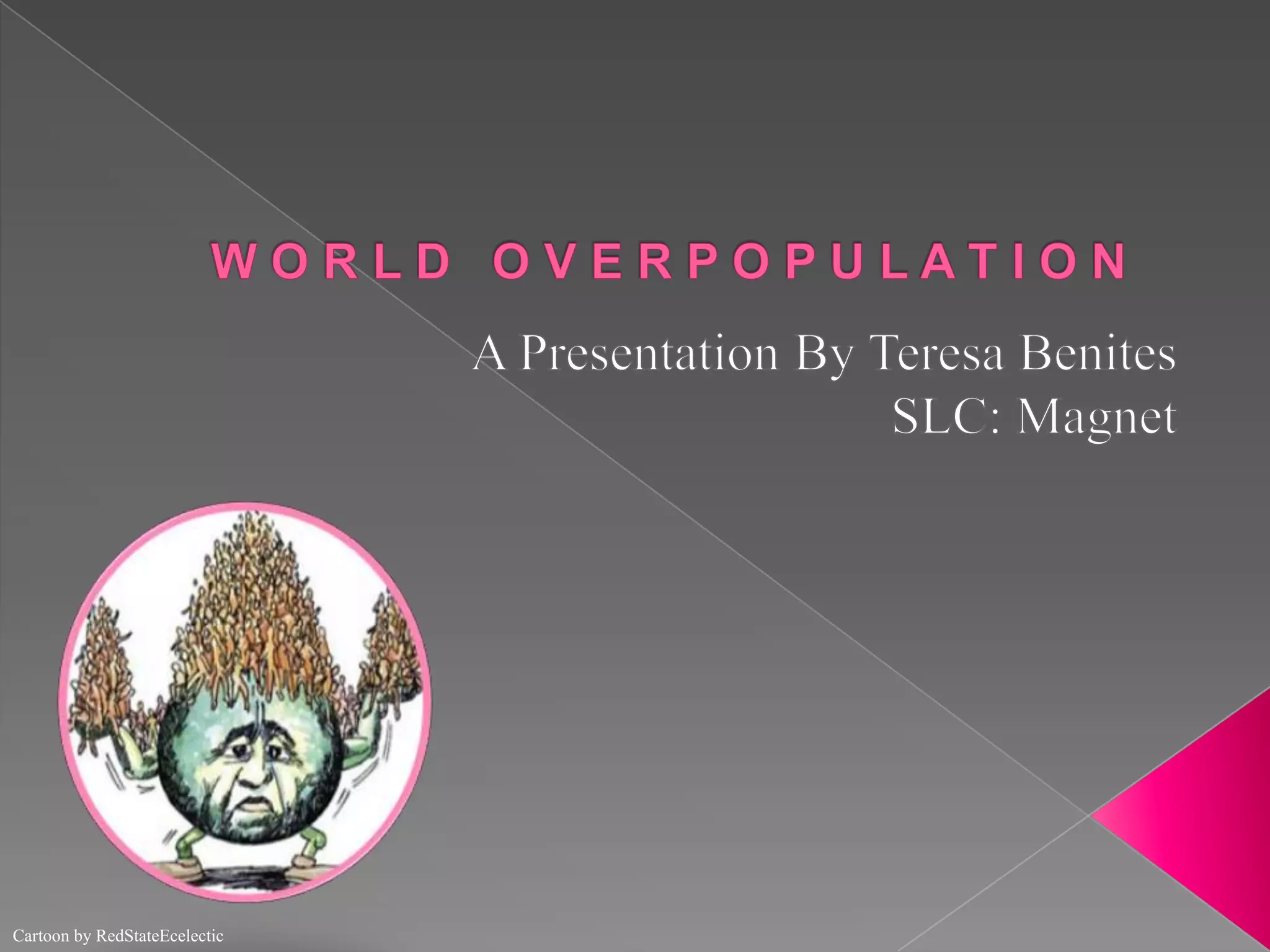
W O R L D   O V E R P O P U L A T I O NA Presentation By Teresa BenitesSLC: MagnetCartoon by RedStateEcelectic
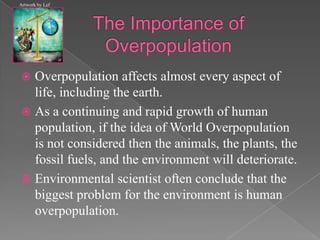
The Importance of OverpopulationOverpopulation affects almost every aspect of life, including the earth. As a continuing and rapid growth of human population, if the idea of World Overpopulation is not considered then the animals, the plants, the fossil fuels, and the environment will deteriorate. Environmental scientist often conclude that the biggest problem for the environment is human overpopulation.  Artwork by Lef
Overpopulation ThesisOverpopulation is not a myth, and will grow into a problem without proper consideration.Education on World Overpopulation is vital and could help sustain the environment to live a morecomfortable life.Overpopulation affects the environment, the economy, our food production, animal species, and even ourselves.
Causes of World OverpopulationDeclination of the Mortality Rate.Death rates are dropping and they will continue to do so with the advanced technology and research humans are providing for each other. Medicine is also big key factor. Increase of Birth Rates.New discoveries in nutritional science have been able to bring an increase in the fertility rates of human beings. Women also have easier births since global maternal death rate has dropped 35 percent in the past 30 years (The Lancet).Emigration.Emigration is also a problem in certain areas, where too many people are coming in and not enough are leaving to balance out the population. For example, in the United States population [under the current immigration policy] will double this century - practically within the lifetimes of children born today (US Census).Lack of Education.If humans were aware of the population, the problems wouldn’t be severe. For example, if every human was taught and given education on birth control and safe sex, there could be a noticeable decrease in unwanted pregnancies. Every year, there are about 80 million pregnancies. 40% of the pregnancies; almost half, are unplanned (Hood 2009).Photography by WorldMystery.com
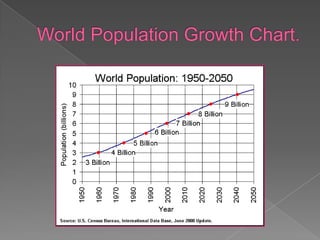
World Population Growth Chart.
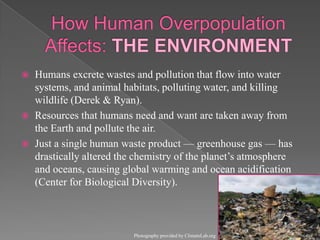
How Human Overpopulation Affects: THE ENVIRONMENTHumans excrete wastes and pollution that flow into water systems, and animal habitats, polluting water, and killing wildlife (Derek & Ryan).Resources that humans need and want are taken away from the Earth and pollute the air. Just a single human waste product — greenhouse gas — has drastically altered the chemistry of the planet’s atmosphere and oceans, causing global warming and ocean acidification (Center for Biological Diversity).Photography provided by ClimateLab.org
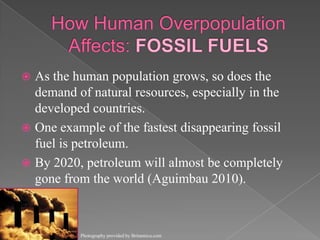
How Human Overpopulation Affects: FOSSIL FUELSAs the human population grows, so does the demand of natural resources, especially in the developed countries. One example of the fastest disappearing fossil fuel is petroleum. By 2020, petroleum will almost be completely gone from the world(Aguimbau 2010).Photography provided by Britannica.com
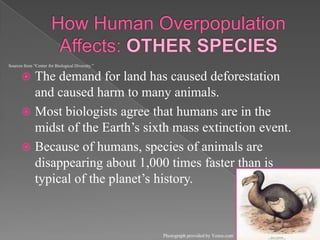
How Human Overpopulation Affects: OTHER SPECIESThe demand for land has caused deforestation and caused harm to many animals.Most biologists agree that humans are in the midst of the Earth’s sixth mass extinction event.Because of humans, species of animals are disappearing about 1,000 times faster than is typical of the planet’s history. Sources from “Center for Biological Diversity.”Photograph provided by Yenra.com
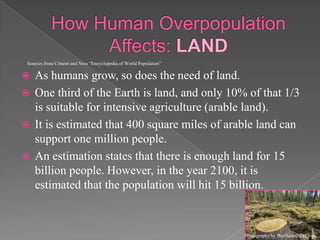
How Human Overpopulation Affects: LANDAs humans grow, so does the need of land. One third of the Earth is land, and only 10% of that 1/3 is suitable for intensive agriculture (arable land).It is estimated that 400 square miles of arable land can support one million people.  An estimation states that there is enough land for 15 billion people. However, in the year 2100, it is estimated that the population will hit 15 billion.Sources from Cimentand Ness “Encyclopedia of World Population”Photography by BigPlanetIdeas.com
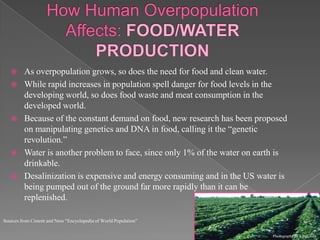
How Human Overpopulation Affects: FOOD/WATER PRODUCTIONAs overpopulation grows, so does the need for food and clean water.While rapid increases in population spell danger for food levels in the developing world, so does food waste and meat consumption in the developed world.Because of the constant demand on food, new research has been proposed on manipulating genetics and DNA in food, calling it the “genetic revolution.”Water is another problem to face, since only 1% of the water on earth is drinkable.Desalinization is expensive and energy consuming and in the US water is being pumped out of the ground far more rapidly than it can be replenished. Sources from Ciment and Ness “Encyclopedia of World Population”Photography by Ketsa.com
How Overpopulation Affects: THE ECONOMYWhen there are too many people on a certain area, the harder it is to get food let alone even obtain to sell.While this is going on, the GPD per capita can drop significantly which forces the government to rely on foreign debt to feed the people. When a country is overpopulated, there is a high rate of unemployment because there just aren’t enough jobs to support the population.Sources from Derek and Ryan “Effects of Overpopulation.”
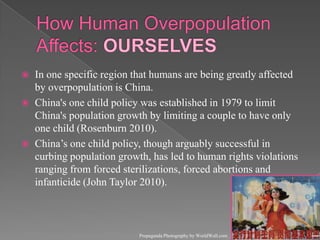
How Human Overpopulation Affects: OURSELVESIn one specific region that humans are being greatly affected by overpopulation is China.China's one child policy was established in 1979 to limit China's population growth by limiting a couple to have only one child (Rosenburn 2010).China’s one child policy, though arguably successful in curbing population growth, has led to human rights violations ranging from forced sterilizations, forced abortions and infanticide (John Taylor 2010).Propaganda Photography by WorldWall.com
CONCLUSIONAs humans try and control their population by enforcing fertility laws, a very important concept is education. Education is the best way to inform and show people awareness of the situations and crisis’s happening to our planet. The awareness and availability of birth control will inevitably drop the unwanted pregnancies. Practicing cleaner agriculture and industrial technology would greatly help the food production and pollution in the world today. Overpopulation is not a myth but a serious matter. However, it can be controlled if everybody in the world spread awareness and education about this situation.
THREE MAIN WORK CITED REFRENCESNess, Immanuel, and James Ciment. The Encyclopedia of Global Population and Demographics. Vol. 1. Armonk, NY: M.E Sharp Inc., 1999. Print."Ozone and Population." Eye in the Sky (2009): n. pag. Web. 16 Nov 2010. <http://www.nationalgeographic.com/eye/ozone/ozone.html>."OVERPOPULATION: A Key Factor in Species Extinction." Overpopulation n. pag. Web. 15 Nov 2010. <http://www.biologicaldiversity.org/campaigns/overpopulation/index.html>.

Period 7 - Teresa Benites - World Overpopulation

  • 1.
    W O RL D O V E R P O P U L A T I O NA Presentation By Teresa BenitesSLC: MagnetCartoon by RedStateEcelectic
  • 2.
    The Importance ofOverpopulationOverpopulation affects almost every aspect of life, including the earth. As a continuing and rapid growth of human population, if the idea of World Overpopulation is not considered then the animals, the plants, the fossil fuels, and the environment will deteriorate. Environmental scientist often conclude that the biggest problem for the environment is human overpopulation. Artwork by Lef
  • 3.
    Overpopulation ThesisOverpopulation isnot a myth, and will grow into a problem without proper consideration.Education on World Overpopulation is vital and could help sustain the environment to live a morecomfortable life.Overpopulation affects the environment, the economy, our food production, animal species, and even ourselves.
  • 4.
    Causes of WorldOverpopulationDeclination of the Mortality Rate.Death rates are dropping and they will continue to do so with the advanced technology and research humans are providing for each other. Medicine is also big key factor. Increase of Birth Rates.New discoveries in nutritional science have been able to bring an increase in the fertility rates of human beings. Women also have easier births since global maternal death rate has dropped 35 percent in the past 30 years (The Lancet).Emigration.Emigration is also a problem in certain areas, where too many people are coming in and not enough are leaving to balance out the population. For example, in the United States population [under the current immigration policy] will double this century - practically within the lifetimes of children born today (US Census).Lack of Education.If humans were aware of the population, the problems wouldn’t be severe. For example, if every human was taught and given education on birth control and safe sex, there could be a noticeable decrease in unwanted pregnancies. Every year, there are about 80 million pregnancies. 40% of the pregnancies; almost half, are unplanned (Hood 2009).Photography by WorldMystery.com
  • 5.
  • 6.
    How Human OverpopulationAffects: THE ENVIRONMENTHumans excrete wastes and pollution that flow into water systems, and animal habitats, polluting water, and killing wildlife (Derek & Ryan).Resources that humans need and want are taken away from the Earth and pollute the air. Just a single human waste product — greenhouse gas — has drastically altered the chemistry of the planet’s atmosphere and oceans, causing global warming and ocean acidification (Center for Biological Diversity).Photography provided by ClimateLab.org
  • 7.
    How Human OverpopulationAffects: FOSSIL FUELSAs the human population grows, so does the demand of natural resources, especially in the developed countries. One example of the fastest disappearing fossil fuel is petroleum. By 2020, petroleum will almost be completely gone from the world(Aguimbau 2010).Photography provided by Britannica.com
  • 8.
    How Human OverpopulationAffects: OTHER SPECIESThe demand for land has caused deforestation and caused harm to many animals.Most biologists agree that humans are in the midst of the Earth’s sixth mass extinction event.Because of humans, species of animals are disappearing about 1,000 times faster than is typical of the planet’s history. Sources from “Center for Biological Diversity.”Photograph provided by Yenra.com
  • 9.
    How Human OverpopulationAffects: LANDAs humans grow, so does the need of land. One third of the Earth is land, and only 10% of that 1/3 is suitable for intensive agriculture (arable land).It is estimated that 400 square miles of arable land can support one million people. An estimation states that there is enough land for 15 billion people. However, in the year 2100, it is estimated that the population will hit 15 billion.Sources from Cimentand Ness “Encyclopedia of World Population”Photography by BigPlanetIdeas.com
  • 10.
    How Human OverpopulationAffects: FOOD/WATER PRODUCTIONAs overpopulation grows, so does the need for food and clean water.While rapid increases in population spell danger for food levels in the developing world, so does food waste and meat consumption in the developed world.Because of the constant demand on food, new research has been proposed on manipulating genetics and DNA in food, calling it the “genetic revolution.”Water is another problem to face, since only 1% of the water on earth is drinkable.Desalinization is expensive and energy consuming and in the US water is being pumped out of the ground far more rapidly than it can be replenished. Sources from Ciment and Ness “Encyclopedia of World Population”Photography by Ketsa.com
  • 11.
    How Overpopulation Affects:THE ECONOMYWhen there are too many people on a certain area, the harder it is to get food let alone even obtain to sell.While this is going on, the GPD per capita can drop significantly which forces the government to rely on foreign debt to feed the people. When a country is overpopulated, there is a high rate of unemployment because there just aren’t enough jobs to support the population.Sources from Derek and Ryan “Effects of Overpopulation.”
  • 12.
    How Human OverpopulationAffects: OURSELVESIn one specific region that humans are being greatly affected by overpopulation is China.China's one child policy was established in 1979 to limit China's population growth by limiting a couple to have only one child (Rosenburn 2010).China’s one child policy, though arguably successful in curbing population growth, has led to human rights violations ranging from forced sterilizations, forced abortions and infanticide (John Taylor 2010).Propaganda Photography by WorldWall.com
  • 13.
    CONCLUSIONAs humans tryand control their population by enforcing fertility laws, a very important concept is education. Education is the best way to inform and show people awareness of the situations and crisis’s happening to our planet. The awareness and availability of birth control will inevitably drop the unwanted pregnancies. Practicing cleaner agriculture and industrial technology would greatly help the food production and pollution in the world today. Overpopulation is not a myth but a serious matter. However, it can be controlled if everybody in the world spread awareness and education about this situation.
  • 14.
    THREE MAIN WORKCITED REFRENCESNess, Immanuel, and James Ciment. The Encyclopedia of Global Population and Demographics. Vol. 1. Armonk, NY: M.E Sharp Inc., 1999. Print."Ozone and Population." Eye in the Sky (2009): n. pag. Web. 16 Nov 2010. <http://www.nationalgeographic.com/eye/ozone/ozone.html>."OVERPOPULATION: A Key Factor in Species Extinction." Overpopulation n. pag. Web. 15 Nov 2010. <http://www.biologicaldiversity.org/campaigns/overpopulation/index.html>.