Alternative Energy IncentivesA Presentation by: Joshua BlackSLC: Magnet
ThesisWhat is an Alternative Energy Incentive?How are they helpful?What are the types of renewable energy?How do they work?
What is an Alternative Energy Incentive?New energy used to replace an old method.It replaces old fuel sources.Same efficient result but with an environment friendly turnout.
How are they helpful?They produce the same result without all the harmful effects of fossil fuels.It’s a clean source of energy with low environmental impact.Renewable energy will NEVER run out.Creates jobs and helps the economy.
What are the types of renewable energy?Wind PowerHydro PowerSolar PowerGeothermal Energy
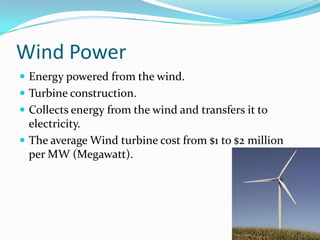
Wind PowerEnergy powered from the wind.Turbine construction.Collects energy from the wind and transfers it to electricity.The average Wind turbine cost from $1 to $2 million per MW (Megawatt).
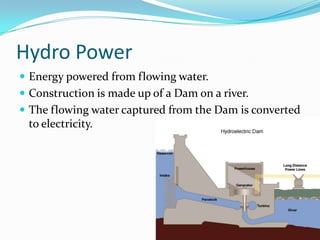
Hydro PowerEnergy powered from flowing water.Construction is made up of a Dam on a river.The flowing water captured from the Dam is converted to electricity.
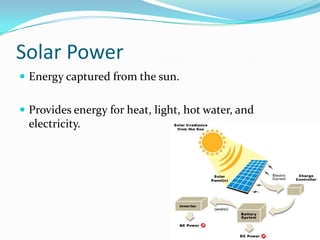
Solar PowerEnergy captured from the sun.Provides energy for heat, light, hot water, and electricity.
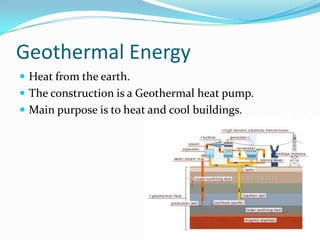
Geothermal EnergyHeat from the earth.The construction is a Geothermal heat pump.Main purpose is to heat and cool buildings.
ConclusionRenewable energy is an environmentally friendly way to produce energy.Alternative Energy Incentives cuts pollution and the bad waste that fossil fuels give off.Renewable energy never runs out.These forms of renewable energy are natural processes and are replenished constantly.
Works Cited1) "Energy Resources: Home Page." Andy Darvill's Science Site: Home. Web. 14 Feb. 2011. <http://www.darvill.clara.net/altenerg/>.2) Boyle, Godfrey. Renewable Energy. Oxford: Oxford UP in Association with the Open University, 2004. Print.3) Renewable Energy World - Renewable Energy News, Jobs, Events, Companies, and More. Web. 14 Feb. 2011. <http://www.renewableenergyworld.com/rea/home>.4) Seifried, Dieter, and Walter Witzel. Renewable Energy: the Facts. London: Earthscan, 2010. Print.

Josh Black - period 6 - Alternative energy incentives

  • 1.
    Alternative Energy IncentivesAPresentation by: Joshua BlackSLC: Magnet
  • 2.
    ThesisWhat is anAlternative Energy Incentive?How are they helpful?What are the types of renewable energy?How do they work?
  • 3.
    What is anAlternative Energy Incentive?New energy used to replace an old method.It replaces old fuel sources.Same efficient result but with an environment friendly turnout.
  • 4.
    How are theyhelpful?They produce the same result without all the harmful effects of fossil fuels.It’s a clean source of energy with low environmental impact.Renewable energy will NEVER run out.Creates jobs and helps the economy.
  • 5.
    What are thetypes of renewable energy?Wind PowerHydro PowerSolar PowerGeothermal Energy
  • 6.
    Wind PowerEnergy poweredfrom the wind.Turbine construction.Collects energy from the wind and transfers it to electricity.The average Wind turbine cost from $1 to $2 million per MW (Megawatt).
  • 7.
    Hydro PowerEnergy poweredfrom flowing water.Construction is made up of a Dam on a river.The flowing water captured from the Dam is converted to electricity.
  • 8.
    Solar PowerEnergy capturedfrom the sun.Provides energy for heat, light, hot water, and electricity.
  • 9.
    Geothermal EnergyHeat fromthe earth.The construction is a Geothermal heat pump.Main purpose is to heat and cool buildings.
  • 10.
    ConclusionRenewable energy isan environmentally friendly way to produce energy.Alternative Energy Incentives cuts pollution and the bad waste that fossil fuels give off.Renewable energy never runs out.These forms of renewable energy are natural processes and are replenished constantly.
  • 11.
    Works Cited1) "EnergyResources: Home Page." Andy Darvill's Science Site: Home. Web. 14 Feb. 2011. <http://www.darvill.clara.net/altenerg/>.2) Boyle, Godfrey. Renewable Energy. Oxford: Oxford UP in Association with the Open University, 2004. Print.3) Renewable Energy World - Renewable Energy News, Jobs, Events, Companies, and More. Web. 14 Feb. 2011. <http://www.renewableenergyworld.com/rea/home>.4) Seifried, Dieter, and Walter Witzel. Renewable Energy: the Facts. London: Earthscan, 2010. Print.