World-Class
Risk Management
Norman
MARKS
2017
The Risk Manager’s List
3
1. You might get run over by a car
2. You might get run over by a bicycle
3. Your home may be burglarized while you are out
4. You might be mugged
5. You might be shot in a drive-by shooting
6. A lot of bad things might happen
“Only xx% of [C-level] respondents
believe their risk management
processes support, at a high level,
the ability to develop and execute
business strategies”
Deloitte: Exploring Strategic Risk
7
“Only 13% of [C-level] respondents
believe their risk management
processes support, at a high level,
the ability to develop and execute
business strategies”
Deloitte: Exploring Strategic Risk
8
The Upgraded Risk Manager’s List
10
1. You might get run over by a car
2. You might get run over by a bicycle
3. Your home may be burglarized while you are out
4. You might be mugged
5. You might be shot in a drive-by shooting
6. A lot of bad things might happen
1. If you work you can earn money
2. You can meet your wife for lunch
3. You can pick up your children after school
4. I can get groceries and be able to eat
5. Getting exercise is healthy
6. A lot of good things might happen
The Upgraded Manager’s List
11
1. You might get run over by a car
2. You might get run over by a bicycle
3. Your home may be burglarized while you are out
4. You might be mugged
5. You might be shot in a drive-by shooting
6. A lot of bad things might happen
1. If you work you can earn money
2. You can meet your wife for lunch
3. You can pick up your children after school
4. I can get groceries and be able to eat
5. Getting exercise is healthy
6. A lot of good things might happen
13
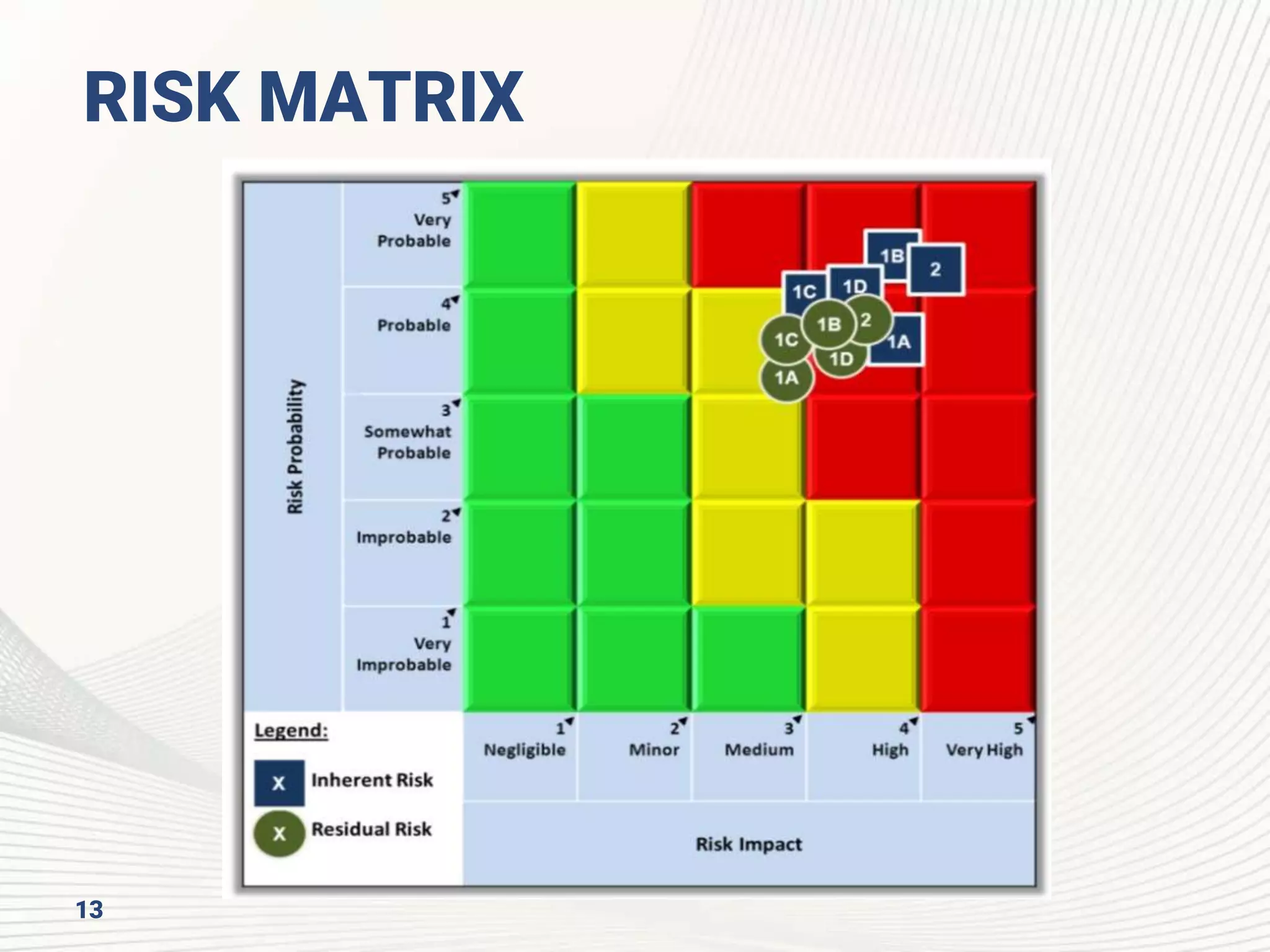
RISK MATRIX
Why We Need to Manage Risk
The purpose of managing risk is to increase
the likelihood of an organization achieving
its objectives by being in a position to
manage threats and adverse situations and
being ready to take advantage of
opportunities that may arise.
National Guidance
on Implementing ISO 31000:2009
From NSAI in Ireland
16
17
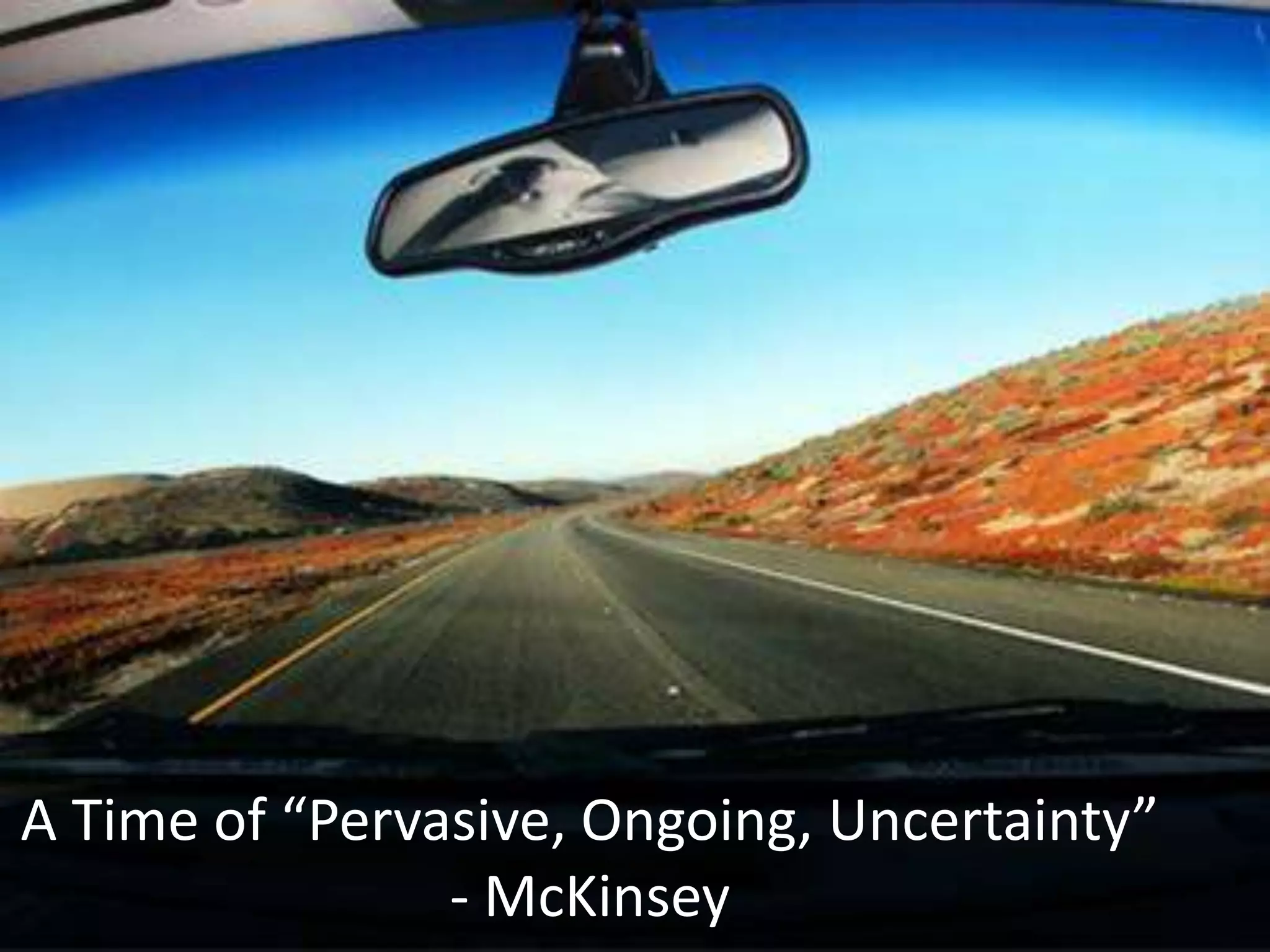
A Time of “Pervasive, Ongoing, Uncertainty”
- McKinsey
Risk management, piercing the fog of
uncertainty – Felix Kloman
20
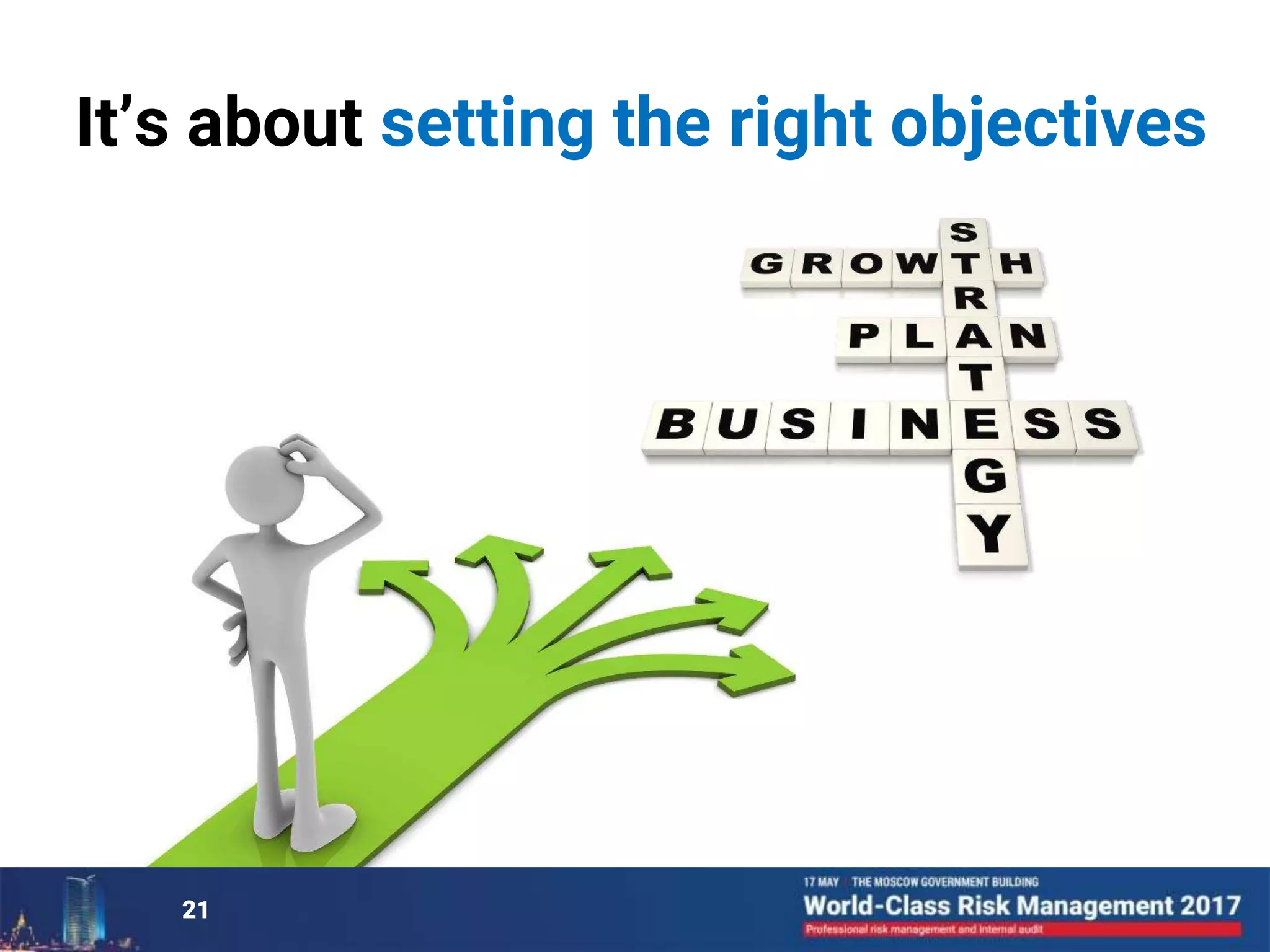
It’s about setting the right objectives
21
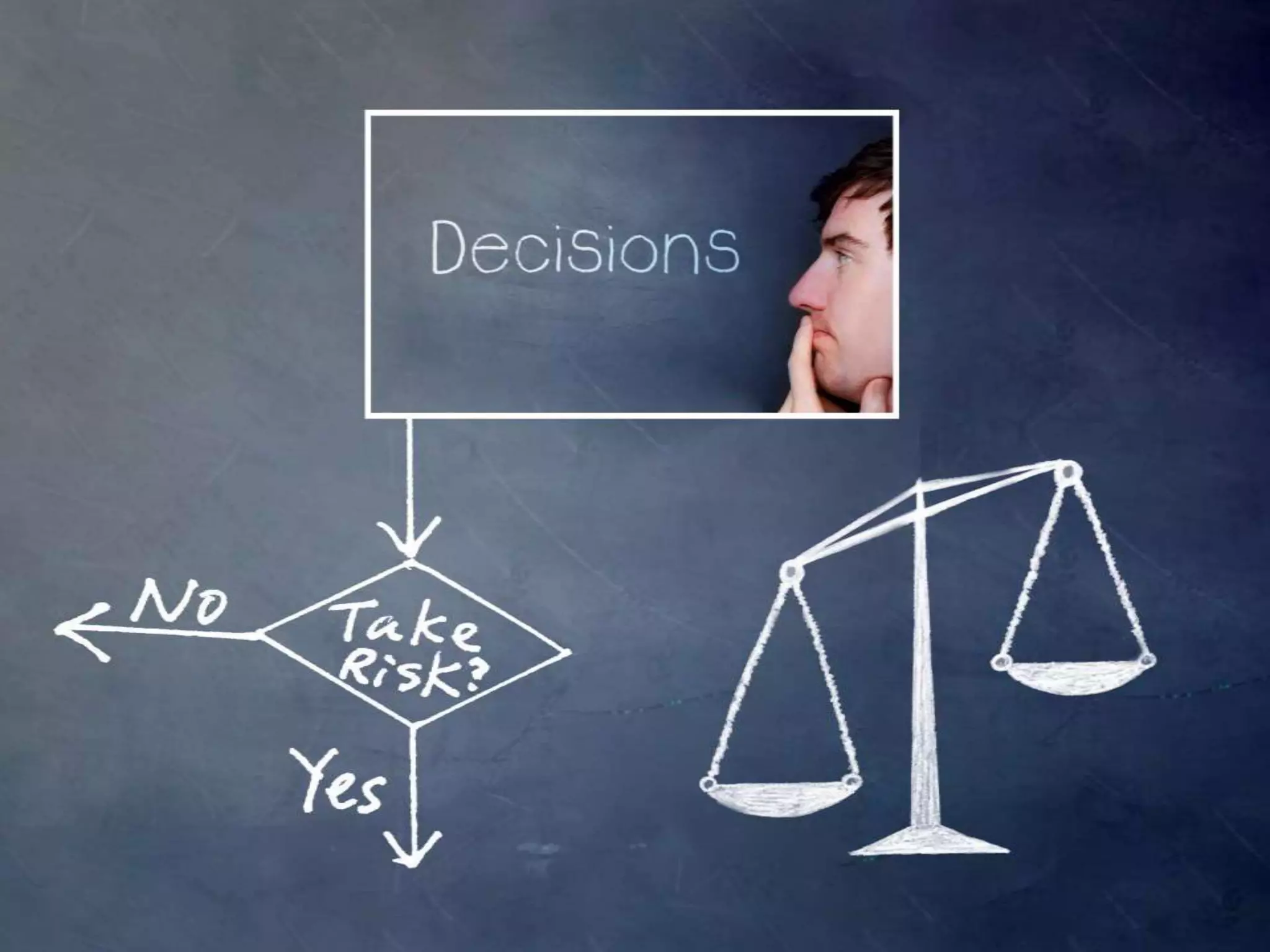
It’s about Making Intelligent Decisions
22
It’s all about Taking the Right Risks
23
24
Why risk management?
“An effective [ERM] capability provides value
by giving organizations the confidence to take
on risk, rather than avoid it.
- Consultancy firm
25
Why risk management?
“By effectively managing the right risks,
management has more timely,
comprehensive and a deeper
understanding of risk which, in turn,
facilitates better decision-making and
confidence to take on new ventures or
even to accept higher levels of risk.
- Consultancy firm
26
Why risk management?
“The upshot of this investment
includes a greater competitive
advantage, reduced cost of capital
and a steady share price.”
- Consultancy firm
27
Why risk management?
Better information leads to:
 Better decisions
 Protection of value
 Seized opportunities
 Agile, optimized performance
28
Drive business results
“In an increasingly competitive, fast-paced
world, organizations need to continually
advance their risk management practices,
building on the strong foundation of protection
and compliance into an expanded focus on risk
factors that impact strategic decision-making
and operational performance.”
- Consultancy firm
29
Drive business results
“We believe a paradigm shift in risk management is
beginning, which is:
• Tied to the increasingly complex world in which
companies now operate
• Based on the awareness that uncertainty is
embedded in (and impacts) everything we do
• Focused on both capturing upside opportunities
as well as protecting the business.”
- Consultancy firm
30
Drive business results
“You need [risk management] to become part of
the rhythm of the business: meaning within the
flow of strategic and business planning,
operations, oversight and monitoring that runs
from the board to the line.”
- Consultancy firm
31
Drive business results
“There are several key business processes, and structural and
functional components that make up this rhythm of the business,
working together to deliver business value creation. Within these
components of the business, we see four basic business process
suites:
• Strategic oversight and planning — board and executive
management level activities
• Business level planning/budgeting — management translation
of strategies into business plans and allocation of capital
• Operational execution — value creating implementation of
plans and strategies
• Monitoring and compliance — audit and compliance activities.”
- Consultancy firm
32
The risk management process
Establish the context
Identify risks
Analyse risks
Evaluate risks
Treat risks
Communicateandconsult
Monitorandreview
Used by every manager for every decision
33
Upgraded risk management process
• Anticipate what might happen
• Analyze the possibilities
• Is there a problem?
• What are the options?
• Which is best?
• Decide
• Act
• Review/monitor/learn
When do you manage risk?
• Every day
• Across the enterprise
• In every decision
• But….. Periodically take stock
How does the Risk Manager help?
• Periodic review, yes – BUT!!
• Process, systems, to enable informed
decisions every day by everyone
• Help everybody manage risk
• Help everybody succeed
35
36
When Risk Management focuses
on the Negative
It fails to focus on the Positive
and Fails to help the organization
Succeed
World-Class Risk Management
• How confident are you in the information you
provide about risk?
• Is it reasonably accurate and complete?
• Does it provide an acceptable basis for
decision-making?
Risks to Risk Management
• Not every executive or board member
embraces and embodies risk management
• Normal human bias when considering risk
• An unwillingness to accept reality
• A reluctance to recognize and seize an
opportunity because of a fear of taking risk
• A reluctance to communicate changes in risk
levels for fear of retribution
39
Risks to Risk Management
• Failures to detect subtle changes in the
business environment
• Risk management processes running slower
than the speed of risk
• Excessive centralization or red tape
bureaucracy
• Insufficient, unreliable, or unclear information
• Changes in personnel
40
Risks to Risk Management
• The inability to adapt risk management
methods as the business changes
• Competing attention for management time
• Decisions made in a rush
• The deliberate violation of risk guidance
• Failures of internal control
41
Risks to Risk Management
• Errors of judgment and simple mistakes
• …and so on
42
Risk Reporting
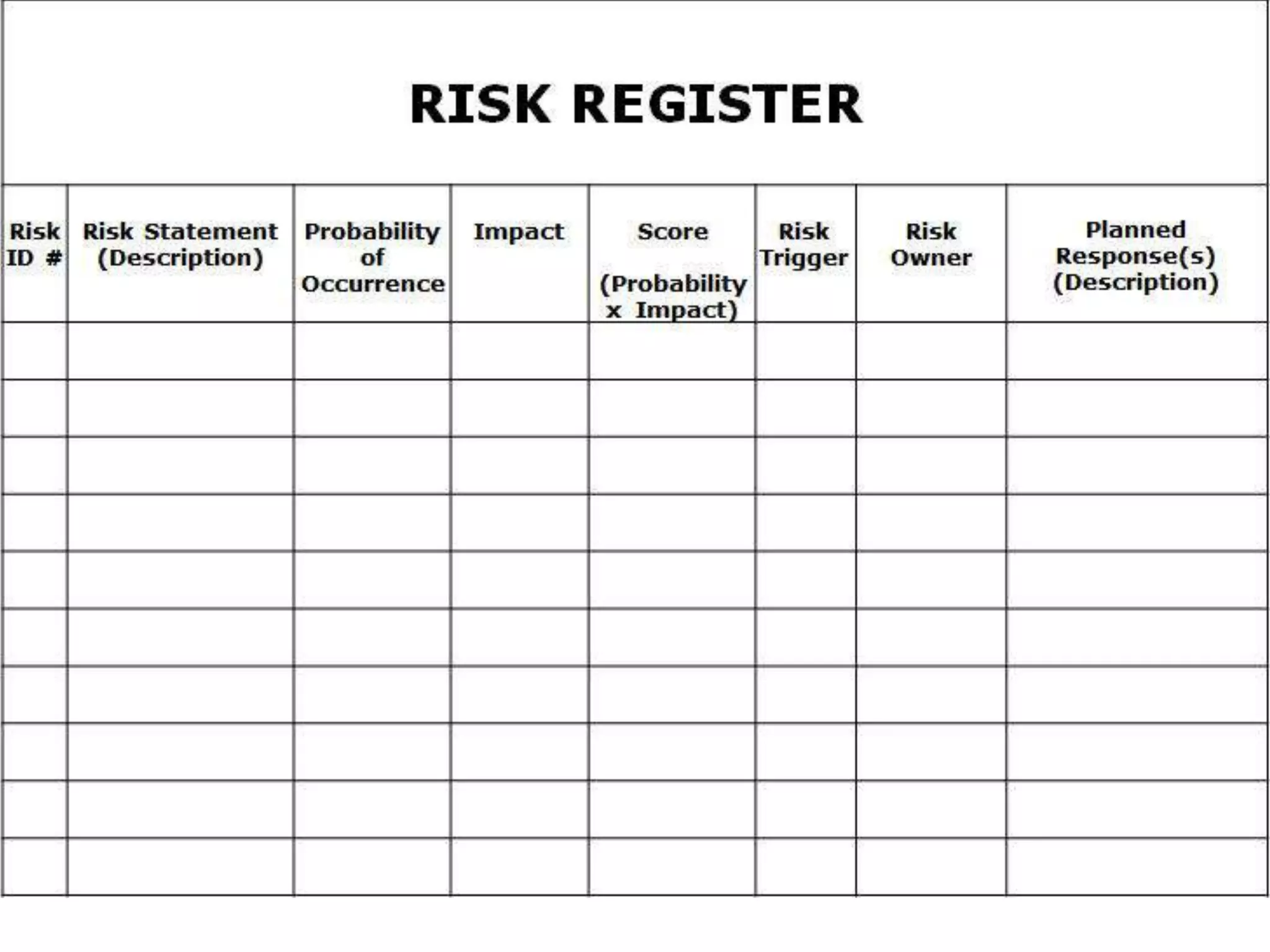
• List of top risks
–Does it help the board and
management make decisions?
–Does it tell you whether you will
achieve objectives?
• Heat map
–Same questions
43
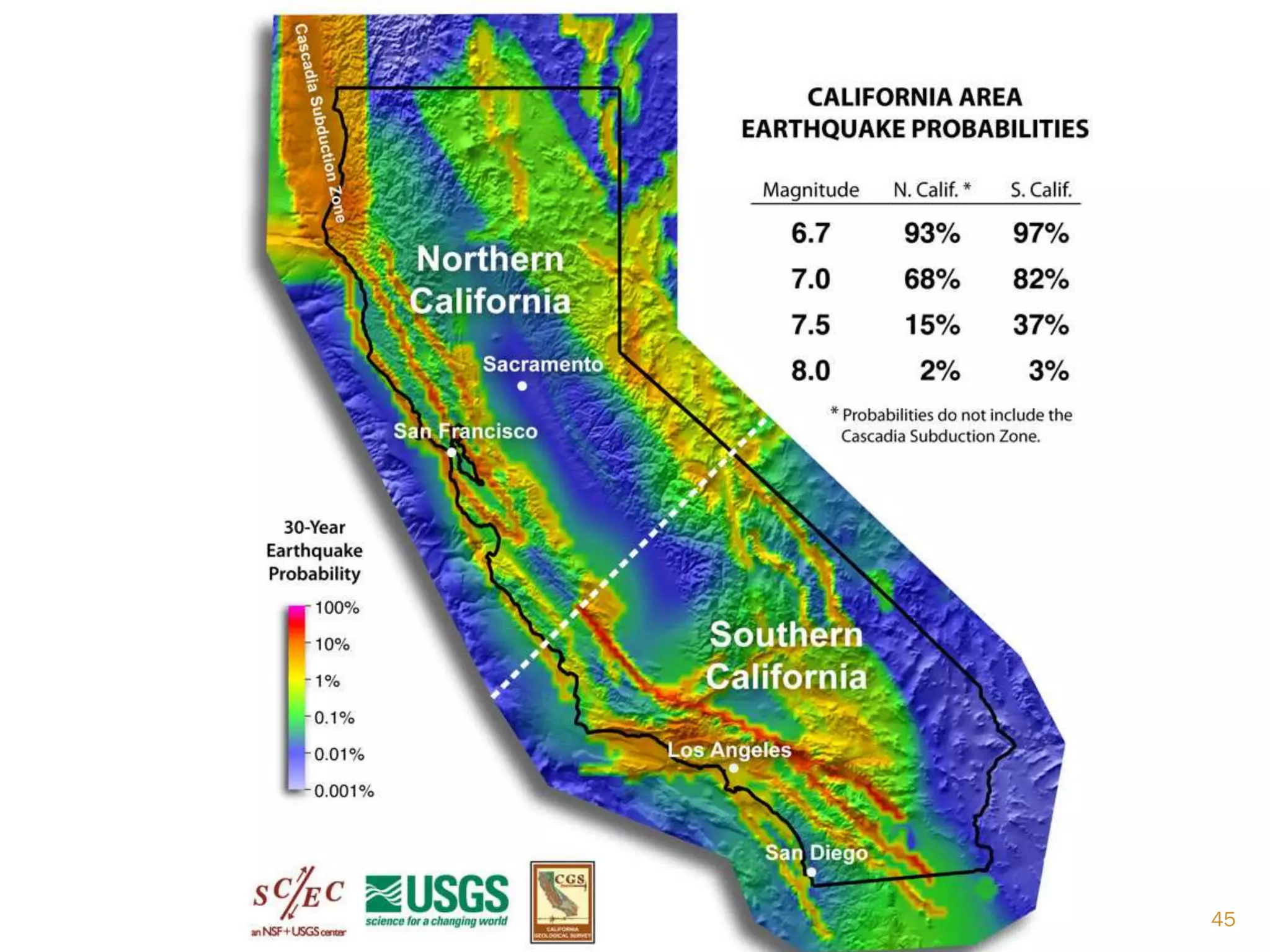
RISK MATRIX
44
45
A range not a point
46
Objectives and their Risks
47
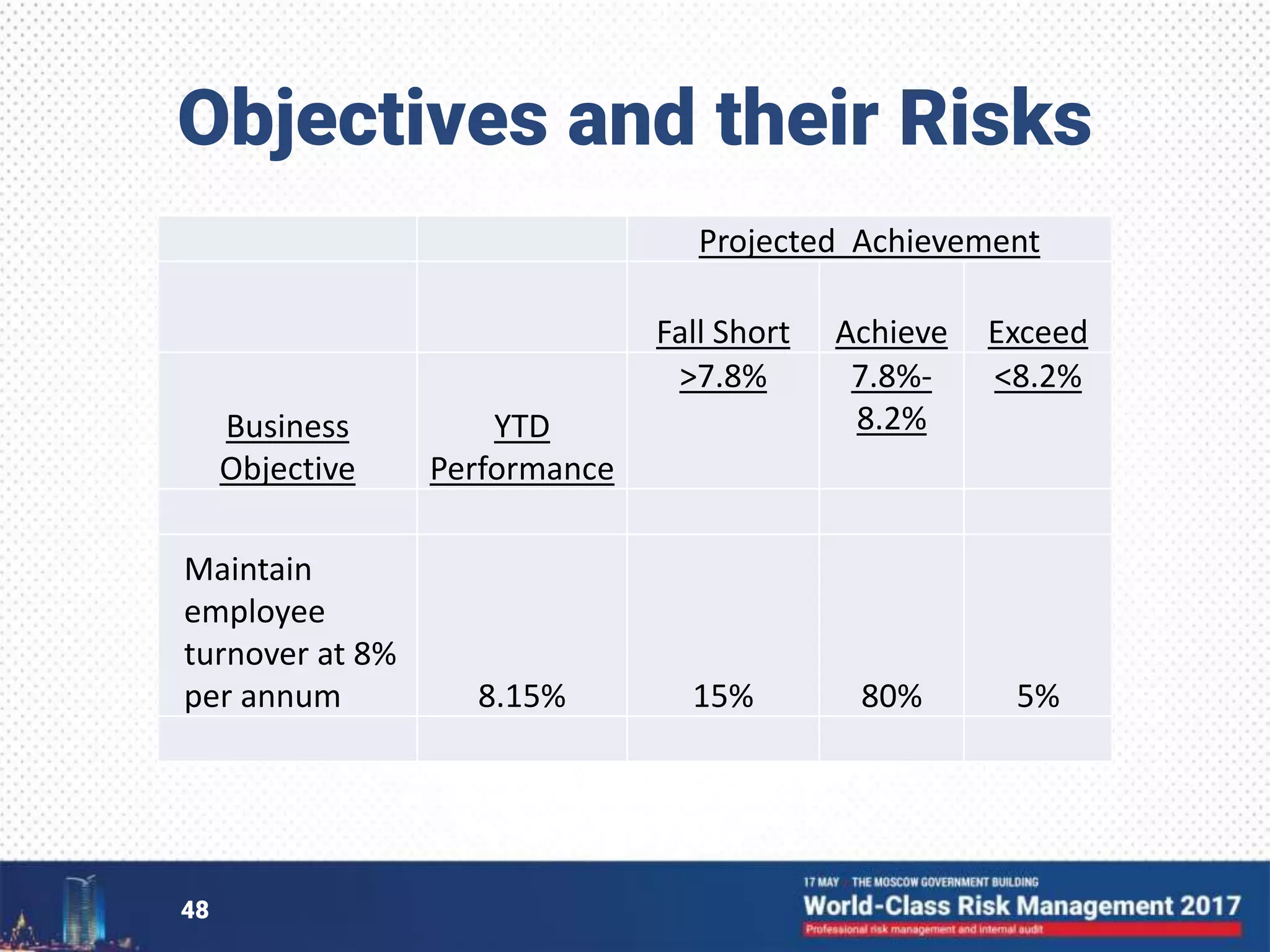
48
Objectives and their Risks
Projected Achievement
Fall Short Achieve Exceed
Business
Objective
YTD
Performance
>7.8% 7.8%-
8.2%
<8.2%
Maintain
employee
turnover at 8%
per annum 8.15% 15% 80% 5%
Risk management in real life
• Select vendor(s) of critical materials
• Objectives:
– Cost management
– Quality products
– On-time delivery
49
50
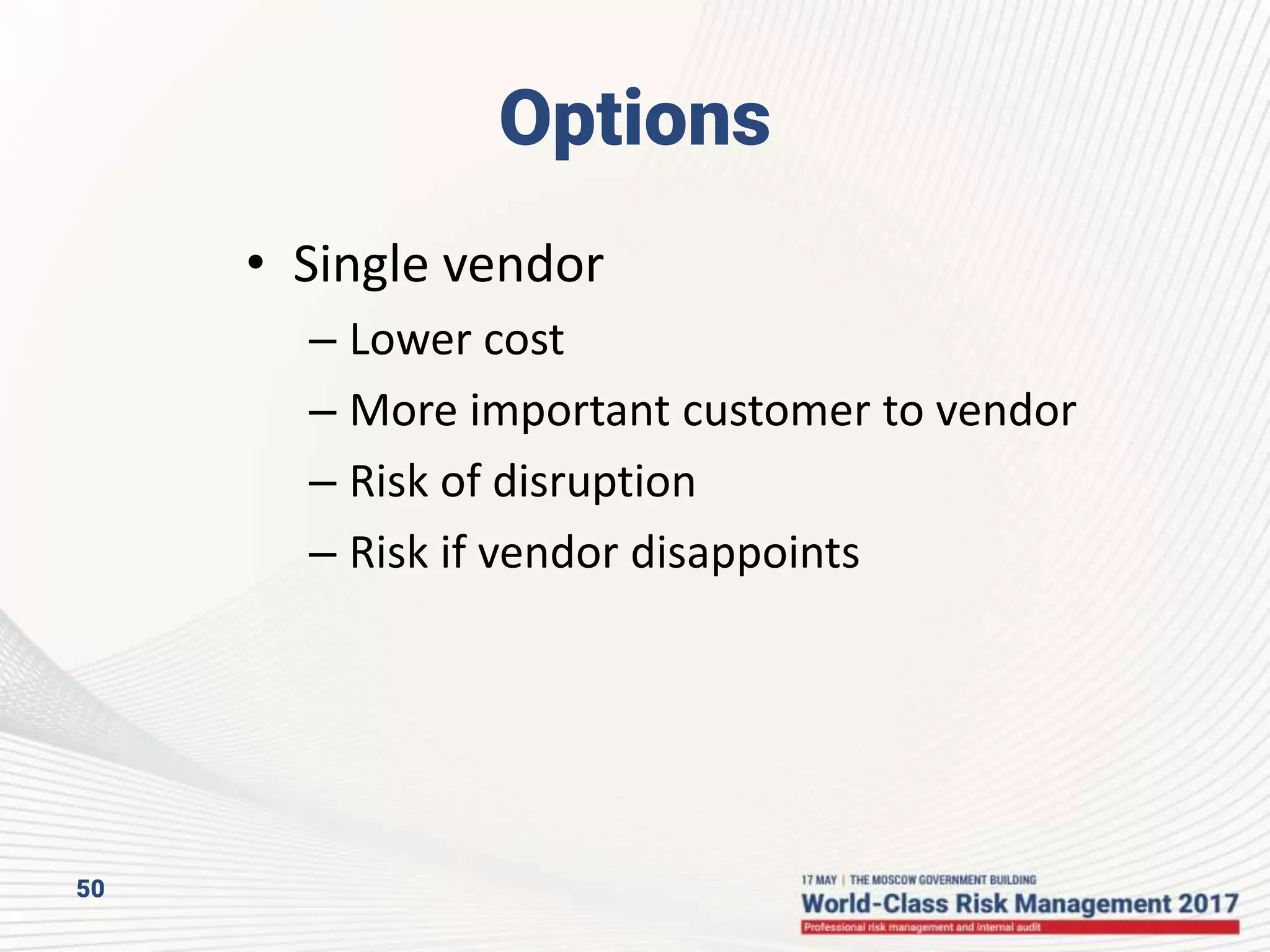
Options
• Single vendor
– Lower cost
– More important customer to vendor
– Risk of disruption
– Risk if vendor disappoints
51
Options
• Two vendors
– Higher cost
– Less important customer to vendor
• May increase prices
• May affect deliveries
– Risk of disruption reduced
– Risk if vendor disappoints reduced
52
Options
• Three or four vendors
– Highest cost
– Much less important customer to vendor
• May increase prices
• May affect deliveries
– Risk of disruption reduced
– Risk if vendor disappoints reduced
The selection
• Involved all affected parties
• Considered each option
• Not a matter of a single risk
• Which option, considering all potential effects,
would be best?
• An enterprise level risk appetite statement
would have no value
53
55
The risk practitioner and the executive
• We share the same goal – performance
• Talk the same language
• Move from ‘no’ to ‘how’
• Management need information and process
• Help assess what might happen, alternatives
• Help managers make intelligent, informed
decisions
• Help them succeed!
56
ASSESS AGAINST ISO 31000 PRINCIPLES
 Creates and protects value
 An integral part of organizational processes
 Part of decision-making
 Dynamic, iterative, responsive to change
 Tailored
57
ASSESS IN REAL-LIFE
Does the practice of risk management
meet the needs of the organization?
57
ASSESS IN REAL LIFE
 What is the likelihood of
achieving enterprise objectives?
 Is that OK?
 What can we do to improve the
Extent and Likelihood of
Success?
 What will we do?
CAN YOU HELP THE BUSINESS MANAGE
AT SPEED?
1. INSERT KEY INTO IGNITION
2. SHIFT INTO DRIVE
3. PRESS FOOT FIRMLY ON THE
THROAT OF MEDIOCRITY
THANK YOU!
Norman Marks, CPA, CRMA
Author; Evangelist for Better Run Business; OCEG Fellow;
Honorary Fellow of the Institute of Risk Management
nmarks2@yahoo.com
https://iaonline.theiia.org/norman-marks
http://normanmarks.wordpress.com/
Twitter: @normanmarks

Норман Маркс на форуме World Class Risk Management 2017

  • 1.
  • 3.
    The Risk Manager’sList 3 1. You might get run over by a car 2. You might get run over by a bicycle 3. Your home may be burglarized while you are out 4. You might be mugged 5. You might be shot in a drive-by shooting 6. A lot of bad things might happen
  • 7.
    “Only xx% of[C-level] respondents believe their risk management processes support, at a high level, the ability to develop and execute business strategies” Deloitte: Exploring Strategic Risk 7
  • 8.
    “Only 13% of[C-level] respondents believe their risk management processes support, at a high level, the ability to develop and execute business strategies” Deloitte: Exploring Strategic Risk 8
  • 10.
    The Upgraded RiskManager’s List 10 1. You might get run over by a car 2. You might get run over by a bicycle 3. Your home may be burglarized while you are out 4. You might be mugged 5. You might be shot in a drive-by shooting 6. A lot of bad things might happen 1. If you work you can earn money 2. You can meet your wife for lunch 3. You can pick up your children after school 4. I can get groceries and be able to eat 5. Getting exercise is healthy 6. A lot of good things might happen
  • 11.
    The Upgraded Manager’sList 11 1. You might get run over by a car 2. You might get run over by a bicycle 3. Your home may be burglarized while you are out 4. You might be mugged 5. You might be shot in a drive-by shooting 6. A lot of bad things might happen 1. If you work you can earn money 2. You can meet your wife for lunch 3. You can pick up your children after school 4. I can get groceries and be able to eat 5. Getting exercise is healthy 6. A lot of good things might happen
  • 13.
  • 16.
    Why We Needto Manage Risk The purpose of managing risk is to increase the likelihood of an organization achieving its objectives by being in a position to manage threats and adverse situations and being ready to take advantage of opportunities that may arise. National Guidance on Implementing ISO 31000:2009 From NSAI in Ireland 16
  • 17.
  • 18.
    A Time of“Pervasive, Ongoing, Uncertainty” - McKinsey
  • 19.
    Risk management, piercingthe fog of uncertainty – Felix Kloman
  • 20.
  • 21.
    It’s about settingthe right objectives 21
  • 22.
    It’s about MakingIntelligent Decisions 22
  • 23.
    It’s all aboutTaking the Right Risks 23
  • 24.
    24 Why risk management? “Aneffective [ERM] capability provides value by giving organizations the confidence to take on risk, rather than avoid it. - Consultancy firm
  • 25.
    25 Why risk management? “Byeffectively managing the right risks, management has more timely, comprehensive and a deeper understanding of risk which, in turn, facilitates better decision-making and confidence to take on new ventures or even to accept higher levels of risk. - Consultancy firm
  • 26.
    26 Why risk management? “Theupshot of this investment includes a greater competitive advantage, reduced cost of capital and a steady share price.” - Consultancy firm
  • 27.
    27 Why risk management? Betterinformation leads to:  Better decisions  Protection of value  Seized opportunities  Agile, optimized performance
  • 28.
    28 Drive business results “Inan increasingly competitive, fast-paced world, organizations need to continually advance their risk management practices, building on the strong foundation of protection and compliance into an expanded focus on risk factors that impact strategic decision-making and operational performance.” - Consultancy firm
  • 29.
    29 Drive business results “Webelieve a paradigm shift in risk management is beginning, which is: • Tied to the increasingly complex world in which companies now operate • Based on the awareness that uncertainty is embedded in (and impacts) everything we do • Focused on both capturing upside opportunities as well as protecting the business.” - Consultancy firm
  • 30.
    30 Drive business results “Youneed [risk management] to become part of the rhythm of the business: meaning within the flow of strategic and business planning, operations, oversight and monitoring that runs from the board to the line.” - Consultancy firm
  • 31.
    31 Drive business results “Thereare several key business processes, and structural and functional components that make up this rhythm of the business, working together to deliver business value creation. Within these components of the business, we see four basic business process suites: • Strategic oversight and planning — board and executive management level activities • Business level planning/budgeting — management translation of strategies into business plans and allocation of capital • Operational execution — value creating implementation of plans and strategies • Monitoring and compliance — audit and compliance activities.” - Consultancy firm
  • 32.
    32 The risk managementprocess Establish the context Identify risks Analyse risks Evaluate risks Treat risks Communicateandconsult Monitorandreview Used by every manager for every decision
  • 33.
    33 Upgraded risk managementprocess • Anticipate what might happen • Analyze the possibilities • Is there a problem? • What are the options? • Which is best? • Decide • Act • Review/monitor/learn
  • 34.
    When do youmanage risk? • Every day • Across the enterprise • In every decision • But….. Periodically take stock
  • 35.
    How does theRisk Manager help? • Periodic review, yes – BUT!! • Process, systems, to enable informed decisions every day by everyone • Help everybody manage risk • Help everybody succeed 35
  • 36.
    36 When Risk Managementfocuses on the Negative It fails to focus on the Positive and Fails to help the organization Succeed
  • 38.
    World-Class Risk Management •How confident are you in the information you provide about risk? • Is it reasonably accurate and complete? • Does it provide an acceptable basis for decision-making?
  • 39.
    Risks to RiskManagement • Not every executive or board member embraces and embodies risk management • Normal human bias when considering risk • An unwillingness to accept reality • A reluctance to recognize and seize an opportunity because of a fear of taking risk • A reluctance to communicate changes in risk levels for fear of retribution 39
  • 40.
    Risks to RiskManagement • Failures to detect subtle changes in the business environment • Risk management processes running slower than the speed of risk • Excessive centralization or red tape bureaucracy • Insufficient, unreliable, or unclear information • Changes in personnel 40
  • 41.
    Risks to RiskManagement • The inability to adapt risk management methods as the business changes • Competing attention for management time • Decisions made in a rush • The deliberate violation of risk guidance • Failures of internal control 41
  • 42.
    Risks to RiskManagement • Errors of judgment and simple mistakes • …and so on 42
  • 43.
    Risk Reporting • Listof top risks –Does it help the board and management make decisions? –Does it tell you whether you will achieve objectives? • Heat map –Same questions 43
  • 44.
  • 45.
  • 46.
    A range nota point 46
  • 47.
  • 48.
    48 Objectives and theirRisks Projected Achievement Fall Short Achieve Exceed Business Objective YTD Performance >7.8% 7.8%- 8.2% <8.2% Maintain employee turnover at 8% per annum 8.15% 15% 80% 5%
  • 49.
    Risk management inreal life • Select vendor(s) of critical materials • Objectives: – Cost management – Quality products – On-time delivery 49
  • 50.
    50 Options • Single vendor –Lower cost – More important customer to vendor – Risk of disruption – Risk if vendor disappoints
  • 51.
    51 Options • Two vendors –Higher cost – Less important customer to vendor • May increase prices • May affect deliveries – Risk of disruption reduced – Risk if vendor disappoints reduced
  • 52.
    52 Options • Three orfour vendors – Highest cost – Much less important customer to vendor • May increase prices • May affect deliveries – Risk of disruption reduced – Risk if vendor disappoints reduced
  • 53.
    The selection • Involvedall affected parties • Considered each option • Not a matter of a single risk • Which option, considering all potential effects, would be best? • An enterprise level risk appetite statement would have no value 53
  • 55.
    55 The risk practitionerand the executive • We share the same goal – performance • Talk the same language • Move from ‘no’ to ‘how’ • Management need information and process • Help assess what might happen, alternatives • Help managers make intelligent, informed decisions • Help them succeed!
  • 56.
    56 ASSESS AGAINST ISO31000 PRINCIPLES  Creates and protects value  An integral part of organizational processes  Part of decision-making  Dynamic, iterative, responsive to change  Tailored
  • 57.
    57 ASSESS IN REAL-LIFE Doesthe practice of risk management meet the needs of the organization? 57
  • 58.
    ASSESS IN REALLIFE  What is the likelihood of achieving enterprise objectives?  Is that OK?  What can we do to improve the Extent and Likelihood of Success?  What will we do?
  • 59.
    CAN YOU HELPTHE BUSINESS MANAGE AT SPEED?
  • 60.
    1. INSERT KEYINTO IGNITION 2. SHIFT INTO DRIVE 3. PRESS FOOT FIRMLY ON THE THROAT OF MEDIOCRITY
  • 61.
    THANK YOU! Norman Marks,CPA, CRMA Author; Evangelist for Better Run Business; OCEG Fellow; Honorary Fellow of the Institute of Risk Management nmarks2@yahoo.com https://iaonline.theiia.org/norman-marks http://normanmarks.wordpress.com/ Twitter: @normanmarks