www.controlrisks.com © Control Risks Group Limited
THE STATE OF ENTERPRISE
RESILIENCE
Resilience Survey 2015
Resilience survey analysis and implications for
business
4 April 2016
2 Building resilient organisations © Control Risks Group Limited
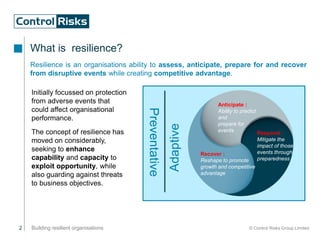
Resilience is an organisations ability to assess, anticipate, prepare for and recover
from disruptive events while creating competitive advantage.
What is resilience?
Anticipate :
Ability to predict
and
prepare for
events
Recover :
Reshape to promote
growth and competitive
advantage
Respond :
Mitigate the
impact of those
events through
preparedness
Preventative
Adaptive
Initially focussed on protection
from adverse events that
could affect organisational
performance.
The concept of resilience has
moved on considerably,
seeking to enhance
capability and capacity to
exploit opportunity, while
also guarding against threats
to business objectives.
3 Building resilient organisations © Control Risks Group Limited
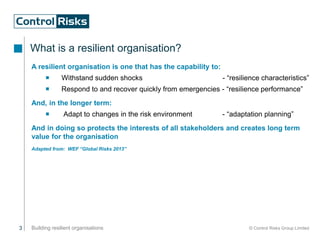
A resilient organisation is one that has the capability to:
 Withstand sudden shocks - “resilience characteristics”
 Respond to and recover quickly from emergencies - “resilience performance”
And, in the longer term:
 Adapt to changes in the risk environment - “adaptation planning”
And in doing so protects the interests of all stakeholders and creates long term
value for the organisation
Adapted from: WEF “Global Risks 2013”
What is a resilient organisation?
4 Building resilient organisations © Control Risks Group Limited
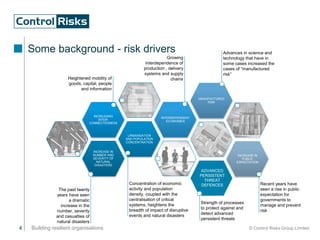
Some background - risk drivers Advances in science and
technology that have in
some cases increased the
cases of “manufactured
risk”
INCREASE IN
NUMBER AND
SEVERITY OF
NATURAL
DISASTERS
URBANISATION
AND POPULATION
CONCENTRATION
INCREASING
INTER-
CONNECTEDNESS
INTERDEPENDENT
ECONOMIES
MANUFACTURED
RISK
INCREASE IN
PUBLIC
EXPECTATION
Concentration of economic
activity and population
density, coupled with the
centralisation of critical
systems, heightens the
breadth of impact of disruptive
events and natural disasters
The past twenty
years have seen
a dramatic
increase in the
number, severity
and casualties of
natural disasters
Heightened mobility of
goods, capital, people
and information
Growing
interdependence of
production , delivery
systems and supply
chains
Recent years have
seen a rise in public
expectation for
governments to
manage and prevent
risk
ADVANCED
PERSISTENT
THREAT
DEFENCES
Strength of processes
to protect against and
detect advanced
persistent threats
5 Building resilient organisations © Control Risks Group Limited
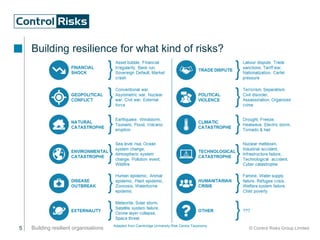
Building resilience for what kind of risks?
Adapted from Cambridge University Risk Centre Taxonomy
www.controlrisks.com
Resilience Survey
Findings
7 Building resilient organisations © Control Risks Group Limited
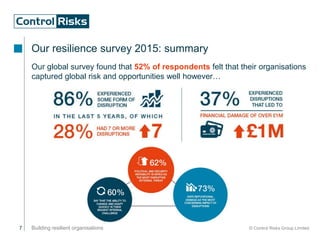
Our resilience survey 2015: summary
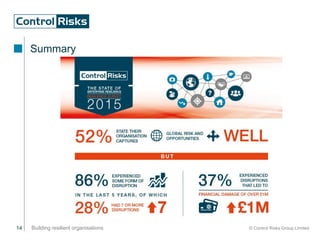
Our global survey found that 52% of respondents felt that their organisations
captured global risk and opportunities well however…
8 Building resilient organisations © Control Risks Group Limited
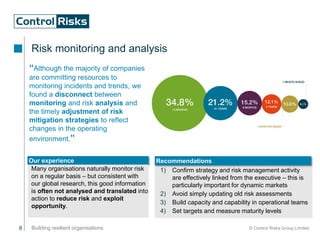
“Although the majority of companies
are committing resources to
monitoring incidents and trends, we
found a disconnect between
monitoring and risk analysis and
the timely adjustment of risk
mitigation strategies to reflect
changes in the operating
environment.”
Our experience
Many organisations naturally monitor risk
on a regular basis – but consistent with
our global research, this good information
is often not analysed and translated into
action to reduce risk and exploit
opportunity.
1) Confirm strategy and risk management activity
are effectively linked from the executive – this is
particularly important for dynamic markets
2) Avoid simply updating old risk assessments
3) Build capacity and capability in operational teams
4) Set targets and measure maturity levels
Risk monitoring and analysis
Recommendations
9 Building resilient organisations © Control Risks Group Limited
“Companies address the challenge of resilience in different ways, but there was
unanimous agreement on the fact that responsibility for resilience should be
driven from the executive.”
Our experience
 Despite risk being an issue that should
be linked to strategy, risk and
resilience activity is often compliance-
driven
 Corporate/Group policy
 Often inadequate structure to seek and
exploit opportunity in a risk-based
manner
Companies can refresh approaches intended to
focus on compliance in order to capture opportunity.
This should be supported by building capacity
through the organisation (as opposed to a ‘risk
manager’ driving all activity).
Responsibility for resilience
Recommendations
10 Building resilient organisations © Control Risks Group Limited
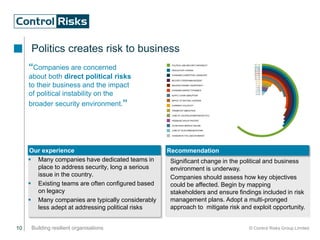
“Companies are concerned
about both direct political risks
to their business and the impact
of political instability on the
broader security environment.”
Our experience
 Many companies have dedicated teams in
place to address security, long a serious
issue in the country.
 Existing teams are often configured based
on legacy
 Many companies are typically considerably
less adept at addressing political risks
Significant change in the political and business
environment is underway.
Companies should assess how key objectives
could be affected. Begin by mapping
stakeholders and ensure findings included in risk
management plans. Adopt a multi-pronged
approach to mitigate risk and exploit opportunity.
Politics creates risk to business
Recommendation
11 Building resilient organisations © Control Risks Group Limited
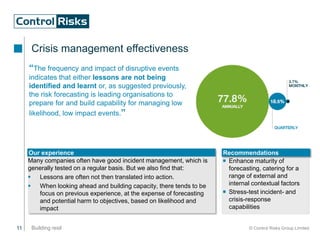
“The frequency and impact of disruptive events
indicates that either lessons are not being
identified and learnt or, as suggested previously,
the risk forecasting is leading organisations to
prepare for and build capability for managing low
likelihood, low impact events.”
Our experience
Many companies often have good incident management, which is
generally tested on a regular basis. But we also find that:
 Lessons are often not then translated into action.
 When looking ahead and building capacity, there tends to be
focus on previous experience, at the expense of forecasting
and potential harm to objectives, based on likelihood and
impact
 Enhance maturity of
forecasting, catering for a
range of external and
internal contextual factors
 Stress-test incident- and
crisis-response
capabilities
Crisis management effectiveness
Recommendations
12 Building resilient organisations © Control Risks Group Limited
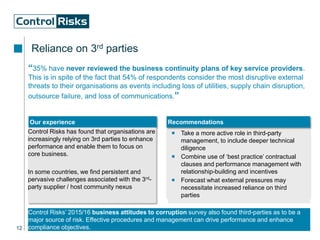
“35% have never reviewed the business continuity plans of key service providers.
This is in spite of the fact that 54% of respondents consider the most disruptive external
threats to their organisations as events including loss of utilities, supply chain disruption,
outsource failure, and loss of communications.”
Our experience
Control Risks has found that organisations are
increasingly relying on 3rd parties to enhance
performance and enable them to focus on
core business.
In some countries, we find persistent and
pervasive challenges associated with the 3rd-
party supplier / host community nexus
 Take a more active role in third-party
management, to include deeper technical
diligence
 Combine use of ‘best practice’ contractual
clauses and performance management with
relationship-building and incentives
 Forecast what external pressures may
necessitate increased reliance on third
parties
Reliance on 3rd parties
Control Risks’ 2015/16 business attitudes to corruption survey also found third-parties as to be a
major source of risk. Effective procedures and management can drive performance and enhance
compliance objectives.
Recommendations
13 Building resilient organisations © Control Risks Group Limited
Our resilience survey 2015:
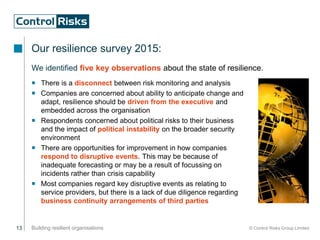
We identified five key observations about the state of resilience.
 There is a disconnect between risk monitoring and analysis
 Companies are concerned about ability to anticipate change and
adapt, resilience should be driven from the executive and
embedded across the organisation
 Respondents concerned about political risks to their business
and the impact of political instability on the broader security
environment
 There are opportunities for improvement in how companies
respond to disruptive events. This may be because of
inadequate forecasting or may be a result of focussing on
incidents rather than crisis capability
 Most companies regard key disruptive events as relating to
service providers, but there is a lack of due diligence regarding
business continuity arrangements of third parties
14 Building resilient organisations © Control Risks Group Limited
Summary
www.controlrisks.com
Questions?
www.controlrisks.com
Andy Cox
Director
Andy.cox@controlrisks.com

#Corpriskforum2016 - Andy Cox

  • 1.
    www.controlrisks.com © ControlRisks Group Limited THE STATE OF ENTERPRISE RESILIENCE Resilience Survey 2015 Resilience survey analysis and implications for business 4 April 2016
  • 2.
    2 Building resilientorganisations © Control Risks Group Limited Resilience is an organisations ability to assess, anticipate, prepare for and recover from disruptive events while creating competitive advantage. What is resilience? Anticipate : Ability to predict and prepare for events Recover : Reshape to promote growth and competitive advantage Respond : Mitigate the impact of those events through preparedness Preventative Adaptive Initially focussed on protection from adverse events that could affect organisational performance. The concept of resilience has moved on considerably, seeking to enhance capability and capacity to exploit opportunity, while also guarding against threats to business objectives.
  • 3.
    3 Building resilientorganisations © Control Risks Group Limited A resilient organisation is one that has the capability to:  Withstand sudden shocks - “resilience characteristics”  Respond to and recover quickly from emergencies - “resilience performance” And, in the longer term:  Adapt to changes in the risk environment - “adaptation planning” And in doing so protects the interests of all stakeholders and creates long term value for the organisation Adapted from: WEF “Global Risks 2013” What is a resilient organisation?
  • 4.
    4 Building resilientorganisations © Control Risks Group Limited Some background - risk drivers Advances in science and technology that have in some cases increased the cases of “manufactured risk” INCREASE IN NUMBER AND SEVERITY OF NATURAL DISASTERS URBANISATION AND POPULATION CONCENTRATION INCREASING INTER- CONNECTEDNESS INTERDEPENDENT ECONOMIES MANUFACTURED RISK INCREASE IN PUBLIC EXPECTATION Concentration of economic activity and population density, coupled with the centralisation of critical systems, heightens the breadth of impact of disruptive events and natural disasters The past twenty years have seen a dramatic increase in the number, severity and casualties of natural disasters Heightened mobility of goods, capital, people and information Growing interdependence of production , delivery systems and supply chains Recent years have seen a rise in public expectation for governments to manage and prevent risk ADVANCED PERSISTENT THREAT DEFENCES Strength of processes to protect against and detect advanced persistent threats
  • 5.
    5 Building resilientorganisations © Control Risks Group Limited Building resilience for what kind of risks? Adapted from Cambridge University Risk Centre Taxonomy
  • 6.
  • 7.
    7 Building resilientorganisations © Control Risks Group Limited Our resilience survey 2015: summary Our global survey found that 52% of respondents felt that their organisations captured global risk and opportunities well however…
  • 8.
    8 Building resilientorganisations © Control Risks Group Limited “Although the majority of companies are committing resources to monitoring incidents and trends, we found a disconnect between monitoring and risk analysis and the timely adjustment of risk mitigation strategies to reflect changes in the operating environment.” Our experience Many organisations naturally monitor risk on a regular basis – but consistent with our global research, this good information is often not analysed and translated into action to reduce risk and exploit opportunity. 1) Confirm strategy and risk management activity are effectively linked from the executive – this is particularly important for dynamic markets 2) Avoid simply updating old risk assessments 3) Build capacity and capability in operational teams 4) Set targets and measure maturity levels Risk monitoring and analysis Recommendations
  • 9.
    9 Building resilientorganisations © Control Risks Group Limited “Companies address the challenge of resilience in different ways, but there was unanimous agreement on the fact that responsibility for resilience should be driven from the executive.” Our experience  Despite risk being an issue that should be linked to strategy, risk and resilience activity is often compliance- driven  Corporate/Group policy  Often inadequate structure to seek and exploit opportunity in a risk-based manner Companies can refresh approaches intended to focus on compliance in order to capture opportunity. This should be supported by building capacity through the organisation (as opposed to a ‘risk manager’ driving all activity). Responsibility for resilience Recommendations
  • 10.
    10 Building resilientorganisations © Control Risks Group Limited “Companies are concerned about both direct political risks to their business and the impact of political instability on the broader security environment.” Our experience  Many companies have dedicated teams in place to address security, long a serious issue in the country.  Existing teams are often configured based on legacy  Many companies are typically considerably less adept at addressing political risks Significant change in the political and business environment is underway. Companies should assess how key objectives could be affected. Begin by mapping stakeholders and ensure findings included in risk management plans. Adopt a multi-pronged approach to mitigate risk and exploit opportunity. Politics creates risk to business Recommendation
  • 11.
    11 Building resilientorganisations © Control Risks Group Limited “The frequency and impact of disruptive events indicates that either lessons are not being identified and learnt or, as suggested previously, the risk forecasting is leading organisations to prepare for and build capability for managing low likelihood, low impact events.” Our experience Many companies often have good incident management, which is generally tested on a regular basis. But we also find that:  Lessons are often not then translated into action.  When looking ahead and building capacity, there tends to be focus on previous experience, at the expense of forecasting and potential harm to objectives, based on likelihood and impact  Enhance maturity of forecasting, catering for a range of external and internal contextual factors  Stress-test incident- and crisis-response capabilities Crisis management effectiveness Recommendations
  • 12.
    12 Building resilientorganisations © Control Risks Group Limited “35% have never reviewed the business continuity plans of key service providers. This is in spite of the fact that 54% of respondents consider the most disruptive external threats to their organisations as events including loss of utilities, supply chain disruption, outsource failure, and loss of communications.” Our experience Control Risks has found that organisations are increasingly relying on 3rd parties to enhance performance and enable them to focus on core business. In some countries, we find persistent and pervasive challenges associated with the 3rd- party supplier / host community nexus  Take a more active role in third-party management, to include deeper technical diligence  Combine use of ‘best practice’ contractual clauses and performance management with relationship-building and incentives  Forecast what external pressures may necessitate increased reliance on third parties Reliance on 3rd parties Control Risks’ 2015/16 business attitudes to corruption survey also found third-parties as to be a major source of risk. Effective procedures and management can drive performance and enhance compliance objectives. Recommendations
  • 13.
    13 Building resilientorganisations © Control Risks Group Limited Our resilience survey 2015: We identified five key observations about the state of resilience.  There is a disconnect between risk monitoring and analysis  Companies are concerned about ability to anticipate change and adapt, resilience should be driven from the executive and embedded across the organisation  Respondents concerned about political risks to their business and the impact of political instability on the broader security environment  There are opportunities for improvement in how companies respond to disruptive events. This may be because of inadequate forecasting or may be a result of focussing on incidents rather than crisis capability  Most companies regard key disruptive events as relating to service providers, but there is a lack of due diligence regarding business continuity arrangements of third parties
  • 14.
    14 Building resilientorganisations © Control Risks Group Limited Summary
  • 15.
  • 16.