Workplace Violence(We’re Not in Mayberry Anymore, Barney)
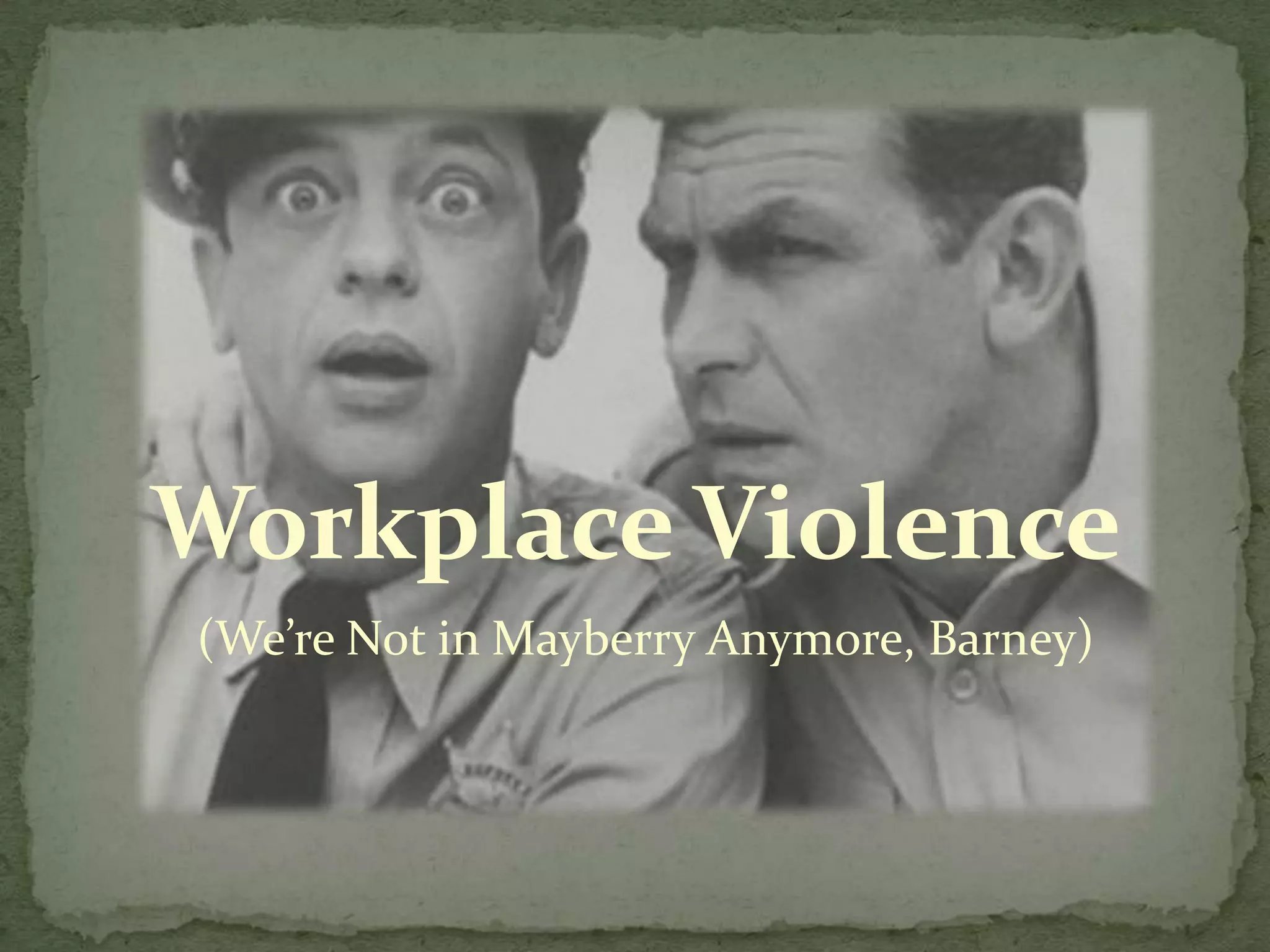
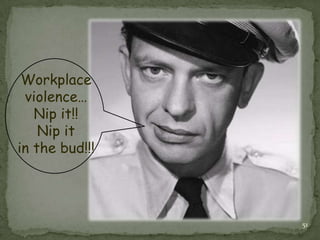
2This PowerPoint is designed to be used by organizations desiring to provide training and education to staff about workplace violence. The slides alternate between a “notes” page (light background – dark green text) that can be used for dialogue (by a presenter or simply to be read by the viewer), followed by the descriptor slide page (dark background – white text and additional graphics). (Thus, the following text below goes with the next slide, and so forth.)  If this presentation saves only one workplace from a workplace violence incident, I will consider this presentation a resounding success.   Good Luck.    LeeAnd here we go…There was a time, and some of you probably remember, that where people lived and worked was probably just as safe as Mayberry, the home of Sheriff Andy Taylor, Deputy Barney Fife, Aunt Bee, Opie and all the rest of the residents there.  The greatest fear those folks probably had was whether or not it would rain for the Fourth of July parade.  But…times have changed.
3
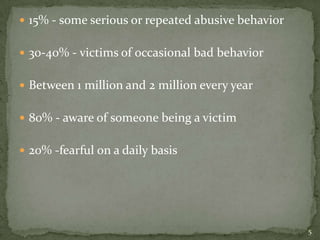
4I want to start by sharing some statistics with you that might really surprise you. Recent figures show that about 15 percent of all people will report serious or repeated abusive behavior, and between 30 and 40 percent of people will report that they’ve been victims of occasional bad behavior in the workplace.   According to Dr. Stephen Hart, Director of ProActiveReSolutions, over 1 million (and possibly as many as 2 million) violent crimes occur in the workplace every year in the United States. He goes on to say that 80 percent of employees report being aware of someone being a victim of workplace violence, and about 1/5 of employees report being fearful of workplace violence on a daily basis.
15% - some serious or repeated abusive behavior
30-40% - victims of occasional bad behavior
Between 1 million and 2 million every year
80% - aware of someone being a victim
20% -fearful on a daily basis5
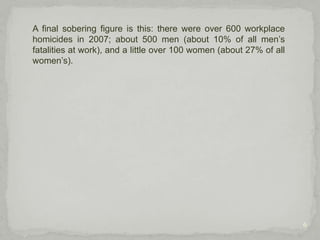
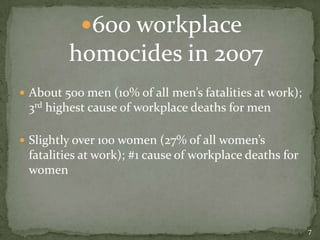
6A final sobering figure is this: there were over 600 workplace homicides in 2007; about 500 men (about 10% of all men’s fatalities at work), and a little over 100 women (about 27% of all women’s).
600 workplacehomocides in 2007
About 5oo men (10% of all men’s fatalities at work); 3rd highest cause of workplace deaths for men
Slightly over 100 women (27% of all women’s fatalities at work); #1 cause of workplace deaths for women7
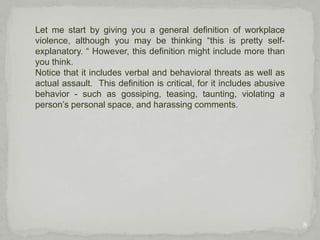
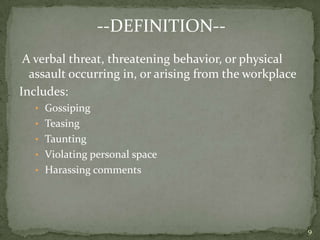
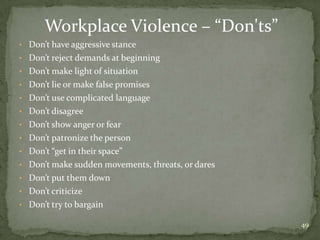
8Let me start by giving you a general definition of workplace violence, although you may be thinking “this is pretty self-explanatory. “ However, this definition might include more than you think.  Notice that it includes verbal and behavioral threats as well as actual assault.  This definition is critical, for it includes abusive behavior - such as gossiping, teasing, taunting, violating a person’s personal space, and harassing comments.
--DEFINITION-- A verbal threat, threatening behavior, or physical assault occurring in, or arising from the workplace Includes:Gossiping
Teasing
Taunting
Violating personal space
Harassing comments9
10Although not overtly violent, these behaviors are important to include, because they are, or can be, “emotionally/psychologically violent,” and oftentimes, behavior that isn’t actually physical is ignored.  You know: “That’s just how Bob is;” or, “Oh, Jane didn’t mean what she said, she was just having a bad day;” and so forth. But these behaviors are like bees or wasps; one sting every so often may only be annoying, not harmful, but repeated stings can cause one serious problems.   And you never know if someone might be “allergic” to a certain comment, due to their background and personal history, which could result in their violent retaliation against the person.
11Emotional/Psychological Violence
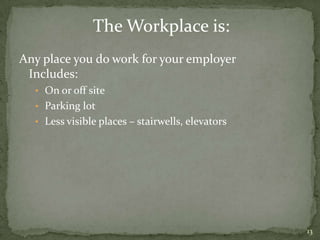
12So, what is the “workplace?”  Well, that’s pretty easily answered; it’s any place where an employee does work.  Of course, that includes any off-site places where the employee goes to transact business – businesses, homes, inside or outside.  When you think about it, the workplace of a sheriff or deputy, for example, would be anywhere and everywhere he or she happens to be.  Don’t forget that the parking lot is also part of your workplace, as well as stairwells, elevators, and other places that would be more isolated than your regular work area.
The Workplace is:Any place you do work for your employerIncludes:On or off site
Parking lot
Less visible places – stairwells, elevators13
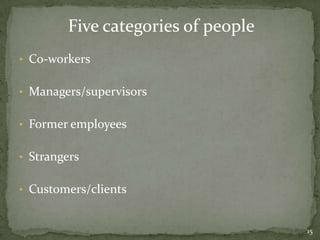
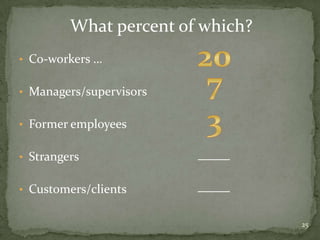
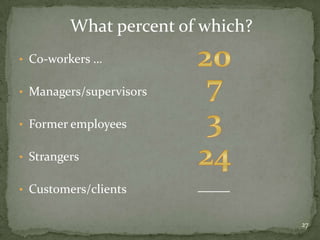
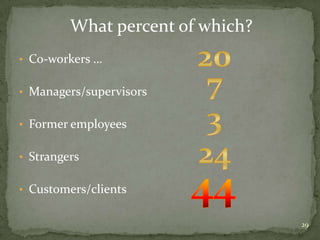
14Let’s now talk briefly about the five categories of people that make up the potential perpetrators of violence. These five are co-workers, managers/supervisors, former employees, strangers and customers/clients.  Think about these categories, write them down quickly on a piece of paper, and then I’m going to let you guess what percentage of workplace violence acts each group makes up.
Five categories of peopleCo-workers
Managers/supervisors
Former employees
Strangers
Customers/clients15
16Here’s the 5 percentage numbers, in no particular order – 44, 24, 20, 7, and 3.  Jot them down, and try to match each number with the group.     No looking ahead!!
2044324717
18Hey!!!! No looking ahead!!
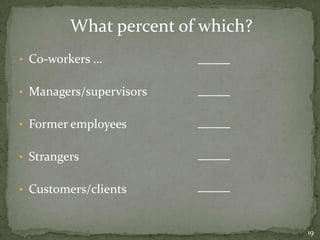
What percent of which?Co-workers …
Managers/supervisors
Former employees
Strangers
Customers/clients____________________19
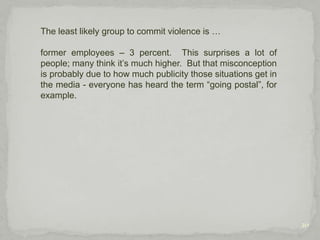
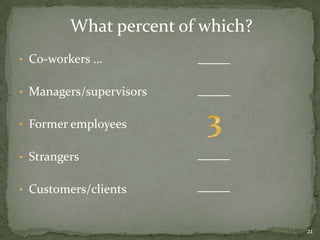
20The least likely group to commit violence is …former employees – 3 percent.  This surprises a lot of people; many think it’s much higher.  But that misconception is probably due to how much publicity those situations get in the media - everyone has heard the term “going postal”, for example.
What percent of which?Co-workers …
Managers/supervisors
Former employees
Strangers
Customers/clients________________321
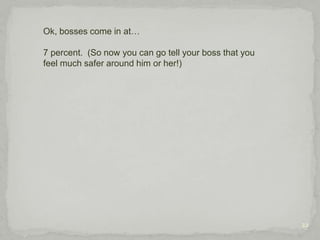
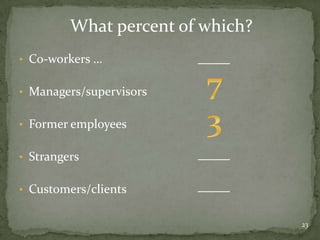
22Ok, bosses come in at…7 percent.  (So now you can go tell your boss that you feel much safer around him or her!)
23What percent of which?Co-workers …
Managers/supervisors
Former employees
Strangers
Customers/clients____________73
24Next…are co-workers at 20 percent.

Workplace Violence With Script

  • 1.
    Workplace Violence(We’re Notin Mayberry Anymore, Barney)
  • 2.
    2This PowerPoint isdesigned to be used by organizations desiring to provide training and education to staff about workplace violence. The slides alternate between a “notes” page (light background – dark green text) that can be used for dialogue (by a presenter or simply to be read by the viewer), followed by the descriptor slide page (dark background – white text and additional graphics). (Thus, the following text below goes with the next slide, and so forth.) If this presentation saves only one workplace from a workplace violence incident, I will consider this presentation a resounding success. Good Luck. LeeAnd here we go…There was a time, and some of you probably remember, that where people lived and worked was probably just as safe as Mayberry, the home of Sheriff Andy Taylor, Deputy Barney Fife, Aunt Bee, Opie and all the rest of the residents there. The greatest fear those folks probably had was whether or not it would rain for the Fourth of July parade. But…times have changed.
  • 3.
  • 4.
    4I want tostart by sharing some statistics with you that might really surprise you. Recent figures show that about 15 percent of all people will report serious or repeated abusive behavior, and between 30 and 40 percent of people will report that they’ve been victims of occasional bad behavior in the workplace. According to Dr. Stephen Hart, Director of ProActiveReSolutions, over 1 million (and possibly as many as 2 million) violent crimes occur in the workplace every year in the United States. He goes on to say that 80 percent of employees report being aware of someone being a victim of workplace violence, and about 1/5 of employees report being fearful of workplace violence on a daily basis.
  • 5.
    15% - someserious or repeated abusive behavior
  • 6.
    30-40% - victimsof occasional bad behavior
  • 7.
    Between 1 millionand 2 million every year
  • 8.
    80% - awareof someone being a victim
  • 9.
    20% -fearful ona daily basis5
  • 10.
    6A final soberingfigure is this: there were over 600 workplace homicides in 2007; about 500 men (about 10% of all men’s fatalities at work), and a little over 100 women (about 27% of all women’s).
  • 11.
  • 12.
    About 5oo men(10% of all men’s fatalities at work); 3rd highest cause of workplace deaths for men
  • 13.
    Slightly over 100women (27% of all women’s fatalities at work); #1 cause of workplace deaths for women7
  • 14.
    8Let me startby giving you a general definition of workplace violence, although you may be thinking “this is pretty self-explanatory. “ However, this definition might include more than you think. Notice that it includes verbal and behavioral threats as well as actual assault. This definition is critical, for it includes abusive behavior - such as gossiping, teasing, taunting, violating a person’s personal space, and harassing comments.
  • 15.
    --DEFINITION-- A verbalthreat, threatening behavior, or physical assault occurring in, or arising from the workplace Includes:Gossiping
  • 16.
  • 17.
  • 18.
  • 19.
  • 20.
    10Although not overtlyviolent, these behaviors are important to include, because they are, or can be, “emotionally/psychologically violent,” and oftentimes, behavior that isn’t actually physical is ignored. You know: “That’s just how Bob is;” or, “Oh, Jane didn’t mean what she said, she was just having a bad day;” and so forth. But these behaviors are like bees or wasps; one sting every so often may only be annoying, not harmful, but repeated stings can cause one serious problems. And you never know if someone might be “allergic” to a certain comment, due to their background and personal history, which could result in their violent retaliation against the person.
  • 21.
  • 22.
    12So, what isthe “workplace?” Well, that’s pretty easily answered; it’s any place where an employee does work. Of course, that includes any off-site places where the employee goes to transact business – businesses, homes, inside or outside. When you think about it, the workplace of a sheriff or deputy, for example, would be anywhere and everywhere he or she happens to be. Don’t forget that the parking lot is also part of your workplace, as well as stairwells, elevators, and other places that would be more isolated than your regular work area.
  • 23.
    The Workplace is:Anyplace you do work for your employerIncludes:On or off site
  • 24.
  • 25.
    Less visible places– stairwells, elevators13
  • 26.
    14Let’s now talkbriefly about the five categories of people that make up the potential perpetrators of violence. These five are co-workers, managers/supervisors, former employees, strangers and customers/clients. Think about these categories, write them down quickly on a piece of paper, and then I’m going to let you guess what percentage of workplace violence acts each group makes up.
  • 27.
    Five categories ofpeopleCo-workers
  • 28.
  • 29.
  • 30.
  • 31.
  • 32.
    16Here’s the 5percentage numbers, in no particular order – 44, 24, 20, 7, and 3. Jot them down, and try to match each number with the group. No looking ahead!!
  • 33.
  • 34.
  • 35.
    What percent ofwhich?Co-workers …
  • 36.
  • 37.
  • 38.
  • 39.
  • 40.
    20The least likelygroup to commit violence is …former employees – 3 percent. This surprises a lot of people; many think it’s much higher. But that misconception is probably due to how much publicity those situations get in the media - everyone has heard the term “going postal”, for example.
  • 41.
    What percent ofwhich?Co-workers …
  • 42.
  • 43.
  • 44.
  • 45.
  • 46.
    22Ok, bosses comein at…7 percent. (So now you can go tell your boss that you feel much safer around him or her!)
  • 47.
    23What percent ofwhich?Co-workers …
  • 48.
  • 49.
  • 50.
  • 51.
  • 52.