
Workplace Violence
Bradley D. Hyde
Delta Medical Center
of Memphis
Workplace Violence
On August 20, 1986, a part-time letter carrier
named Patrick H. Sherrill, facing possible
dismissal after a troubled work history, walked
into the Edmond, Oklahoma, post office, where
he worked and shot 14 people to death before
killing himself.
Workplace Violence
 In California form 1989 to 1997, there were 15
workplace homicide incidents, six with multiple victims,
that killed 29 people.
 In Connecticut four state lottery executives were killed
by a lottery accountant. (3/89)
 In Hawaii a Xerox technician killed several coworkers.
(11/99)
 In Massachusetts a software engineer killed seven
coworkers. (12/2000)
Workplace Violence
 In Illinois a former forklift driver killed four
current workers at the Navistar plant. (2/2001)
 In New York three coworkers were killed by an
insurance executive. (9/2002)
 In Missouri three workers were killed by a
coworker. (7/2003)
 In Mississippi six aircraft plants workers were
killed by a coworker. (7/2003)
Workplace Violence
 School Shootings
 Terrorism
Workplace Violence
 Assaults
 Domestic Violence
 Stalking
 Threats
 Harassment (Including Sexual Harassment)
 Physical and Emotional Abuse
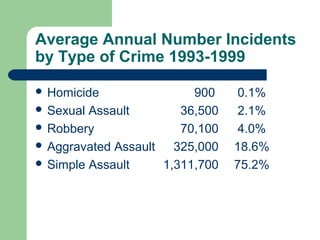
Average Annual Number Incidents
by Type of Crime 1993-1999
 Homicide 900 0.1%
 Sexual Assault 36,500 2.1%
 Robbery 70,100 4.0%
 Aggravated Assault 325,000 18.6%
 Simple Assault 1,311,700 75.2%
Workplace Violence
It is rare for someone to just “snap” and go on a
killing rampage.
There are usually warning sings. The warning
signs include threats both overt and covert.
What is a Threat?
 An expression of an intention to inflict
something harmful.
 An indication of impending danger or harm.
 One regarded as a possible danger.
“All Men Are Created Equal”
Threat Assessment
But all threats are not equal!
Threat Assessment
Gather Information
Listen to what has happened and DOCUMENT
Like all narratives given under stress--gaps may
be present.
Clarification may be needed.
Threat Assessment
Basic Information
Age
Marital Status
Previous Health Status
Work History
Job Description
Previous Behavior
Threat Assessment
Company Environment
Blue Collar vs. White Collar
Previous History of Violence at Company
Ongoing Union Disputes
Changes in Leadership or Management
Potential Closing or Down Sizing
Threat Assessment
Talk To Others
If no one is willing to talk -- Bad Sign
May mean that everyone is afraid of him -- or he
may just be aloof.
Threat Assessment
Written Incident Report Is Very Important
Without a written report--you must confront the
employee with hearsay evidence.
Threat Assessment
How does the employee react to the allegations?
1. He may betray his anger and make further
threats.
2. He may be accepting of his actions.
Acceptance has a better prognosis.
Risk Factors for Violence
What is the sex of the person making the threat?
Most workplace violence is committed by men.
Risk Factors for Violence
Is there a past history of violence?
Prior criminal acts
Motor vehicle infractions
Spouse or child abuse
Bad Temper (prone to property destruction)
Risk Factors for Violence
Is there an identified victim?
If the threat is directed at a specific person, it is
much more ominous.
Risk Factors for Violence
Does the employee have access to weapons?
Recent acquisitions or preoccupation with
weapons is much more worrisome.
Long term ownership is less problematic.
Risk Factors for Violence
Does the employee use alcohol or other drugs?
The issue here is the affect of alcohol on the
employee.
1. Reduces inhibitions
2. Increases impulsitivity
Risk Factors for Violence
“of all the many variables that are being studies
in models for the prediction of violence,
substance abuse emerges as the most
significant factor.”
Risk Factors for Violence
Does the employee have a psychiatric illness?
Paranoid delusions or command hallucinations
constitute a distinct risk.
Risk Factors for Violence
Does the employee have a social network to look
to for assistance?
Social isolation and recent loss are significant
risk factors.
Risk Factors for Violence
Violence rarely occurs without a recent loss
Loss of job, promotion, grievance
Loss of spouse or other family difficulties
Risk Factors for Violence
Has the employee contacted the EAP and
complied with their recommendations?
An employee that uses the EAP to work through
problems and who follows their
recommendations is of a lesser risk than
someone who refuses help.
Risk Factors for Violence
Are there other subjective factors?
Some people may evoke fear in people across
different segments of the company (security,
management, coworkers, and supervisors).
When an employee upsets everybody
Take Heed!!
Houston, we have a problem!
Typical Call
“we have an employee we are worried about”
Or
“one of our employees just made a threat!”
You may have a duty to inform the potential
victim.
Early Intervention
A useful but non-intuitive intervention is to
confront the employee who made the threat
and relate how their actions have affected
others.
Early Intervention
Many employees, when confronted, are surprised
by the allegations and seek to reassure the
employer that they mean no harm.
Early Intervention
When you talk to an employee -- Listen!
Employees who feel that they are not being
heard sufficiently will escalate their anger.
Outside Referral
 Psychiatrist
 Emergency Room
 Clinician in Private Practice
Fitness For Duty Evaluation
Employee should be told that an independent
clinician has been retained to assess the
incident and that confidentially can not be
guaranteed.
The employee should sign a release to that
effect.
Fitness For Duty Evaluation
A determination will be made as to whether the
employee may return to work and if so under
what conditions, or whether he represents such
a threat that he can not go back to work.
It is rare to find an employee that requires
emergency psychiatric evaluation or police
intervention.
Fitness For Duty Evaluation
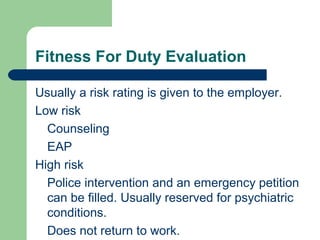
Usually a risk rating is given to the employer.
Low risk
Counseling
EAP
High risk
Police intervention and an emergency petition
can be filled. Usually reserved for psychiatric
conditions.
Does not return to work.
Workplace Violence
Conclusions
Thank You
Bradley D Hyde
bhyde@suddenlink.net
Delta Medical Center of Memphis

Workplace violence by Brad Hyde

  • 1.
    Workplace Violence Bradley D.Hyde Delta Medical Center of Memphis
  • 2.
    Workplace Violence On August20, 1986, a part-time letter carrier named Patrick H. Sherrill, facing possible dismissal after a troubled work history, walked into the Edmond, Oklahoma, post office, where he worked and shot 14 people to death before killing himself.
  • 3.
    Workplace Violence  InCalifornia form 1989 to 1997, there were 15 workplace homicide incidents, six with multiple victims, that killed 29 people.  In Connecticut four state lottery executives were killed by a lottery accountant. (3/89)  In Hawaii a Xerox technician killed several coworkers. (11/99)  In Massachusetts a software engineer killed seven coworkers. (12/2000)
  • 4.
    Workplace Violence  InIllinois a former forklift driver killed four current workers at the Navistar plant. (2/2001)  In New York three coworkers were killed by an insurance executive. (9/2002)  In Missouri three workers were killed by a coworker. (7/2003)  In Mississippi six aircraft plants workers were killed by a coworker. (7/2003)
  • 5.
    Workplace Violence  SchoolShootings  Terrorism
  • 6.
    Workplace Violence  Assaults Domestic Violence  Stalking  Threats  Harassment (Including Sexual Harassment)  Physical and Emotional Abuse
  • 7.
    Average Annual NumberIncidents by Type of Crime 1993-1999  Homicide 900 0.1%  Sexual Assault 36,500 2.1%  Robbery 70,100 4.0%  Aggravated Assault 325,000 18.6%  Simple Assault 1,311,700 75.2%
  • 8.
    Workplace Violence It israre for someone to just “snap” and go on a killing rampage. There are usually warning sings. The warning signs include threats both overt and covert.
  • 9.
    What is aThreat?  An expression of an intention to inflict something harmful.  An indication of impending danger or harm.  One regarded as a possible danger.
  • 10.
    “All Men AreCreated Equal”
  • 11.
    Threat Assessment But allthreats are not equal!
  • 12.
    Threat Assessment Gather Information Listento what has happened and DOCUMENT Like all narratives given under stress--gaps may be present. Clarification may be needed.
  • 13.
    Threat Assessment Basic Information Age MaritalStatus Previous Health Status Work History Job Description Previous Behavior
  • 14.
    Threat Assessment Company Environment BlueCollar vs. White Collar Previous History of Violence at Company Ongoing Union Disputes Changes in Leadership or Management Potential Closing or Down Sizing
  • 15.
    Threat Assessment Talk ToOthers If no one is willing to talk -- Bad Sign May mean that everyone is afraid of him -- or he may just be aloof.
  • 16.
    Threat Assessment Written IncidentReport Is Very Important Without a written report--you must confront the employee with hearsay evidence.
  • 17.
    Threat Assessment How doesthe employee react to the allegations? 1. He may betray his anger and make further threats. 2. He may be accepting of his actions. Acceptance has a better prognosis.
  • 18.
    Risk Factors forViolence What is the sex of the person making the threat? Most workplace violence is committed by men.
  • 19.
    Risk Factors forViolence Is there a past history of violence? Prior criminal acts Motor vehicle infractions Spouse or child abuse Bad Temper (prone to property destruction)
  • 20.
    Risk Factors forViolence Is there an identified victim? If the threat is directed at a specific person, it is much more ominous.
  • 21.
    Risk Factors forViolence Does the employee have access to weapons? Recent acquisitions or preoccupation with weapons is much more worrisome. Long term ownership is less problematic.
  • 22.
    Risk Factors forViolence Does the employee use alcohol or other drugs? The issue here is the affect of alcohol on the employee. 1. Reduces inhibitions 2. Increases impulsitivity
  • 23.
    Risk Factors forViolence “of all the many variables that are being studies in models for the prediction of violence, substance abuse emerges as the most significant factor.”
  • 24.
    Risk Factors forViolence Does the employee have a psychiatric illness? Paranoid delusions or command hallucinations constitute a distinct risk.
  • 25.
    Risk Factors forViolence Does the employee have a social network to look to for assistance? Social isolation and recent loss are significant risk factors.
  • 26.
    Risk Factors forViolence Violence rarely occurs without a recent loss Loss of job, promotion, grievance Loss of spouse or other family difficulties
  • 27.
    Risk Factors forViolence Has the employee contacted the EAP and complied with their recommendations? An employee that uses the EAP to work through problems and who follows their recommendations is of a lesser risk than someone who refuses help.
  • 28.
    Risk Factors forViolence Are there other subjective factors? Some people may evoke fear in people across different segments of the company (security, management, coworkers, and supervisors). When an employee upsets everybody Take Heed!!
  • 29.
    Houston, we havea problem!
  • 30.
    Typical Call “we havean employee we are worried about” Or “one of our employees just made a threat!” You may have a duty to inform the potential victim.
  • 31.
    Early Intervention A usefulbut non-intuitive intervention is to confront the employee who made the threat and relate how their actions have affected others.
  • 32.
    Early Intervention Many employees,when confronted, are surprised by the allegations and seek to reassure the employer that they mean no harm.
  • 33.
    Early Intervention When youtalk to an employee -- Listen! Employees who feel that they are not being heard sufficiently will escalate their anger.
  • 34.
    Outside Referral  Psychiatrist Emergency Room  Clinician in Private Practice
  • 35.
    Fitness For DutyEvaluation Employee should be told that an independent clinician has been retained to assess the incident and that confidentially can not be guaranteed. The employee should sign a release to that effect.
  • 36.
    Fitness For DutyEvaluation A determination will be made as to whether the employee may return to work and if so under what conditions, or whether he represents such a threat that he can not go back to work. It is rare to find an employee that requires emergency psychiatric evaluation or police intervention.
  • 37.
    Fitness For DutyEvaluation Usually a risk rating is given to the employer. Low risk Counseling EAP High risk Police intervention and an emergency petition can be filled. Usually reserved for psychiatric conditions. Does not return to work.
  • 38.
  • 39.
    Thank You Bradley DHyde bhyde@suddenlink.net Delta Medical Center of Memphis

Editor's Notes

  • #3 Though the most deadly, the Edmond tragedy was not the first episode of its kind in this period. In just the previous three years, four postal employees were killed by present or former coworkers in separate shootings in Johnston, South Carolina; Aniston, Alabama; and Atlanta Georgia. The shock of the Edmond killings raised public awareness to the kind of incident now most commonly associated with the phrase “workplace violence”—murder or other violent acts by a disturbed, aggrieved employee or ex-employee against coworkers or supervisors. The term “going postal” was born and has become synonymous with this type of violence.
  • #6 Workplace violence also includes school shootings. Columbine; Jonesboro, Arkansas; and most recently Minnesota. Mass murders in the workplace by unstable employees have become media-intensive events. However, contrary to popular belief, sensational multiple homicides represent a very small number of work place violence incidents.
  • #7 The majority of incidents that employees and managers have to deal with on a daily basis are lesser cases of assaults, domestic violence, stalking, threats, harassment, and physical and emotional abuse that make no headlines.