• An action (verbal, written, or physical
aggression) which is intended to control
or cause, or is capable of causing
death or serious bodily injury to oneself
or others, or damage to property.
Workplace violence includes abusive
behavior toward authority or
co-workers, intimidating or harassing
behavior, and threats. The US Department of Labor
• Beatings
• Stabbings
• Suicides
• Shootings
• Rapes
• Near-suicides
• Psychological
traumas
• Threats or obscene
phone calls
• Intimidation
• Harassment of any
nature
• Being followed,
sworn or shouted at
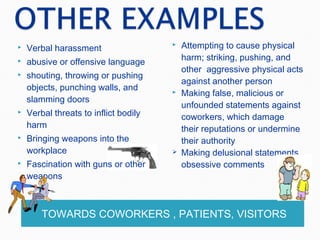
TOWARDS COWORKERS , PATIENTS, VISITORS
 Verbal harassment
 abusive or offensive language
 shouting, throwing or pushing
objects, punching walls, and
slamming doors
 Verbal threats to inflict bodily
harm
 Bringing weapons into the
workplace
 Fascination with guns or other
weapons
 Attempting to cause physical
harm; striking, pushing, and
other aggressive physical acts
against another person
 Making false, malicious or
unfounded statements against
coworkers, which damage
their reputations or undermine
their authority
 Making delusional statements,
obsessive comments
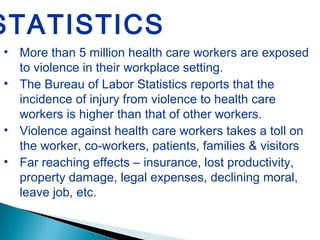
• More than 5 million health care workers are exposed
to violence in their workplace setting.
• The Bureau of Labor Statistics reports that the
incidence of injury from violence to health care
workers is higher than that of other workers.
• Violence against health care workers takes a toll on
the worker, co-workers, patients, families & visitors
• Far reaching effects – insurance, lost productivity,
property damage, legal expenses, declining moral,
leave job, etc.
STATISTICS
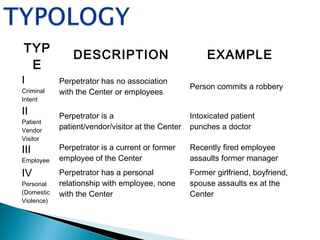
TYP
E
DESCRIPTION EXAMPLE
I
Criminal
Intent
Perpetrator has no association
with the Center or employees
Person commits a robbery
II
Patient
Vendor
Visitor
Perpetrator is a
patient/vendor/visitor at the Center
Intoxicated patient
punches a doctor
III
Employee
Perpetrator is a current or former
employee of the Center
Recently fired employee
assaults former manager
IV
Personal
(Domestic
Violence)
Perpetrator has a personal
relationship with employee, none
with the Center
Former girlfriend, boyfriend,
spouse assaults ex at the
Center
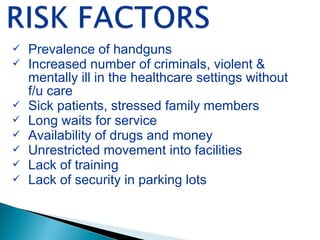
 Prevalence of handguns
 Increased number of criminals, violent &
mentally ill in the healthcare settings without
f/u care
 Sick patients, stressed family members
 Long waits for service
 Availability of drugs and money
 Unrestricted movement into facilities
 Lack of training
 Lack of security in parking lots
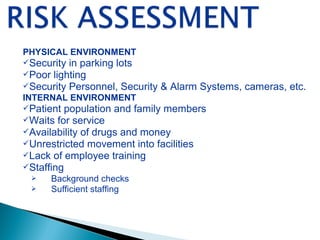
PHYSICAL ENVIRONMENT
Security in parking lots
Poor lighting
Security Personnel, Security & Alarm Systems, cameras, etc.
INTERNAL ENVIRONMENT
Patient population and family members
Waits for service
Availability of drugs and money
Unrestricted movement into facilities
Lack of employee training
Staffing
 Background checks
 Sufficient staffing
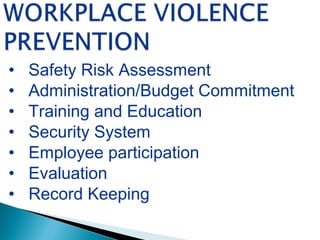
• Safety Risk Assessment
• Administration/Budget Commitment
• Training and Education
• Security System
• Employee participation
• Evaluation
• Record Keeping
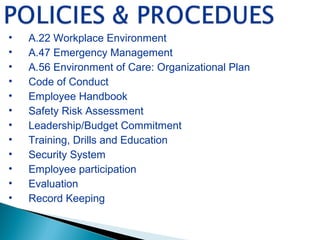
• A.22 Workplace Environment
• A.47 Emergency Management
• A.56 Environment of Care: Organizational Plan
• Code of Conduct
• Employee Handbook
• Safety Risk Assessment
• Leadership/Budget Commitment
• Training, Drills and Education
• Security System
• Employee participation
• Evaluation
• Record Keeping
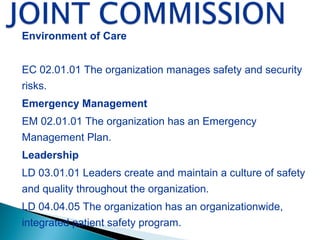
Environment of Care
EC 02.01.01 The organization manages safety and security
risks.
Emergency Management
EM 02.01.01 The organization has an Emergency
Management Plan.
Leadership
LD 03.01.01 Leaders create and maintain a culture of safety
and quality throughout the organization.
LD 04.04.05 The organization has an organizationwide,
integrated patient safety program.
OSHA requires employers to mitigate or prevent “recognizable
hazards” which include workplace violence by:
•Insuring employees are involved and educated on process
•Evaluating worksites to ensure safety requirements are met
•Hazard prevention through the use of “panic alarms” or metal
detectors
•Safety and Health Training is provided
•Compliance with the program must be documented
•OSHA fined a hospital $78,000 for non compliance involving
injured staff
1. Healthy work environments promote positive patient
outcomes.
2. Recognition that violence can and does happen anywhere.
3. All aspects of violence (patient, visitors & staff) must be
addressed.
4. All staff is accountable for upholding foundational behavior
standards, regardless of position or discipline.
5. When a staff member identifies an issue that contributes to
violence in the workplace, he has an obligation to address
it.
6. Intention, commitment and collaboration of all staff at all
levels in upholding behavioral standards is needed to
create a culture shift.
MPLOYEE RESPONSIBILIT
AONE-ENA White Paper, April 2015. Accessed May 2015.http://www.aone.org/resources/PDFs/Mitigating_Violence_GP_final.pdf42© Copyright, The Joint Commission
TO MAKE THIS WORK:
Respectful communication, including active listening
Mutual respect demonstrated by all (i.e., staff, doctors,
patients, visitors, family, etc.
Honesty, trust and beneficence
Lateral violence/abuse is prohibited, regardless of role
or position of authority (i.e., the standard of behavior is
the same for doctors, nurses, staff and administration)
Personal accountability, meaning everyone in the
Center is responsible for reporting and responding to an
incidence of violence/abuse
MPLOYEE RESPONSIBILIT
AONE-ENA White Paper, April 2015. Accessed May 2015.http://www.aone.org/resources/PDFs/Mitigating_Violence_GP_final.pdf42© Copyright, The Joint Commission
TIPS FOR CREATING A SAFE WORKPLACE
Encourage and promote courteous interactions
Pay attention to behavioral warning signs
Consider objects that could be used as
weapons
Assess your environment
Trust your instincts
Stay up to date on policies & procedure protocol
Promote a team approach
MPLOYEE RESPONSIBILIT
Source: Crisis Prevention Institute, Inc.
Listen to this video describing the most common
reactions to disruptive behaviors

Workplace Violence Prevention 2017

  • 2.
    • An action(verbal, written, or physical aggression) which is intended to control or cause, or is capable of causing death or serious bodily injury to oneself or others, or damage to property. Workplace violence includes abusive behavior toward authority or co-workers, intimidating or harassing behavior, and threats. The US Department of Labor
  • 4.
    • Beatings • Stabbings •Suicides • Shootings • Rapes • Near-suicides • Psychological traumas • Threats or obscene phone calls • Intimidation • Harassment of any nature • Being followed, sworn or shouted at
  • 5.
    TOWARDS COWORKERS ,PATIENTS, VISITORS  Verbal harassment  abusive or offensive language  shouting, throwing or pushing objects, punching walls, and slamming doors  Verbal threats to inflict bodily harm  Bringing weapons into the workplace  Fascination with guns or other weapons  Attempting to cause physical harm; striking, pushing, and other aggressive physical acts against another person  Making false, malicious or unfounded statements against coworkers, which damage their reputations or undermine their authority  Making delusional statements, obsessive comments
  • 6.
    • More than5 million health care workers are exposed to violence in their workplace setting. • The Bureau of Labor Statistics reports that the incidence of injury from violence to health care workers is higher than that of other workers. • Violence against health care workers takes a toll on the worker, co-workers, patients, families & visitors • Far reaching effects – insurance, lost productivity, property damage, legal expenses, declining moral, leave job, etc. STATISTICS
  • 7.
    TYP E DESCRIPTION EXAMPLE I Criminal Intent Perpetrator hasno association with the Center or employees Person commits a robbery II Patient Vendor Visitor Perpetrator is a patient/vendor/visitor at the Center Intoxicated patient punches a doctor III Employee Perpetrator is a current or former employee of the Center Recently fired employee assaults former manager IV Personal (Domestic Violence) Perpetrator has a personal relationship with employee, none with the Center Former girlfriend, boyfriend, spouse assaults ex at the Center
  • 8.
     Prevalence ofhandguns  Increased number of criminals, violent & mentally ill in the healthcare settings without f/u care  Sick patients, stressed family members  Long waits for service  Availability of drugs and money  Unrestricted movement into facilities  Lack of training  Lack of security in parking lots
  • 9.
    PHYSICAL ENVIRONMENT Security inparking lots Poor lighting Security Personnel, Security & Alarm Systems, cameras, etc. INTERNAL ENVIRONMENT Patient population and family members Waits for service Availability of drugs and money Unrestricted movement into facilities Lack of employee training Staffing  Background checks  Sufficient staffing
  • 10.
    • Safety RiskAssessment • Administration/Budget Commitment • Training and Education • Security System • Employee participation • Evaluation • Record Keeping
  • 11.
    • A.22 WorkplaceEnvironment • A.47 Emergency Management • A.56 Environment of Care: Organizational Plan • Code of Conduct • Employee Handbook • Safety Risk Assessment • Leadership/Budget Commitment • Training, Drills and Education • Security System • Employee participation • Evaluation • Record Keeping
  • 12.
    Environment of Care EC02.01.01 The organization manages safety and security risks. Emergency Management EM 02.01.01 The organization has an Emergency Management Plan. Leadership LD 03.01.01 Leaders create and maintain a culture of safety and quality throughout the organization. LD 04.04.05 The organization has an organizationwide, integrated patient safety program.
  • 13.
    OSHA requires employersto mitigate or prevent “recognizable hazards” which include workplace violence by: •Insuring employees are involved and educated on process •Evaluating worksites to ensure safety requirements are met •Hazard prevention through the use of “panic alarms” or metal detectors •Safety and Health Training is provided •Compliance with the program must be documented •OSHA fined a hospital $78,000 for non compliance involving injured staff
  • 14.
    1. Healthy workenvironments promote positive patient outcomes. 2. Recognition that violence can and does happen anywhere. 3. All aspects of violence (patient, visitors & staff) must be addressed. 4. All staff is accountable for upholding foundational behavior standards, regardless of position or discipline. 5. When a staff member identifies an issue that contributes to violence in the workplace, he has an obligation to address it. 6. Intention, commitment and collaboration of all staff at all levels in upholding behavioral standards is needed to create a culture shift. MPLOYEE RESPONSIBILIT AONE-ENA White Paper, April 2015. Accessed May 2015.http://www.aone.org/resources/PDFs/Mitigating_Violence_GP_final.pdf42© Copyright, The Joint Commission
  • 15.
    TO MAKE THISWORK: Respectful communication, including active listening Mutual respect demonstrated by all (i.e., staff, doctors, patients, visitors, family, etc. Honesty, trust and beneficence Lateral violence/abuse is prohibited, regardless of role or position of authority (i.e., the standard of behavior is the same for doctors, nurses, staff and administration) Personal accountability, meaning everyone in the Center is responsible for reporting and responding to an incidence of violence/abuse MPLOYEE RESPONSIBILIT AONE-ENA White Paper, April 2015. Accessed May 2015.http://www.aone.org/resources/PDFs/Mitigating_Violence_GP_final.pdf42© Copyright, The Joint Commission
  • 16.
    TIPS FOR CREATINGA SAFE WORKPLACE Encourage and promote courteous interactions Pay attention to behavioral warning signs Consider objects that could be used as weapons Assess your environment Trust your instincts Stay up to date on policies & procedure protocol Promote a team approach MPLOYEE RESPONSIBILIT Source: Crisis Prevention Institute, Inc.
  • 17.
    Listen to thisvideo describing the most common reactions to disruptive behaviors