Class 9th - Civics - Working of Institution - Full Chapter Explanation
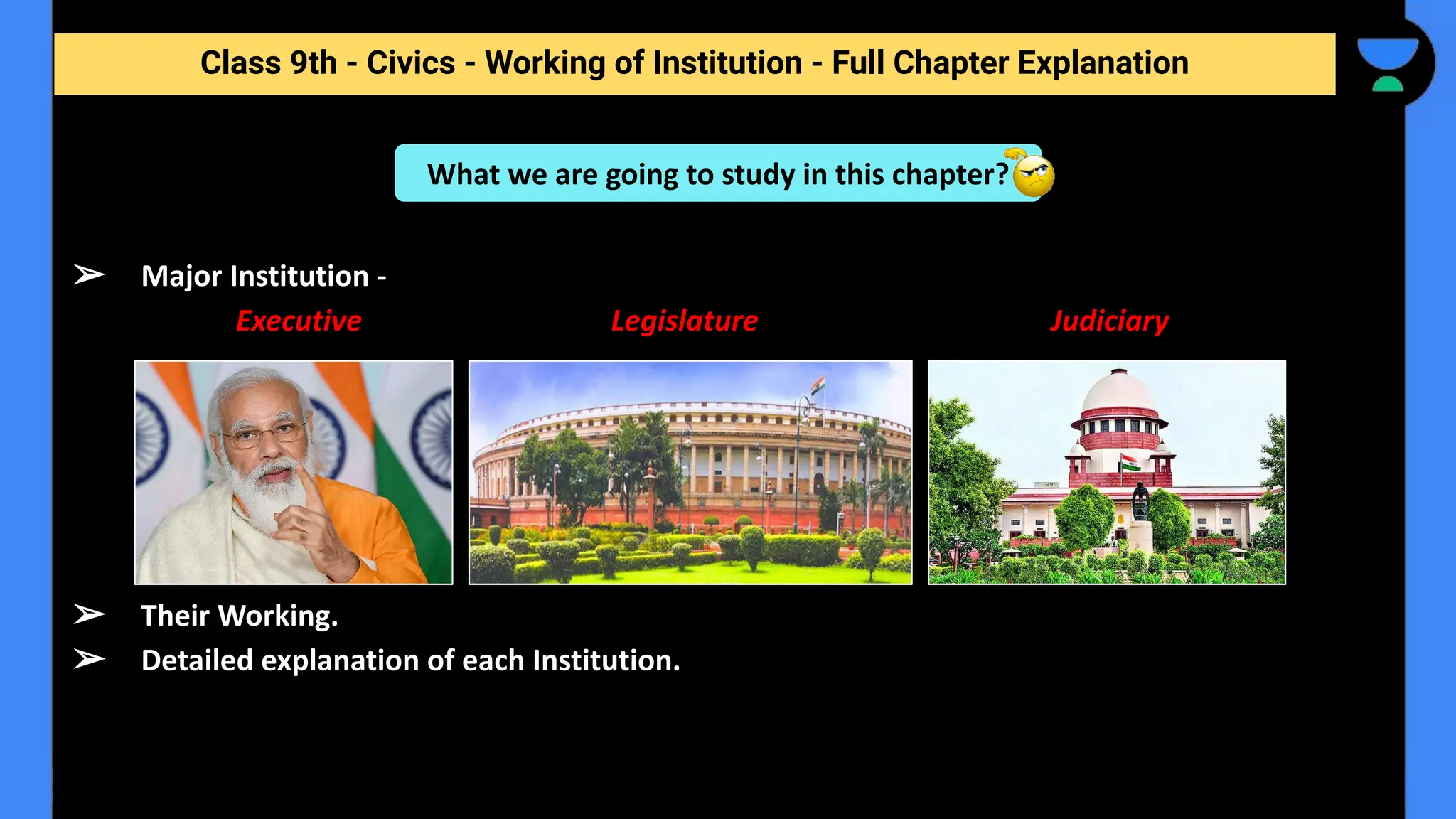
➢ Major Institution -
Executive Legislature Judiciary
➢ Their Working.
➢ Detailed explanation of each Institution.
What we are going to study in this chapter?
Class 9th - Civics - Working of Institution - Full Chapter Explanation
How is a major Policy Decision taken?
● Story of Office Memorandum
➔ An order issued by Government of India on
August 13, 1990.
● Department of personnel and Training in the
ministry of personnel, Public Grievances and
pension.
➢ Was this so simple to do?
By whom?
What?
This order announced 27 per cent
reservation for Socially and
Educationally backward classes [SEBC]
in government jobs.
Class 9th - Civics - Working of Institution - Full Chapter Explanation
Mandal Commission
● It was the second backward class Commission.
● Appointed in 1979, under the chairmanship of
B.P. Mandal.
∴ Mandal Commission
➢ To identify the socially and educationally
backward classes in India, and to recommend
steps for their advancement.
➢ Commission gave its report in 1980.
Why it is appointed?
What was there in that Report?
● Many points were discussed in the
report about backward classes.
● One of the recommendation was to
give 27 percent reservation to
socially and educationally backward
classes in Government Jobs.
➔ Dose recommendation means law?
➔ Then how did the recommendation
become a law.
Class 9th - Civics - Working of Institution - Full Chapter Explanation
Lok Sabha Election of 1989
● Election manifesto of Janata Dal.
● Promise to implement the Mandal Commission
report if they came in power.
● Eventually Janta Dal came on power, V.P. Singh
became the Prime Minister and an Office
Memorandum regarding reservation was brought.
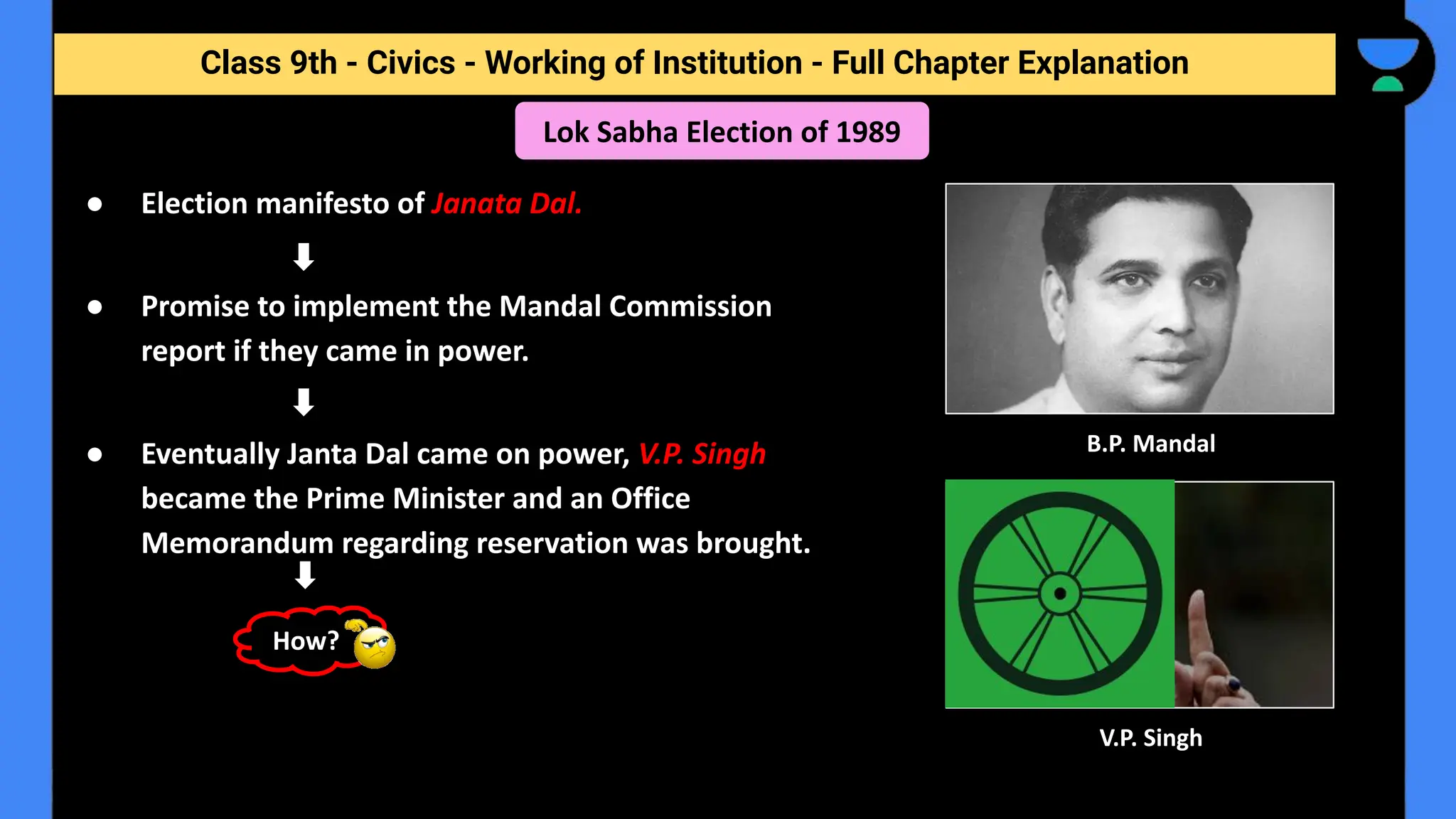
B.P. Mandal
V.P. Singh
How?
Class 9th - Civics - Working of Institution - Full Chapter Explanation
➔ Then who resolved the conflicts?
■ Judiciary [Supreme court and High court]
● In ‘India Sawhney and other vs Union of India Case’ supreme court declared that this
order of the government of India was valid and government was asked to modify the
original order.
➔ Accordingly, the department of personnel and training issued another Office
Memorandum on september 8, 1993.
Conflicts
Some were in its favour.
Some opposed it.
Class 9th - Civics - Working of Institution - Full Chapter Explanation
Need for Political Institution
● Governing a country involves various activities
E.g. Security, Education, Health, etc.
● Democratic Government rests on different institution to run the Country.
➔ Some institution are required to make laws. [Parliament]
➔ Some institution take decisions and implement them. [Prime Minister and Civil Servant]
➔ Some institution work to resolve the dispute. [Supreme Court]
This often leads to delay and complications.
➔ You may think that one person should take all the decision, but it is against the spirit of democracy.
➔ Institution provide an opportunity for consultation and discussion.
These activities are performed
by various institutions.
Then is it good to have
political Institution.
Improve the quality of decision.
Class 9th - Civics - Working of Institution - Full Chapter Explanation
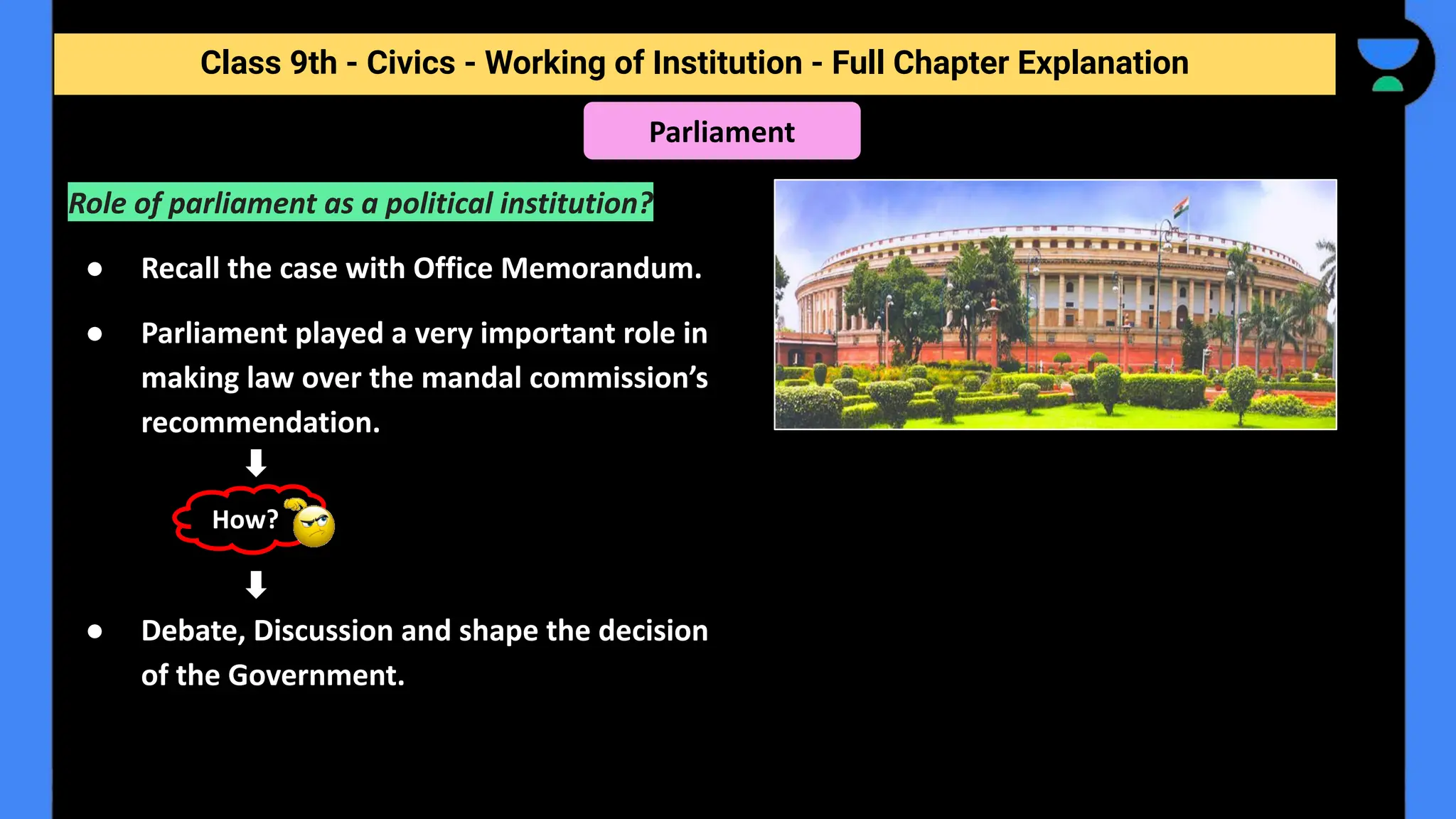
Parliament
Role of parliament as a political institution?
● Recall the case with Office Memorandum.
● Parliament played a very important role in
making law over the mandal commission’s
recommendation.
● Debate, Discussion and shape the decision
of the Government.
How?
Class 9th - Civics - Working of Institution - Full Chapter Explanation
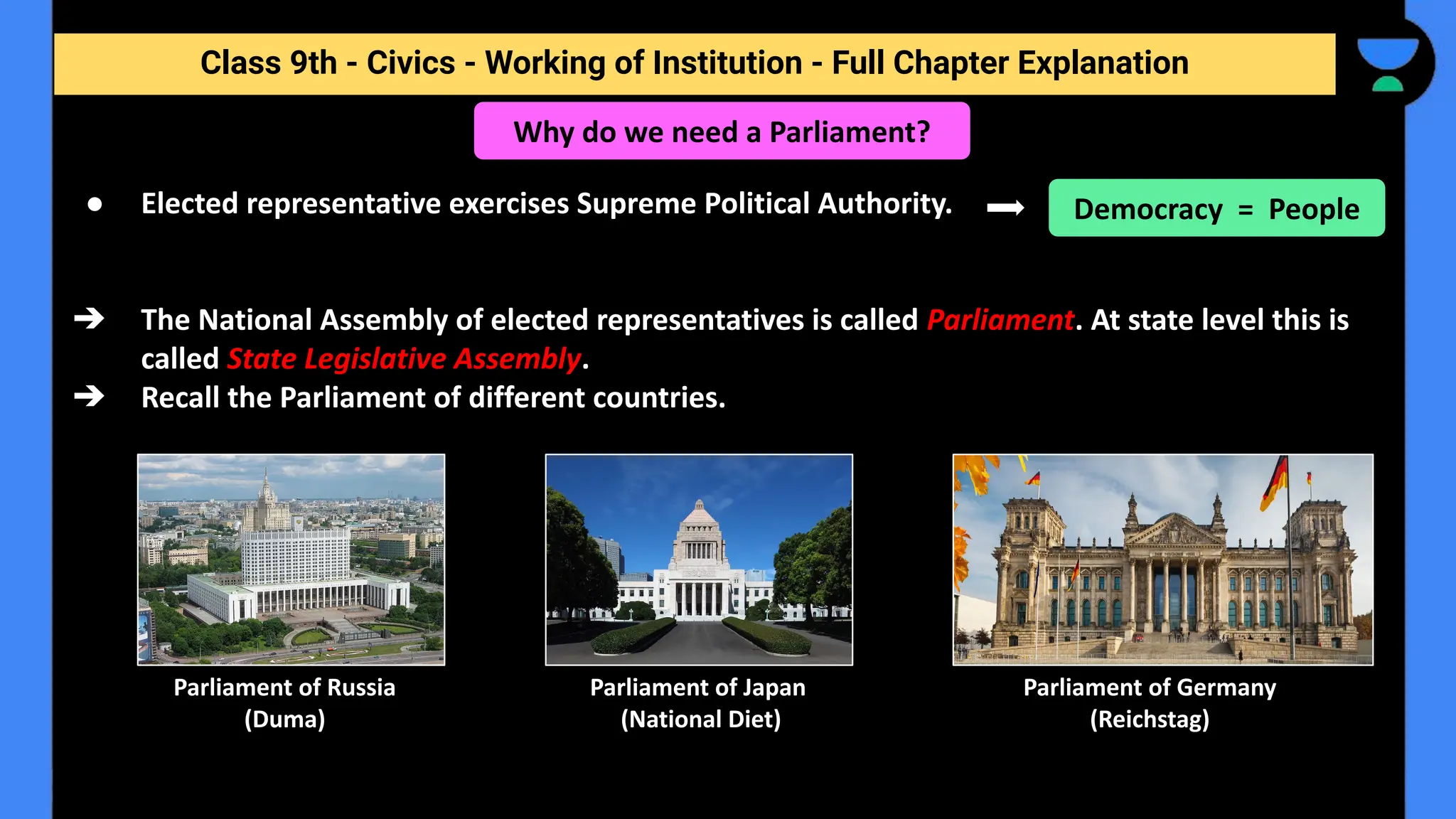
Why do we need a Parliament?
● Elected representative exercises Supreme Political Authority.
➔ The National Assembly of elected representatives is called Parliament. At state level this is
called State Legislative Assembly.
➔ Recall the Parliament of different countries.
Democracy = People
Parliament of Russia
(Duma)
Parliament of Germany
(Reichstag)
Parliament of Japan
(National Diet)
Class 9th - Civics - Working of Institution - Full Chapter Explanation
➔ Need/ Function/ Power of the Parliament ?
● Parliament is the Final authority for making laws in any country.
■ Parliament can make laws, change existing laws or abolish them and can make new
laws in their place.
● Parliament exercise some control over those who run the Government.
■ Those who run the Government can take decision only so long as they enjoy support of
the parliament. Majority Support.
● Parliament Control all the money that Government have.
■ Parliamentary sanctions are required to spent the public money.
[Budget is needed to be approved in parliament]
● Parliament: Highest forum of discussion and debate.
■ Public issues and national policy are discussed in the parliament.
How
Class 9th - Civics - Working of Institution - Full Chapter Explanation
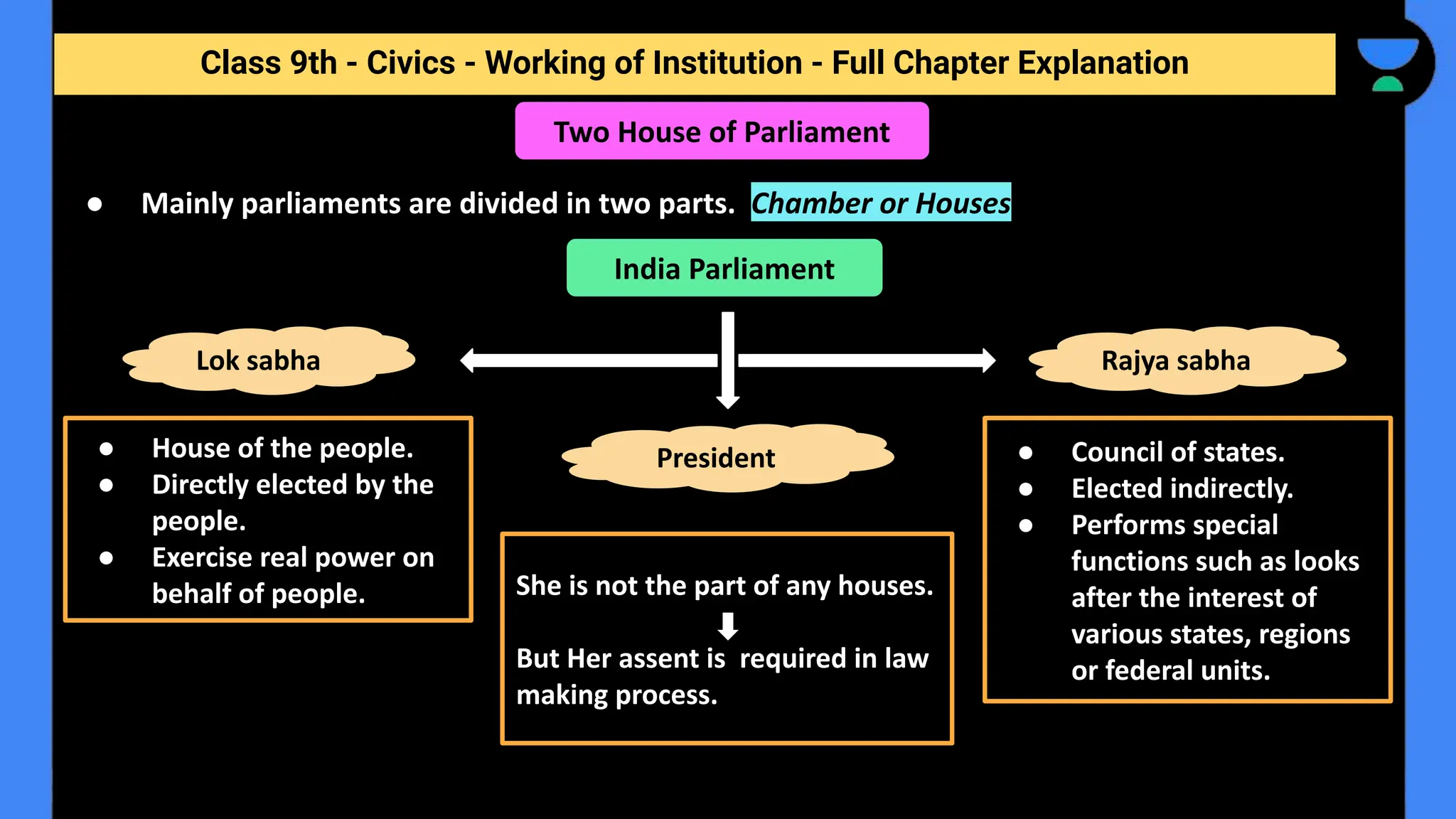
Two House of Parliament
● Mainly parliaments are divided in two parts. Chamber or Houses
Lok sabha
President
Rajya sabha
India Parliament
● House of the people.
● Directly elected by the
people.
● Exercise real power on
behalf of people. She is not the part of any houses.
But Her assent is required in law
making process.
● Council of states.
● Elected indirectly.
● Performs special
functions such as looks
after the interest of
various states, regions
or federal units.
Class 9th - Civics - Working of Institution - Full Chapter Explanation
Lok Sabha Rajya Sabha
Total no. of members? 543 233 + 12
Who elects the member? Directly elected by people Indirectly by the MLAs
What is the length of term
(in years)?
5 years 6 years
Can the house be dissolved or is
it permanent?
It is dissolved after every 5
years.
Permanent
Class 9th - Civics - Working of Institution - Full Chapter Explanation
Which of the House [Lok Sabha or Rajya Sabha] is more Powerful?
● Rajya Sabha is called ‘Upper Chamber’ and Lok Sabha is called ‘Lower Chamber’.
This is just an old style of speaking.
● Our constitution does give the Rajya sabha some special powers over the state. But on most
matters the Lok sabha exercise supreme power.
Does it mean that Rajya
Sabha is more powerful?
How?
Class 9th - Civics - Working of Institution - Full Chapter Explanation
● Lok Sabha exercises more power than Rajya Sabha.
1. During joint session, the view of the Lok Sabha is likely to prevail.
■ In case of difference between two houses Members of both the houses sit
together in joint session.
The view is Lok Sabha is likely to prevail due to large no. of members.
2. Lok Sabha exercises more powers in money matters.
■ Budget on any money related laws passed by lok Sabha cannot be rejected by Rajya
Sabha. It can only delay it by 14 days or suggest any change. Whereas Lok Sabha is not
bound follow it.
3. Lok Sabha control the council of Ministers and Prime minister.
■ Only the person who enjoy the majority support in Lok Sabha can be appoint as the
Prime Minister.
■ With “No confidence” All ministers including prime Minister can be forced to quit.
How?
Class 9th - Civics - Working of Institution - Full Chapter Explanation
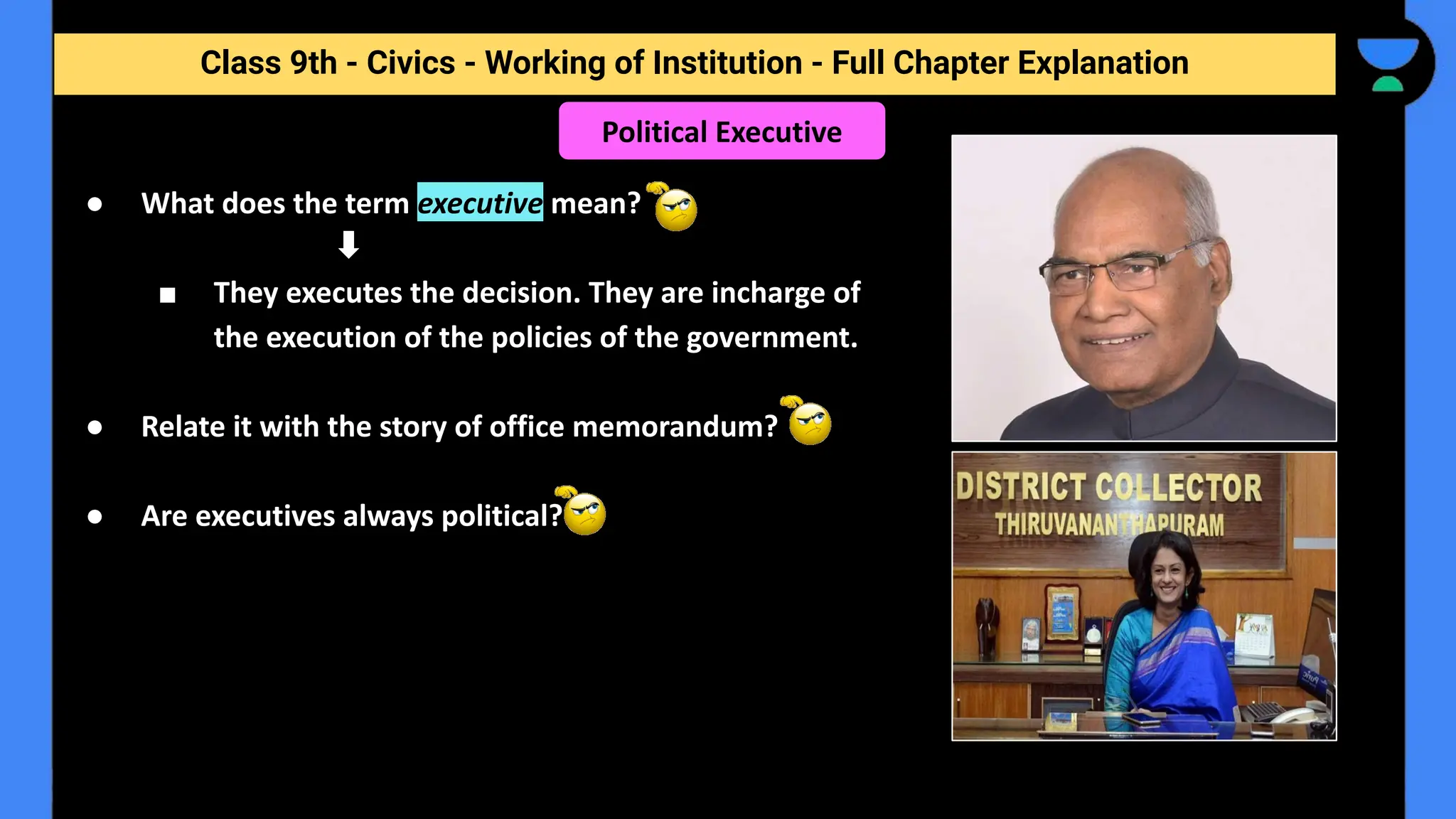
Political Executive
● What does the term executive mean?
■ They executes the decision. They are incharge of
the execution of the policies of the government.
● Relate it with the story of office memorandum?
● Are executives always political?
Class 9th - Civics - Working of Institution - Full Chapter Explanation
Political and Permanent Executive
Political Executive Permanent Executive
➔ Elected by the people for a specific
period of time.
➔ Vacate the position with the change in
government.
➔ E.g. Political leaders
[P.M., C.M.]
➔ Elected on the basis of merit and
appointed on a long term basis.
➔ They remain in office even when the
ruling party changes.
➔ E.g. Civil servant
[I.A.S., I.P.S. etc]
Class 9th - Civics - Working of Institution - Full Chapter Explanation
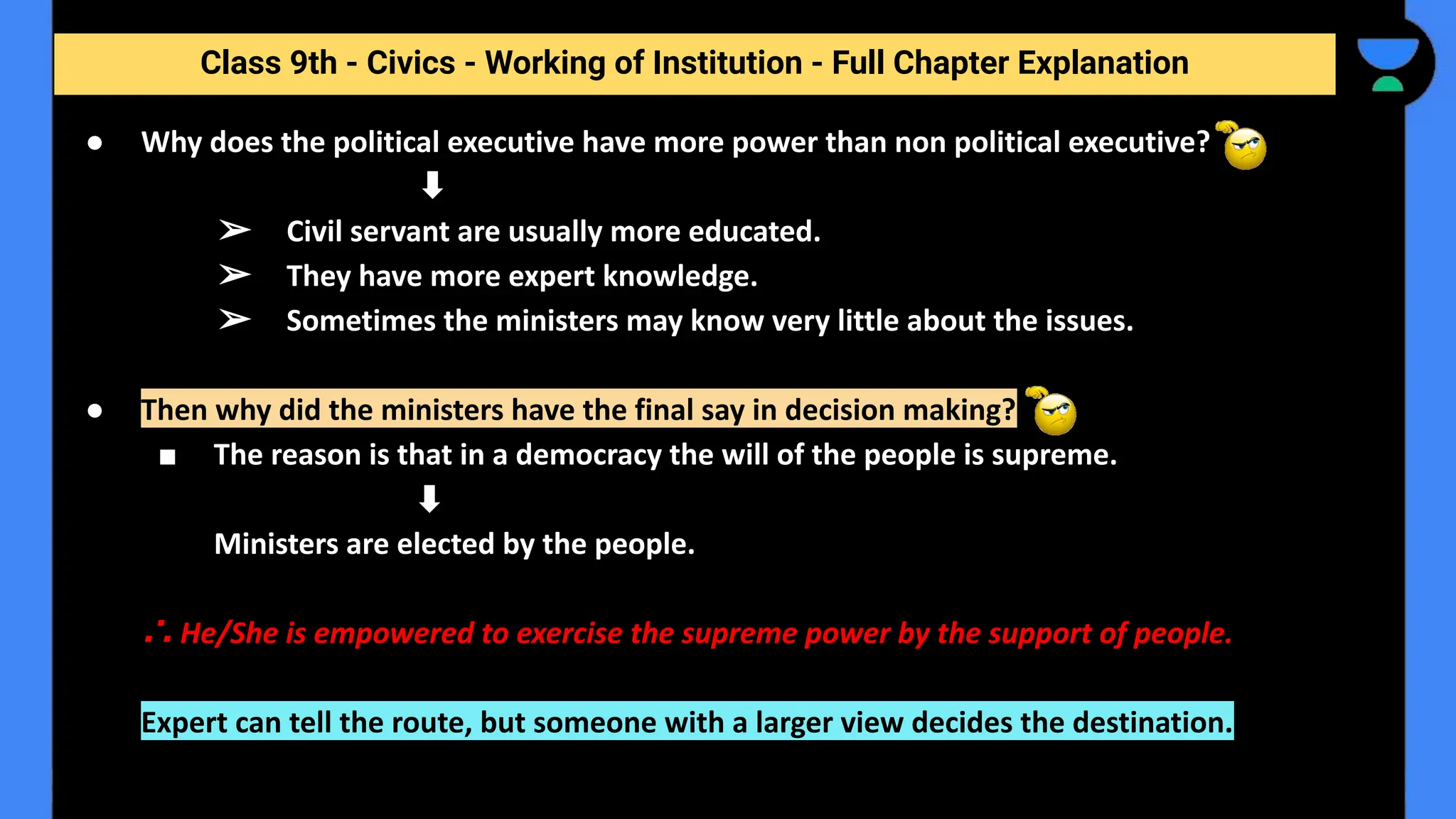
● Why does the political executive have more power than non political executive?
➢ Civil servant are usually more educated.
➢ They have more expert knowledge.
➢ Sometimes the ministers may know very little about the issues.
● Then why did the ministers have the final say in decision making?
■ The reason is that in a democracy the will of the people is supreme.
Ministers are elected by the people.
∴ He/She is empowered to exercise the supreme power by the support of people.
Expert can tell the route, but someone with a larger view decides the destination.
Class 9th - Civics - Working of Institution - Full Chapter Explanation
Prime Minister
➔ Prime Minister is not only a person, He/She is also the most important Political
Institution in the country.
◆ Yet there is no direct election to the post of Prime Minister.
◆ President appoints the Prime Minister.
◆ Leader of majority party or coalition parties is appointed as Prime Minister.
◆ He/She continues to be in power so long as he remain the leader of the majority
party or coalition.
Class 9th - Civics - Working of Institution - Full Chapter Explanation
Powers of the Prime Minister
● Prime Minister chairs the cabinet meetings [Coordinator, Takes final decision]
● All ministers work under his leadership.
[Distribute and redistributes work, can dismiss ministers]
● Parliamentary democracies = Prime Ministerial Form of Government.
➢ Role of political parties and media in influencing the power of P.M.
● The extent of power of P.M. depends on the personality of the person holding that position.
● Power of the P.M. in coalition politics
➢ Coalition Government = Accommodation of different group and people = Power.
∴ He/She is required to heed to the views and position of coalition partners because their
support is essential for survival of government.
Class 9th - Civics - Working of Institution - Full Chapter Explanation
Council of Ministers
● President appoints council of minister on the advice of the Prime Minister.
From where?
From his own party or from the coalition partner.
Appointed council of minister may be a
Member of parliament
Or a person who is not a
member of parliament.
But He/She has to get elected
in parliament within six
months of appointment as
minister.
Class 9th - Civics - Working of Institution - Full Chapter Explanation
● It is a body of 60 to 80 minister at different ranks.
➔ Parliamentary democracy = Cabinet form of government
◆ Because cabinet ministers takes major decisions in their ministry.
◆ Ministry Departments Secretaries [Civil Servants]
Cabinet ministers
Ministers of state with
independent charge
Ministers of state
● Top level leaders of the
ruling party.
● Incharge of major
ministry.
● Inner ring of council of
ministers, Comprises
about 20 ministers.
● In-charge of smaller
ministry.
● Participate in the
cabinet meetings only
when specially invited.
● They are attached with
the portfolio to assist
the cabinet ministers.
Why?
Class 9th - Civics - Working of Institution - Full Chapter Explanation
The President
❖ He/She is the head of the state.
➢ He/She has the nominal power like Queen of
Britain.
➢ His/Her functions are mostly ceremonial.
➢ President is not elected directly by the people.
● Elected MPs and MLAs elects President.
● The one who gets the majority of votes is elected as
President.
● He represent the entire nation but can never claim the
direct popular mandate.
Then how is
he elected?
Class 9th - Civics - Working of Institution - Full Chapter Explanation
Powers of President
If we go by the constitution, President has the power to do everything.
➢ All Government activities take place in the name of the
President.
➢ Major appointment such as Chief Justice of India, Judges,
Governors, Election Commissioners, Ambassadors to other
countries are done by President.
➢ All international treaties and agreement are made in the
name of the President.
➢ President is the Supreme Commander of the defence forces
of India.
❖ What if the president does not agree on the advice given to him?
President exercise all
this power only on
the advice of the
council of Ministers.
Class 9th - Civics - Working of Institution - Full Chapter Explanation
What if the president does not agree on the advice given to him?
● If president is not satisfied with advice given by council of minister.
● He/She can ask the council of minister to reconsider its advice.
● But he/she is bound to act according to the advice rendered after reconsideration.
● You may wonder what does the President really do?
➢ President appoint the Prime Minister [Leader of majority] but in case no party or
coalition get majority in Lok Sabha then President exercises her discretionary power.
Class 9th - Civics - Working of Institution - Full Chapter Explanation
The Judiciary
❖ Connect it with Office Memorandum.
● What would have happen in the absence of Judiciary?
● All the court at different level in country put together.
Supreme court
[Entire Nation]
High Courts
[For State]
District Courts
[For District and local level]
Class 9th - Civics - Working of Institution - Full Chapter Explanation
❖ Judiciary resolve the disputes such as -
➢ Disputes between citizens of the country.
➢ Disputes between citizen and government.
➢ Disputes between two or more state government.
➢ Disputes between government and state government.
❖ Supreme court is the highest court of appeal in civil and criminal cases.
It can hear appeals against the decision of High courts.
Class 9th - Civics - Working of Institution - Full Chapter Explanation
Independent and Powerful Judiciary
❖ Why Independent Judiciary is required?
➢ So that the Judiciary can work impartially, free from the pressure of executive
and legislature.
❖ How this independence is ensured?
➢ Through appointment of Judges.
■ Appointed by President on the advice of Prime Minister and in
consultation with the chief justice of the Supreme Court.
➢ It is nearly impossible to remove a Judge.
■ He/She can be removed only by an impeachment motion passed
separately by two-third member of the two houses of the parliament.
❖ Office of CJI (Chief justice of India)
Class 9th - Civics - Working of Institution - Full Chapter Explanation
Indian Judiciary is one of the most powerful Judiciary of the world.
● Supreme Court and High Courts have the power to interpret the constitution of the
country. [Determines the constitutional validity of any law]
● Power of Judicial Review.
● Judiciary acts as the Guardian of the Fundamental rights.
● Through public interest Litigation Judiciary work for the protection of Public Interest.
● Judiciary enjoys a high level of confidence among the people.
How?
Working of Institution (1)  grade 9 .pdf

Working of Institution (1) grade 9 .pdf

  • 1.
    Class 9th -Civics - Working of Institution - Full Chapter Explanation
  • 2.
    Class 9th -Civics - Working of Institution - Full Chapter Explanation ➢ Major Institution - Executive Legislature Judiciary ➢ Their Working. ➢ Detailed explanation of each Institution. What we are going to study in this chapter?
  • 3.
    Class 9th -Civics - Working of Institution - Full Chapter Explanation How is a major Policy Decision taken? ● Story of Office Memorandum ➔ An order issued by Government of India on August 13, 1990. ● Department of personnel and Training in the ministry of personnel, Public Grievances and pension. ➢ Was this so simple to do? By whom? What? This order announced 27 per cent reservation for Socially and Educationally backward classes [SEBC] in government jobs.
  • 4.
    Class 9th -Civics - Working of Institution - Full Chapter Explanation Mandal Commission ● It was the second backward class Commission. ● Appointed in 1979, under the chairmanship of B.P. Mandal. ∴ Mandal Commission ➢ To identify the socially and educationally backward classes in India, and to recommend steps for their advancement. ➢ Commission gave its report in 1980. Why it is appointed? What was there in that Report? ● Many points were discussed in the report about backward classes. ● One of the recommendation was to give 27 percent reservation to socially and educationally backward classes in Government Jobs. ➔ Dose recommendation means law? ➔ Then how did the recommendation become a law.
  • 5.
    Class 9th -Civics - Working of Institution - Full Chapter Explanation Lok Sabha Election of 1989 ● Election manifesto of Janata Dal. ● Promise to implement the Mandal Commission report if they came in power. ● Eventually Janta Dal came on power, V.P. Singh became the Prime Minister and an Office Memorandum regarding reservation was brought. B.P. Mandal V.P. Singh How?
  • 6.
    Class 9th -Civics - Working of Institution - Full Chapter Explanation ➔ Then who resolved the conflicts? ■ Judiciary [Supreme court and High court] ● In ‘India Sawhney and other vs Union of India Case’ supreme court declared that this order of the government of India was valid and government was asked to modify the original order. ➔ Accordingly, the department of personnel and training issued another Office Memorandum on september 8, 1993. Conflicts Some were in its favour. Some opposed it.
  • 7.
    Class 9th -Civics - Working of Institution - Full Chapter Explanation Need for Political Institution ● Governing a country involves various activities E.g. Security, Education, Health, etc. ● Democratic Government rests on different institution to run the Country. ➔ Some institution are required to make laws. [Parliament] ➔ Some institution take decisions and implement them. [Prime Minister and Civil Servant] ➔ Some institution work to resolve the dispute. [Supreme Court] This often leads to delay and complications. ➔ You may think that one person should take all the decision, but it is against the spirit of democracy. ➔ Institution provide an opportunity for consultation and discussion. These activities are performed by various institutions. Then is it good to have political Institution. Improve the quality of decision.
  • 8.
    Class 9th -Civics - Working of Institution - Full Chapter Explanation Parliament Role of parliament as a political institution? ● Recall the case with Office Memorandum. ● Parliament played a very important role in making law over the mandal commission’s recommendation. ● Debate, Discussion and shape the decision of the Government. How?
  • 9.
    Class 9th -Civics - Working of Institution - Full Chapter Explanation Why do we need a Parliament? ● Elected representative exercises Supreme Political Authority. ➔ The National Assembly of elected representatives is called Parliament. At state level this is called State Legislative Assembly. ➔ Recall the Parliament of different countries. Democracy = People Parliament of Russia (Duma) Parliament of Germany (Reichstag) Parliament of Japan (National Diet)
  • 10.
    Class 9th -Civics - Working of Institution - Full Chapter Explanation ➔ Need/ Function/ Power of the Parliament ? ● Parliament is the Final authority for making laws in any country. ■ Parliament can make laws, change existing laws or abolish them and can make new laws in their place. ● Parliament exercise some control over those who run the Government. ■ Those who run the Government can take decision only so long as they enjoy support of the parliament. Majority Support. ● Parliament Control all the money that Government have. ■ Parliamentary sanctions are required to spent the public money. [Budget is needed to be approved in parliament] ● Parliament: Highest forum of discussion and debate. ■ Public issues and national policy are discussed in the parliament. How
  • 11.
    Class 9th -Civics - Working of Institution - Full Chapter Explanation Two House of Parliament ● Mainly parliaments are divided in two parts. Chamber or Houses Lok sabha President Rajya sabha India Parliament ● House of the people. ● Directly elected by the people. ● Exercise real power on behalf of people. She is not the part of any houses. But Her assent is required in law making process. ● Council of states. ● Elected indirectly. ● Performs special functions such as looks after the interest of various states, regions or federal units.
  • 12.
    Class 9th -Civics - Working of Institution - Full Chapter Explanation Lok Sabha Rajya Sabha Total no. of members? 543 233 + 12 Who elects the member? Directly elected by people Indirectly by the MLAs What is the length of term (in years)? 5 years 6 years Can the house be dissolved or is it permanent? It is dissolved after every 5 years. Permanent
  • 13.
    Class 9th -Civics - Working of Institution - Full Chapter Explanation Which of the House [Lok Sabha or Rajya Sabha] is more Powerful? ● Rajya Sabha is called ‘Upper Chamber’ and Lok Sabha is called ‘Lower Chamber’. This is just an old style of speaking. ● Our constitution does give the Rajya sabha some special powers over the state. But on most matters the Lok sabha exercise supreme power. Does it mean that Rajya Sabha is more powerful? How?
  • 14.
    Class 9th -Civics - Working of Institution - Full Chapter Explanation ● Lok Sabha exercises more power than Rajya Sabha. 1. During joint session, the view of the Lok Sabha is likely to prevail. ■ In case of difference between two houses Members of both the houses sit together in joint session. The view is Lok Sabha is likely to prevail due to large no. of members. 2. Lok Sabha exercises more powers in money matters. ■ Budget on any money related laws passed by lok Sabha cannot be rejected by Rajya Sabha. It can only delay it by 14 days or suggest any change. Whereas Lok Sabha is not bound follow it. 3. Lok Sabha control the council of Ministers and Prime minister. ■ Only the person who enjoy the majority support in Lok Sabha can be appoint as the Prime Minister. ■ With “No confidence” All ministers including prime Minister can be forced to quit. How?
  • 15.
    Class 9th -Civics - Working of Institution - Full Chapter Explanation Political Executive ● What does the term executive mean? ■ They executes the decision. They are incharge of the execution of the policies of the government. ● Relate it with the story of office memorandum? ● Are executives always political?
  • 16.
    Class 9th -Civics - Working of Institution - Full Chapter Explanation Political and Permanent Executive Political Executive Permanent Executive ➔ Elected by the people for a specific period of time. ➔ Vacate the position with the change in government. ➔ E.g. Political leaders [P.M., C.M.] ➔ Elected on the basis of merit and appointed on a long term basis. ➔ They remain in office even when the ruling party changes. ➔ E.g. Civil servant [I.A.S., I.P.S. etc]
  • 17.
    Class 9th -Civics - Working of Institution - Full Chapter Explanation ● Why does the political executive have more power than non political executive? ➢ Civil servant are usually more educated. ➢ They have more expert knowledge. ➢ Sometimes the ministers may know very little about the issues. ● Then why did the ministers have the final say in decision making? ■ The reason is that in a democracy the will of the people is supreme. Ministers are elected by the people. ∴ He/She is empowered to exercise the supreme power by the support of people. Expert can tell the route, but someone with a larger view decides the destination.
  • 18.
    Class 9th -Civics - Working of Institution - Full Chapter Explanation Prime Minister ➔ Prime Minister is not only a person, He/She is also the most important Political Institution in the country. ◆ Yet there is no direct election to the post of Prime Minister. ◆ President appoints the Prime Minister. ◆ Leader of majority party or coalition parties is appointed as Prime Minister. ◆ He/She continues to be in power so long as he remain the leader of the majority party or coalition.
  • 19.
    Class 9th -Civics - Working of Institution - Full Chapter Explanation
  • 20.
    Class 9th -Civics - Working of Institution - Full Chapter Explanation Powers of the Prime Minister ● Prime Minister chairs the cabinet meetings [Coordinator, Takes final decision] ● All ministers work under his leadership. [Distribute and redistributes work, can dismiss ministers] ● Parliamentary democracies = Prime Ministerial Form of Government. ➢ Role of political parties and media in influencing the power of P.M. ● The extent of power of P.M. depends on the personality of the person holding that position. ● Power of the P.M. in coalition politics ➢ Coalition Government = Accommodation of different group and people = Power. ∴ He/She is required to heed to the views and position of coalition partners because their support is essential for survival of government.
  • 21.
    Class 9th -Civics - Working of Institution - Full Chapter Explanation Council of Ministers ● President appoints council of minister on the advice of the Prime Minister. From where? From his own party or from the coalition partner. Appointed council of minister may be a Member of parliament Or a person who is not a member of parliament. But He/She has to get elected in parliament within six months of appointment as minister.
  • 22.
    Class 9th -Civics - Working of Institution - Full Chapter Explanation ● It is a body of 60 to 80 minister at different ranks. ➔ Parliamentary democracy = Cabinet form of government ◆ Because cabinet ministers takes major decisions in their ministry. ◆ Ministry Departments Secretaries [Civil Servants] Cabinet ministers Ministers of state with independent charge Ministers of state ● Top level leaders of the ruling party. ● Incharge of major ministry. ● Inner ring of council of ministers, Comprises about 20 ministers. ● In-charge of smaller ministry. ● Participate in the cabinet meetings only when specially invited. ● They are attached with the portfolio to assist the cabinet ministers. Why?
  • 23.
    Class 9th -Civics - Working of Institution - Full Chapter Explanation The President ❖ He/She is the head of the state. ➢ He/She has the nominal power like Queen of Britain. ➢ His/Her functions are mostly ceremonial. ➢ President is not elected directly by the people. ● Elected MPs and MLAs elects President. ● The one who gets the majority of votes is elected as President. ● He represent the entire nation but can never claim the direct popular mandate. Then how is he elected?
  • 24.
    Class 9th -Civics - Working of Institution - Full Chapter Explanation Powers of President If we go by the constitution, President has the power to do everything. ➢ All Government activities take place in the name of the President. ➢ Major appointment such as Chief Justice of India, Judges, Governors, Election Commissioners, Ambassadors to other countries are done by President. ➢ All international treaties and agreement are made in the name of the President. ➢ President is the Supreme Commander of the defence forces of India. ❖ What if the president does not agree on the advice given to him? President exercise all this power only on the advice of the council of Ministers.
  • 25.
    Class 9th -Civics - Working of Institution - Full Chapter Explanation What if the president does not agree on the advice given to him? ● If president is not satisfied with advice given by council of minister. ● He/She can ask the council of minister to reconsider its advice. ● But he/she is bound to act according to the advice rendered after reconsideration. ● You may wonder what does the President really do? ➢ President appoint the Prime Minister [Leader of majority] but in case no party or coalition get majority in Lok Sabha then President exercises her discretionary power.
  • 26.
    Class 9th -Civics - Working of Institution - Full Chapter Explanation The Judiciary ❖ Connect it with Office Memorandum. ● What would have happen in the absence of Judiciary? ● All the court at different level in country put together. Supreme court [Entire Nation] High Courts [For State] District Courts [For District and local level]
  • 27.
    Class 9th -Civics - Working of Institution - Full Chapter Explanation ❖ Judiciary resolve the disputes such as - ➢ Disputes between citizens of the country. ➢ Disputes between citizen and government. ➢ Disputes between two or more state government. ➢ Disputes between government and state government. ❖ Supreme court is the highest court of appeal in civil and criminal cases. It can hear appeals against the decision of High courts.
  • 28.
    Class 9th -Civics - Working of Institution - Full Chapter Explanation Independent and Powerful Judiciary ❖ Why Independent Judiciary is required? ➢ So that the Judiciary can work impartially, free from the pressure of executive and legislature. ❖ How this independence is ensured? ➢ Through appointment of Judges. ■ Appointed by President on the advice of Prime Minister and in consultation with the chief justice of the Supreme Court. ➢ It is nearly impossible to remove a Judge. ■ He/She can be removed only by an impeachment motion passed separately by two-third member of the two houses of the parliament. ❖ Office of CJI (Chief justice of India)
  • 29.
    Class 9th -Civics - Working of Institution - Full Chapter Explanation Indian Judiciary is one of the most powerful Judiciary of the world. ● Supreme Court and High Courts have the power to interpret the constitution of the country. [Determines the constitutional validity of any law] ● Power of Judicial Review. ● Judiciary acts as the Guardian of the Fundamental rights. ● Through public interest Litigation Judiciary work for the protection of Public Interest. ● Judiciary enjoys a high level of confidence among the people. How?