Working in Partnership:  Benefits and Challenges 10 June 2009 Carolyn Royston
What this talk will cover This talk is based on my recent experience with NMOLP: Benefits of working in partnership Working with the right partners Understanding your partnership – gaining commitment and working with constraints Some lessons learnt from NMOLP
About me Currently Head of New Media, IWM Project manager NMOLP until March 09 NMOLP was f irst time I had worked in the public sector Previously Head of e-Learning in a UK new media agency
Partnership working
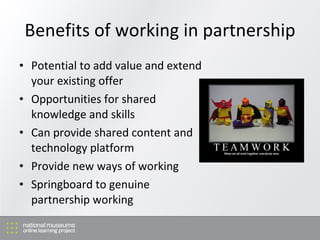
Benefits of working in partnership Potential to add value and extend your existing offer Opportunities for shared knowledge and skills Can provide shared content and technology platform Provide new ways of working Springboard to genuine partnership working
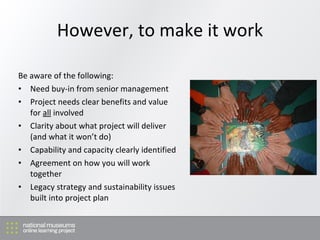
However, to make it work Be aware of the following: Need buy-in from senior management Project needs clear benefits and value for  all  involved Clarity about what project will deliver (and what it won’t do) Capability and capacity clearly identified Agreement on how you will work together Legacy strategy and sustainability issues built into project plan
Different types of partners It doesn’t always have to be other museums or galleries Work out what sort of organisation(s) will add value and fit with your wider strategic aims Don’t rule out commercial partners or organisations outside your sector
Variety of approaches Be creative with your partnership and ways of working Key Question: How can you get the most out of the partners and partnership? Phased approach Different contributions as part of a whole Smaller partnerships out of the larger partnership
NMOLP
Nine national museums British Museum Imperial War Museum Natural History Museum National Portrait Gallery Royal Armouries Sir John Soane’s Museum Tate Victoria and Albert Museum Wallace Collection
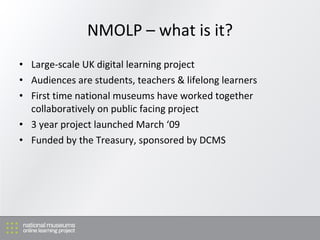
NMOLP – what is it? Large-scale UK digital learning project Audiences are students, teachers & lifelong learners First time national museums have worked together collaboratively on public facing project 3 year project launched March ‘09 Funded by the Treasury, sponsored by DCMS
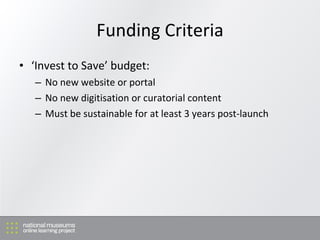
Funding Criteria ‘ Invest to Save’ budget: No new website or portal No new digitisation or curatorial content Must be sustainable for at least 3 years post-launch
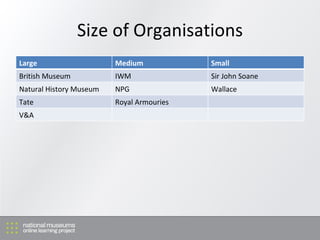
Size of Organisations Large Medium Small British Museum IWM Sir John Soane Natural History Museum NPG Wallace Tate Royal Armouries V&A
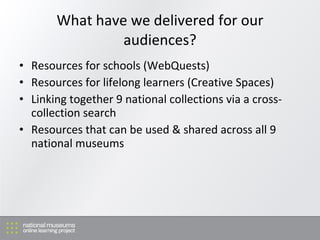
What have we delivered for our audiences? Resources for schools (WebQuests) Resources for lifelong learners (Creative Spaces) Linking together 9 national collections via a cross-collection search Resources that can be used & shared across all 9 national museums
This is what we made WebQuests Creative Spaces
Managing NMOLP partnership
Issues when I started Project plan written and funding allocated Partnership already determined by project funding T echnical solution promised but implementation not scoped out Content deliverables outlined but not fully defined
My approach Visited every partner for fact-finding Discovered d ifferent expectations about what the project would deliver for each partner: I nstitutional D epartmental Individuals
Key areas I focussed on Developing c ollective aims and objectives for project M anaging expectations from the start W hat this project will deliver and what it won’t deliver Establishing people’s commitment to the project Not just showing up at meetings – active participation Importance of deadlines to everyone Identifying the potential barriers to success for: Each institution Departments within institutions Individuals working on the project Legacy and sustainability
Why was this important? Partners needed to take responsibility for the project in their own institutions I couldn’t solve their institutional issues But we could discuss those issues which: Enabled us in many cases to find collective solutions and offer support Build relationships between partner representatives Ownership of project brought more commitment from partners
Building commitment Gaining commitment from people in the project: Assign different roles and responsibilities for people Different types of meetings Active involvement from partners Set realistic deadlines Acknowledge achievements along the way Be transparent about decisions PM is the leader of the project
Working with constraints Lots of constraints on this project: Number of stakeholders and meetings D ifferent capabilities and capacities T echnical differences C opyright restrictions Brand conflicts M arketing and PR conflicts S ustainability issues
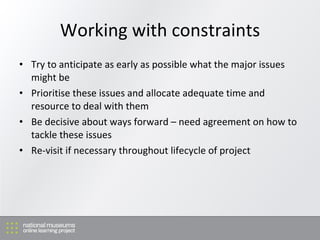
Working with constraints Try to anticipate as early as possible what the major issues might be Prioritise these issues and allocate adequate time and resource to deal with them Be decisive about ways forward  –  need agreement on how to tackle these issues Re-visit if necessary throughout lifecycle of project
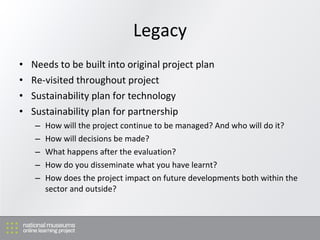
Legacy Needs to be built into original project plan R e-visited throughout project S ustainability plan for technology Sustainability plan for partnership H ow will the project continue to be managed?  A nd who will do it? How will decisions be made? What happens after the evaluation? How do you disseminate what you have learnt? How does the project impact on future developments both within the sector and outside?
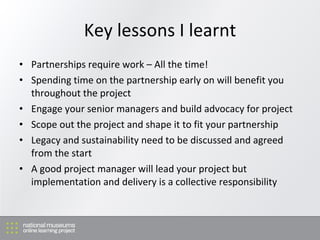
Key lessons I learnt Partnerships require work – All the time! Spending time on the partnership early on will benefit you throughout the project Engage your senior managers and build advocacy for project Scope out the project and shape it to fit your partnership Legacy and sustainability need to be discussed and agreed from the start A good project manager will lead your project but implementation and delivery is a collective responsibility
Carolyn Royston [email_address]

Working in Partnership: Benefits and Challenges

  • 1.
  • 2.
    Working in Partnership: Benefits and Challenges 10 June 2009 Carolyn Royston
  • 3.
    What this talkwill cover This talk is based on my recent experience with NMOLP: Benefits of working in partnership Working with the right partners Understanding your partnership – gaining commitment and working with constraints Some lessons learnt from NMOLP
  • 4.
    About me CurrentlyHead of New Media, IWM Project manager NMOLP until March 09 NMOLP was f irst time I had worked in the public sector Previously Head of e-Learning in a UK new media agency
  • 5.
  • 6.
    Benefits of workingin partnership Potential to add value and extend your existing offer Opportunities for shared knowledge and skills Can provide shared content and technology platform Provide new ways of working Springboard to genuine partnership working
  • 7.
    However, to makeit work Be aware of the following: Need buy-in from senior management Project needs clear benefits and value for all involved Clarity about what project will deliver (and what it won’t do) Capability and capacity clearly identified Agreement on how you will work together Legacy strategy and sustainability issues built into project plan
  • 8.
    Different types ofpartners It doesn’t always have to be other museums or galleries Work out what sort of organisation(s) will add value and fit with your wider strategic aims Don’t rule out commercial partners or organisations outside your sector
  • 9.
    Variety of approachesBe creative with your partnership and ways of working Key Question: How can you get the most out of the partners and partnership? Phased approach Different contributions as part of a whole Smaller partnerships out of the larger partnership
  • 10.
  • 11.
    Nine national museumsBritish Museum Imperial War Museum Natural History Museum National Portrait Gallery Royal Armouries Sir John Soane’s Museum Tate Victoria and Albert Museum Wallace Collection
  • 12.
    NMOLP – whatis it? Large-scale UK digital learning project Audiences are students, teachers & lifelong learners First time national museums have worked together collaboratively on public facing project 3 year project launched March ‘09 Funded by the Treasury, sponsored by DCMS
  • 13.
    Funding Criteria ‘Invest to Save’ budget: No new website or portal No new digitisation or curatorial content Must be sustainable for at least 3 years post-launch
  • 14.
    Size of OrganisationsLarge Medium Small British Museum IWM Sir John Soane Natural History Museum NPG Wallace Tate Royal Armouries V&A
  • 15.
    What have wedelivered for our audiences? Resources for schools (WebQuests) Resources for lifelong learners (Creative Spaces) Linking together 9 national collections via a cross-collection search Resources that can be used & shared across all 9 national museums
  • 16.
    This is whatwe made WebQuests Creative Spaces
  • 17.
  • 18.
    Issues when Istarted Project plan written and funding allocated Partnership already determined by project funding T echnical solution promised but implementation not scoped out Content deliverables outlined but not fully defined
  • 19.
    My approach Visitedevery partner for fact-finding Discovered d ifferent expectations about what the project would deliver for each partner: I nstitutional D epartmental Individuals
  • 20.
    Key areas Ifocussed on Developing c ollective aims and objectives for project M anaging expectations from the start W hat this project will deliver and what it won’t deliver Establishing people’s commitment to the project Not just showing up at meetings – active participation Importance of deadlines to everyone Identifying the potential barriers to success for: Each institution Departments within institutions Individuals working on the project Legacy and sustainability
  • 21.
    Why was thisimportant? Partners needed to take responsibility for the project in their own institutions I couldn’t solve their institutional issues But we could discuss those issues which: Enabled us in many cases to find collective solutions and offer support Build relationships between partner representatives Ownership of project brought more commitment from partners
  • 22.
    Building commitment Gainingcommitment from people in the project: Assign different roles and responsibilities for people Different types of meetings Active involvement from partners Set realistic deadlines Acknowledge achievements along the way Be transparent about decisions PM is the leader of the project
  • 23.
    Working with constraintsLots of constraints on this project: Number of stakeholders and meetings D ifferent capabilities and capacities T echnical differences C opyright restrictions Brand conflicts M arketing and PR conflicts S ustainability issues
  • 24.
    Working with constraintsTry to anticipate as early as possible what the major issues might be Prioritise these issues and allocate adequate time and resource to deal with them Be decisive about ways forward – need agreement on how to tackle these issues Re-visit if necessary throughout lifecycle of project
  • 25.
    Legacy Needs tobe built into original project plan R e-visited throughout project S ustainability plan for technology Sustainability plan for partnership H ow will the project continue to be managed? A nd who will do it? How will decisions be made? What happens after the evaluation? How do you disseminate what you have learnt? How does the project impact on future developments both within the sector and outside?
  • 26.
    Key lessons Ilearnt Partnerships require work – All the time! Spending time on the partnership early on will benefit you throughout the project Engage your senior managers and build advocacy for project Scope out the project and shape it to fit your partnership Legacy and sustainability need to be discussed and agreed from the start A good project manager will lead your project but implementation and delivery is a collective responsibility
  • 27.