PRESENTED BY:
KAUSHIK GOHIL
ENROLL. NO. 157550592038
DAHEJ MANUFACTUR DIVISION
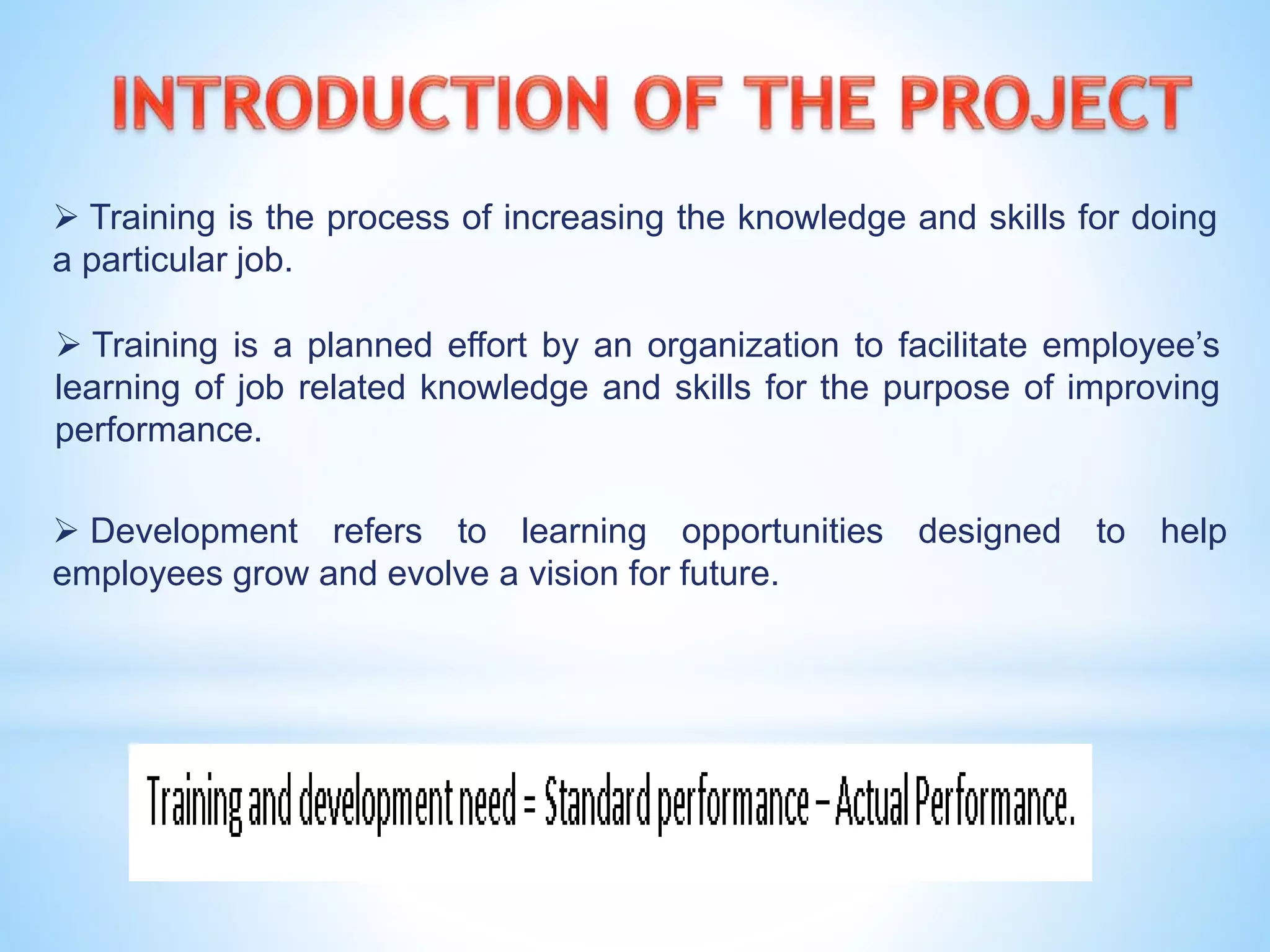
 Training is the process of increasing the knowledge and skills for doing
a particular job.
 Training is a planned effort by an organization to facilitate employee’s
learning of job related knowledge and skills for the purpose of improving
performance.
 Development refers to learning opportunities designed to help
employees grow and evolve a vision for future.
 Reliance Industries Limited (RIL) is India’s largest private sector
company
 RIL Ranked 107 in terms of revenues and 128 in terms of profits.
 Reliance Industries is one of the major players in the petrochemical
sector in India
 RIL contributes approximately 20 % of India’s total exports.
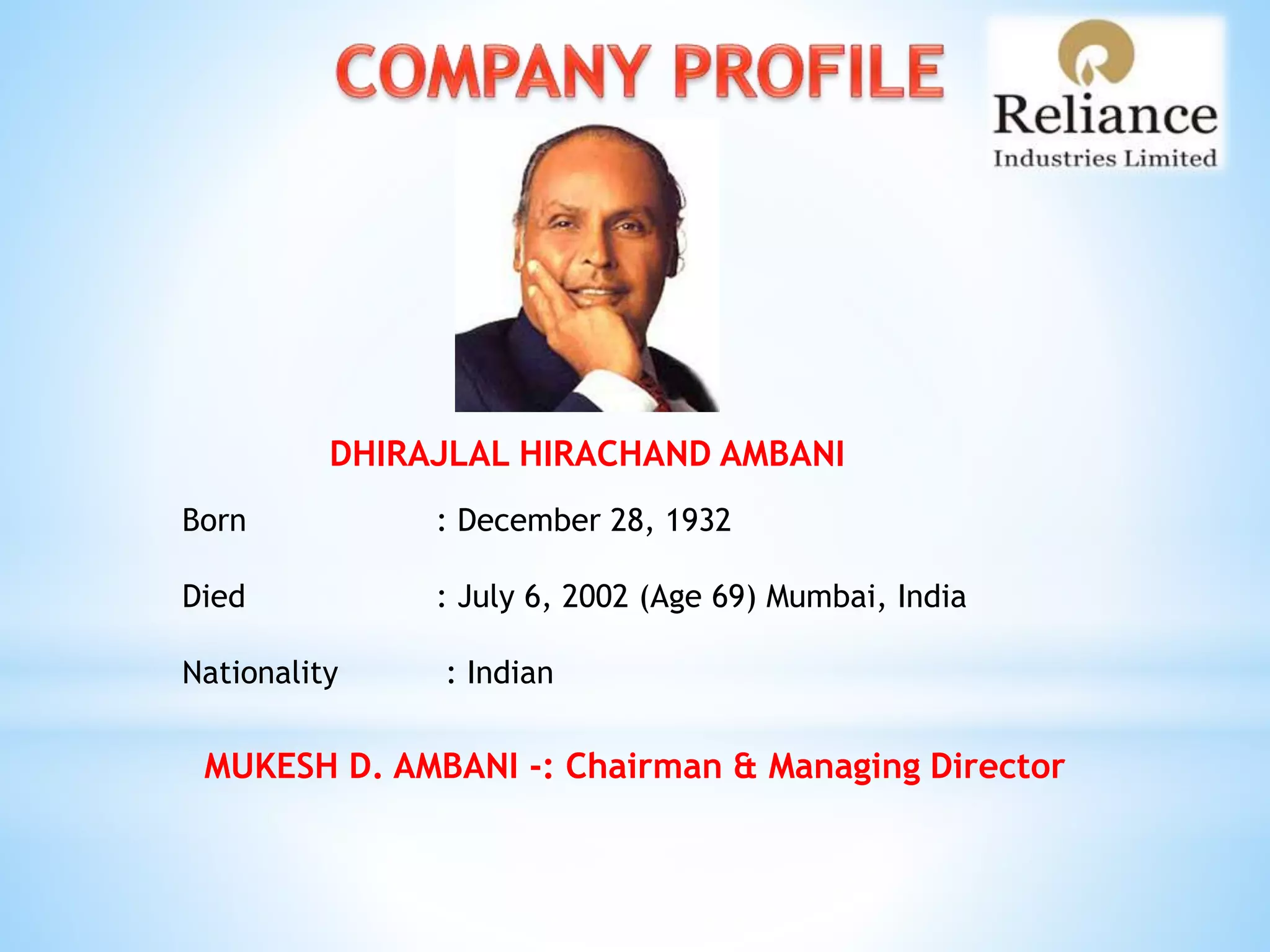
DHIRAJLAL HIRACHAND AMBANI
Born : December 28, 1932
Died : July 6, 2002 (Age 69) Mumbai, India
Nationality : Indian
MUKESH D. AMBANI -: Chairman & Managing Director
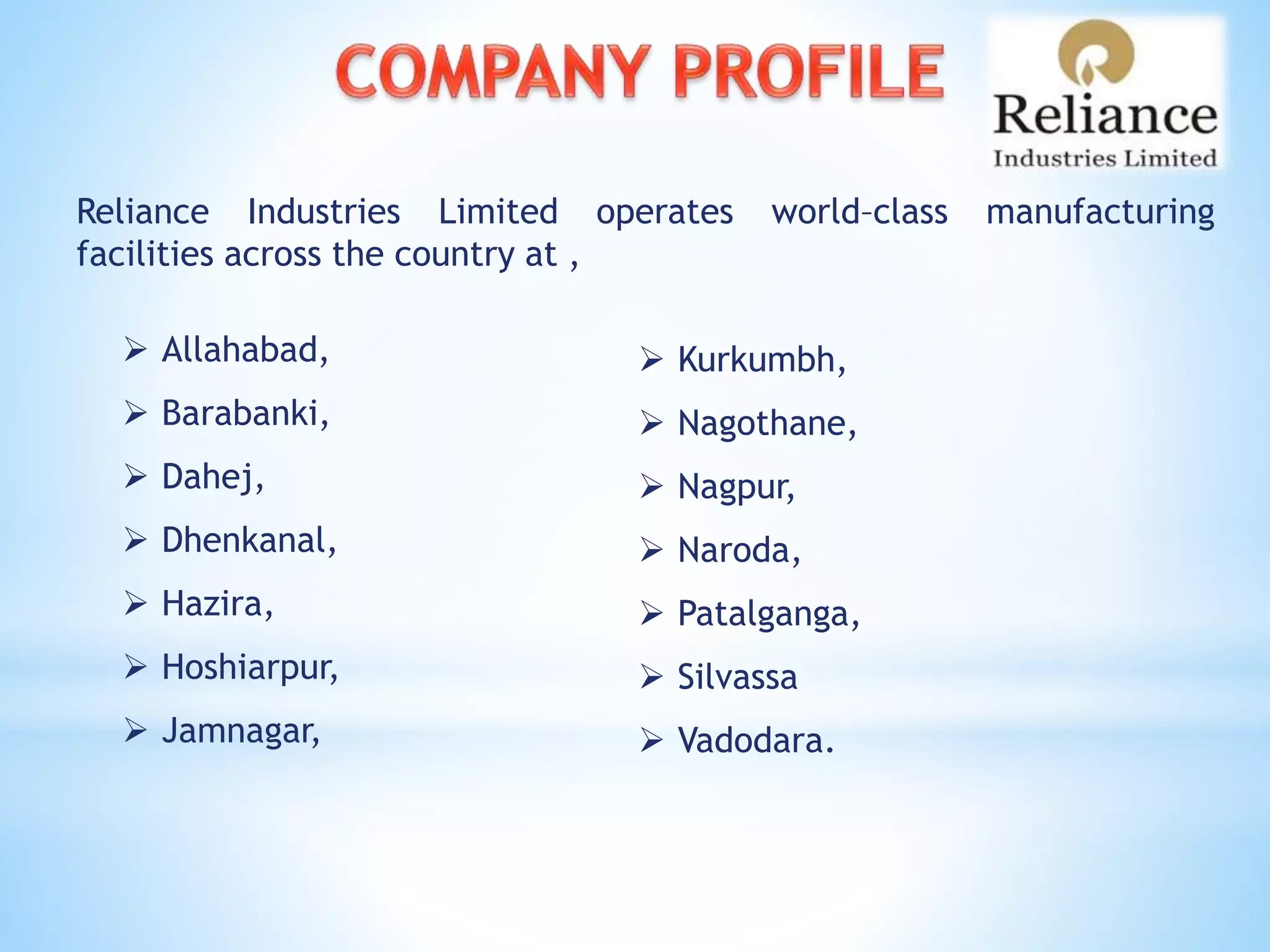
Reliance Industries Limited operates world–class manufacturing
facilities across the country at ,
 Allahabad,
 Barabanki,
 Dahej,
 Dhenkanal,
 Hazira,
 Hoshiarpur,
 Jamnagar,
 Kurkumbh,
 Nagothane,
 Nagpur,
 Naroda,
 Patalganga,
 Silvassa
 Vadodara.
The company works under different business segments:
 Petroleum Refining and Marketing
 Petrochemical
 Textiles
 Retail
 Jio
Reliance industries are following method using by providing training her
employee :
1. Class room Training:
2. Web based Training:
TYPES OF TRAINING In RIL
1. Mandatory Training
2. Behaviour Training
3. Un plan Training
4. High Power Training
Other Development Pogroms :
1. Emerald
2. R-University
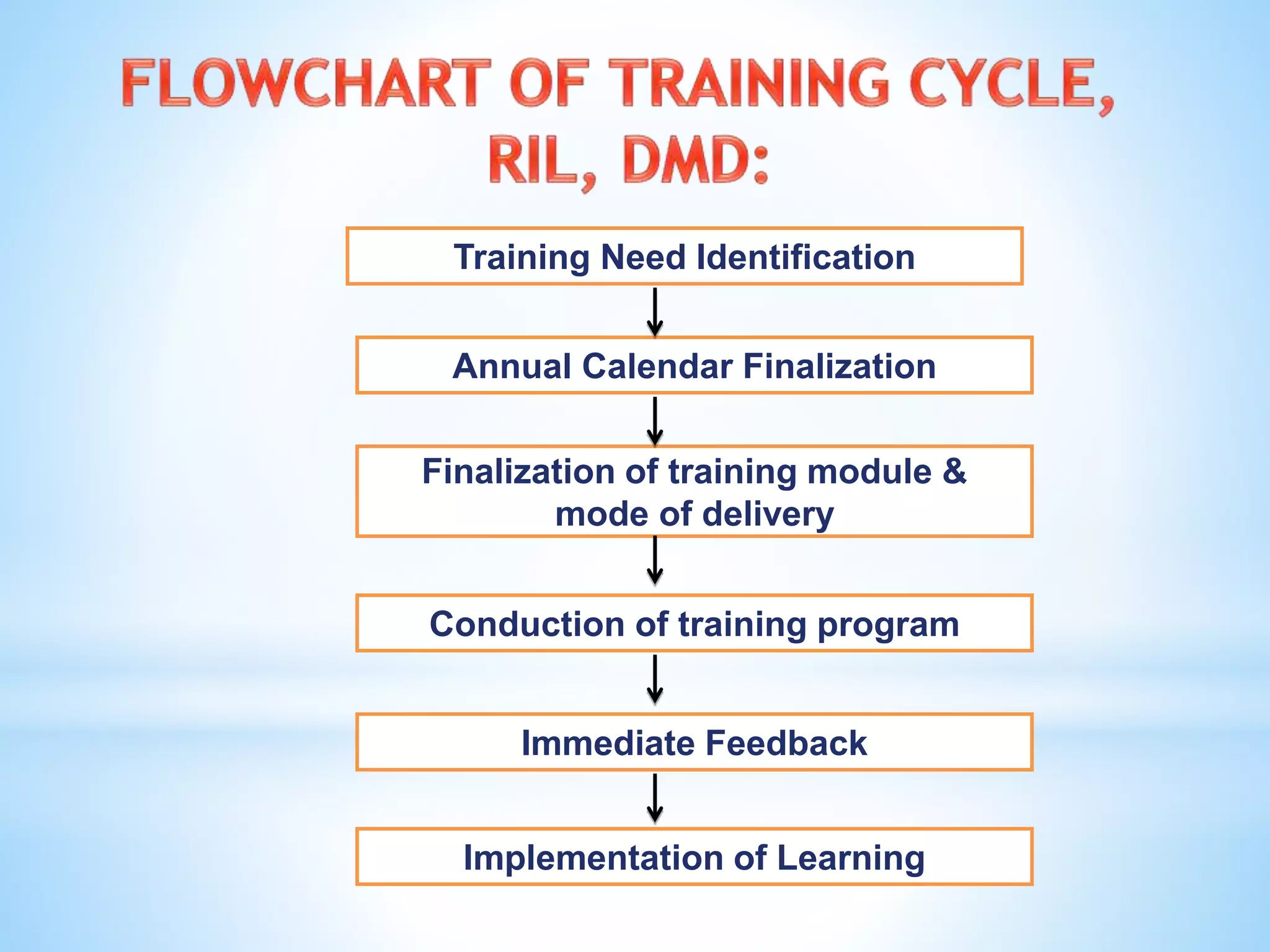
Training Need Identification
Annual Calendar Finalization
Finalization of training module &
mode of delivery
Conduction of training program
Immediate Feedback
Implementation of Learning
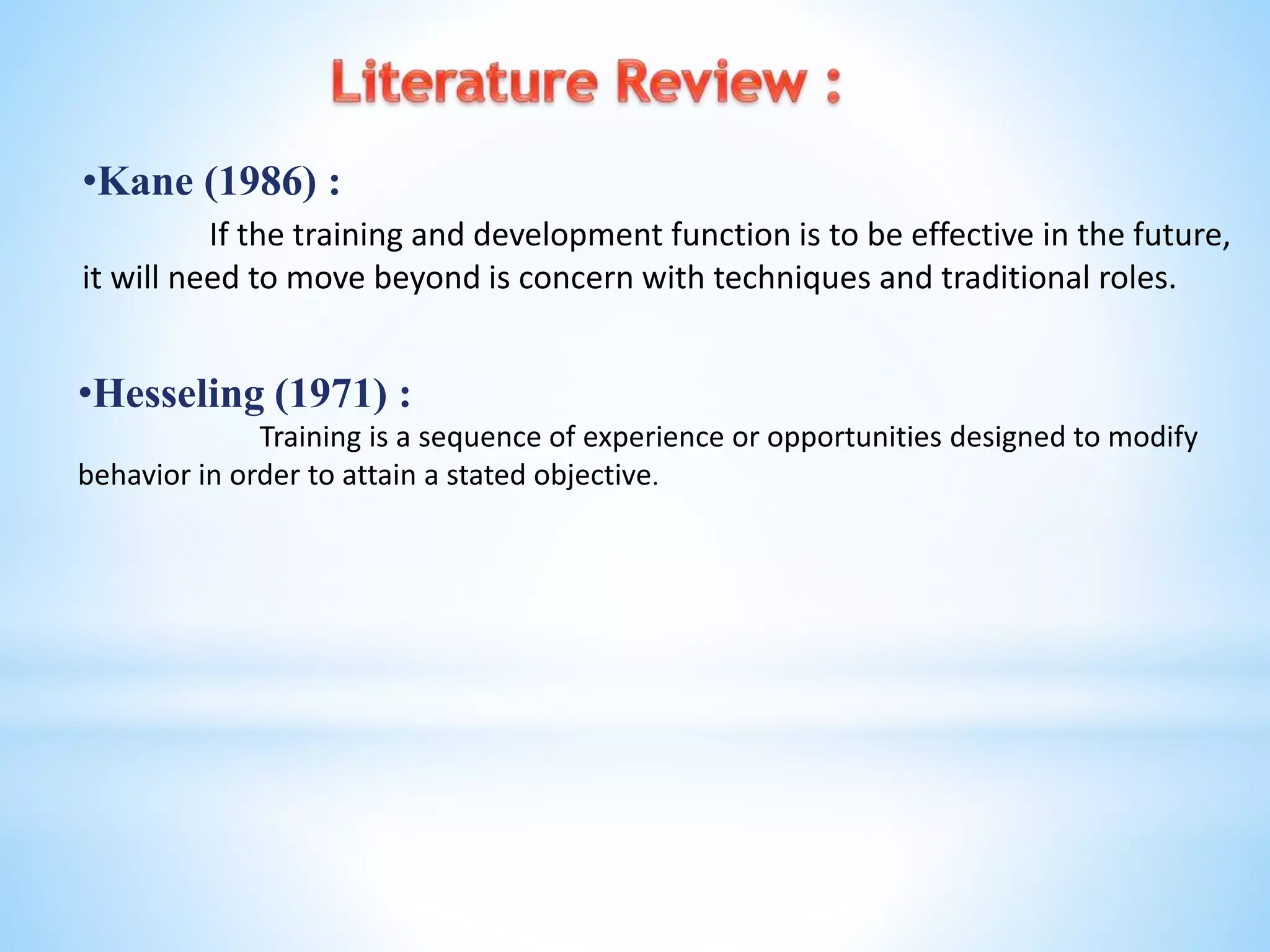
•Kane (1986) :
If the training and development function is to be effective in the future,
it will need to move beyond is concern with techniques and traditional roles.
•Hesseling (1971) :
Training is a sequence of experience or opportunities designed to modify
behavior in order to attain a stated objective.
Objectives of the study
To study training and development at RIL, DMD.
To Know the satisfaction level of the employees related to training
and development at RIL.
To find out the training and development cycle and types.
To find out the training and development effectiveness.
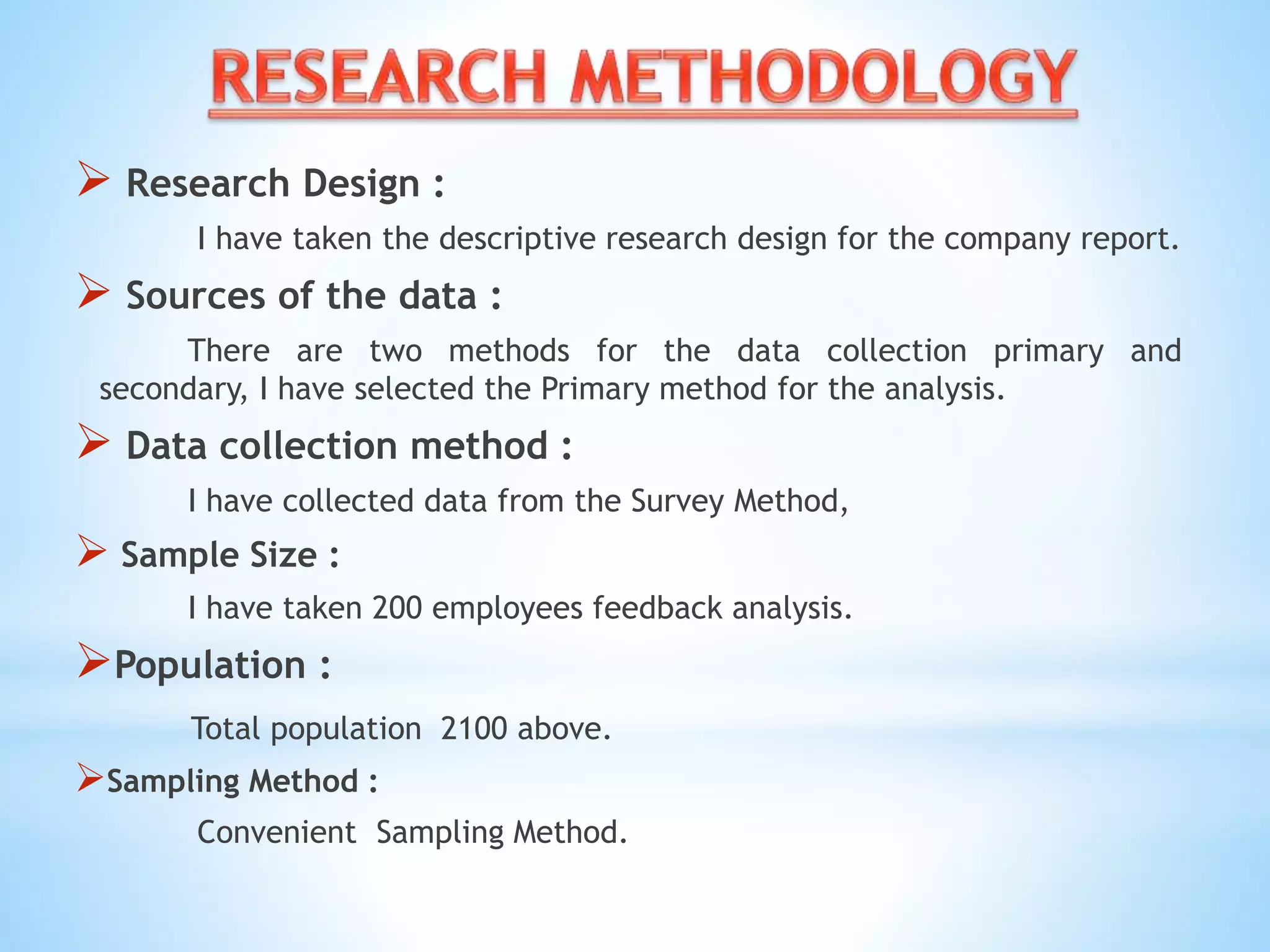
 Research Design :
I have taken the descriptive research design for the company report.
 Sources of the data :
There are two methods for the data collection primary and
secondary, I have selected the Primary method for the analysis.
 Data collection method :
I have collected data from the Survey Method,
 Sample Size :
I have taken 200 employees feedback analysis.
Population :
Total population 2100 above.
Sampling Method :
Convenient Sampling Method.
Limitation of the Study
1. I have taken only Current years data for the analysis and the
interpretation so it is little difficult to compare and the
findings the results and the conclusion.
2. Some information being very sensitive as far as organization
is concerned with left untouched and not mentioned in any
way.
3. Top-level strategic type of decisions and information too are
not taken under study to avoid any favour to the business
counter parts.
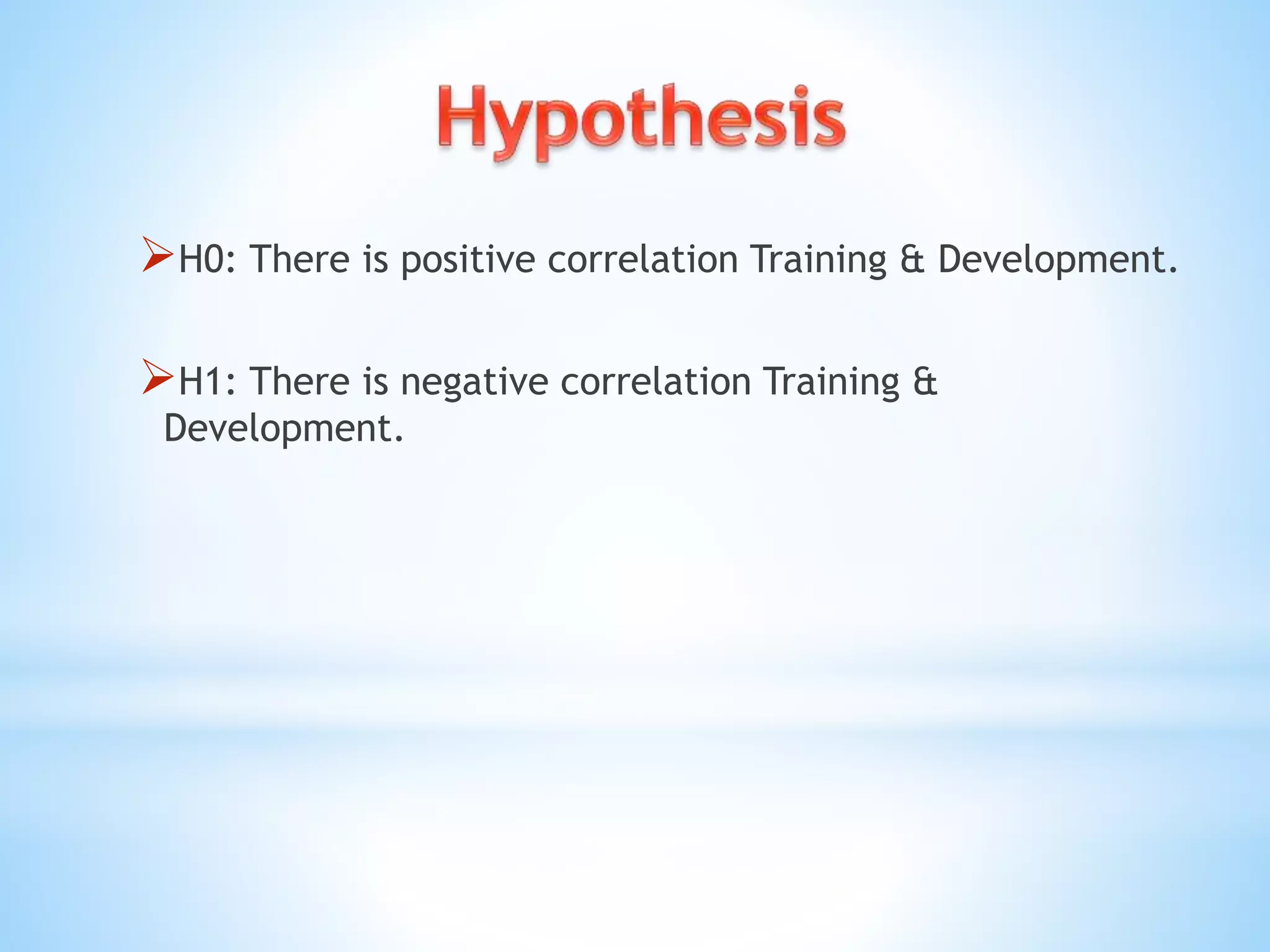
H0: There is positive correlation Training & Development.
H1: There is negative correlation Training &
Development.
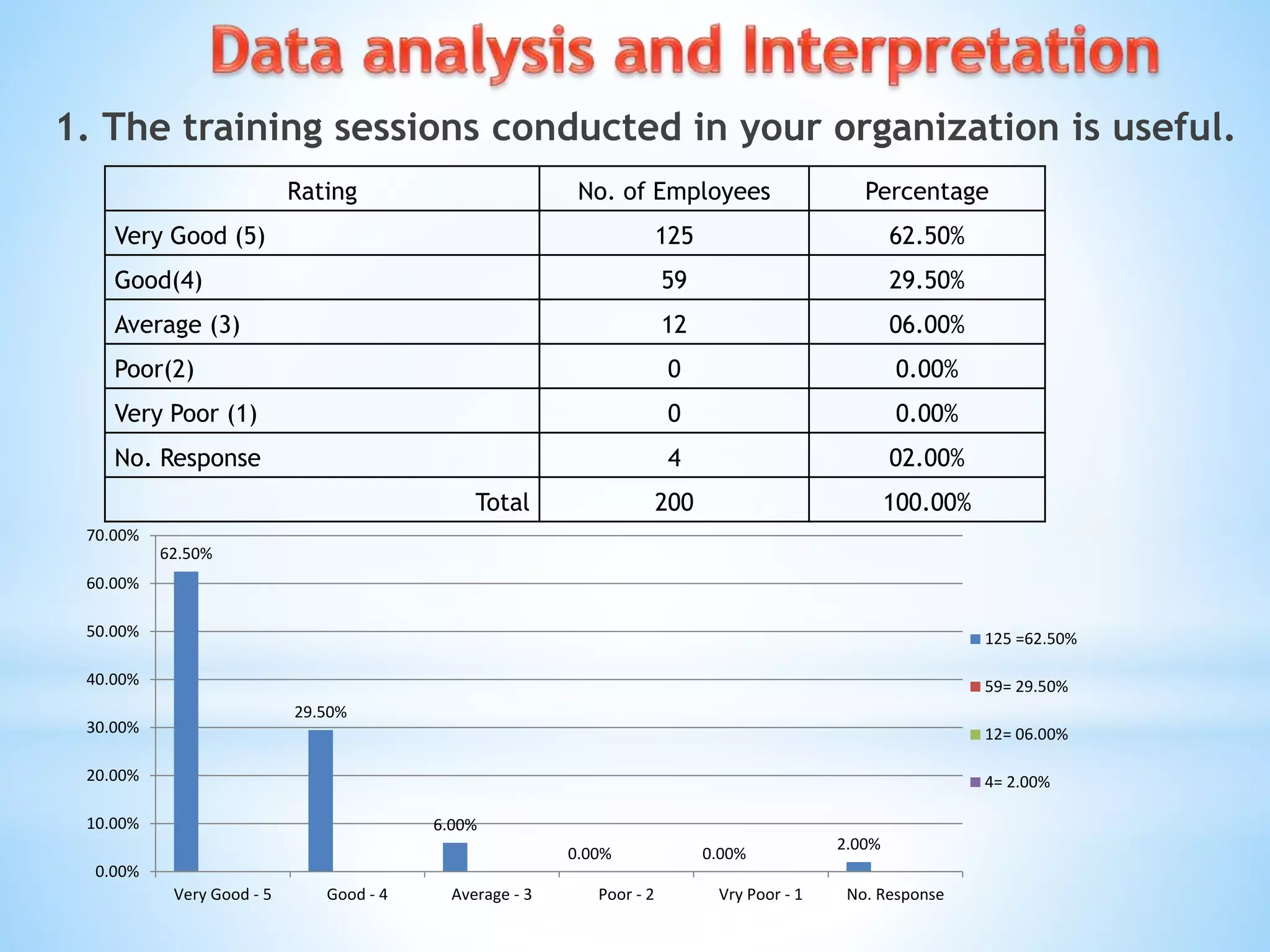
1. The training sessions conducted in your organization is useful.
Rating No. of Employees Percentage
Very Good (5) 125 62.50%
Good(4) 59 29.50%
Average (3) 12 06.00%
Poor(2) 0 0.00%
Very Poor (1) 0 0.00%
No. Response 4 02.00%
Total 200 100.00%
62.50%
29.50%
6.00%
0.00% 0.00%
2.00%
0.00%
10.00%
20.00%
30.00%
40.00%
50.00%
60.00%
70.00%
Very Good - 5 Good - 4 Average - 3 Poor - 2 Vry Poor - 1 No. Response
125 =62.50%
59= 29.50%
12= 06.00%
4= 2.00%
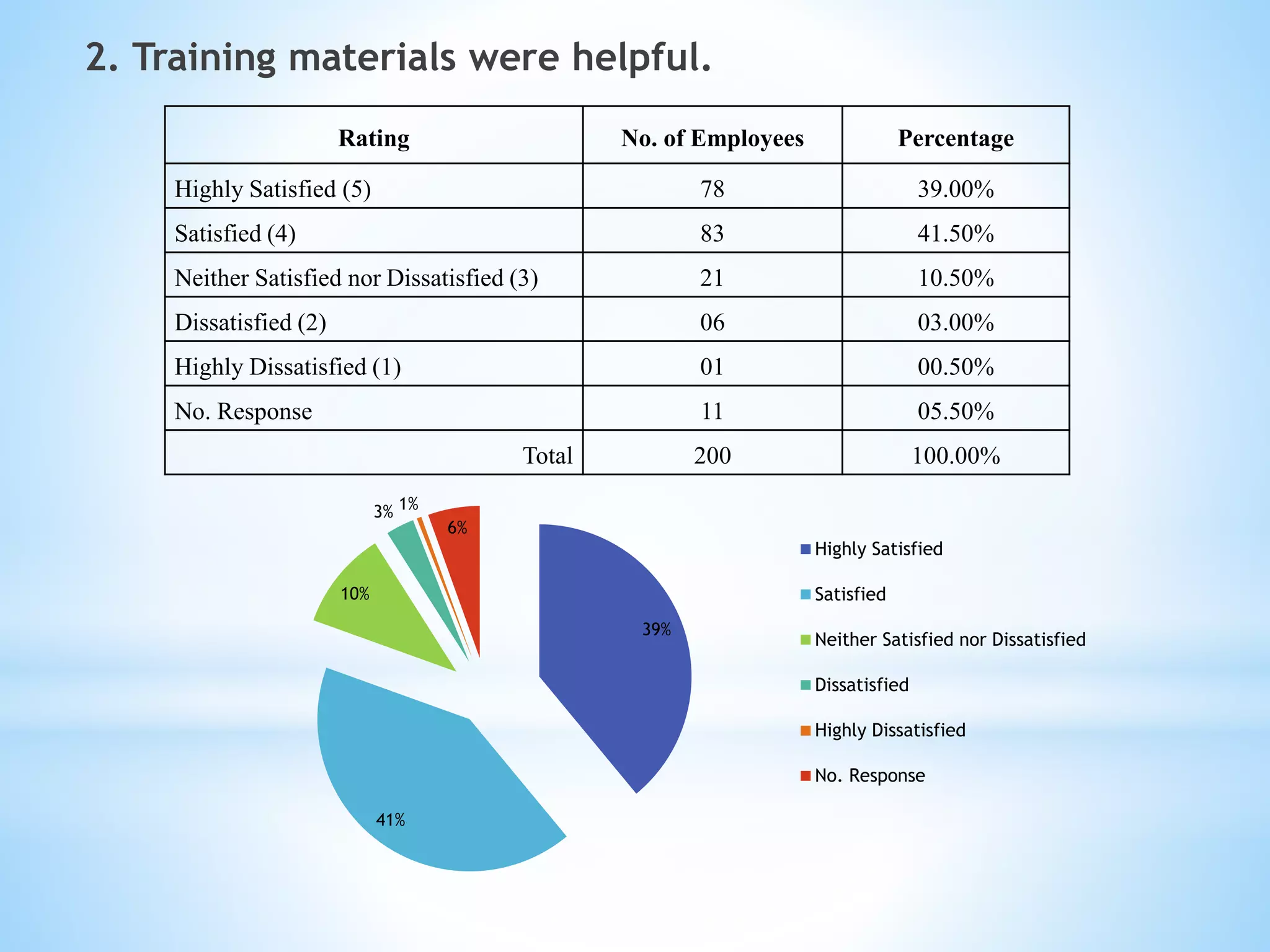
2. Training materials were helpful.
Rating No. of Employees Percentage
Highly Satisfied (5) 78 39.00%
Satisfied (4) 83 41.50%
Neither Satisfied nor Dissatisfied (3) 21 10.50%
Dissatisfied (2) 06 03.00%
Highly Dissatisfied (1) 01 00.50%
No. Response 11 05.50%
Total 200 100.00%
39%
41%
10%
3% 1%
6%
Highly Satisfied
Satisfied
Neither Satisfied nor Dissatisfied
Dissatisfied
Highly Dissatisfied
No. Response
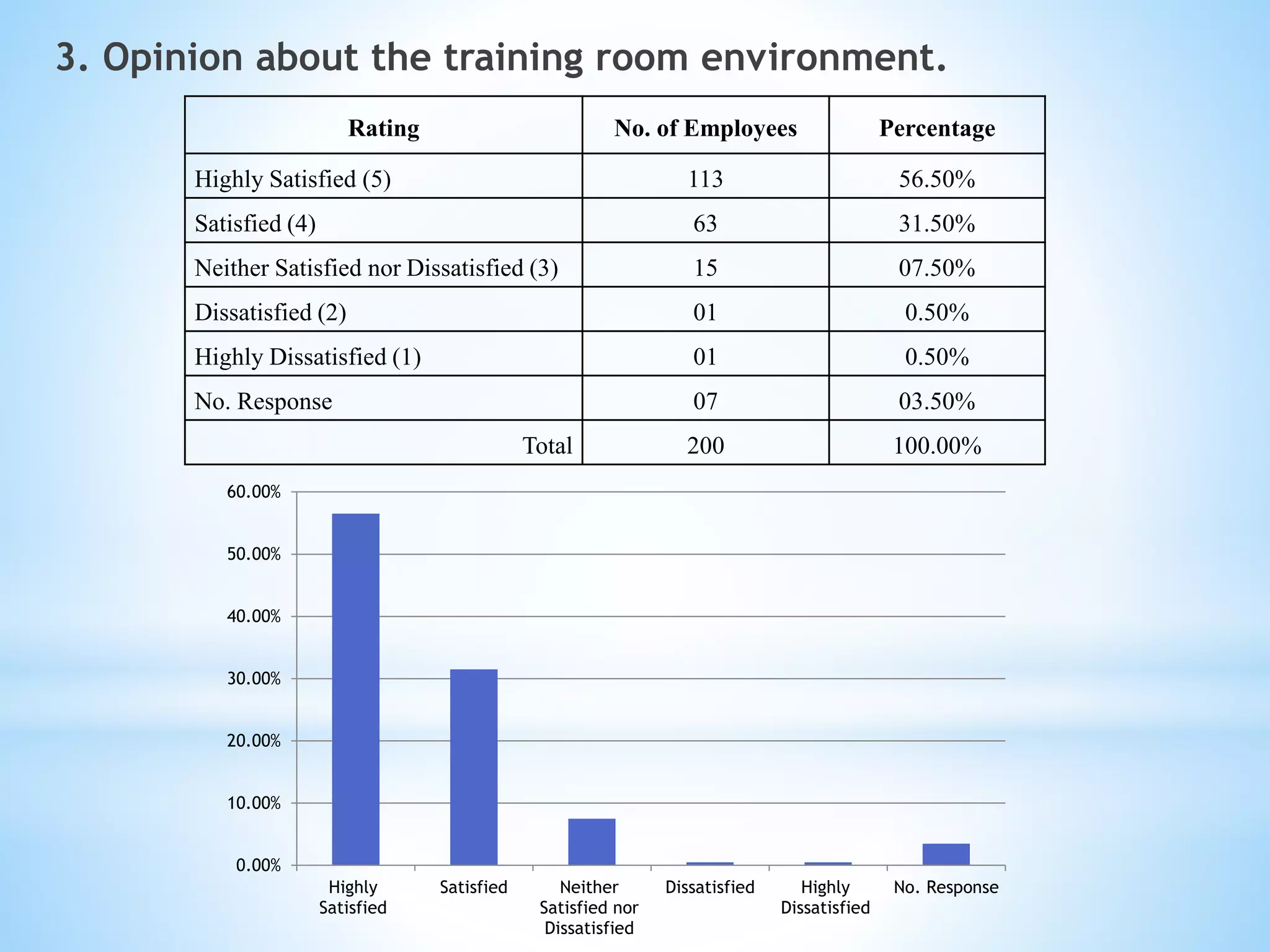
3. Opinion about the training room environment.
0.00%
10.00%
20.00%
30.00%
40.00%
50.00%
60.00%
Highly
Satisfied
Satisfied Neither
Satisfied nor
Dissatisfied
Dissatisfied Highly
Dissatisfied
No. Response
Rating No. of Employees Percentage
Highly Satisfied (5) 113 56.50%
Satisfied (4) 63 31.50%
Neither Satisfied nor Dissatisfied (3) 15 07.50%
Dissatisfied (2) 01 0.50%
Highly Dissatisfied (1) 01 0.50%
No. Response 07 03.50%
Total 200 100.00%
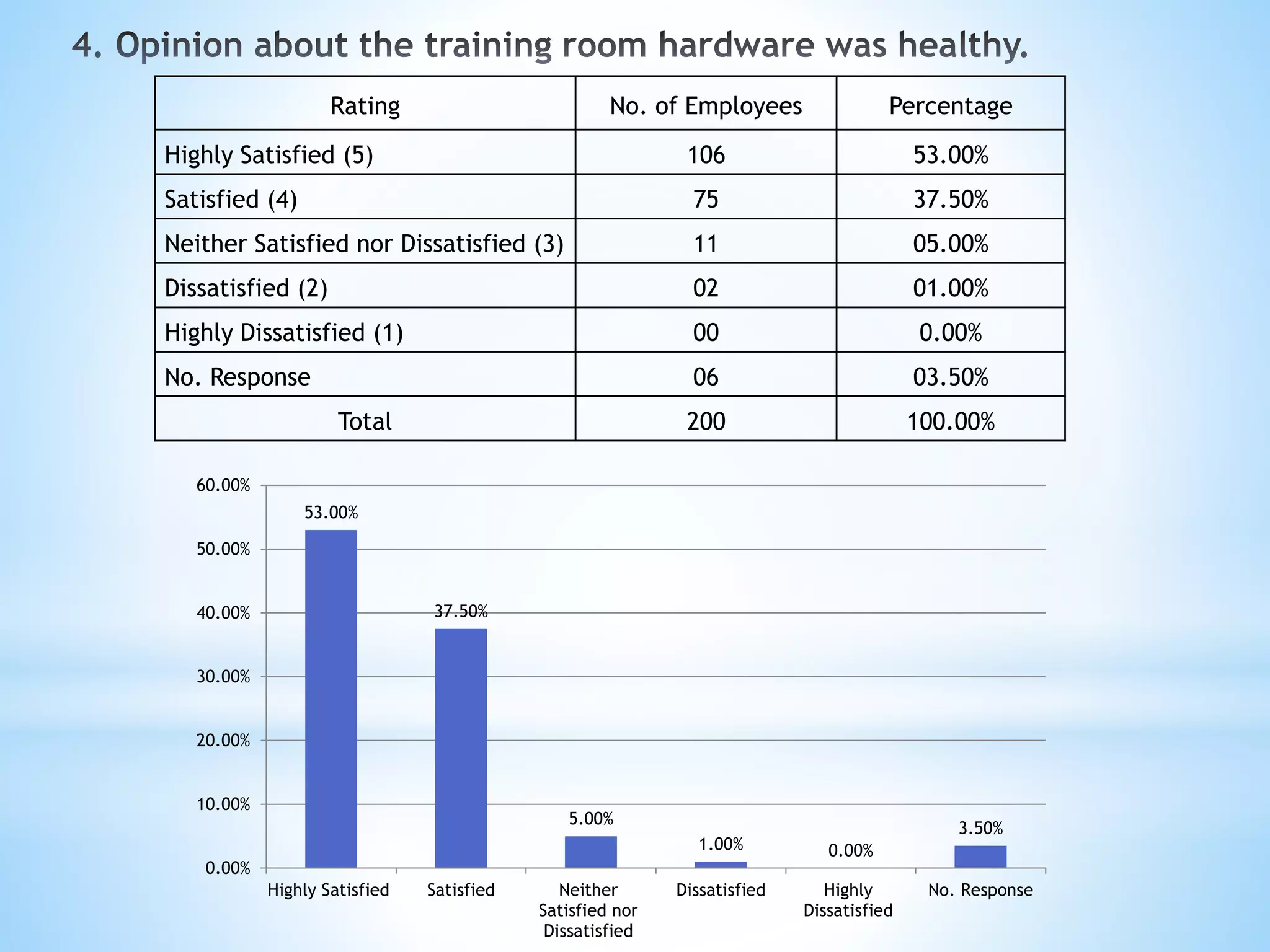
Rating No. of Employees Percentage
Highly Satisfied (5) 106 53.00%
Satisfied (4) 75 37.50%
Neither Satisfied nor Dissatisfied (3) 11 05.00%
Dissatisfied (2) 02 01.00%
Highly Dissatisfied (1) 00 0.00%
No. Response 06 03.50%
Total 200 100.00%
53.00%
37.50%
5.00%
1.00% 0.00%
3.50%
0.00%
10.00%
20.00%
30.00%
40.00%
50.00%
60.00%
Highly Satisfied Satisfied Neither
Satisfied nor
Dissatisfied
Dissatisfied Highly
Dissatisfied
No. Response
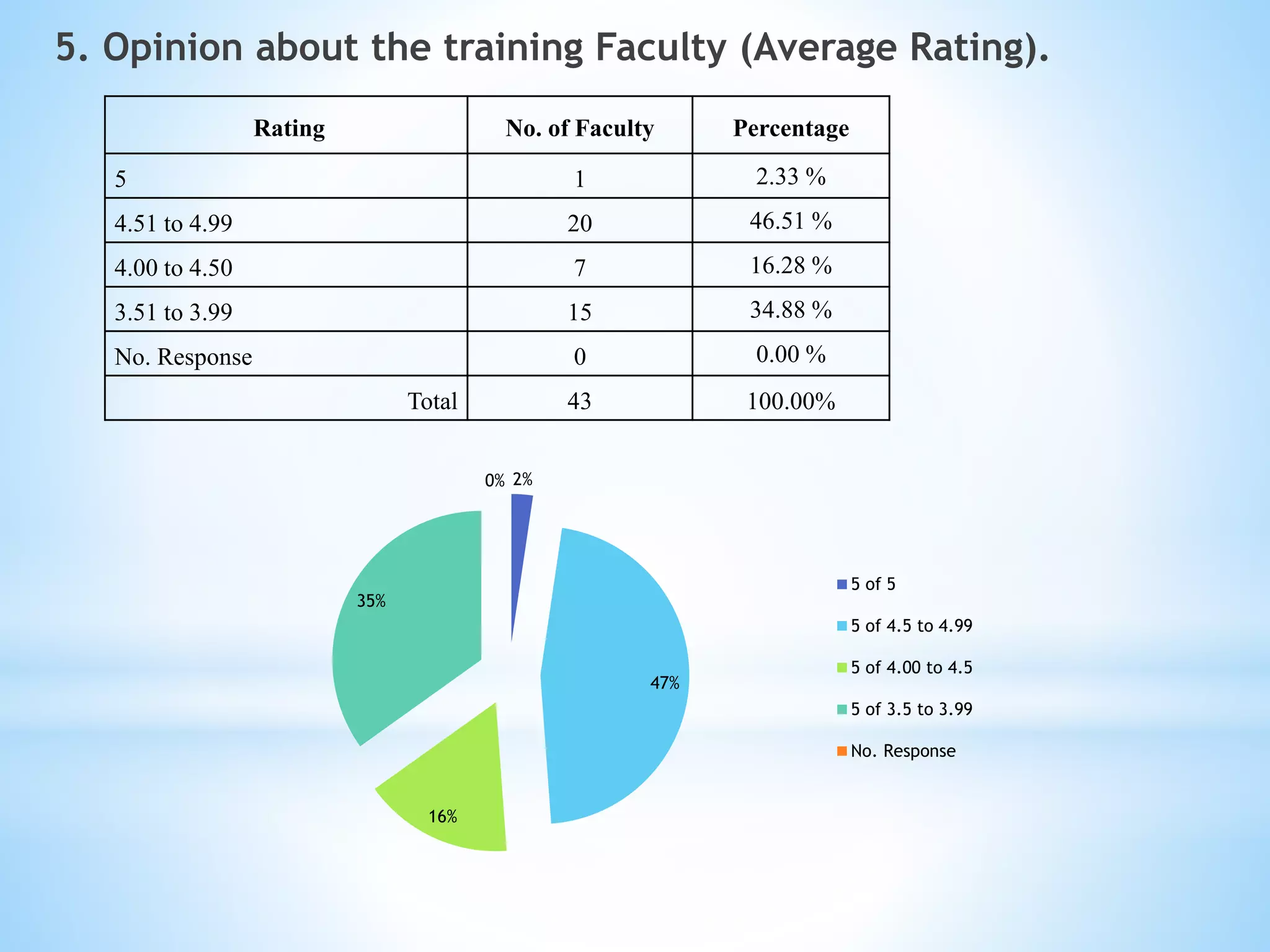
5. Opinion about the training Faculty (Average Rating).
Rating No. of Faculty Percentage
5 1 2.33 %
4.51 to 4.99 20 46.51 %
4.00 to 4.50 7 16.28 %
3.51 to 3.99 15 34.88 %
No. Response 0 0.00 %
Total 43 100.00%
2%
47%
16%
35%
0%
5 of 5
5 of 4.5 to 4.99
5 of 4.00 to 4.5
5 of 3.5 to 3.99
No. Response
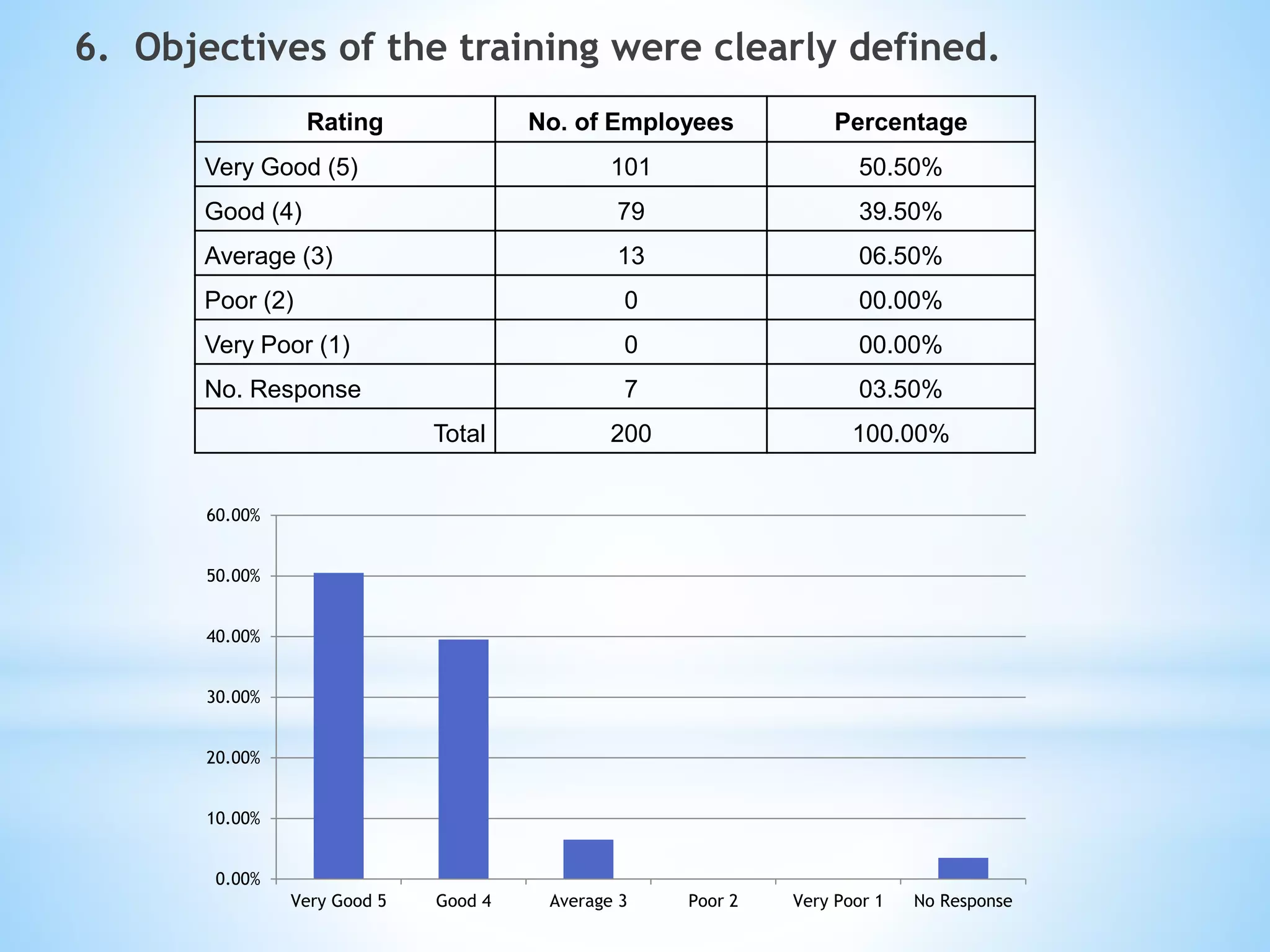
6. Objectives of the training were clearly defined.
Rating No. of Employees Percentage
Very Good (5) 101 50.50%
Good (4) 79 39.50%
Average (3) 13 06.50%
Poor (2) 0 00.00%
Very Poor (1) 0 00.00%
No. Response 7 03.50%
Total 200 100.00%
0.00%
10.00%
20.00%
30.00%
40.00%
50.00%
60.00%
Very Good 5 Good 4 Average 3 Poor 2 Very Poor 1 No Response
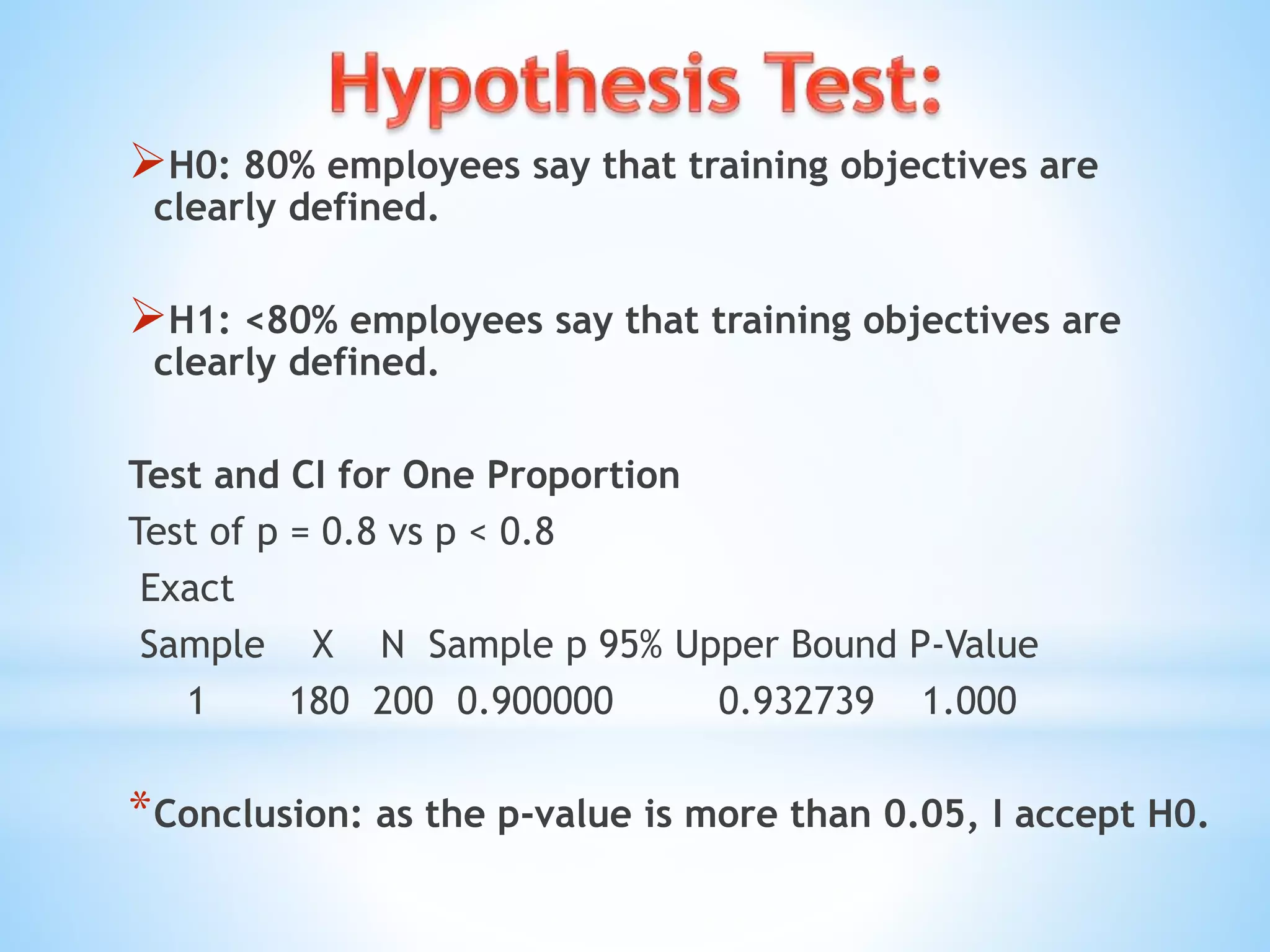
H0: 80% employees say that training objectives are
clearly defined.
H1: <80% employees say that training objectives are
clearly defined.
Test and CI for One Proportion
Test of p = 0.8 vs p < 0.8
Exact
Sample X N Sample p 95% Upper Bound P-Value
1 180 200 0.900000 0.932739 1.000
*Conclusion: as the p-value is more than 0.05, I accept H0.
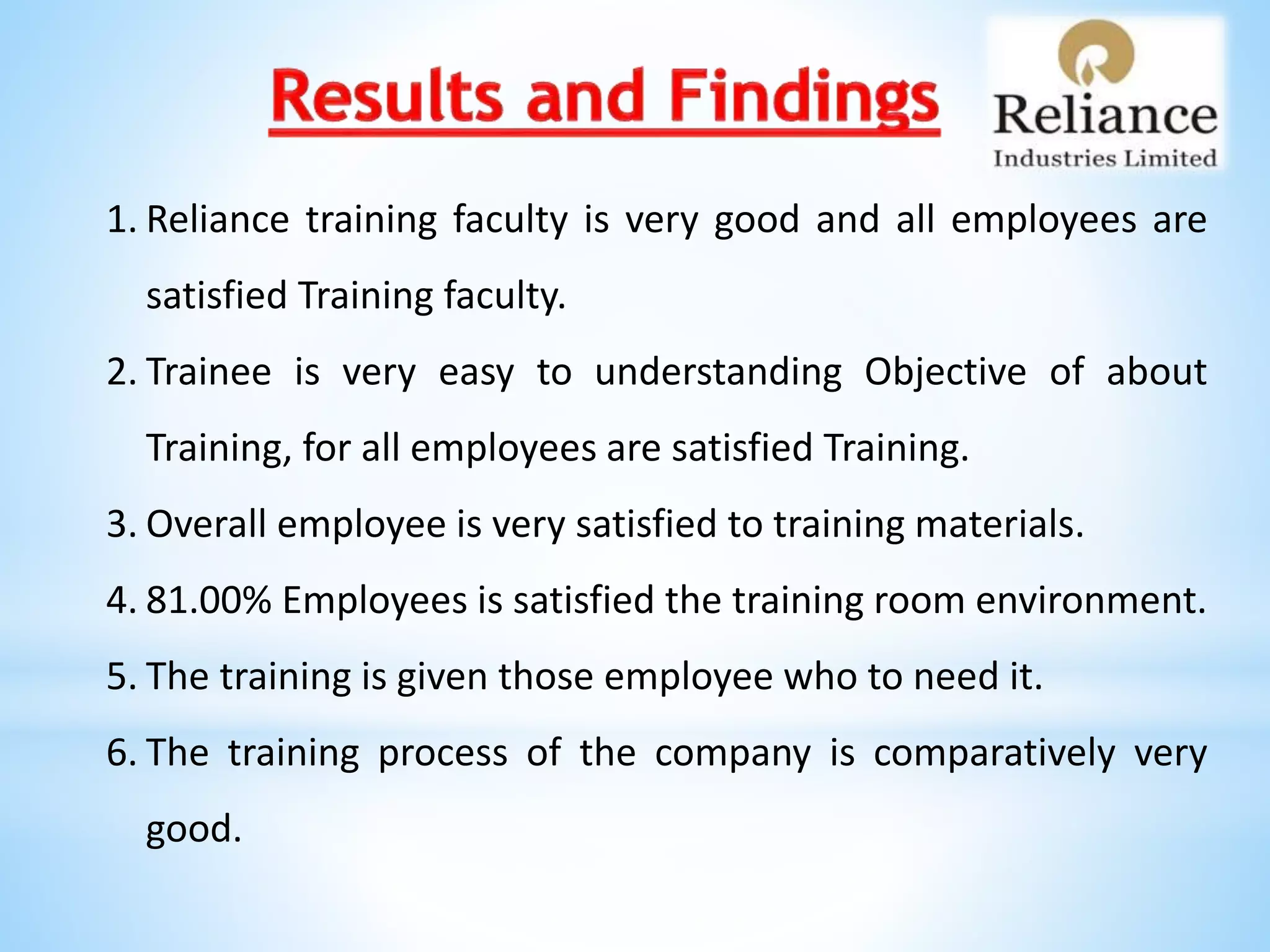
1. Reliance training faculty is very good and all employees are
satisfied Training faculty.
2. Trainee is very easy to understanding Objective of about
Training, for all employees are satisfied Training.
3. Overall employee is very satisfied to training materials.
4. 81.00% Employees is satisfied the training room environment.
5. The training is given those employee who to need it.
6. The training process of the company is comparatively very
good.
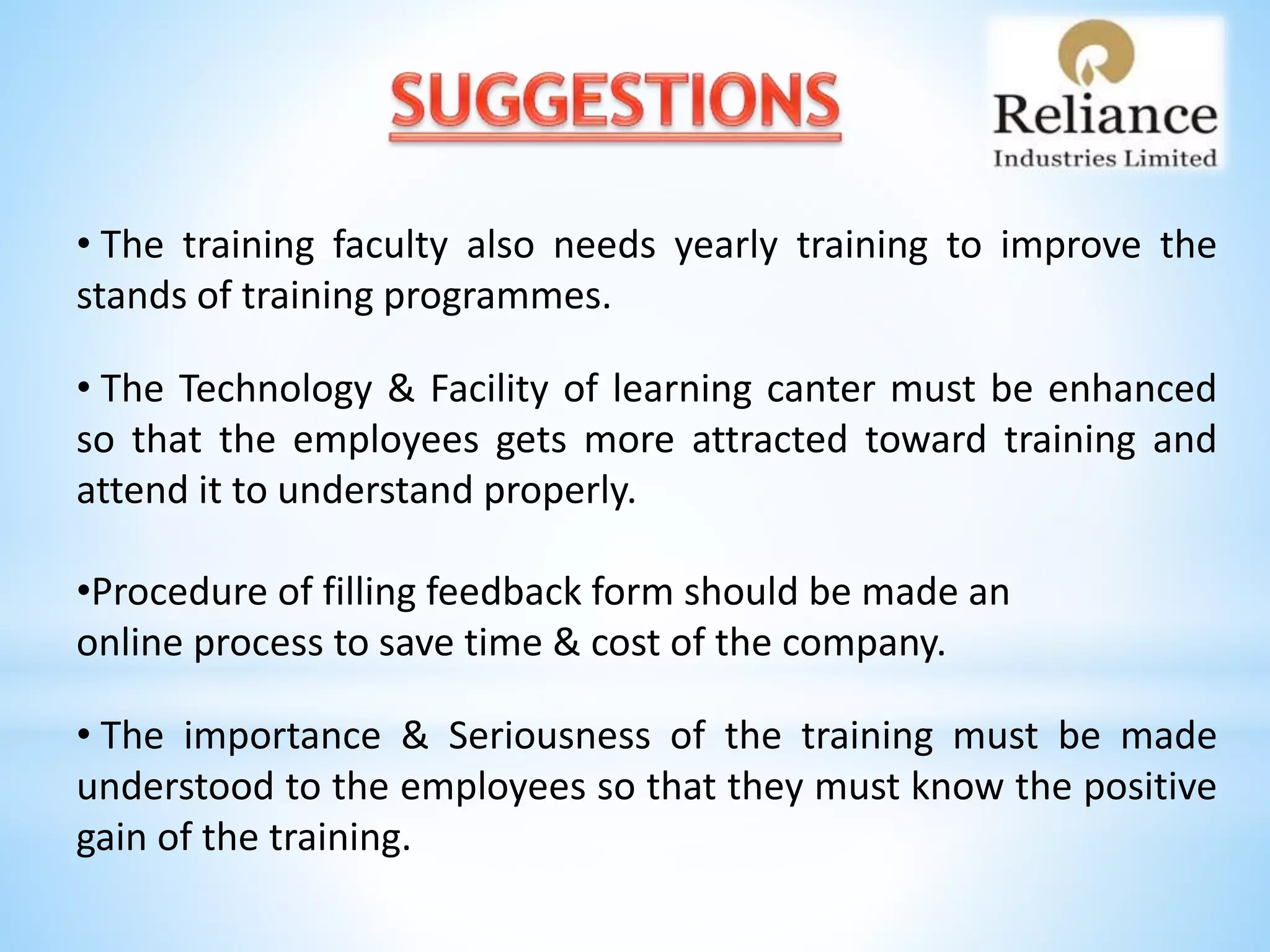
• The training faculty also needs yearly training to improve the
stands of training programmes.
• The Technology & Facility of learning canter must be enhanced
so that the employees gets more attracted toward training and
attend it to understand properly.
•Procedure of filling feedback form should be made an
online process to save time & cost of the company.
• The importance & Seriousness of the training must be made
understood to the employees so that they must know the positive
gain of the training.
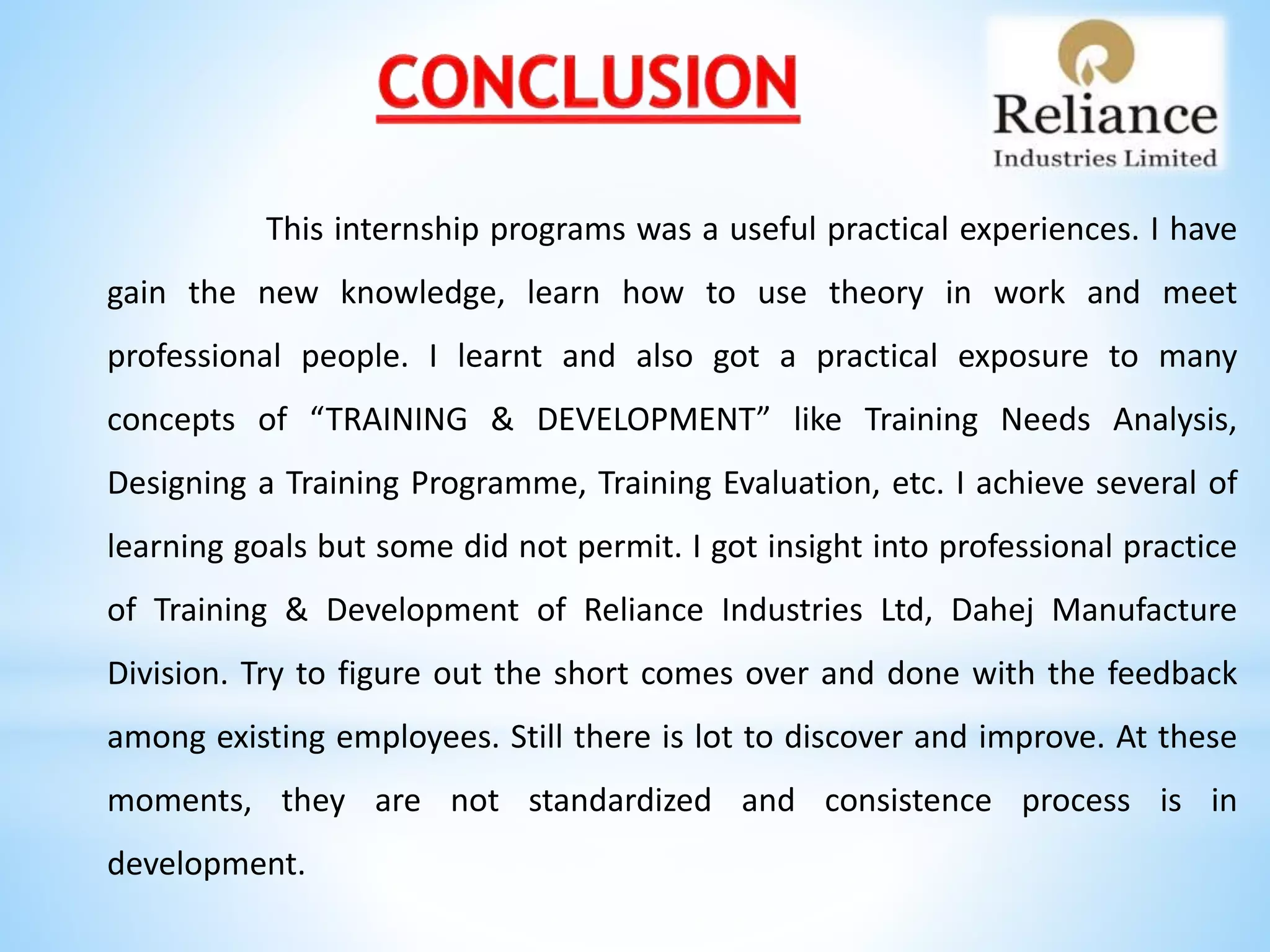
This internship programs was a useful practical experiences. I have
gain the new knowledge, learn how to use theory in work and meet
professional people. I learnt and also got a practical exposure to many
concepts of “TRAINING & DEVELOPMENT” like Training Needs Analysis,
Designing a Training Programme, Training Evaluation, etc. I achieve several of
learning goals but some did not permit. I got insight into professional practice
of Training & Development of Reliance Industries Ltd, Dahej Manufacture
Division. Try to figure out the short comes over and done with the feedback
among existing employees. Still there is lot to discover and improve. At these
moments, they are not standardized and consistence process is in
development.
BIBILIOGRAPHY
1. Books:
Business Research Methodology, Author- Donald R Cooper and Pamela S
Schindler
Human Resource Management, Author- Gargy Dessler and Bijub Varkkery
2. Websites:
 www.ril.com
www.wikipedia.com
www.slideshare.net
www.profit.ndtv.com
www.ukessays.com
SIP 2038

SIP 2038

  • 1.
    PRESENTED BY: KAUSHIK GOHIL ENROLL.NO. 157550592038 DAHEJ MANUFACTUR DIVISION
  • 2.
     Training isthe process of increasing the knowledge and skills for doing a particular job.  Training is a planned effort by an organization to facilitate employee’s learning of job related knowledge and skills for the purpose of improving performance.  Development refers to learning opportunities designed to help employees grow and evolve a vision for future.
  • 3.
     Reliance IndustriesLimited (RIL) is India’s largest private sector company  RIL Ranked 107 in terms of revenues and 128 in terms of profits.  Reliance Industries is one of the major players in the petrochemical sector in India  RIL contributes approximately 20 % of India’s total exports.
  • 4.
    DHIRAJLAL HIRACHAND AMBANI Born: December 28, 1932 Died : July 6, 2002 (Age 69) Mumbai, India Nationality : Indian MUKESH D. AMBANI -: Chairman & Managing Director
  • 5.
    Reliance Industries Limitedoperates world–class manufacturing facilities across the country at ,  Allahabad,  Barabanki,  Dahej,  Dhenkanal,  Hazira,  Hoshiarpur,  Jamnagar,  Kurkumbh,  Nagothane,  Nagpur,  Naroda,  Patalganga,  Silvassa  Vadodara.
  • 6.
    The company worksunder different business segments:  Petroleum Refining and Marketing  Petrochemical  Textiles  Retail  Jio
  • 7.
    Reliance industries arefollowing method using by providing training her employee : 1. Class room Training: 2. Web based Training: TYPES OF TRAINING In RIL 1. Mandatory Training 2. Behaviour Training 3. Un plan Training 4. High Power Training
  • 8.
    Other Development Pogroms: 1. Emerald 2. R-University
  • 9.
    Training Need Identification AnnualCalendar Finalization Finalization of training module & mode of delivery Conduction of training program Immediate Feedback Implementation of Learning
  • 10.
    •Kane (1986) : Ifthe training and development function is to be effective in the future, it will need to move beyond is concern with techniques and traditional roles. •Hesseling (1971) : Training is a sequence of experience or opportunities designed to modify behavior in order to attain a stated objective.
  • 11.
    Objectives of thestudy To study training and development at RIL, DMD. To Know the satisfaction level of the employees related to training and development at RIL. To find out the training and development cycle and types. To find out the training and development effectiveness.
  • 12.
     Research Design: I have taken the descriptive research design for the company report.  Sources of the data : There are two methods for the data collection primary and secondary, I have selected the Primary method for the analysis.  Data collection method : I have collected data from the Survey Method,  Sample Size : I have taken 200 employees feedback analysis. Population : Total population 2100 above. Sampling Method : Convenient Sampling Method.
  • 13.
    Limitation of theStudy 1. I have taken only Current years data for the analysis and the interpretation so it is little difficult to compare and the findings the results and the conclusion. 2. Some information being very sensitive as far as organization is concerned with left untouched and not mentioned in any way. 3. Top-level strategic type of decisions and information too are not taken under study to avoid any favour to the business counter parts.
  • 14.
    H0: There ispositive correlation Training & Development. H1: There is negative correlation Training & Development.
  • 15.
    1. The trainingsessions conducted in your organization is useful. Rating No. of Employees Percentage Very Good (5) 125 62.50% Good(4) 59 29.50% Average (3) 12 06.00% Poor(2) 0 0.00% Very Poor (1) 0 0.00% No. Response 4 02.00% Total 200 100.00% 62.50% 29.50% 6.00% 0.00% 0.00% 2.00% 0.00% 10.00% 20.00% 30.00% 40.00% 50.00% 60.00% 70.00% Very Good - 5 Good - 4 Average - 3 Poor - 2 Vry Poor - 1 No. Response 125 =62.50% 59= 29.50% 12= 06.00% 4= 2.00%
  • 16.
    2. Training materialswere helpful. Rating No. of Employees Percentage Highly Satisfied (5) 78 39.00% Satisfied (4) 83 41.50% Neither Satisfied nor Dissatisfied (3) 21 10.50% Dissatisfied (2) 06 03.00% Highly Dissatisfied (1) 01 00.50% No. Response 11 05.50% Total 200 100.00% 39% 41% 10% 3% 1% 6% Highly Satisfied Satisfied Neither Satisfied nor Dissatisfied Dissatisfied Highly Dissatisfied No. Response
  • 17.
    3. Opinion aboutthe training room environment. 0.00% 10.00% 20.00% 30.00% 40.00% 50.00% 60.00% Highly Satisfied Satisfied Neither Satisfied nor Dissatisfied Dissatisfied Highly Dissatisfied No. Response Rating No. of Employees Percentage Highly Satisfied (5) 113 56.50% Satisfied (4) 63 31.50% Neither Satisfied nor Dissatisfied (3) 15 07.50% Dissatisfied (2) 01 0.50% Highly Dissatisfied (1) 01 0.50% No. Response 07 03.50% Total 200 100.00%
  • 18.
    Rating No. ofEmployees Percentage Highly Satisfied (5) 106 53.00% Satisfied (4) 75 37.50% Neither Satisfied nor Dissatisfied (3) 11 05.00% Dissatisfied (2) 02 01.00% Highly Dissatisfied (1) 00 0.00% No. Response 06 03.50% Total 200 100.00% 53.00% 37.50% 5.00% 1.00% 0.00% 3.50% 0.00% 10.00% 20.00% 30.00% 40.00% 50.00% 60.00% Highly Satisfied Satisfied Neither Satisfied nor Dissatisfied Dissatisfied Highly Dissatisfied No. Response
  • 19.
    5. Opinion aboutthe training Faculty (Average Rating). Rating No. of Faculty Percentage 5 1 2.33 % 4.51 to 4.99 20 46.51 % 4.00 to 4.50 7 16.28 % 3.51 to 3.99 15 34.88 % No. Response 0 0.00 % Total 43 100.00% 2% 47% 16% 35% 0% 5 of 5 5 of 4.5 to 4.99 5 of 4.00 to 4.5 5 of 3.5 to 3.99 No. Response
  • 20.
    6. Objectives ofthe training were clearly defined. Rating No. of Employees Percentage Very Good (5) 101 50.50% Good (4) 79 39.50% Average (3) 13 06.50% Poor (2) 0 00.00% Very Poor (1) 0 00.00% No. Response 7 03.50% Total 200 100.00% 0.00% 10.00% 20.00% 30.00% 40.00% 50.00% 60.00% Very Good 5 Good 4 Average 3 Poor 2 Very Poor 1 No Response
  • 21.
    H0: 80% employeessay that training objectives are clearly defined. H1: <80% employees say that training objectives are clearly defined. Test and CI for One Proportion Test of p = 0.8 vs p < 0.8 Exact Sample X N Sample p 95% Upper Bound P-Value 1 180 200 0.900000 0.932739 1.000 *Conclusion: as the p-value is more than 0.05, I accept H0.
  • 22.
    1. Reliance trainingfaculty is very good and all employees are satisfied Training faculty. 2. Trainee is very easy to understanding Objective of about Training, for all employees are satisfied Training. 3. Overall employee is very satisfied to training materials. 4. 81.00% Employees is satisfied the training room environment. 5. The training is given those employee who to need it. 6. The training process of the company is comparatively very good.
  • 23.
    • The trainingfaculty also needs yearly training to improve the stands of training programmes. • The Technology & Facility of learning canter must be enhanced so that the employees gets more attracted toward training and attend it to understand properly. •Procedure of filling feedback form should be made an online process to save time & cost of the company. • The importance & Seriousness of the training must be made understood to the employees so that they must know the positive gain of the training.
  • 24.
    This internship programswas a useful practical experiences. I have gain the new knowledge, learn how to use theory in work and meet professional people. I learnt and also got a practical exposure to many concepts of “TRAINING & DEVELOPMENT” like Training Needs Analysis, Designing a Training Programme, Training Evaluation, etc. I achieve several of learning goals but some did not permit. I got insight into professional practice of Training & Development of Reliance Industries Ltd, Dahej Manufacture Division. Try to figure out the short comes over and done with the feedback among existing employees. Still there is lot to discover and improve. At these moments, they are not standardized and consistence process is in development.
  • 25.
    BIBILIOGRAPHY 1. Books: Business ResearchMethodology, Author- Donald R Cooper and Pamela S Schindler Human Resource Management, Author- Gargy Dessler and Bijub Varkkery 2. Websites:  www.ril.com www.wikipedia.com www.slideshare.net www.profit.ndtv.com www.ukessays.com