WORKER PROTECTION
STANDARDS
Greenhouses, Nurseries,
Farms, and Forests

Casey Seals
UW Laramie R&E Center Manager and Graduate Student
Karen Panter
Extension Horticulture Specialist
BASIC PRINCIPLES OF THE WORKER
PROTECTION STANDARD
• August 1992
– EPA Worker Protection Standard (WPS) (40
CFR Part 170) for Agricultural Pesticides
– Revised 2005

• Federal regulation covering workers
–
–
–
–

Farms
Forests
Nurseries
Greenhouses

• Protects about 2.5 million agricultural
workers
EPA DEFINITIONS
• Certified Pesticide Applicator
– Authorized to apply "restricted-use" pesticides
– Meets requirements for certification under FIFRAmandated programs

• Pesticide Handler
– Mixes, loads, applies, or otherwise handles pesticides

• Worker
– Is employed for any type of compensation
– Does tasks, such as harvesting, weeding, or watering in
production of agricultural plants
– Farm, forest, nursery, or greenhouse
SUMMARY OF WPS
REQUIREMENTS
• Protection during applications
– Applicators prohibited from exposing workers or other
persons
– Workers are barred from treated areas during and
after applications

• Restricted-entry intervals (REI)
– REI found on all agricultural plant pesticide product
labels.
– Workers barred from entering a pesticide treated area
during REI
– Some provisions made for early entry
SUMMARY OF WPS REQUIREMENTS
(CONT.)
• Personal Protective
Equipment (PPE)
– Must provide and
maintain PPE for
handlers and earlyentry workers
– Boots, gloves, cover
alls, head
covering, respirator
DUTIES RELATED TO PERSONAL
PROTECTIVE EQUIPMENT
• Provide handlers with the PPE the pesticide label
requires
–
–
–
–

Clean and in operating condition
Worn and used correctly
Inspected before each day of use
Repaired or replaced as needed

• Respirators must fit correctly
– OSHA fit test
procedureswww.osha/gov/SLTC/etools/respiratory/

• Take steps to avoid heat illness
– Symptoms may mimic pesticide exposure
DUTIES RELATED TO PERSONAL
PROTECTIVE EQUIPMENT
• Provide pesticide-free area for
– Storing personal clothing
– Putting on PPE at start of task
– Taking off PPE at end of task

• Do not allow used PPE to be worn home or taken
home
• Store clean PPE away from other clothing and
away from pesticide areas
• Follow federal, state, and local laws when
disposing of PPE that cannot be cleaned
SUMMARY OF WPS REQUIREMENTS
(CONT.)
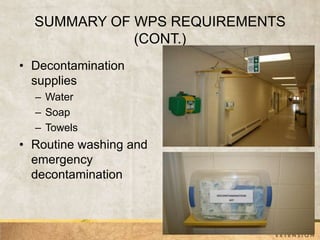
• Decontamination
supplies
– Water
– Soap
– Towels

• Routine washing and
emergency
decontamination
SUMMARY OF WPS REQUIREMENTS
(CONT.)
• Notification
– Employees working
in treated areas
– Must be notified
about treated
– To avoid inadvertent
exposures
PESTICIDE APPLICATION
NOTIFICATIONS
• Must notify workers
– No entry allowed if warning
sign is posted on a
greenhouse door or in field
access
• Until REI expires without proper
PPE

– Application info available
• Central location
SUMMARY OF WPS REQUIREMENTS
(CONT.)
• Emergency
assistance
– Transportation must
be made available
– To medical care facility
– Poisoning or injury
– Must provide info
about specific (usually
the label)
SUMMARY OF WPS REQUIREMENTS
(CONT.)
• Pesticide safety
training and safety
posters
– Training is required for
all workers and
handlers
– Pesticide safety poster
must be displayed
RESTRICTIONS IN NURSERIES
Special Application Restrictions in Nurseries
Column A: When a Pesticide is Being Applied:

Column B: Workers and Other Persons are
Prohibited in:

1.
•
•
•

Pesticide-treated area plus 100 feet in all
directions on the nursery

(a) Applied:
Aerially, or
In an upward direction, or
Using a spray pressure greater than 150
pounds per square inch

OR
•
•
•
•
•

(b) Applied as a:
Fumigant, or
Smoke, or
Mist, or
Fog, or
Aerosol
Special Application Restrictions in Nurseries
Column A: When a Pesticide is Being Applied:

Column B: Workers and Other Persons are
Prohibited in:

2. (a) Applied downward using:
Pesticide-treated area plus 25 feet in all
• A height of greater than 12 inches from the directions on the nursery
planting medium, or
• A fine spray, or
• A spray pressure greater than 40 pounds
per square inch and less than 150 pounds
per square inch
OR
(b) Under circumstances other than (1)(a) or
(1)(b) or (2)(a) above but for which the
pesticide labeling requires the applicator to
wear a respirator
3. In any other manner

Pesticide-treated area
RESTRICTIONS IN GREENHOUSES
Special Application Restrictions in Greenhouses

Column A: When a
Pesticide is Applied:

Column B: Workers
Column C: Until
and Other Persons are
Prohibited in:

Column D: After the
Expiration of Time in
Column C Until the REI
Expires, the EntryRestriced Area Is:

1. As a fumigant

Entire greenhouse
The ventilation criteria No entry restrictions
plus any adjacent
are met
after criteria in
structure that cannot
Column C are met
be sealed off from the
treated area

2. As a
• Smoke, or
• Mist, or
• Fog, or
• Aerosol

Entire enclosed area

The ventilation criteria Entire enclosed area is
are met
the treated area
Special Application Restrictions in Greenhouses

Column A: When a
Pesticide is Applied:

Column B: Workers
Column C: Until
and Other Persons are
Prohibited in:

3. Under
circumstances (other
than in 1 or 2) for
which the pesticide
labeling requires the
applicator to wear a
respirator

Entire enclosed area

Column D: After the
Expiration of Time in
Column C Until the REI
Expires, the EntryRestricted Area Is:

The ventilation criteria Pesticide-treated area
are met
Special Application Restrictions in Greenhouses
Column A: When a
Pesticide is Applied:

Column B: Workers
Column C: Until
and Other Persons are
Prohibited in:

Column D: After the
Expiration of Time in
Column C Until the REI
Expires, the EntryRestricted Area Is:

3. Other than in 1, 2,
or 3 but:
• From a height of
greater than 12
inches from the
planting medium,
or
• As a fine spray, or
• Using a spray
pressure greater
than 40 pounds
per square inch

Pesticide-treated area
plus 25 feet in all
directions within the
entire enclosed area

Application is
complete

Pesticide-treated area

5. In any other
manner

Pesticide-treated area

Application is
complete

Pesticide-treated area
GREENHOUSE VENTILATION
REQUIREMENTS
• If Column C indicates ventilation
restrictions apply
– Then at least one of the following must be met
• Concentration of pesticide in the air less than or
equal to inhalation exposure level on label
• OR
GREENHOUSE VENTILATION
REQUIREMENTS
• If no inhalation exposure is listed, keep workers out
until after:
– 10 air exchanges, or
– 2 hours ventilation using fans or other mechanical
ventilating systems, or
– 4 hours of ventilation using vents, windows or other
passive ventilation, or
– 11 hours with no ventilation followed by 1 hour of
mechanical ventilation, or
– 11 hours with no ventilation followed by 2 hours of passive
ventilation, or
– 24 hours with no ventilation
SUMMARY OF WPS REQUIREMENTS
(CONT.)
• Access to labels and
site specific information
– Labels must be available
– MSDS as well (Material
Safety Data Sheets or
Material Data Sheets)
– Central posting of recent
pesticide applications is
required
WHO MUST HAVE PESTICIDE
TRAINING?
• WPS training must be provided to
untrained workers for entry to area
– Where pesticide applied within past 30 days
– REI has been in effect

• Licensed applicators are exempt from this
training
• Training is valid for 5 years upon
completion
PESTICIDE SAFETY INFORMATION
• Pesticides or pesticide residues may be on
or in:
– Plants
– Soil
– Irrigation water
– Drift
PESTICIDE SAFETY INFORMATION
(CONT.)
• To prevent pesticide exposure
– Pay attention to signs about staying out of
treated areas
– Wash hands before and after
eating, drinking, using chewing gum or
tobacco, or restroom use
– Wear appropriate work clothing
• Socks and closed toe shoes
• Long sleeve shirt
• Long pants
PESTICIDE SAFETY INFORMATION
(CONT.)
– Wash/shower and put on clean clothes
after work
– Wash work clothes separately from
other clothes
– Wash immediately in the nearest clean
water if accidentally exposed
– ASAP shower, change into clean
clothes
PESTICIDE SAFETY INFORMATION
(CONT.)
• Workers should not
–
–
–
–
–

Take home or reuse empty pesticide containers
Clean up a pesticide spill
Apply pesticides on the premises (handlers only)
Stay in areas near the application of a pesticide
Attempt to rescue a person who is incapacitated
in pesticide application area
• Workers SHOULD call 911instead
PESTICIDE LABEL INFORMATION
• Pesticide Label includes
–
–
–
–
–
–
–

–
–

Personal Protective Equipment (PPE)
Restricted-Entry Interval (REI)
EPA Registration Number
Active ingredients
Application Information/Directions for Use/Storage
and Disposal
First Aid Information
Precautionary Statements/Safety
Recommendations
Agricultural Use Requirements
Environmental Hazards
PESTICIDE LABEL INFORMATION
(CONT.)
*Material Safety Data Sheets (MSDS) or Poison
Control Centers may not have all of the
information that is included on the Product
Label.
*Have the product label with you when calling a
poison control center or doctor, or going for
treatment.
FORMS OF PESTICIDES ENCOUNTERED
•
•
•
•
•
•
•

Fumigant
Granule
Mist
Aerosol
Spray
Drench
Bait
PESTICIDE CENTRAL INFORMATION
BOARD
INFORMATION AT A CENTRAL
LOCATION
• Easily-seen central
location, close
together
– WPS safety poster
– name, address, and
telephone number of
the nearest medical
facility
INFORMATION AT A CENTRAL
LOCATION
• Must display for each pesticide application
– from before each application begins until 30
days after REI expires
– product name, EPA registration number, and
active ingredient(s)
– location and description of treated area
– time and date of application
– REI
INFORMATION AT A CENTRAL
LOCATION
INFORMATION AT A CENTRAL
LOCATION
• Inform workers and handlers where the
information is posted and allow them
access
• Inform workers and handlers about
changes in emergency facility information
• Keep posted information legible
SYMPTOMS OF PESTICIDE POISONING
•
•
•
•
•
•
•
•

Tiredness or dizziness
Headache or blurred vision
Excessive sweating
Chest pains or trouble breathing
Nausea
Stomach cramps or diarrhea
Skin rashes
Eye irritation
PESTICIDE POISONING (CONT.)
• If you suspect pesticide poisoning
1. Stop what you are doing
2. Follow emergency first aid procedures on the
pesticide label
3. Contact your boss or a co-worker for help
4. Have someone drive you to an emergency
medical center
SYMPTOMS OF HEAT ILLNESS
•
•
•
•
•
•
•
•
•

Dizziness
Fatigue/fainting
Decreased concentration/coordination
Impaired judgment
Headache
Heavy sweating
Muscle weakness/cramps
Fast pulse
Nausea
HEAT ILLNESS (CONT.)
• Five steps to cool someone down
1. Get them out of direct sun
2. Take off outer layers of clothing
3. Wrap them loosely in wet cloths or towels
4. Pour water on them
5. Fan them vigorously
RESOURCES FOR WPS
How To Comply With the Worker Protection Standard for
Agricultural Pesticides: What Employers Need To Know
http://www.epa.gov/oecaagct/htc.html

EPA Office of Pesticide Programs:
www.epa.gov/pesticides
Region 8 (CO, MT, ND, SD, UT, WY)
U.S. Environmental Protection Agency, Region 8
Pesticide Program (8P-P3T)
999 18th St., Suite 300
Denver, CO 80202-2466 (800) 227- 8917
RESOURCES FOR WPS
Food Quality Protection Act: www.epa.gov/opp00001/regulating/laws/fqpa/
National Institute for Occupational Safety and Health (NIOSH):
www.cdc.gov/niosh/
Pesticide Poisoning Surveillance System:
www.cdc.gov/niosh/topics/pesticides/overview.html
National Pesticide Information Center (EPA-funded): http://npic.orst.edu

EPA Controlling Pests: www.epa.gov/pesticides/controlling/index.htm

NEETF’s Pesticides Resource Library:
www.neetf.org/Health/Resources/healthcare.htm
Gemplers: http://www.gemplers.com/safety
Occupational Safety and Health, Respiratory Protection:
THANKS
• Questions?

Worker Protection Standards Basics 2014

  • 1.
    WORKER PROTECTION STANDARDS Greenhouses, Nurseries, Farms,and Forests Casey Seals UW Laramie R&E Center Manager and Graduate Student Karen Panter Extension Horticulture Specialist
  • 2.
    BASIC PRINCIPLES OFTHE WORKER PROTECTION STANDARD • August 1992 – EPA Worker Protection Standard (WPS) (40 CFR Part 170) for Agricultural Pesticides – Revised 2005 • Federal regulation covering workers – – – – Farms Forests Nurseries Greenhouses • Protects about 2.5 million agricultural workers
  • 3.
    EPA DEFINITIONS • CertifiedPesticide Applicator – Authorized to apply "restricted-use" pesticides – Meets requirements for certification under FIFRAmandated programs • Pesticide Handler – Mixes, loads, applies, or otherwise handles pesticides • Worker – Is employed for any type of compensation – Does tasks, such as harvesting, weeding, or watering in production of agricultural plants – Farm, forest, nursery, or greenhouse
  • 4.
    SUMMARY OF WPS REQUIREMENTS •Protection during applications – Applicators prohibited from exposing workers or other persons – Workers are barred from treated areas during and after applications • Restricted-entry intervals (REI) – REI found on all agricultural plant pesticide product labels. – Workers barred from entering a pesticide treated area during REI – Some provisions made for early entry
  • 5.
    SUMMARY OF WPSREQUIREMENTS (CONT.) • Personal Protective Equipment (PPE) – Must provide and maintain PPE for handlers and earlyentry workers – Boots, gloves, cover alls, head covering, respirator
  • 6.
    DUTIES RELATED TOPERSONAL PROTECTIVE EQUIPMENT • Provide handlers with the PPE the pesticide label requires – – – – Clean and in operating condition Worn and used correctly Inspected before each day of use Repaired or replaced as needed • Respirators must fit correctly – OSHA fit test procedureswww.osha/gov/SLTC/etools/respiratory/ • Take steps to avoid heat illness – Symptoms may mimic pesticide exposure
  • 7.
    DUTIES RELATED TOPERSONAL PROTECTIVE EQUIPMENT • Provide pesticide-free area for – Storing personal clothing – Putting on PPE at start of task – Taking off PPE at end of task • Do not allow used PPE to be worn home or taken home • Store clean PPE away from other clothing and away from pesticide areas • Follow federal, state, and local laws when disposing of PPE that cannot be cleaned
  • 8.
    SUMMARY OF WPSREQUIREMENTS (CONT.) • Decontamination supplies – Water – Soap – Towels • Routine washing and emergency decontamination
  • 9.
    SUMMARY OF WPSREQUIREMENTS (CONT.) • Notification – Employees working in treated areas – Must be notified about treated – To avoid inadvertent exposures
  • 10.
    PESTICIDE APPLICATION NOTIFICATIONS • Mustnotify workers – No entry allowed if warning sign is posted on a greenhouse door or in field access • Until REI expires without proper PPE – Application info available • Central location
  • 11.
    SUMMARY OF WPSREQUIREMENTS (CONT.) • Emergency assistance – Transportation must be made available – To medical care facility – Poisoning or injury – Must provide info about specific (usually the label)
  • 12.
    SUMMARY OF WPSREQUIREMENTS (CONT.) • Pesticide safety training and safety posters – Training is required for all workers and handlers – Pesticide safety poster must be displayed
  • 13.
    RESTRICTIONS IN NURSERIES SpecialApplication Restrictions in Nurseries Column A: When a Pesticide is Being Applied: Column B: Workers and Other Persons are Prohibited in: 1. • • • Pesticide-treated area plus 100 feet in all directions on the nursery (a) Applied: Aerially, or In an upward direction, or Using a spray pressure greater than 150 pounds per square inch OR • • • • • (b) Applied as a: Fumigant, or Smoke, or Mist, or Fog, or Aerosol
  • 14.
    Special Application Restrictionsin Nurseries Column A: When a Pesticide is Being Applied: Column B: Workers and Other Persons are Prohibited in: 2. (a) Applied downward using: Pesticide-treated area plus 25 feet in all • A height of greater than 12 inches from the directions on the nursery planting medium, or • A fine spray, or • A spray pressure greater than 40 pounds per square inch and less than 150 pounds per square inch OR (b) Under circumstances other than (1)(a) or (1)(b) or (2)(a) above but for which the pesticide labeling requires the applicator to wear a respirator 3. In any other manner Pesticide-treated area
  • 15.
    RESTRICTIONS IN GREENHOUSES SpecialApplication Restrictions in Greenhouses Column A: When a Pesticide is Applied: Column B: Workers Column C: Until and Other Persons are Prohibited in: Column D: After the Expiration of Time in Column C Until the REI Expires, the EntryRestriced Area Is: 1. As a fumigant Entire greenhouse The ventilation criteria No entry restrictions plus any adjacent are met after criteria in structure that cannot Column C are met be sealed off from the treated area 2. As a • Smoke, or • Mist, or • Fog, or • Aerosol Entire enclosed area The ventilation criteria Entire enclosed area is are met the treated area
  • 16.
    Special Application Restrictionsin Greenhouses Column A: When a Pesticide is Applied: Column B: Workers Column C: Until and Other Persons are Prohibited in: 3. Under circumstances (other than in 1 or 2) for which the pesticide labeling requires the applicator to wear a respirator Entire enclosed area Column D: After the Expiration of Time in Column C Until the REI Expires, the EntryRestricted Area Is: The ventilation criteria Pesticide-treated area are met
  • 17.
    Special Application Restrictionsin Greenhouses Column A: When a Pesticide is Applied: Column B: Workers Column C: Until and Other Persons are Prohibited in: Column D: After the Expiration of Time in Column C Until the REI Expires, the EntryRestricted Area Is: 3. Other than in 1, 2, or 3 but: • From a height of greater than 12 inches from the planting medium, or • As a fine spray, or • Using a spray pressure greater than 40 pounds per square inch Pesticide-treated area plus 25 feet in all directions within the entire enclosed area Application is complete Pesticide-treated area 5. In any other manner Pesticide-treated area Application is complete Pesticide-treated area
  • 18.
    GREENHOUSE VENTILATION REQUIREMENTS • IfColumn C indicates ventilation restrictions apply – Then at least one of the following must be met • Concentration of pesticide in the air less than or equal to inhalation exposure level on label • OR
  • 19.
    GREENHOUSE VENTILATION REQUIREMENTS • Ifno inhalation exposure is listed, keep workers out until after: – 10 air exchanges, or – 2 hours ventilation using fans or other mechanical ventilating systems, or – 4 hours of ventilation using vents, windows or other passive ventilation, or – 11 hours with no ventilation followed by 1 hour of mechanical ventilation, or – 11 hours with no ventilation followed by 2 hours of passive ventilation, or – 24 hours with no ventilation
  • 20.
    SUMMARY OF WPSREQUIREMENTS (CONT.) • Access to labels and site specific information – Labels must be available – MSDS as well (Material Safety Data Sheets or Material Data Sheets) – Central posting of recent pesticide applications is required
  • 21.
    WHO MUST HAVEPESTICIDE TRAINING? • WPS training must be provided to untrained workers for entry to area – Where pesticide applied within past 30 days – REI has been in effect • Licensed applicators are exempt from this training • Training is valid for 5 years upon completion
  • 22.
    PESTICIDE SAFETY INFORMATION •Pesticides or pesticide residues may be on or in: – Plants – Soil – Irrigation water – Drift
  • 23.
    PESTICIDE SAFETY INFORMATION (CONT.) •To prevent pesticide exposure – Pay attention to signs about staying out of treated areas – Wash hands before and after eating, drinking, using chewing gum or tobacco, or restroom use – Wear appropriate work clothing • Socks and closed toe shoes • Long sleeve shirt • Long pants
  • 24.
    PESTICIDE SAFETY INFORMATION (CONT.) –Wash/shower and put on clean clothes after work – Wash work clothes separately from other clothes – Wash immediately in the nearest clean water if accidentally exposed – ASAP shower, change into clean clothes
  • 25.
    PESTICIDE SAFETY INFORMATION (CONT.) •Workers should not – – – – – Take home or reuse empty pesticide containers Clean up a pesticide spill Apply pesticides on the premises (handlers only) Stay in areas near the application of a pesticide Attempt to rescue a person who is incapacitated in pesticide application area • Workers SHOULD call 911instead
  • 26.
    PESTICIDE LABEL INFORMATION •Pesticide Label includes – – – – – – – – – Personal Protective Equipment (PPE) Restricted-Entry Interval (REI) EPA Registration Number Active ingredients Application Information/Directions for Use/Storage and Disposal First Aid Information Precautionary Statements/Safety Recommendations Agricultural Use Requirements Environmental Hazards
  • 27.
    PESTICIDE LABEL INFORMATION (CONT.) *MaterialSafety Data Sheets (MSDS) or Poison Control Centers may not have all of the information that is included on the Product Label. *Have the product label with you when calling a poison control center or doctor, or going for treatment.
  • 28.
    FORMS OF PESTICIDESENCOUNTERED • • • • • • • Fumigant Granule Mist Aerosol Spray Drench Bait
  • 29.
  • 30.
    INFORMATION AT ACENTRAL LOCATION • Easily-seen central location, close together – WPS safety poster – name, address, and telephone number of the nearest medical facility
  • 31.
    INFORMATION AT ACENTRAL LOCATION • Must display for each pesticide application – from before each application begins until 30 days after REI expires – product name, EPA registration number, and active ingredient(s) – location and description of treated area – time and date of application – REI
  • 32.
    INFORMATION AT ACENTRAL LOCATION
  • 33.
    INFORMATION AT ACENTRAL LOCATION • Inform workers and handlers where the information is posted and allow them access • Inform workers and handlers about changes in emergency facility information • Keep posted information legible
  • 34.
    SYMPTOMS OF PESTICIDEPOISONING • • • • • • • • Tiredness or dizziness Headache or blurred vision Excessive sweating Chest pains or trouble breathing Nausea Stomach cramps or diarrhea Skin rashes Eye irritation
  • 35.
    PESTICIDE POISONING (CONT.) •If you suspect pesticide poisoning 1. Stop what you are doing 2. Follow emergency first aid procedures on the pesticide label 3. Contact your boss or a co-worker for help 4. Have someone drive you to an emergency medical center
  • 36.
    SYMPTOMS OF HEATILLNESS • • • • • • • • • Dizziness Fatigue/fainting Decreased concentration/coordination Impaired judgment Headache Heavy sweating Muscle weakness/cramps Fast pulse Nausea
  • 37.
    HEAT ILLNESS (CONT.) •Five steps to cool someone down 1. Get them out of direct sun 2. Take off outer layers of clothing 3. Wrap them loosely in wet cloths or towels 4. Pour water on them 5. Fan them vigorously
  • 38.
    RESOURCES FOR WPS HowTo Comply With the Worker Protection Standard for Agricultural Pesticides: What Employers Need To Know http://www.epa.gov/oecaagct/htc.html EPA Office of Pesticide Programs: www.epa.gov/pesticides Region 8 (CO, MT, ND, SD, UT, WY) U.S. Environmental Protection Agency, Region 8 Pesticide Program (8P-P3T) 999 18th St., Suite 300 Denver, CO 80202-2466 (800) 227- 8917
  • 39.
    RESOURCES FOR WPS FoodQuality Protection Act: www.epa.gov/opp00001/regulating/laws/fqpa/ National Institute for Occupational Safety and Health (NIOSH): www.cdc.gov/niosh/ Pesticide Poisoning Surveillance System: www.cdc.gov/niosh/topics/pesticides/overview.html National Pesticide Information Center (EPA-funded): http://npic.orst.edu EPA Controlling Pests: www.epa.gov/pesticides/controlling/index.htm NEETF’s Pesticides Resource Library: www.neetf.org/Health/Resources/healthcare.htm Gemplers: http://www.gemplers.com/safety Occupational Safety and Health, Respiratory Protection:
  • 40.