1-1
<Insert 7/e cover
image here>
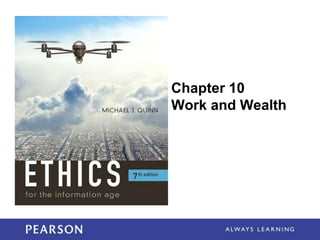
Chapter 10
Work and Wealth
1-2
10-2
Chapter Overview
• Introduction
• Automation and employment
• Workplace changes
• Globalization
• The digital divide
• The “winner-take-all society”
1-3
10-3
10.1 Introduction
• Information technology and automation
affecting workplace
– Increases in productivity
– Globalization of job market
– Organization of companies
– Telework
– Workplace monitoring
• Impacts of information technology on society
– Digital divide
– Winner-take-all effects
1-4
10.2 Automation and Employment
10-4
1-5
10-5
Automation and Job Destruction
• Between 1979 and 2011…
– U.S. population increased 39%
– Manufacturing employment dropped 40%, from
19.4 million jobs to 11.7 million jobs
• Lost white-collar jobs
– Secretarial and clerical positions
– Accountants and bookkeepers
– Middle managers
• Juliet Schor: Work week got longer between
1979 and 1990
1-6
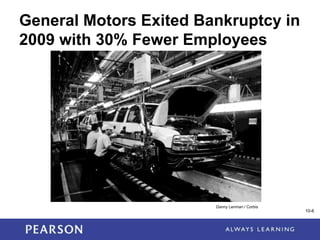
General Motors Exited Bankruptcy in
2009 with 30% Fewer Employees
10-6
Danny Lenman / Corbis
1-7
Layoffs May Increase Stress on
Remaining White-Collar Workers
10-7
1-8
10-8
Automation and Job Creation
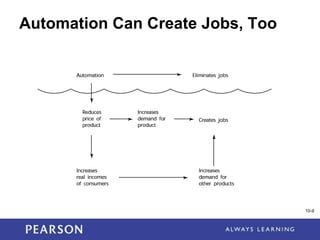
• Automation lowers prices
• That increases demand for the product
• It also increases real incomes, increasing
demand for other products
• Increased demand  more jobs
• Number of manufacturing jobs worldwide is
increasing
• Martin Carnoy: Workers today work less than
workers 100 years ago
1-9
Automation Can Create Jobs, Too
10-9
1-10
10-10
Effects of Increase in Productivity
• We have used higher productivity to achieve a
higher material standard of living
• This is in contrast to medieval or ancient times
(before modern capitalism)
• In medieval or ancient times
– Low caloric intake meant pace of work was slow
– Work was seasonal and intermittent
– Laborers resisted working if they had enough money
(i.e., they weren’t consumers)
– When wages rose, laborers worked less
1-11
Case Study: The Canceled Vacation
• Stuart is a software developer for Seattle start-up
• Everybody works 60 hours/week
• Company’s vacation policy is 3 weeks/year
– Nobody takes that much
– Some of Stuart’s coworkers have had zero vacation in 2+ years
• Six months ago, Stuart learns his parents are moving
from San Diego to Australia
– He gets permission for one week’s vacation in San Diego
– Doesn’t tell parents
10-11
1-12
Case Study: The Canceled Vacation
• One week before vacation, supervisor asks
Stuart to delay vacation
– Important product update
– Offers Stuart three weeks’ vacation next year
– Round-trip airfare
• Stuart agrees to request and cancels
vacation to San Diego
10-12
1-13
Kantian / Social Contract Theory
Evaluation
• Stuart broke no promises and didn’t
deceive anyone
• Stuart was not obligated to visit his parent
before they moved from San Diego to
Australia
• Stuart did nothing wrong
10-13
1-14
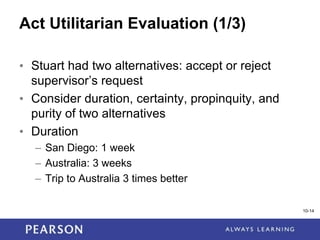
Act Utilitarian Evaluation (1/3)
• Stuart had two alternatives: accept or reject
supervisor’s request
• Consider duration, certainty, propinquity, and
purity of two alternatives
• Duration
– San Diego: 1 week
– Australia: 3 weeks
– Trip to Australia 3 times better
10-14
1-15
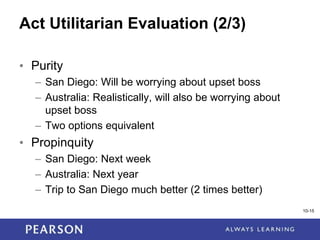
Act Utilitarian Evaluation (2/3)
• Purity
– San Diego: Will be worrying about upset boss
– Australia: Realistically, will also be worrying about
upset boss
– Two options equivalent
• Propinquity
– San Diego: Next week
– Australia: Next year
– Trip to San Diego much better (2 times better)
10-15
1-16
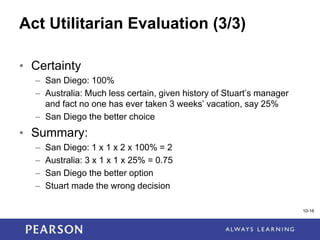
Act Utilitarian Evaluation (3/3)
• Certainty
– San Diego: 100%
– Australia: Much less certain, given history of Stuart’s manager
and fact no one has ever taken 3 weeks’ vacation, say 25%
– San Diego the better choice
• Summary:
– San Diego: 1 x 1 x 2 x 100% = 2
– Australia: 3 x 1 x 1 x 25% = 0.75
– San Diego the better option
– Stuart made the wrong decision
10-16
1-17
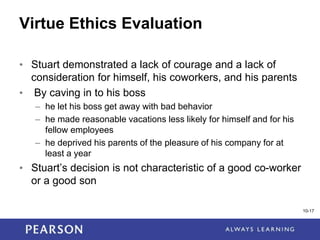
Virtue Ethics Evaluation
• Stuart demonstrated a lack of courage and a lack of
consideration for himself, his coworkers, and his parents
• By caving in to his boss
– he let his boss get away with bad behavior
– he made reasonable vacations less likely for himself and for his
fellow employees
– he deprived his parents of the pleasure of his company for at
least a year
• Stuart’s decision is not characteristic of a good co-worker
or a good son
10-17
1-18
10-18
Rise of the Robots?
• Some experts suggest most jobs will be taken
over by machines
• Artificial intelligence: Field of computer science
focusing on intelligent behavior by machines
• Rapid increases in microprocessor speeds have
led to various successes in AI
• What will happen as computers continue to
increase in speed?
1-19
10-19
Notable Achievements in AI since 1995
• Computer-controlled minivan “drove” on freeways across USA in
1995
• IBM supercomputer Deep Blue defeated chess champion Gary
Kasparov in 1997
• Honda’s ASIMO android climbed and descended stairs (2000)
• Electrolux introduced robotic vacuum cleaner in 2001
• Five autonomous vehicles successfully completed 128-mile course in
Nevada desert in 2005
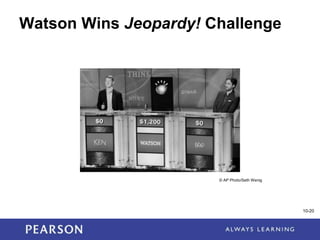
• Watson trounced two most successful human Jeopardy! champions
in 2011
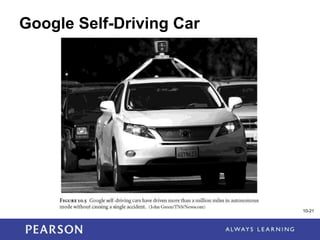
• Google’s self-driving cars logged more than one million miles
between 2009 and 2015 without an accident (caused by the car)
1-20
Watson Wins Jeopardy! Challenge
10-20
© AP Photo/Seth Wenig
1-21
Google Self-Driving Car
10-21
<Insert Figure 10.5 image here>
1-22
10-22
Moral Question Related to Robotics
• Is it wrong to create machines capable of making human
labor obsolete?
• Would intelligent robots demoralize humanity?
• Is it wrong to work on an intelligent machine if it can’t be
guaranteed the machine will be benevolent toward
humans?
• What if a malevolent human puts intelligent machines to
an evil use?
• How would creative computers change our ideas about
intellectual property?
• How will our ideas about privacy change if superfast
computers constantly analyze our electronic records?
1-23
10.3 Workplace Changes
10-23
1-24
10-24
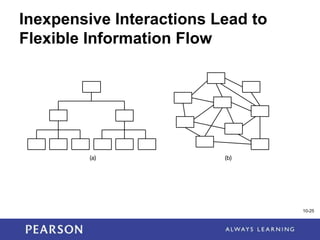
Organizational Changes
• Information technology integration into firms
– Automating back office functions (e.g., payroll)
– Improving manufacturing
– Improving communication among business units
• Results
– Flattened organizational structures
– Eliminating transactional middlemen (supply-chain
automation)
1-25
Inexpensive Interactions Lead to
Flexible Information Flow
10-25
1-26
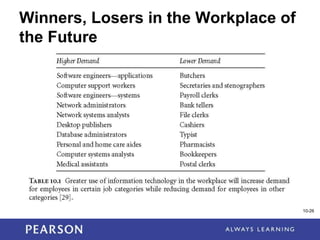
Winners, Losers in the Workplace of
the Future
10-26
<Insert Table 10.1 here>
1-27
10-27
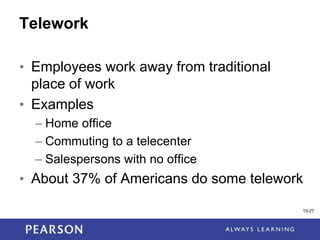
Telework
• Employees work away from traditional
place of work
• Examples
– Home office
– Commuting to a telecenter
– Salespersons with no office
• About 37% of Americans do some telework
1-28
10-28
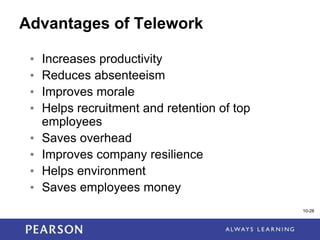
Advantages of Telework
• Increases productivity
• Reduces absenteeism
• Improves morale
• Helps recruitment and retention of top
employees
• Saves overhead
• Improves company resilience
• Helps environment
• Saves employees money
1-29
10-29
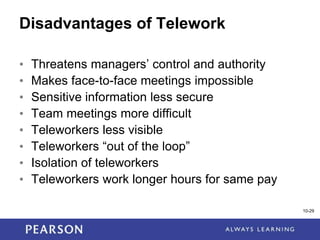
Disadvantages of Telework
• Threatens managers’ control and authority
• Makes face-to-face meetings impossible
• Sensitive information less secure
• Team meetings more difficult
• Teleworkers less visible
• Teleworkers “out of the loop”
• Isolation of teleworkers
• Teleworkers work longer hours for same pay
1-30
10-30
The Gig Economy (1/3)
• Companies less committed to employees
• Lay-offs not taboo as they once were
• Companies hiring more subcontractors and
temporary employees
– Saves money on benefits
– Makes it easier to downsize
1-31
10-31
The Gig Economy (2/3)
• Some start-ups make money by connecting
people who want a service with people willing to
provide that service
• Gig economy: Service workers making a living by
completing short-term jobs for clients
• Examples
– Uber, Lyft: Connect riders and drivers
– Instacart: Grocery delivery service
– Airbnb: Connect travelers and those with
accommodations
1-32
The Gig Economy (3/3)
• Proponents say workers gain independence,
flexibility
• Critics say these are last-resort jobs and
competition among workers drives down wages
• Robert Reich: “The big money goes to the
corporations that own the software. The scraps
go to the on-demand workers.”
• Uber and Lyft drivers filed lawsuits to be
classified as employees
10-32
1-33
10-33
Monitoring (1/2)
• Two-thirds of companies monitor Internet use of
their employees
• Other examples of monitoring
– Video surveillance
– Monitoring keyboard activity
– Monitoring time spent on phone
– Monitoring emails
• Purpose: Identify inappropriate use of
company resources
– Can also detect illegal activities
1-34
10-34
Monitoring (1/2)
• Other uses of monitoring
– Gauge productivity
– Improve productivity
– Improve security; i.e., in schools
• Evidence that monitoring…
– Makes employees more focused on work
– Reduces job satisfaction
1-35
10-35
Multinational Teams
• Software development teams in India since
1980s
• Advantages of multinational teams
– Company has people on duty more hours per day
– Cost savings
• Disadvantage of multinational teams
– Poorer infrastructure in less developed countries
1-36
10.4 Globalization
10-36
1-37
10-37
Globalization Basics
• Globalization: Process of creating a worldwide
network of businesses and markets
• Globalization causes a greater mobility of goods,
services, and capital around the world
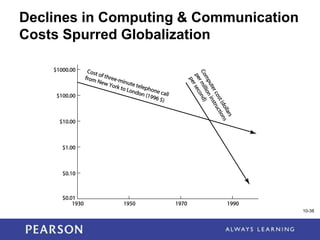
• Globalization made possible through rapidly
decreasing cost of information technology
1-38
Declines in Computing & Communication
Costs Spurred Globalization
10-38
1-39
10-39
Arguments for Globalization
• Increases competition
• People in poorer countries deserve jobs,
too
• It is a tried-and-true route for a poor
country to become prosperous
• Global jobs reduce unrest and increase
stability
1-40
10-40
Arguments against Globalization
• Makes the United States subordinate to the
World Trade Organization
• Forces American workers to compete with
foreigners who do not get decent wages and
benefits
• Accelerates exodus of manufacturing and white-
collar jobs from United States
• Hurts workers in foreign countries
1-41
10-41
Dot-Com Bust Increases IT Sector
Unemployment
• Dot-com: Internet-related start-up company
• Early 2000: stock prices of dot-coms fell
sharply
• Hundreds of dot-coms went out of
business
• Half a million high-tech jobs lost
1-42
10-42
Foreign Workers in the IT Industry
• Visas allow foreigners to work inside U.S.
• H-1B
– Right to work up in United States to six years
– Company must show no qualified Americans available
– Congress still authorizes 65,000 H-1B visas per year, plus
20,000 more for foreigners with advanced degrees
– Quota not filled in 2009 due to economic downturn
• L-1
– Allows a company to transfer a worker from an overseas
facility to the United States
– Workers do not need to be paid the prevailing wage
– In 2006 about 50,000 foreigners in U.S. under L-1 visa
1-43
10-43
Foreign Competition
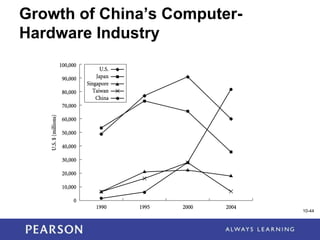
• China is world’s number one producer of
computer hardware
• IT outsourcing to India is growing rapidly
• Number of college students in China increasing
rapidly
• ACM Collegiate Programming Contest provides
evidence of global competition
– No American team has placed first since 1997
– From 2011-2015, only 1 of 20 teams earning gold
medals was from the United States
1-44
Growth of China’s Computer-
Hardware Industry
10-44
1-45
10.5 The Digital Divide
10-45
1-46
10-46
Concept of the Digital Divide
• Digital divide: Some people have access to
modern information technology while others do
not
• Underlying assumption: people with access to
telephones, computers, Internet have
opportunities denied to those without access
• Concept of digital divide became popular with
emergence of World Wide Web
1-47
10-47
Evidence of the Digital Divide
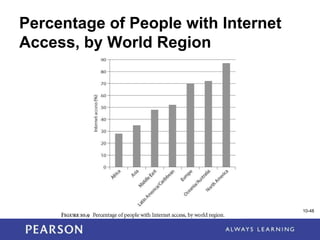
• Global divide
– Access higher in wealthy countries
– Access higher where IT infrastructure good
– Access higher where literacy higher
– Access higher in English-speaking countries
– Access higher where it is culturally valued
• Social divide
– Access higher for young people
– Access higher for well-educated people
1-48
Percentage of People with Internet
Access, by World Region
10-48
1-49
10-49
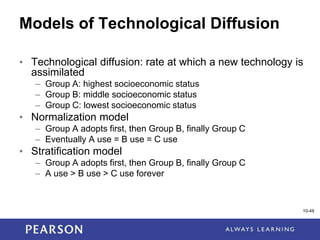
Models of Technological Diffusion
• Technological diffusion: rate at which a new technology is
assimilated
– Group A: highest socioeconomic status
– Group B: middle socioeconomic status
– Group C: lowest socioeconomic status
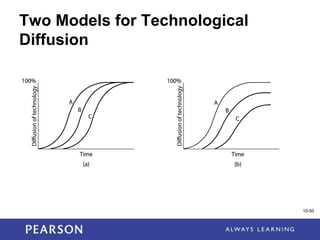
• Normalization model
– Group A adopts first, then Group B, finally Group C
– Eventually A use = B use = C use
• Stratification model
– Group A adopts first, then Group B, finally Group C
– A use > B use > C use forever
1-50
Two Models for Technological
Diffusion
10-50
1-51
10-51
Critiques of the Digital Divide
• DD talk suggests the difference between
“haves” and “have nots” is simply about
access
• DD talk puts everyone in two categories, but
reality is a continuum
• DD implies lack of access leads to less
advantaged social position, but maybe it is
the other way around
• Internet is not the pinnacle of information
technology
1-52
Massive Open Online Courses
• Rate of tuition increases at US universities has exceeded
inflation for several decades
• Financing college education increasingly difficult for
poorer families
• Free massive open online courses (MOOCs) promoted
as a way to make higher education more affordable
• Study by Community College Research Center
– Students less likely to complete and do well in MOOCs than
traditional courses
– MOOCs widen achievement gap between white and black
students and between those with higher GPAs and those with
lower GPAs 10-52
1-53
Net Neutrality
• Tiered service: Charging more for high-priority routing of Internet
packets
• Supporters of tiered service say it is needed to support Voice-over-IP
and other services
• Opponents to tiered service (e.g., Google, Yahoo!) say it would hurt
small start-up companies and lower innovation
• Other critics believe companies controlling Internet might favor some
content over other content
• Net neutrality legislation would require all Internet packets be treated
the same
• Opponents of proposed legislation say consumers should be able to
pay more to get higher quality service; e.g., those doing video
conferencing willing to pay more than those sending email
• February 2015: FCC issued the Open Internet Order to preserve net
neutrality; the ruling being challenged by lawsuits 10-53
1-54
10.6 The “Winner-Take-All Society”
10-54
1-55
10-55
The Winner-Take-All Phenomenon
• Winner-take-all: a few top performers have
disproportionate share of wealth
• Causes
– IT and efficient transportation systems
– Network economies
– Dominance of English language
– Changing business norms
1-56
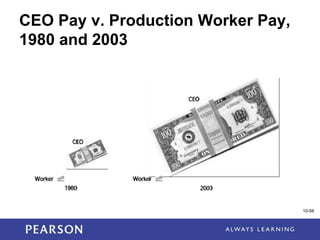
CEO Pay v. Production Worker Pay,
1980 and 2003
10-56
1-57
Is Rory McIlroy That Much Better Than Sergio
Garcia or Derek Ernst?
10-57
<Insert Table 10.2 here>
1-58
Reducing Winner-Take-All Effects
• Limit number of hours that stores remain
open
• Businesses form cooperative agreements
to reduce positional arms races
– Example: salary caps on pro sports teams
• More progressive tax structures
• Campaign finance reform
10-58

ch10 (1).ppt

  • 1.
    1-1 <Insert 7/e cover imagehere> Chapter 10 Work and Wealth
  • 2.
    1-2 10-2 Chapter Overview • Introduction •Automation and employment • Workplace changes • Globalization • The digital divide • The “winner-take-all society”
  • 3.
    1-3 10-3 10.1 Introduction • Informationtechnology and automation affecting workplace – Increases in productivity – Globalization of job market – Organization of companies – Telework – Workplace monitoring • Impacts of information technology on society – Digital divide – Winner-take-all effects
  • 4.
    1-4 10.2 Automation andEmployment 10-4
  • 5.
    1-5 10-5 Automation and JobDestruction • Between 1979 and 2011… – U.S. population increased 39% – Manufacturing employment dropped 40%, from 19.4 million jobs to 11.7 million jobs • Lost white-collar jobs – Secretarial and clerical positions – Accountants and bookkeepers – Middle managers • Juliet Schor: Work week got longer between 1979 and 1990
  • 6.
    1-6 General Motors ExitedBankruptcy in 2009 with 30% Fewer Employees 10-6 Danny Lenman / Corbis
  • 7.
    1-7 Layoffs May IncreaseStress on Remaining White-Collar Workers 10-7
  • 8.
    1-8 10-8 Automation and JobCreation • Automation lowers prices • That increases demand for the product • It also increases real incomes, increasing demand for other products • Increased demand  more jobs • Number of manufacturing jobs worldwide is increasing • Martin Carnoy: Workers today work less than workers 100 years ago
  • 9.
  • 10.
    1-10 10-10 Effects of Increasein Productivity • We have used higher productivity to achieve a higher material standard of living • This is in contrast to medieval or ancient times (before modern capitalism) • In medieval or ancient times – Low caloric intake meant pace of work was slow – Work was seasonal and intermittent – Laborers resisted working if they had enough money (i.e., they weren’t consumers) – When wages rose, laborers worked less
  • 11.
    1-11 Case Study: TheCanceled Vacation • Stuart is a software developer for Seattle start-up • Everybody works 60 hours/week • Company’s vacation policy is 3 weeks/year – Nobody takes that much – Some of Stuart’s coworkers have had zero vacation in 2+ years • Six months ago, Stuart learns his parents are moving from San Diego to Australia – He gets permission for one week’s vacation in San Diego – Doesn’t tell parents 10-11
  • 12.
    1-12 Case Study: TheCanceled Vacation • One week before vacation, supervisor asks Stuart to delay vacation – Important product update – Offers Stuart three weeks’ vacation next year – Round-trip airfare • Stuart agrees to request and cancels vacation to San Diego 10-12
  • 13.
    1-13 Kantian / SocialContract Theory Evaluation • Stuart broke no promises and didn’t deceive anyone • Stuart was not obligated to visit his parent before they moved from San Diego to Australia • Stuart did nothing wrong 10-13
  • 14.
    1-14 Act Utilitarian Evaluation(1/3) • Stuart had two alternatives: accept or reject supervisor’s request • Consider duration, certainty, propinquity, and purity of two alternatives • Duration – San Diego: 1 week – Australia: 3 weeks – Trip to Australia 3 times better 10-14
  • 15.
    1-15 Act Utilitarian Evaluation(2/3) • Purity – San Diego: Will be worrying about upset boss – Australia: Realistically, will also be worrying about upset boss – Two options equivalent • Propinquity – San Diego: Next week – Australia: Next year – Trip to San Diego much better (2 times better) 10-15
  • 16.
    1-16 Act Utilitarian Evaluation(3/3) • Certainty – San Diego: 100% – Australia: Much less certain, given history of Stuart’s manager and fact no one has ever taken 3 weeks’ vacation, say 25% – San Diego the better choice • Summary: – San Diego: 1 x 1 x 2 x 100% = 2 – Australia: 3 x 1 x 1 x 25% = 0.75 – San Diego the better option – Stuart made the wrong decision 10-16
  • 17.
    1-17 Virtue Ethics Evaluation •Stuart demonstrated a lack of courage and a lack of consideration for himself, his coworkers, and his parents • By caving in to his boss – he let his boss get away with bad behavior – he made reasonable vacations less likely for himself and for his fellow employees – he deprived his parents of the pleasure of his company for at least a year • Stuart’s decision is not characteristic of a good co-worker or a good son 10-17
  • 18.
    1-18 10-18 Rise of theRobots? • Some experts suggest most jobs will be taken over by machines • Artificial intelligence: Field of computer science focusing on intelligent behavior by machines • Rapid increases in microprocessor speeds have led to various successes in AI • What will happen as computers continue to increase in speed?
  • 19.
    1-19 10-19 Notable Achievements inAI since 1995 • Computer-controlled minivan “drove” on freeways across USA in 1995 • IBM supercomputer Deep Blue defeated chess champion Gary Kasparov in 1997 • Honda’s ASIMO android climbed and descended stairs (2000) • Electrolux introduced robotic vacuum cleaner in 2001 • Five autonomous vehicles successfully completed 128-mile course in Nevada desert in 2005 • Watson trounced two most successful human Jeopardy! champions in 2011 • Google’s self-driving cars logged more than one million miles between 2009 and 2015 without an accident (caused by the car)
  • 20.
    1-20 Watson Wins Jeopardy!Challenge 10-20 © AP Photo/Seth Wenig
  • 21.
  • 22.
    1-22 10-22 Moral Question Relatedto Robotics • Is it wrong to create machines capable of making human labor obsolete? • Would intelligent robots demoralize humanity? • Is it wrong to work on an intelligent machine if it can’t be guaranteed the machine will be benevolent toward humans? • What if a malevolent human puts intelligent machines to an evil use? • How would creative computers change our ideas about intellectual property? • How will our ideas about privacy change if superfast computers constantly analyze our electronic records?
  • 23.
  • 24.
    1-24 10-24 Organizational Changes • Informationtechnology integration into firms – Automating back office functions (e.g., payroll) – Improving manufacturing – Improving communication among business units • Results – Flattened organizational structures – Eliminating transactional middlemen (supply-chain automation)
  • 25.
    1-25 Inexpensive Interactions Leadto Flexible Information Flow 10-25
  • 26.
    1-26 Winners, Losers inthe Workplace of the Future 10-26 <Insert Table 10.1 here>
  • 27.
    1-27 10-27 Telework • Employees workaway from traditional place of work • Examples – Home office – Commuting to a telecenter – Salespersons with no office • About 37% of Americans do some telework
  • 28.
    1-28 10-28 Advantages of Telework •Increases productivity • Reduces absenteeism • Improves morale • Helps recruitment and retention of top employees • Saves overhead • Improves company resilience • Helps environment • Saves employees money
  • 29.
    1-29 10-29 Disadvantages of Telework •Threatens managers’ control and authority • Makes face-to-face meetings impossible • Sensitive information less secure • Team meetings more difficult • Teleworkers less visible • Teleworkers “out of the loop” • Isolation of teleworkers • Teleworkers work longer hours for same pay
  • 30.
    1-30 10-30 The Gig Economy(1/3) • Companies less committed to employees • Lay-offs not taboo as they once were • Companies hiring more subcontractors and temporary employees – Saves money on benefits – Makes it easier to downsize
  • 31.
    1-31 10-31 The Gig Economy(2/3) • Some start-ups make money by connecting people who want a service with people willing to provide that service • Gig economy: Service workers making a living by completing short-term jobs for clients • Examples – Uber, Lyft: Connect riders and drivers – Instacart: Grocery delivery service – Airbnb: Connect travelers and those with accommodations
  • 32.
    1-32 The Gig Economy(3/3) • Proponents say workers gain independence, flexibility • Critics say these are last-resort jobs and competition among workers drives down wages • Robert Reich: “The big money goes to the corporations that own the software. The scraps go to the on-demand workers.” • Uber and Lyft drivers filed lawsuits to be classified as employees 10-32
  • 33.
    1-33 10-33 Monitoring (1/2) • Two-thirdsof companies monitor Internet use of their employees • Other examples of monitoring – Video surveillance – Monitoring keyboard activity – Monitoring time spent on phone – Monitoring emails • Purpose: Identify inappropriate use of company resources – Can also detect illegal activities
  • 34.
    1-34 10-34 Monitoring (1/2) • Otheruses of monitoring – Gauge productivity – Improve productivity – Improve security; i.e., in schools • Evidence that monitoring… – Makes employees more focused on work – Reduces job satisfaction
  • 35.
    1-35 10-35 Multinational Teams • Softwaredevelopment teams in India since 1980s • Advantages of multinational teams – Company has people on duty more hours per day – Cost savings • Disadvantage of multinational teams – Poorer infrastructure in less developed countries
  • 36.
  • 37.
    1-37 10-37 Globalization Basics • Globalization:Process of creating a worldwide network of businesses and markets • Globalization causes a greater mobility of goods, services, and capital around the world • Globalization made possible through rapidly decreasing cost of information technology
  • 38.
    1-38 Declines in Computing& Communication Costs Spurred Globalization 10-38
  • 39.
    1-39 10-39 Arguments for Globalization •Increases competition • People in poorer countries deserve jobs, too • It is a tried-and-true route for a poor country to become prosperous • Global jobs reduce unrest and increase stability
  • 40.
    1-40 10-40 Arguments against Globalization •Makes the United States subordinate to the World Trade Organization • Forces American workers to compete with foreigners who do not get decent wages and benefits • Accelerates exodus of manufacturing and white- collar jobs from United States • Hurts workers in foreign countries
  • 41.
    1-41 10-41 Dot-Com Bust IncreasesIT Sector Unemployment • Dot-com: Internet-related start-up company • Early 2000: stock prices of dot-coms fell sharply • Hundreds of dot-coms went out of business • Half a million high-tech jobs lost
  • 42.
    1-42 10-42 Foreign Workers inthe IT Industry • Visas allow foreigners to work inside U.S. • H-1B – Right to work up in United States to six years – Company must show no qualified Americans available – Congress still authorizes 65,000 H-1B visas per year, plus 20,000 more for foreigners with advanced degrees – Quota not filled in 2009 due to economic downturn • L-1 – Allows a company to transfer a worker from an overseas facility to the United States – Workers do not need to be paid the prevailing wage – In 2006 about 50,000 foreigners in U.S. under L-1 visa
  • 43.
    1-43 10-43 Foreign Competition • Chinais world’s number one producer of computer hardware • IT outsourcing to India is growing rapidly • Number of college students in China increasing rapidly • ACM Collegiate Programming Contest provides evidence of global competition – No American team has placed first since 1997 – From 2011-2015, only 1 of 20 teams earning gold medals was from the United States
  • 44.
    1-44 Growth of China’sComputer- Hardware Industry 10-44
  • 45.
  • 46.
    1-46 10-46 Concept of theDigital Divide • Digital divide: Some people have access to modern information technology while others do not • Underlying assumption: people with access to telephones, computers, Internet have opportunities denied to those without access • Concept of digital divide became popular with emergence of World Wide Web
  • 47.
    1-47 10-47 Evidence of theDigital Divide • Global divide – Access higher in wealthy countries – Access higher where IT infrastructure good – Access higher where literacy higher – Access higher in English-speaking countries – Access higher where it is culturally valued • Social divide – Access higher for young people – Access higher for well-educated people
  • 48.
    1-48 Percentage of Peoplewith Internet Access, by World Region 10-48
  • 49.
    1-49 10-49 Models of TechnologicalDiffusion • Technological diffusion: rate at which a new technology is assimilated – Group A: highest socioeconomic status – Group B: middle socioeconomic status – Group C: lowest socioeconomic status • Normalization model – Group A adopts first, then Group B, finally Group C – Eventually A use = B use = C use • Stratification model – Group A adopts first, then Group B, finally Group C – A use > B use > C use forever
  • 50.
    1-50 Two Models forTechnological Diffusion 10-50
  • 51.
    1-51 10-51 Critiques of theDigital Divide • DD talk suggests the difference between “haves” and “have nots” is simply about access • DD talk puts everyone in two categories, but reality is a continuum • DD implies lack of access leads to less advantaged social position, but maybe it is the other way around • Internet is not the pinnacle of information technology
  • 52.
    1-52 Massive Open OnlineCourses • Rate of tuition increases at US universities has exceeded inflation for several decades • Financing college education increasingly difficult for poorer families • Free massive open online courses (MOOCs) promoted as a way to make higher education more affordable • Study by Community College Research Center – Students less likely to complete and do well in MOOCs than traditional courses – MOOCs widen achievement gap between white and black students and between those with higher GPAs and those with lower GPAs 10-52
  • 53.
    1-53 Net Neutrality • Tieredservice: Charging more for high-priority routing of Internet packets • Supporters of tiered service say it is needed to support Voice-over-IP and other services • Opponents to tiered service (e.g., Google, Yahoo!) say it would hurt small start-up companies and lower innovation • Other critics believe companies controlling Internet might favor some content over other content • Net neutrality legislation would require all Internet packets be treated the same • Opponents of proposed legislation say consumers should be able to pay more to get higher quality service; e.g., those doing video conferencing willing to pay more than those sending email • February 2015: FCC issued the Open Internet Order to preserve net neutrality; the ruling being challenged by lawsuits 10-53
  • 54.
  • 55.
    1-55 10-55 The Winner-Take-All Phenomenon •Winner-take-all: a few top performers have disproportionate share of wealth • Causes – IT and efficient transportation systems – Network economies – Dominance of English language – Changing business norms
  • 56.
    1-56 CEO Pay v.Production Worker Pay, 1980 and 2003 10-56
  • 57.
    1-57 Is Rory McIlroyThat Much Better Than Sergio Garcia or Derek Ernst? 10-57 <Insert Table 10.2 here>
  • 58.
    1-58 Reducing Winner-Take-All Effects •Limit number of hours that stores remain open • Businesses form cooperative agreements to reduce positional arms races – Example: salary caps on pro sports teams • More progressive tax structures • Campaign finance reform 10-58