Words Their Way: A Word Study Program Presented by: Katie Glover
Literacy Introduction The Three Questions By:  J.  Muth Muth, J.J.  (2002).   The three questions .  New York, NY:  Scholastic Press.
What is Word Study? Word Study is program that incorporates the many threads that make up the braid of literacy: orthography (correct sequence of letters), reading, oral language, stories and writing. Word Study “occurs in hands-on activities that mimic basic cognitive learning processes: comparing and contrasting categories of word features and discovering similarities and differences within and between categories” (Bear et al., p. 2). “ During Word Study, words and pictures are sorted in routines that require children to examine, discriminate, and make critical judgments about speech sounds, spelling patterns and meanings (p. 2).
Why is Word Study Important? Students need hands-on activities to manipulate words and make generalizations to entire groups of words It involves meaningful reading and writing opportunities to use the new words in many different contexts Teachers students how to look at words to construct a deep understanding of how spelling works Does not involve simple rote memorization of spelling and rules (p. 3)
Word Study:  Getting Started Take advantage of your daily opportunities to observe your students’ reading and writing:  you can learn much about your students’ orthographic knowledge, such as blends, vowels, digraphs, etc.  Observe your students’ as they write and sound out words, and observe their reading for reading errors and decoding skills.  This information will show you what the students are using, but still confusing.
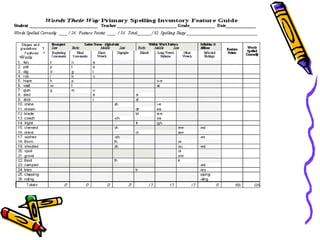
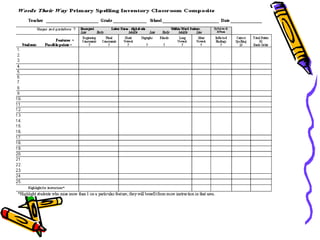
Administering Spelling Inventories SI are quick to administer and score.  They analyze a student’s spellings using a feature guide. Kindergarten uses a Primary Spelling Inventory. You give the students a “spelling test” then analyze the results using the feature guide. You then record the data on the classroom composite form in rank order. This data will help with the forming of groups: group like students who miss 2 or more in a feature group.
 
 
Roles of Word Sorts “ Sorting is a powerful way to help students make sense of words” (p. 51) Students are able to make their own discoveries and generalizations about the spelling of the English language Word sorts are exciting manipulatives  that require the student to pay attention to words and make logical decisions about their sound, pattern, and meaning Types of sorts: Sound sorts Pattern sorts Meaning sorts
Sample Sorts: Weekly Schedule (1) Monday: Introduce sort Tuesday: Re-sort and write sort Wednesday: Buddy sort and speed sort Thursday:  Word hunt Friday: Testing (spelling test) and Word Games (this schedule for primary and elementary grades)
Sample Sorts: Weekly Schedule (2) Monday: Picture sort Tuesday: Drawing and labeling Wednesday: Cutting and Pasting Thursday: Word hunts Friday: Games (this schedule is for word study with just pictures)
Sample Sorts: Kindergarten Word Families -at and -an Monday- Read  The Cat in the Hat  as an introduction to word families.  Sort word family pictures Tuesday- Sort word pictures with –at and –an header Wednesday- Introduce words and practice sorting words Thursday- Independent word sorting, and speed sorts; write words in word study notebook Friday- Assessment and make word family flip book
Group Participation Activity one:  With your copy of a primary feature guide, score the spelling test by “Charlie” Record Charlie’s spelling words and practice scoring the features
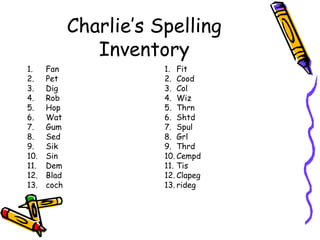
Charlie’s Spelling Inventory Fan Pet Dig Rob Hop Wat Gum Sed Sik Sin Dem Blad coch Fit Cood Col Wiz Thrn Shtd Spul Grl Thrd Cempd Tis Clapeg rideg
Reference Bear, D.R., Invernizzi, M., Templeton, S., &  Johnston, F. (2008).  Words their way:  Word study for phonics, vocabulary,  and spelling instruction . Columbus, OH: Merrill/Prentice Hall.

Baiden Glover In Service Plan

  • 1.
    Words Their Way:A Word Study Program Presented by: Katie Glover
  • 2.
    Literacy Introduction TheThree Questions By: J. Muth Muth, J.J.  (2002).  The three questions .  New York, NY:  Scholastic Press.
  • 3.
    What is WordStudy? Word Study is program that incorporates the many threads that make up the braid of literacy: orthography (correct sequence of letters), reading, oral language, stories and writing. Word Study “occurs in hands-on activities that mimic basic cognitive learning processes: comparing and contrasting categories of word features and discovering similarities and differences within and between categories” (Bear et al., p. 2). “ During Word Study, words and pictures are sorted in routines that require children to examine, discriminate, and make critical judgments about speech sounds, spelling patterns and meanings (p. 2).
  • 4.
    Why is WordStudy Important? Students need hands-on activities to manipulate words and make generalizations to entire groups of words It involves meaningful reading and writing opportunities to use the new words in many different contexts Teachers students how to look at words to construct a deep understanding of how spelling works Does not involve simple rote memorization of spelling and rules (p. 3)
  • 5.
    Word Study: Getting Started Take advantage of your daily opportunities to observe your students’ reading and writing: you can learn much about your students’ orthographic knowledge, such as blends, vowels, digraphs, etc. Observe your students’ as they write and sound out words, and observe their reading for reading errors and decoding skills. This information will show you what the students are using, but still confusing.
  • 6.
    Administering Spelling InventoriesSI are quick to administer and score. They analyze a student’s spellings using a feature guide. Kindergarten uses a Primary Spelling Inventory. You give the students a “spelling test” then analyze the results using the feature guide. You then record the data on the classroom composite form in rank order. This data will help with the forming of groups: group like students who miss 2 or more in a feature group.
  • 7.
  • 8.
  • 9.
    Roles of WordSorts “ Sorting is a powerful way to help students make sense of words” (p. 51) Students are able to make their own discoveries and generalizations about the spelling of the English language Word sorts are exciting manipulatives that require the student to pay attention to words and make logical decisions about their sound, pattern, and meaning Types of sorts: Sound sorts Pattern sorts Meaning sorts
  • 10.
    Sample Sorts: WeeklySchedule (1) Monday: Introduce sort Tuesday: Re-sort and write sort Wednesday: Buddy sort and speed sort Thursday: Word hunt Friday: Testing (spelling test) and Word Games (this schedule for primary and elementary grades)
  • 11.
    Sample Sorts: WeeklySchedule (2) Monday: Picture sort Tuesday: Drawing and labeling Wednesday: Cutting and Pasting Thursday: Word hunts Friday: Games (this schedule is for word study with just pictures)
  • 12.
    Sample Sorts: KindergartenWord Families -at and -an Monday- Read The Cat in the Hat as an introduction to word families. Sort word family pictures Tuesday- Sort word pictures with –at and –an header Wednesday- Introduce words and practice sorting words Thursday- Independent word sorting, and speed sorts; write words in word study notebook Friday- Assessment and make word family flip book
  • 13.
    Group Participation Activityone: With your copy of a primary feature guide, score the spelling test by “Charlie” Record Charlie’s spelling words and practice scoring the features
  • 14.
    Charlie’s Spelling InventoryFan Pet Dig Rob Hop Wat Gum Sed Sik Sin Dem Blad coch Fit Cood Col Wiz Thrn Shtd Spul Grl Thrd Cempd Tis Clapeg rideg
  • 15.
    Reference Bear, D.R.,Invernizzi, M., Templeton, S., & Johnston, F. (2008). Words their way: Word study for phonics, vocabulary, and spelling instruction . Columbus, OH: Merrill/Prentice Hall.