TIME CLAUSES
FACTS TO REMEMBER
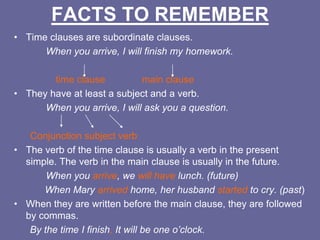
• Time clauses are subordinate clauses.
      When you arrive, I will finish my homework.

        time clause          main clause
• They have at least a subject and a verb.
      When you arrive, I will ask you a question.

   Conjunction subject verb
• The verb of the time clause is usually a verb in the present
  simple. The verb in the main clause is usually in the future.
       When you arrive, we will have lunch. (future)
      When Mary arrived home, her husband started to cry. (past)
• When they are written before the main clause, they are followed
  by commas.
   By the time I finish, It will be one o’clock.
CONJUNCTIONS AND EXPRESSIONS
    INTRODUCING A TIME CLAUSE
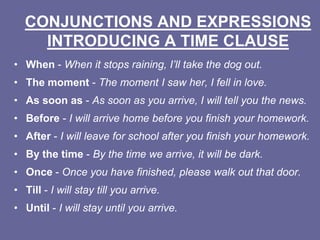
• When - When it stops raining, I’ll take the dog out.
• The moment - The moment I saw her, I fell in love.
• As soon as - As soon as you arrive, I will tell you the news.
• Before - I will arrive home before you finish your homework.
• After - I will leave for school after you finish your homework.
• By the time - By the time we arrive, it will be dark.
• Once - Once you have finished, please walk out that door.
• Till - I will stay till you arrive.
• Until - I will stay until you arrive.

Time clauses

  • 1.
  • 2.
    FACTS TO REMEMBER •Time clauses are subordinate clauses. When you arrive, I will finish my homework. time clause main clause • They have at least a subject and a verb. When you arrive, I will ask you a question. Conjunction subject verb • The verb of the time clause is usually a verb in the present simple. The verb in the main clause is usually in the future. When you arrive, we will have lunch. (future) When Mary arrived home, her husband started to cry. (past) • When they are written before the main clause, they are followed by commas. By the time I finish, It will be one o’clock.
  • 3.
    CONJUNCTIONS AND EXPRESSIONS INTRODUCING A TIME CLAUSE • When - When it stops raining, I’ll take the dog out. • The moment - The moment I saw her, I fell in love. • As soon as - As soon as you arrive, I will tell you the news. • Before - I will arrive home before you finish your homework. • After - I will leave for school after you finish your homework. • By the time - By the time we arrive, it will be dark. • Once - Once you have finished, please walk out that door. • Till - I will stay till you arrive. • Until - I will stay until you arrive.