Word Choice and
Imagery
From Perrine’s Literature – The Elements of Poetry, Chapters 3-4
Denotation and Connotation
 Words have three component parts
 Denotation = literal meaning of a word (dictionary definition)
 Connotation = what the word suggests beyond its denotation: the overtone of meaning that the word
has developed through usage
 Sound = the consonant and vowel sounds made to speak the word
 The distinction between denotative and connotative meanings is very important in
the study of poetry
 Sound is important too, but we’ll study this later in the unit
Friday, January 13, 2017 2
Denotation and Connotation
 To illustrate the difference between denotation and connotation, consider the words
house and home
 Both share the same denotation = a place where people reside
 However, they each contain different connotations
 House = suggests a structure that people live in
 Very little emotional or imaginative content
 When you read this word, you see an object only
 Home = suggests a state of mind
 Much emotional and imaginative content
 When you read this word, you likely feel something: warmth, comfort, safety, love
 The word conjures a number of related ideas from your memories: family, meals, familiar sights and
sounds and smells
Friday, January 13, 2017 3
Friday, January 13, 2017 4
Denotation and Connotation
 Dickenson uses several highly connotative words to suggest meaning beyond what
the poem literally says
 Frigate = not just any boat, a vessel made popular during the golden age of exploration, a type of
ship synonymous with adventure and romance
 Coursers = not just any type of horse, a breed of warhorse used in a Middle Ages for its swiftness
and its bravery in battle
 Chariot = not just any vehicle, an icon of classical Greece and Rome, the vessel of Apollo and
Helios, who would fly his chariot across the sky carrying the sun
 When analyzing a word’s meaning, look once again at the four dimensions of
language
 Intellectual = denotation
 Sensuous = the physical sensations the word suggests
 Emotional = the emotions the word suggests
 Imaginative = the related ideas and symbolic meanings the word suggests
Friday, January 13, 2017 5
Denotation and Connotation
 Just as a word can suggest multiple connotations, so may it suggest multiple
denotations
 Homophones = words which have the same spelling and pronunciation but are actually different
words altogether, with different dictionary definitions
 Spring = ( 1 ) a pounce or leap, (2) the season after Winter, ( 3 ) a natural source of water, ( 4) a
coiled elastic wire
 Poets will sometimes take advantage of verbal ambiguity
 Ambiguity = doubtfulness or uncertainty of meaning or intention
 The reader is meant to puzzle over the word’s double meaning
 All meanings are important to understanding what the poem says
Friday, January 13, 2017 6
Friday, January 13, 2017 7
Denotation and Connotation
 Several words with double meanings in this poem
 Vain = excessive pride or futility (suggests her thoughts are both arrogant and pointless)
 Habit = common behavior or dwelling place (suggests that people in love cannot help but act this
way and that dishonesty is where love comes from)
 Lie = tell falsehood or to sleep with someone (suggests that their relationship is built on lies and
sex)
Friday, January 13, 2017 8
Denotation and Connotation
 When poets choose words carefully, their poems affect us on a subconscious level
 We just understand more about the poem, without necessarily knowing why
 But when we study literature, it’s our job to figure out exactly why
Friday, January 13, 2017 9
Friday, January 13, 2017 10
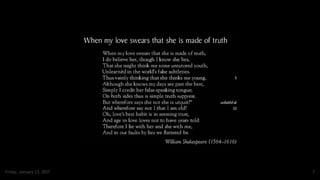
There is a distinctive shift in this poem: where the
speaker goes from describing the woman as she
might have liked to describe herself to where the
speaker begins to judge the woman.
Between which two stanzas does this shift take
place?
Denotation and Connotation
 In stanzas 1-4, the speaker describes the woman as she might have described
herself
 In stanzas 5-7, the speaker shifts to judging the woman
 How do we know this?
 There is a distinctive shift in the word choice
 Stanzas 1-4 feature highly positive diction; the words used to describe her suggest qualities that a
person might like about themselves
 Stanzas 5-7 feature decidedly negative diction; these words describe a person in an unfavorable
way
 Go back to the poem and pick our words which support this interpretation
 Work in your desk groups
 Create two lists: words which connote positive sensations/emotions/ideas, words which connote
negative sensations/emotions/ideas
Friday, January 13, 2017 11
Imagery
 Communicating experience is the primary function of poetry
 Experience comes to use largely through our five senses: sight, sound, taste, smell, touch
 Our brains process sensation before anything else
 When we see something, we first sense its shape, size, color, etc.
 Then our brains label it intellectually, and react to it emotionally and imaginatively
 Because sensations are so integral to how we experience things, poets rely heavily
on imagery
 Imagery = the representation through language of sense experience
 We call individual uses of imagery images
 Image can refer to an experience through any of the senses
 So poems can contain visual images, but also auditory images and tactile images
Friday, January 13, 2017 12
Imagery
 When analyzing imagery, it helps to know the adjectives that go with each sense
 Sight = visual
 Sound = auditory
 Taste = gustatory
 Smell = olfactory
 Touch = tactile
Friday, January 13, 2017 13
Friday, January 13, 2017 14
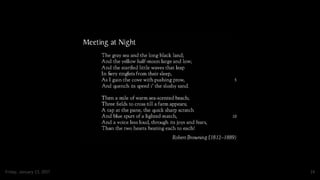
Imagery
 This poem is about love: it’s theme might be expressed as “love is exciting and
makes the world appear beautiful and everything in it seem significant”
 But it doesn’t mention love at all
 Instead these ideas and emotions are communicated through sensory experience
 The poet uses vivid imagery to access these ideas
 When the reader sees, smells, or hears what the poem says it accesses our own experiences with
those sights smells and sounds
 It also accesses the sensations, emotions, and ideas related to those sensory experiences
 And since our brains are all chemically similar, we generally have the same responses
Friday, January 13, 2017 15
Friday, January 13, 2017 16
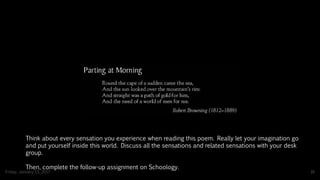
Think about every sensation you experience when reading this poem. Really let your imagination go
and put yourself inside this world. Discuss all the sensations and related sensations with your desk
group.
Then, complete the follow-up assignment on Schoology.

Word Choice and Imagery

  • 1.
    Word Choice and Imagery FromPerrine’s Literature – The Elements of Poetry, Chapters 3-4
  • 2.
    Denotation and Connotation Words have three component parts  Denotation = literal meaning of a word (dictionary definition)  Connotation = what the word suggests beyond its denotation: the overtone of meaning that the word has developed through usage  Sound = the consonant and vowel sounds made to speak the word  The distinction between denotative and connotative meanings is very important in the study of poetry  Sound is important too, but we’ll study this later in the unit Friday, January 13, 2017 2
  • 3.
    Denotation and Connotation To illustrate the difference between denotation and connotation, consider the words house and home  Both share the same denotation = a place where people reside  However, they each contain different connotations  House = suggests a structure that people live in  Very little emotional or imaginative content  When you read this word, you see an object only  Home = suggests a state of mind  Much emotional and imaginative content  When you read this word, you likely feel something: warmth, comfort, safety, love  The word conjures a number of related ideas from your memories: family, meals, familiar sights and sounds and smells Friday, January 13, 2017 3
  • 4.
  • 5.
    Denotation and Connotation Dickenson uses several highly connotative words to suggest meaning beyond what the poem literally says  Frigate = not just any boat, a vessel made popular during the golden age of exploration, a type of ship synonymous with adventure and romance  Coursers = not just any type of horse, a breed of warhorse used in a Middle Ages for its swiftness and its bravery in battle  Chariot = not just any vehicle, an icon of classical Greece and Rome, the vessel of Apollo and Helios, who would fly his chariot across the sky carrying the sun  When analyzing a word’s meaning, look once again at the four dimensions of language  Intellectual = denotation  Sensuous = the physical sensations the word suggests  Emotional = the emotions the word suggests  Imaginative = the related ideas and symbolic meanings the word suggests Friday, January 13, 2017 5
  • 6.
    Denotation and Connotation Just as a word can suggest multiple connotations, so may it suggest multiple denotations  Homophones = words which have the same spelling and pronunciation but are actually different words altogether, with different dictionary definitions  Spring = ( 1 ) a pounce or leap, (2) the season after Winter, ( 3 ) a natural source of water, ( 4) a coiled elastic wire  Poets will sometimes take advantage of verbal ambiguity  Ambiguity = doubtfulness or uncertainty of meaning or intention  The reader is meant to puzzle over the word’s double meaning  All meanings are important to understanding what the poem says Friday, January 13, 2017 6
  • 7.
  • 8.
    Denotation and Connotation Several words with double meanings in this poem  Vain = excessive pride or futility (suggests her thoughts are both arrogant and pointless)  Habit = common behavior or dwelling place (suggests that people in love cannot help but act this way and that dishonesty is where love comes from)  Lie = tell falsehood or to sleep with someone (suggests that their relationship is built on lies and sex) Friday, January 13, 2017 8
  • 9.
    Denotation and Connotation When poets choose words carefully, their poems affect us on a subconscious level  We just understand more about the poem, without necessarily knowing why  But when we study literature, it’s our job to figure out exactly why Friday, January 13, 2017 9
  • 10.
    Friday, January 13,2017 10 There is a distinctive shift in this poem: where the speaker goes from describing the woman as she might have liked to describe herself to where the speaker begins to judge the woman. Between which two stanzas does this shift take place?
  • 11.
    Denotation and Connotation In stanzas 1-4, the speaker describes the woman as she might have described herself  In stanzas 5-7, the speaker shifts to judging the woman  How do we know this?  There is a distinctive shift in the word choice  Stanzas 1-4 feature highly positive diction; the words used to describe her suggest qualities that a person might like about themselves  Stanzas 5-7 feature decidedly negative diction; these words describe a person in an unfavorable way  Go back to the poem and pick our words which support this interpretation  Work in your desk groups  Create two lists: words which connote positive sensations/emotions/ideas, words which connote negative sensations/emotions/ideas Friday, January 13, 2017 11
  • 12.
    Imagery  Communicating experienceis the primary function of poetry  Experience comes to use largely through our five senses: sight, sound, taste, smell, touch  Our brains process sensation before anything else  When we see something, we first sense its shape, size, color, etc.  Then our brains label it intellectually, and react to it emotionally and imaginatively  Because sensations are so integral to how we experience things, poets rely heavily on imagery  Imagery = the representation through language of sense experience  We call individual uses of imagery images  Image can refer to an experience through any of the senses  So poems can contain visual images, but also auditory images and tactile images Friday, January 13, 2017 12
  • 13.
    Imagery  When analyzingimagery, it helps to know the adjectives that go with each sense  Sight = visual  Sound = auditory  Taste = gustatory  Smell = olfactory  Touch = tactile Friday, January 13, 2017 13
  • 14.
  • 15.
    Imagery  This poemis about love: it’s theme might be expressed as “love is exciting and makes the world appear beautiful and everything in it seem significant”  But it doesn’t mention love at all  Instead these ideas and emotions are communicated through sensory experience  The poet uses vivid imagery to access these ideas  When the reader sees, smells, or hears what the poem says it accesses our own experiences with those sights smells and sounds  It also accesses the sensations, emotions, and ideas related to those sensory experiences  And since our brains are all chemically similar, we generally have the same responses Friday, January 13, 2017 15
  • 16.
    Friday, January 13,2017 16 Think about every sensation you experience when reading this poem. Really let your imagination go and put yourself inside this world. Discuss all the sensations and related sensations with your desk group. Then, complete the follow-up assignment on Schoology.

Editor's Notes

  • #2 NOTE: Want a different image on this slide? Select the picture and delete it. Now click the Pictures icon in the placeholder to insert your own image.