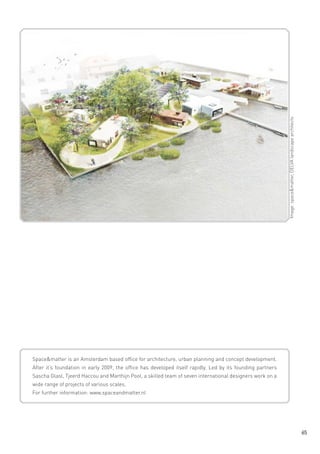
ACTIVATE & INVOLVE
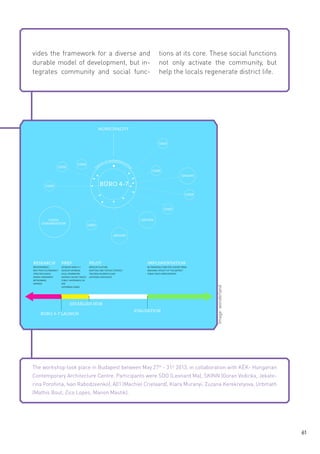
content

Content	
Editorial	

2
4

Activate & Involve	8
	
Reactivate!	
12
	
Mobile Fertile	
14
	
Share & Communicate	
18
Architecture for public - Budapest	
19
Vacancy - Cluj	
22
Social Coherence - Paris
24	
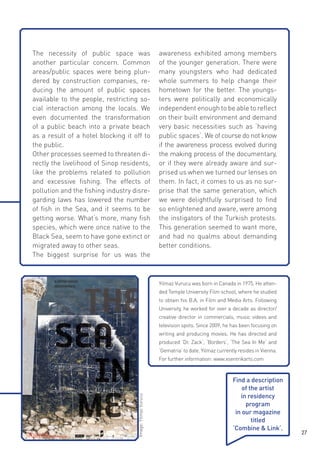
The case of ‘The Sea in me‘‘	
26
LOCAL SQUARES:
connecting and training participation experts in Europe	
28
PLAN E[XTINCTION]	30
Suburban Storytelling	
31
Interview with Volkmar Pamer, planning department City of Vienna	32
Test & Intervene	
34
The wonderland pavilion - Venice	
35
Project Space - Amsterdam	
38
The Urban Islands Project	40
Play van Gendthallen! The making of the Freezing Favela	
42
Park[haus] 	
44
Creating ordinary utopia	
46
Interview with Stefanie Raab, Coopolis, Berlin	48
Interview with Jesper Koefoed-Melson, givrum.nu, Copenhagen	51


2
Embed & Endure	
56
Mach Mann Heim - Mannheim 	
57
Vacancy - Budapest	59
The Vacant Budapest workshop 	60
The V-House	62
Dragon Dryer 	
63
De Ceuvel	
64
Interview with Sandor Finta, Chief Architect, Budapest	66
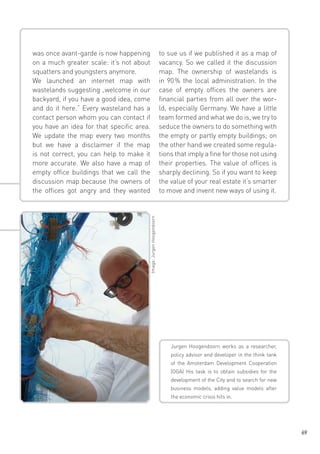
Interview with Jurgen Hoogendoorn, Policy advisor, Amsterdam	68
Thanks	
Wonderland’s mission – a growing European agenda	
Masthead

70
72
75


3
Activate &Involve
editorial

Wonderland – platform for European
architecture is a network fostering the
exchange of experiences, information
and knowledge between young European architecture practices, based in
Vienna, Austria.
Wonderland’s journey started in 2002,
with the exhibition of 11 young Austrian
offices. The goal was to show how the
young generation practices architecture and interprets the roles and tasks
of architects. In the following years,
wonderland expanded to various countries throughout Europe and offered
young offices, groups and organizations
a platform to exchange knowledge, test
ideas and find collaborators for international projects. With this expansion,
the focus shifted from what architects
do, to how architects operate.
Throughout its 11 years of existence,
wonderland established new formats
which bring emerging practices to-

4

gether in various locations to address
dilemmas of the discipline, both at the
local as well as the international level.
Blind Dates, matched architecture offices
and organisations along a defined theme
and helped them identify parallel issues
and challenges in their practices. Project
Spaces, site-specific workshops selecting teams through competitions and
encouraging them to work together on
a local problem, brought new perspectives in local planning and sometimes
inspired decision-makers to rethink
their strategies. Movies in wonderland, films screenings in public spaces,
brought life to peculiar locations in the
form of site-specific documentaries
and experimental films.
These frameworks offered by wonderland helped young practitioners experiment with new tools, test new uses,
and learn new skills about cooperation, participation, strategy making and
Image: Levente Polyák

process design. But more importantly,
they served as seismographs of the
current state of emerging architectural
practices, revealing the convergence of
ideas and professional strategies among
young offices. If these events highlighted
these new perspectives and ambitions,
wonderland‘s research went beyond
this in identifying patterns and statistical evidence of how young practices
operate; with two recent publications,
Underconstructions and the Manual for
Emerging Architects, wonderland offered
practical guidelines to those venturing
into the field.
Wonderlab, the 11th anniversary exhibition

of wonderland and the three magazines
published for its occasion follow this
evolution. The issues interact with the
exhibition in various ways: while being
exposed as elements of the exhibit, they
also define its themes and orientations.
By giving samples of the past years of
wonderland’s activities and the works
of member offices, the magazines invite the reader to explore where architecture goes today and where it might
head tomorrow.

June 2013
Daniela Patti, Levente Polyák

5
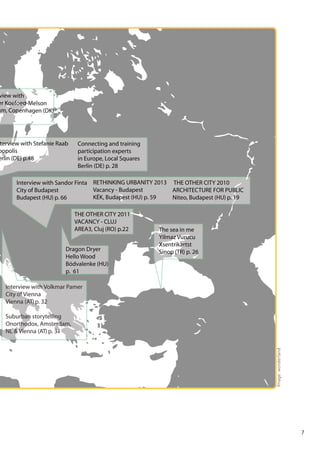
Interview with Jurgen Hoogendoorn Reactivate!
Indira van ’t Klooster
City of Amsterdam
A10, Amsterdam (NL)
Amsterdam (NL) p. 68
p. 12
De Ceuvel
ACTIVATING URBAN VOIDS 2012
space&matter
PROJECT SPACE AMSTERDAM
placemakers, Amsterdam (NL) p. 38 Amsterdam (NL) p. 64

The Urban Islands
Spacepilots
Aachen (DE) p. 40

Interv
Jespe
Givru
p. 51

Play van Gendthallen!
Play the City
Amsterdam (NL) p. 42

Park[haus]
ACTIVATING URBAN VOIDS
superwondergroup MACH MANN HEIM
Mannheim (DE) p. 44 Mannheim (DE) p. 57
Mobile Fertile
Coloco
Paris (FR) p. 14

THE OTHER CITY 2011
SOCIAL COHERENCE - PARIS
Zirup, Vienna (AT) p. 24

Creating ordinary utopia
Cochenko
Paris (FR) p. 46
THE OTHER CITY 2010
THE WONDERLAND PAVILION – VENICE
celia & Hannes, Montpelier (FR) p. 35

PLAN E[XTINCTION]
PKMN
Madrid (ES) p. 30

6

The V-House
The Milk Train
Rome (IT) p. 62

Int
Co
Be
view with
er Koefoed-Melson
um, Copenhagen (DK)

terview with Stefanie Raab
oopolis
erlin (DE) p.48

Connecting and training
participation experts
in Europe, Local Squares
Berlin (DE) p. 28

Interview with Sandor Finta RETHINKING URBANITY 2013 THE OTHER CITY 2010
Vacancy - Budapest
ARCHITECTURE FOR PUBLIC
City of Budapest
KÉK, Budapest (HU) p. 59
Niteo, Budapest (HU) p. 19
Budapest (HU) p. 66
THE OTHER CITY 2011
VACANCY - CLUJ
AREA3, Cluj (RO) p.22
Dragon Dryer
Hello Wood
Bódvalenke (HU)
p. 61

The sea in me
Yilmaz Vurucu
Xsentrikartst
Sinop (TR) p. 26

Interview with Volkmar Pamer
City of Vienna
Vienna (AT) p. 32

Image: wonderland

Suburban storytelling
Onorthodox, Amsterdam,
NL & Vienna (AT) p. 31

7
Activate & Involve
Daniela Patti, Rome (IT) & Levente Polyak, Budapest (HU)

Architecture has in recent years witnessed an extension in its interests,
subjects and preoccupations, as well
as in its spectrum of tools, instruments and methodologies. As opposed
to exclusively designing and building,
architects developed new instruments
and methodologies to bring sense and
life into dysfunctional elements of the
built environment, such as participative
interventions in space, the involvement
of different groups of stakeholders and
moderation / communication strategies in
order to foster process-oriented projects.
The role of architects and planners is
changing as they are gaining more
active roles in collaboratively rational
processes which engage communities,
public administrations and other main
actors into collectively managing often
conflicting information and interests,
ultimately guiding governance towards
resilient solutions.1
Before this, for a long time the professional role of the architect had, to
a large degree, remained unchanged,
“founded on an assumed expertise in
thinking and forming space that simply

8

has been handed down since early modernity.”2 Architecture’s concept of autonomy arose from the disillusionment
with modern architecture’s social engineering enterprise.3 In the excess of
postmodern experimentations with language and form, the increasing visibility
of iconic architecture helped architects
“distance themselves from such ‘hard’
economic process by emphasising their
status as artists engaged in the production of aesthetically and socially meaningful form”4, “emphasising the aesthetic and the semiotic at the expense
of the political-economic.”5
Architecture’s autonomy, however, has
been increasingly questioned in the past
decade. The profession’s intra-disciplinary dynamisms gave way to the “expansion of the architectural field” with a
new focus on the idea of the program as
a means “to create the basis for an architecture that realistically confronts the
present global political, social, and economic reality.”6 In this expanded field,
architecture is “a way of negotiating the
real, (…) a specific kind of socially symbolic production whose primary task is

1. Judith Innes and David Booher, ‘Planning With Complexity‘ (Routledge, 2010)
2. Catharina Gabrielsson, ‘The necessity of distance. Setting the position for critical spatial practice‘, in
Curating Architecture and the City, ed. 
Sarah Chaplin and Alexandra Stara (London and New York, NY:
Routledge, 2009), 219.
3. Andrew Leach and John MacArthur, ‘Architecture, Disciplinarity, and the Arts: Considering the Issues‘,
in Architecture, Disciplinarity, and the Arts, ed. Andrew Leach and John MacArthur (Ghent: A&S Books,
2009), 9.
4. Paul Jones, ‘Putting Architecture in its Social Place: A Cultural Political Economy of Architecture‘,
the construction of concepts and subject positions rather than the making
of things.”7 It is also in this expanded
field that “liberated from the obligation to construct, architecture can become a way of thinking about anything – a
discipline that represents relationships,
proportions, connections, effects, the
diagram of everything.”8
The economic crisis emphasised and
accelerated this professional transformation. The devastating effect of
the crisis on the construction industry
made architects painfully aware of the
unsustainability of previous concepts
of funding mechanisms and development processes. Finding themselves in
the midst of landscapes of unfinished
constructions and vacant complexes, a
generation of architects began to think
critically about the speculation-based
economy and to take into account the limitations of the shrunk market, started
to notice the opportunities of the urban
areas neglected by the official planning
mechanisms, and grew more inclined
to respond to the needs of local citizens, giving preference to small-scale,
community-oriented and often temporary interventions over large-scale construction projects, clearly responding
to the reduction of services and funding
previously provided by public adminis
trations. For this generation, the task of

architecture is less to produce pretty
objects than to create spatial impacts.
Led by their rediscovery of the critical
potentiality of architecture and spatial
interventions, architects in the past years began to turn increasingly towards
practices that had been elaborated by
avant-garde architecture collectives
in the 1960s and 1970s, and quickly
gained recognition by the art-world, but
never made their way into mainstream
architecture and planning. If architects
increasingly chose the means of communication campaigns, performances, participatory processes, temporary installations or in-between use programs to
intervene in the built environment, this
phenomenon shows how ineffective
conventional architectural instruments
can be in unconventional situations.
For this reason it can be noticed also in
Europe how many of those which used
to be niche practices are now being
partially integrated into more official
planning and decision making processes, in order to tackle the real urban
challenges.
In recent years, architectural projects
concentrating on disaffected public
spaces, vacant lots, empty buildings
or temporary situations found their
way not only into the more progressive state and municipal development
programs but also to the mainstream

Urban Studies, 46 (2009): 2519.
5. Paul Jones, 2519.
6. Anthony Vidler, “Architecture‘s expanded field: finding inspiration in jellyfish and geopolitics, architects
today are working within radically new frames of reference,” ArtForum April (2004)
7. Michael K. Hays, “Architecture‘s Desire: Reading the Late Avant-Garde,” (Cambridge, MA: MIT Press,
2009), 1.
8. Rem Koolhaas, “Editorial,” in Content, ed. Rem Koolhaas, (New York: Taschen, 2003), 20.
9
discourse defined by the most important architectural exhibition spaces.
A few years after the Actions: ‘What
You Can Do With the City‘ exhibition
presenting 99 bottom-up architectural initiatives at the Canadian Centre
for Architecture, Europe’s leading institutions were suddenly flooded with
exhibitions displaying various forms of
community architecture and urbanism.
Exhibitions like ‘Hands-On Urbanism‘ at
the Architekturzentrum Wien, ‘Re:Architecture‘ at the Pavillon de l’Arsenal
in Paris, ‘Spontaneous Interventions‘ in
the American Pavilion of the 2012 Venice
Biennial of Architecture or ‘Reactivate!‘
at Bureau Europa in Maastricht are all
manifestations of a movement that redraws the boundaries of the architectural profession.
Wonderland - platform for European
Architecture, through its events and
the activities of its member offices,
embraces this movement. The three
issues of the wonderland magazine
published for the 11th anniversary wonderlab exhibition, are veritable showcases of architectural innovation at various scales and by various means. The
three chapters of this issue, ‘Activate
& Involve‘ offer a brief inventory of the
variety of positions, methods and instruments offices, organisations and

10

decision-makers from and around the
Wonderland network use in their quest
to activate disaffected spaces and involve various stakeholders. The chapter ‘Share & 
Communicate‘ shows the
importance of generating discourse
around a spatial problem or possibility, making the issue visible for a broader audience and using architecture
to create communities via of a variety
of specific communication tools. The
chapter ‘Test & Intervene‘ suggests that
in contrast to deterministic concepts of
planning and designing, open-ended
processes give value to the time in-between, identifying it as an opportunity
to generate temporary uses and situations. And finally, the chapter ‘Embed &
Endure‘ depicts the processes in which
successful uses elaborated through
tests and experiments are fixed in space and time not statically, but allowing
constant changes that respond to the
surrounding.
Sometimes parts of larger development
schemes, but just as often isolated actions, examples of design and planning
innovation presented here are precursors of an alternative logic of developing the contemporary city, revealing
new ways of thinking space, time and
people, producing connections through
architectural situations.
 
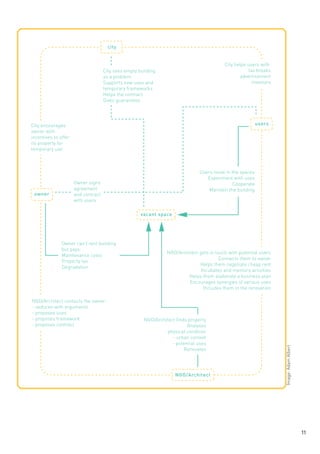
city
City helps users with
tax breaks
advertisement
investors

City sees empty building
as a problem
Supports new uses and
temporary frameworks
Helps the contract
Gives guarantees

users

City encourages
owner with
incentives to offer
its property for
temporary use

owner

Users move in the spaces
Experiment with uses
Cooperate
Maintain the building

Owner signs
agreement
and contract
with users
vacant space

NGO/Architect contacts the owner:
- seduces with arguments
- proposes uses
- proposes framework
- proposes contract

NGO/Architect gets in touch with potential users
Connects them to owner
Helps them negotiate cheap rent
Incubates and mentors activities
Helps them elaborate a business plan
Encourages synergies of various uses
Includes them in the renovation

NGO/Architect finds property
Analyses
- physical condition
- urban context
- potential uses
Renovates

NGO/Architect

Image: Adam Albert

Owner can't rent building
but pays:
Maintenance costs
Property tax
Degradation

11
Reactivate!
Indira van’t Klooster/A10,
Amsterdam (NL)
The post-starchitect is not working
on iconic concepts, or on mass-produced façades in the suburbs. At the
beginning of the twenty-first century,
ideas about how society should function on a social, economic and cultural
level have changed dramatically. And
so the latest generation in The Netherlands does not talk about programmes of requirements and planning, but
about economic engineering, Lofthomes, open-source urbanism, urban bio
logic, Freemium, performative urbanism, crowdfunding and the Ideal Day
method. These are the instruments for
new financing constructs, product development for do-it-yourself builders,
energy flows and closed cycles, soil decontamination and social regeneration
in vacant properties.
Oh well, say the older architects, we
used to do that too; it was just called
something else. Oh well, say the cynics,
those big words are nothing more than
labels to disguise a lack of big ideas
and powerful funding streams. Is this
true? What is going on with the latest
generation of architects? Not just in the
Netherlands, but elsewhere in Europe
as well? To understand the present generation of architects, we should not
start with Mies van der Rohe, or with
Rem Koolhaas. We might start with a

12

quotation from Kristian Koreman of
ZUS architecten.
“We designed a 300-m bridge because
we wanted to create a new context now.
You can’t wait for a client who’s going
to take 30 years to do it. So you have
to get the population involved. But we
didn’t ask: What do you think would be
a nice bridge, and how would you like
to have it? We designed something that
contributed to a sense of community
and asked what they would want to pay
for it.“ Crowdfunding in fact.
Koreman: “Yes, but not out of political
drive, just out of the deadlock that now
exists in traditional planning.“
This is how many young architects
in The Netherlands approach their
practice: What can I do now? How much
architecture is needed? Not of political
drive, but ‘just’ to force jammed planning machines. (...)
All of this is not an exclusively Dutch
development. Architects are addressing social challenges and rezoning
problems all over Europe. In the spring
of 2012, Failed Architecture investigated the Savamala district in Belgrade,
Serbia, with students and young professionals. In Estonia, KOKO Architects
gave huge hangars in Tallinn a second
life as a maritime museum. In Krakow,
Poland, a communist housing district is
new technologies, new challenges and
user desires. In the process they are
seeking solutions for problems that
are greater than themselves, which
they cannot tackle on their own: vacant
buildings, rezoning, energy-neutral
construction. But also: How can contaminated soil be made fit for habitation?
How can food cycles be established an
as large a scale as possible, and what
does this mean for other flows? How
can I involve the user better? Or, more
business-like: How do I regain control
over my projects? (...)

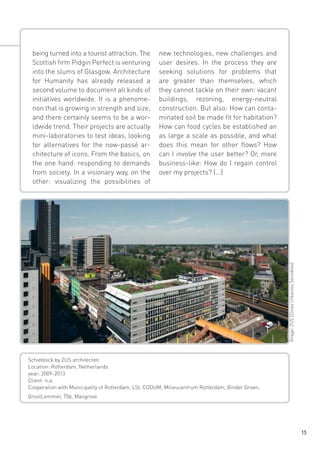
Image: ZUS (Zones Urbaines Sensibles)

being turned into a tourist attraction. The
Scottish firm Pidgin Perfect is venturing
into the slums of Glasgow. Architecture
for Humanity has already released a
second volume to document all kinds of
initiatives worldwide. It is a phenomenon that is growing in strength and size,
and there certainly seems to be a worldwide trend. Their projects are actually
mini-laboratories to test ideas, looking
for alternatives for the now-passé architecture of icons. From the basics, on
the one hand: responding to demands
from society. In a visionary way, on the
other: visualizing the possibilities of

Schieblock by ZUS architecten
Location: Rotterdam, Netherlands
year: 2009-2013
Client: n.a.
Cooperation with Municipality of Rotterdam, LSI, CODUM, Milieucentrum Rotterdam, Binder Groen,
GrootLemmer, 75b, Mangrove

13
be established on as large a scale as
possible, and what does this mean for
other flows? How can I involve the user

better? Or, more business-like: How do
I regain control over my projects?
 

Indira van’t Klooster (1971) is editor in chief of A10 new European architecture and the author of various
architecture publications in the Netherlands and beyond. In addition, she works with Architectuur Lokaal
and as a visiting lecturer at the Academy of Architecture in Amsterdam.
For further information: www.a10.eu

Mobile Fertile
Miguel Georgieff, Pablo Georgieff and Nicolas Bonnenfant/
Coloco, Paris (FR)
Coloco’s activities connect research,
strategy, experimentation, artistic actions, gardening, project supervision and
party – to celebrate life. We founded Coloco, which refers to our double practice
as landscape architects and a collective
of artists and constructors. We face the
challenge to maintain these practices in
parallel and to be able to adapt to different contexts of making the city.
This is the solution that we found, to be

14

able to realize a wide variety of projects
and to host a large team that grows and
renews itself over time. Our trio is responsible for the economic, artistic and
legal aspects of the project coordination. Coloco’s team is open and polymorphic, and reconfigures itself at every
opportunity to realize a project.
It is not obvious to classify our work in a
category, even for ourselves. We ended
up saying that this is an opportunity.
Because it forces us to discuss the relevance of each situation, each project,
and to find out what connects them.
Even though it draws a meandering
path, our practice is guided by our desire to establish fertile relationships between urban space and living, being in
the very wide expression of their forms.
The sites of our actions are spread
all over the world as we are essentially mobile. Mobile between fields of
knowledge and fields of practice. Mobile also between all scales of landscape.
We claim to be able to give value to all
projects regardless of their magnitude
and their geographical location.
Whether it comes unexpectedly or from
a long process, we analyse the commission carefully in order to broaden
the opportunities of decision-makers
through our proposals for collective
construction. We consider this questioning essential, because we have to act,
individually and in groups, to change at
all scales our predatory behaviour, our
relationship to consumption and our
delegation of action to institutions that
maintain the collective inertia. The right
to appropriate public space, to build by
weaving friendships or to meet in the
street; we claim all this.
Since the first research for Skeletons
to live and Aerial Gardens, we travelled the world to meet people who build
their own homes and invent their gardens themselves. We recognized the
geniality of DIY, the intelligence of the

just effort and the wisdom of reuse.
The results of the projects undertaken by informal communities in Rio
de Janeiro, Havana or Jakarta are to
be judged from the aspect of inventiveness, and not from the viewpoint of
spending. With these lessons of ingeniousness rather than engineering, we
understand that we control so little the
most complex creation of humanity, the
cities where we live: they are in perpetual transformation and hardly obey to
projections.
Coloco develops both a reflection and
practice on the transformation of public spaces, through projects for which
we are invited as thinkers, designers, or
constructors. Aware of the limitations
of the modes of planning, we are questioning our approach to imagine broader possibilities. The current structure
of public commissions hardly integrates the specificities of the use of places.
The stiffness of the procedures and the
strict documentation processes make it
difficult to adapt the initiatives on site
and in the construction. Therefore the
development is not organised to maximise the collective investment in the
production of the city but to produce
indefinitely planning mechanisms. In
our understanding, these procedures
are dissipating the creative energy and
financial resources.
We developed a practice of discovering
the territories and meeting their inhabitants that cannot be formulated in

15
a protocol, but is engaged in everyday
spaces and everyday life. This recognition leads us to converge the forces in
place in contributive actions where we
support the realisation of development
imagined collectively.
These actions are sometimes adopting
a command, acting as a catalyst and
revealing the aspirations of citizens; in
other cases, after an investigation, demonstrating and testing the developed
hypotheses at a real scale. An essential
part of our work is to establish a platform for negotiation where new possi-

bilities are opened for the developers,
institutions, and suitable to the desires
of people who can speak their minds
and hands about the transformation of
their living spaces.
Convinced that collective action plays
the role of the engine in the dynamics
of urban projects, we include these
practices in the creative process.
Waking up the potential of dormant sites, these activations create desire, essential lever for change. In this context
of appropriate construction, we wish to
integrate the possibility of existing reuse

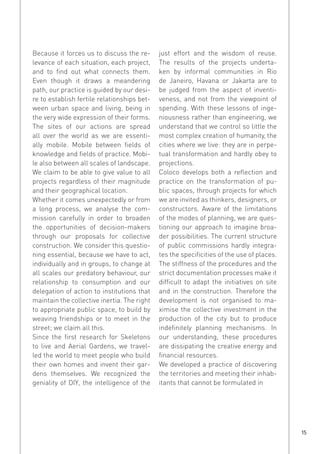
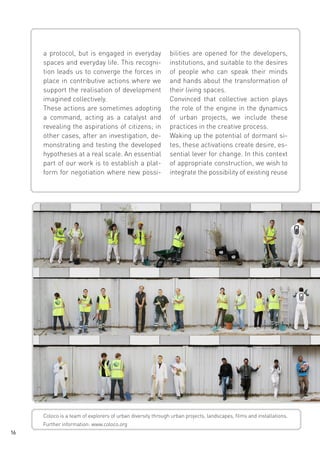
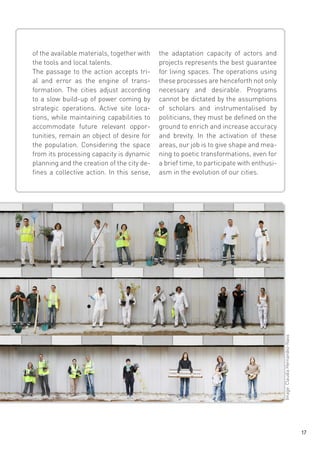
Coloco is a team of explorers of urban diversity through urban projects, landscapes, films and installations.
Further information: www.coloco.org
16
the adaptation capacity of actors and
projects represents the best guarantee
for living spaces. The operations using
these processes are henceforth not only
necessary and desirable. Programs
cannot be dictated by the assumptions
of scholars and instrumentalised by
politicians, they must be defined on the
ground to enrich and increase accuracy
and brevity. In the activation of these
areas, our job is to give shape and meaning to poetic transformations, even for
a brief time, to participate with enthusiasm in the evolution of our cities.

Image: Claudia Hernandez-Nass

of the available materials, together with
the tools and local talents.
The passage to the action accepts trial and error as the engine of transformation. The cities adjust according
to a slow build-up of power coming by
strategic operations. Active site locations, while maintaining capabilities to
accommodate future relevant opportunities, remain an object of desire for
the population. Considering the space
from its processing capacity is dynamic
planning and the creation of the city defines a collective action. In this sense,

17
Share & Communicate
Daniela Patti, Rome (IT) & Levente Polyak, Budapest (HU)

Since public and private commissions
grew thinner with the crisis, architects,
in their search for new opportunities,
acquired a variety of new roles: they
became researchers, real estate developers, consultation experts or mediators. Instead of waiting for assignments, architects began to embrace
the entire process of development, becoming initiators of new projects, with
the support of many actors such as
public administrations, private investors but especially citizens, NGOs, local
representatives, users etc. In these cooperations, architects often occupy a
central position.
This is radically different in comparison
to previous roles architects identified
themselves with. The first change has
to do with the flow of information: how
it is generated, expressed and received. The profession of organising space

18

has gradually turned into organising
information. Architects developed new
skills in order to tackle these challenges: from expertise in communication
methodologies and information campaigns to competence in funding mechanisms and interventions.
And there is a certain, if subtle difference between informing, communicating and sharing information and
knowledge, as the level of commitment
and involvement of the various actors
gradually increases. Commitment and
involvement are crucial in today’s development processes: they can only be
considered socially sustainable when
representing the interest of a larger
community. Feeling part of the space
you live in and having a voice in the decisions that mould it are one of the current challenges of democracy…
PROJECT SPACE
THE OTHER CITY 2010

Architecture for public
Gábor Zimborás / niteo,
Budapest (HU)
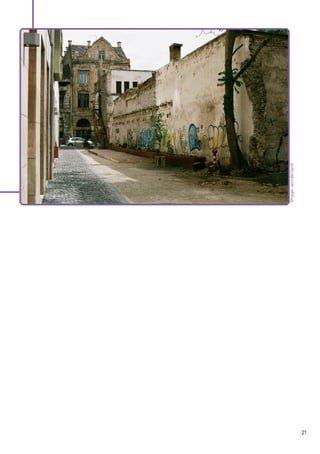
city habitat, the Roma city dwelling.
However, after spending the first two
days on exploring the site and establishing a dialogue with the local community (inside the houses, on the streets,
in the local wine shops and in the community centre) we realised that the people living in this district do not have one
single dream. They are very fragmented
and they have very different aspirations.
However, we found that this neighbourhood has a hidden identity. It is a
hidden district. There are hidden and
empty places. Time is a non-existing dimension for this place. It is a ‘sleeping
community‘ with a lot of ghosts, unstructured life in space and time. The
only common positive thing is the interest in the traditional music, and local

Image: wonderland

The aim of this collaborative planning
experience was to encourage a community space for Romanies in one of
the most underprivileged districts of
Budapest.
The Project Space was located in the
Magdolna Neighbourhood of the 8th
District of Budapest, one of the most
underprivileged areas of the Hungarian
capital. This is a neighbourhood populated by a big percentage of the Roma
minority, living in city blocks that are
hardest hit by unemployment, social
conflicts and everyday crime. This part
of the city population is hardly ever asked about their ideas on architecture.
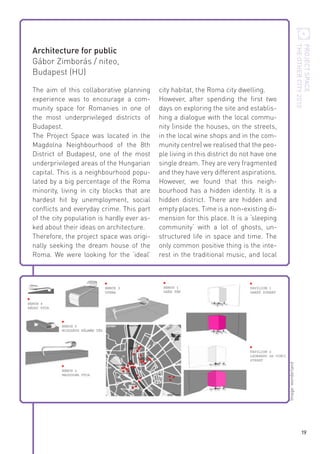
Therefore, the project space was originally seeking the dream house of the
Roma. We were looking for the ‘ideal’

19
knowledge to play music does exist.
Consequently, we realised that we had
to propose a project that establishes
the pride of the district. Another objective was ‘making places’ on the empty
lots. We wanted to do something that
gives a sense of structured time and
space for the inhabitants and establishes the connection between themselves, and communication with other
parts of the capital.
So, our idea was a design of symbolic
stages. The stage structure is a symbolic one-cubic-metre cage structure
made of the materials found after the
demolition of the old houses (one cubic
metre of Józsefváros) multiplied for several players. The structures are erected
on empty lots, next to the existing dead
walls. Lightweight ‘mega-lampions‘ are
attached to the walls above the stages
so they could act as landmarks on the
territory of the demolished land.

A microphone wire with a plug is integrated into the structure. Microphones
and instruments could be borrowed
from the Kesztyűgyár Community Centre for the locals who want to perform.
The 8th District stages are complemented with the design of special benches
with integrated loudspeakers in selected places in the downtown of Budapest,
where you can listen to the ‘Voice of the
8th District’. The spontaneous performances on the stages could be integrated into the programmes of the official
Spring Music Festivals in Budapest.
Simultaneously, the project space group
also proposed an art project to be photographed on the empty lots of the 8th
District with the local people posing
with simple but thoughtful statements
or questions. We designed the photomontage images of the pictures with
the wordings and the real scenes of the
empty lots.


This project space took place between September 7th and 10th 2010 and was hosted by UIArchitects and
Niteo Projects & Architecture teams. The participating teams were Cremascoli Okumura Rodrigues Arquitecto, glocalstudio and Gruber/ Lenart/ Opel architects.

20
21

Image: wonderland
PROJECT SPACE
THE OTHER CITY 2011
22

VACANCY – CLUJ
AREA3, Cluj (RO)
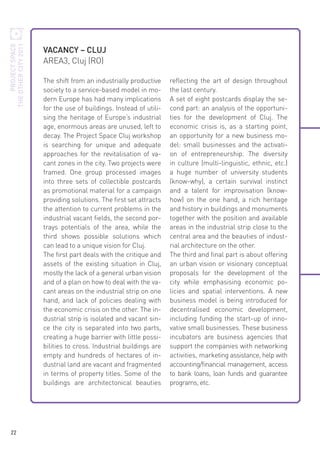
The shift from an industrially productive
society to a service-based model in modern Europe has had many implications
for the use of buildings. Instead of utilising the heritage of Europe’s industrial
age, enormous areas are unused, left to
decay. The Project Space Cluj workshop
is searching for unique and adequate
approaches for the revitalisation of vacant zones in the city. Two projects were
framed. One group processed images
into three sets of collectible postcards
as promotional material for a campaign
providing solutions. The first set attracts
the attention to current problems in the
industrial vacant fields, the second portrays potentials of the area, while the
third shows possible solutions which
can lead to a unique vision for Cluj.
The first part deals with the critique and
assets of the existing situation in Cluj,
mostly the lack of a general urban vision
and of a plan on how to deal with the vacant areas on the industrial strip on one
hand, and lack of policies dealing with
the economic crisis on the other. The industrial strip is isolated and vacant since the city is separated into two parts,
creating a huge barrier with little possibilities to cross. Industrial buildings are
empty and hundreds of hectares of industrial land are vacant and fragmented
in terms of property titles. Some of the
buildings are architectonical beauties

reflecting the art of design throughout
the last century.
A set of eight postcards display the second part: an analysis of the opportunities for the development of Cluj. The
economic crisis is, as a starting point,
an opportunity for a new business model: small businesses and the activation of entrepreneurship. The diversity
in culture (multi-linguistic, ethnic, etc.)
a huge number of university students
(know-why), a certain survival instinct
and a talent for improvisation (knowhow) on the one hand, a rich heritage
and history in buildings and monuments
together with the position and available
areas in the industrial strip close to the
central area and the beauties of industrial architecture on the other.
The third and final part is about offering
an urban vision or visionary conceptual
proposals for the development of the
city while emphasising economic policies and spatial interventions. A new
business model is being introduced for
decentralised economic development,
including funding the start-up of innovative small businesses. These business
incubators are business agencies that
support the companies with networking
activities, marketing assistance, help with
accounting/financial management, access
to bank loans, loan funds and guarantee
programs, etc.
Image: wonderland
Image: wonderland

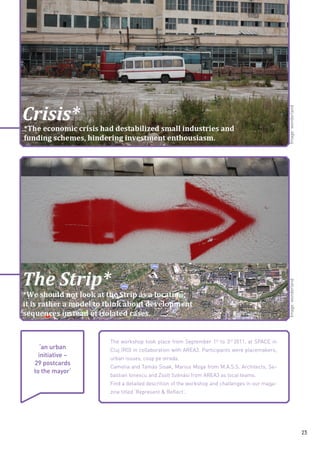
‘an urban
initiative –
29 postcards
to the mayor‘

The workshop took place from September 1st to 3rd 2011, at SPACE in
Cluj (RO) in collaboration with AREA3. Participants were placemakers,
urban issues, coop pe strada.
Camelia and Tamás Sisak, Marius Moga from M.A.S.S. Architects, Sebastian Ionescu and Zsolt Szénási from AREA3 as local teams.
Find a detailed descrition of the workshop and challenges in our magazine titled ‘Represent & Reflect‘.

23
PROJECT SPACE
THE OTHER CITY 2011

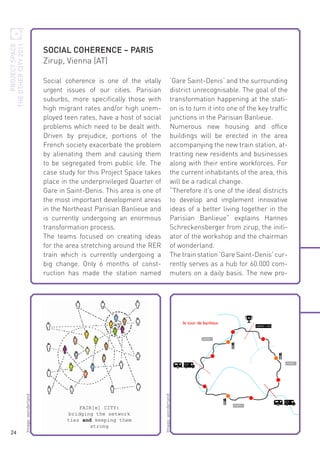
‘Gare Saint-Denis‘ and the surrounding
district unrecognisable. The goal of the
transformation happening at the station is to turn it into one of the key traffic
junctions in the Parisian Banlieue.
Numerous new housing and office
buildings will be erected in the area
accompanying the new train station, attracting new residents and businesses
along with their entire workforces. For
the current inhabitants of the area, this
will be a radical change.
“Therefore it’s one of the ideal districts
to develop and implement innovative
ideas of a better living together in the
Parisian Banlieue” explains Hannes
Schreckensberger from zirup, the initiator of the workshop and the chairman
of wonderland.
The train station ‘Gare Saint-Denis‘ currently serves as a hub for 60.000 commuters on a daily basis. The new pro-

Image: wonderland

Social coherence is one of the vitally
urgent issues of our cities. Parisian
suburbs, more specifically those with
high migrant rates and/or high unemployed teen rates, have a host of social
problems which need to be dealt with.
Driven by prejudice, portions of the
French society exacerbate the problem
by alienating them and causing them
to be segregated from public life. The
case study for this Project Space takes
place in the underprivileged Quarter of
Gare in Saint-Denis. This area is one of
the most important development areas
in the Northeast Parisian Banlieue and
is currently undergoing an enormous
transformation process.
The teams focused on creating ideas
for the area stretching around the RER
train which is currently undergoing a
big change. Only 6 months of construction has made the station named

Image: wonderland

24

SOCIAL COHERENCE – PARIS
Zirup, Vienna (AT)
“To make a fair city you need to work
with the people who live in it – master
planning is not going to do the job. Therefore we developed an approach rather
than a plan or strategy of how to do something. The approach is based on the
idea of Open Source Placemaking: an
informal, open source approach to occupation, enterprise and the building of
collective identity.”
Superwondergroup from Stuttgart (DE)
thinks that through the creation of
temporary ‘community kitchens‘ in the
quarter, dialogue among the communities would increase and improve.
The bad reputation of the suburbs was
the target for the Austrian team IKA
(AT). They adapted the idea of a bike
tour, naming it ‘Tour de Banlieue‘, lasting several days with various stopovers
in unexplored peripheral areas.

The Project Space took place from August 16th
to 19th 2011 in cooperatoion with zirup.
Participating teams were superwondergroup
(DE), collectiva IKA (AT), islant (NL), Cochenko,
Fertile, range ta chambre and START XXI as
local teams.

Image: wonderland

Image: wonderland

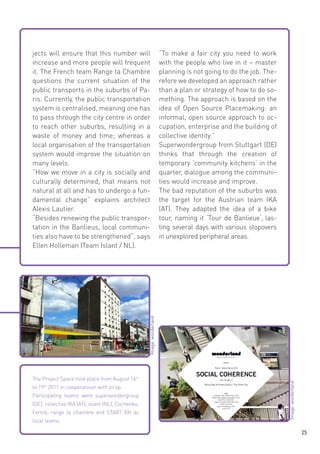
jects will ensure that this number will
increase and more people will frequent
it. The French team Range ta Chambre
questions the current situation of the
public transports in the suburbs of Paris. Currently, the public transportation
system is centralised, meaning one has
to pass through the city centre in order
to reach other suburbs, resulting in a
waste of money and time; whereas a
local organisation of the transportation
system would improve the situation on
many levels.
“How we move in a city is socially and
culturally determined, that means not
natural at all and has to undergo a fundamental change” explains architect
Alexis Lautier.
“Besides renewing the public transportation in the Banlieus, local communities also have to be strengthened”, says
Ellen Holleman (Team Islant / NL).

25
MOVIES IN WONDERLAND 2013

The case of ‘The Sea In Me‘
Yilmaz Vurucu, Vienna (AT)

Image: Yilmaz Vurucu

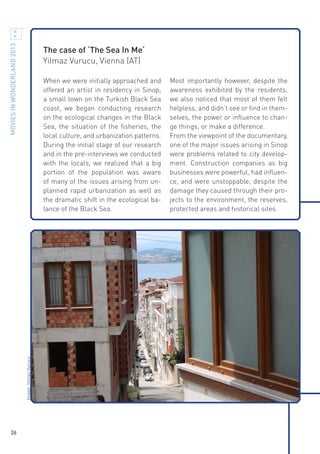
When we were initially approached and
offered an artist in residency in Sinop,
a small town on the Turkish Black Sea
coast, we began conducting research
on the ecological changes in the Black
Sea, the situation of the fisheries, the
local culture, and urbanization patterns.
During the initial stage of our research
and in the pre-interviews we conducted
with the locals, we realized that a big
portion of the population was aware
of many of the issues arising from unplanned rapid urbanization as well as
the dramatic shift in the ecological balance of the Black Sea.

26

Most importantly however, despite the
awareness exhibited by the residents,
we also noticed that most of them felt
helpless, and didn’t see or find in themselves, the power or influence to change things, or make a difference.
From the viewpoint of the documentary,
one of the major issues arising in Sinop
were problems related to city development. Construction companies as big
businesses were powerful, had influence, and were unstoppable, despite the
damage they caused through their projects to the environment, the reserves,
protected areas and historical sites.
The necessity of public space was
another particular concern. Common
areas/public spaces were being plundered by construction companies, reducing the amount of public spaces
available to the people, restricting social interaction among the locals. We
even documented the transformation
of a public beach into a private beach
as a result of a hotel blocking it off to
the public.
Other processes seemed to threaten directly the livelihood of Sinop residents,
like the problems related to pollution
and excessive fishing. The effects of
pollution and the fishing industry disregarding laws has lowered the number
of fish in the Sea, and it seems to be
getting worse. What‘s more, many fish
species, which were once native to the
Black Sea, seem to have gone extinct or
migrated away to other seas.
The biggest surprise for us was the

awareness exhibited among members
of the younger generation. There were
many youngsters who had dedicated
whole summers to help change their
hometown for the better. The youngsters were politically and economically
independent enough to be able to reflect
on their built environment and demand
very basic necessities such as ‘having
public spaces‘. We of course do not know
if the awareness process evolved during
the making process of the documentary,
or if they were already aware and surprised us when we turned our lenses on
them. In fact, it comes to us as no surprise that the same generation, which
we were delightfully surprised to find
so enlightened and aware, were among
the instigators of the Turkish protests.
This generation seemed to want more,
and had no qualms about demanding
better conditions.

Yilmaz Vurucu was born in Canada in 1975. He attended Temple University Film school, where he studied
to obtain his B.A. in Film and Media Arts. Following
University, he worked for over a decade as director/
creative director in commercials, music videos and
television spots. Since 2009, he has been focusing on
writing and producing movies. He has directed and
produced ‘Dr. Zack‘, ‘Borders‘, ‘The Sea In Me‘ and
‘Gematria‘ to date. Yilmaz currently resides in Vienna.

Image: Yilmaz Vurucu

For further information: www.xsentrikarts.com

Find a description
of the artist
in residency
program
in our magazine
titled
‘Combine & Link‘.

27
Connecting and training participation experts in Europe
LOCAL SQAUES, International

What happens if you put in the same
room, urban planners, activists, researchers, facilitators and community
managers, architects, public administration officers – all with a passion for a
participatory planning of public spaces
in the city?
LOCAL SQUARES: connecting and training participation experts in Europe embraces this adventure with a two-year
project that brings seven organisations
from five different countries (Spain, Germany, Netherlands, Belgium, Austria)
together to work and exchange strategies in order to involve a greater diversity
of people and communities in the management of public spaces.
One of the assumptions behind this
EU-funded Leonardo da Vinci project is
that, in order to work on the future shape of public spaces in a sustainable and
inclusive way, it is fundamental to gain
awareness on the diversity of the actors
active in the field and to better connect
their synergies by acknowledging their
different roles in and by trying to combine the methods and approaches used
daily. In other words, learning from
each other. LOCAL SQUARES wants to
recreate a micro arena of collaboration
among different actors and find ways to

28

bring this strategy outside of its circle
to promote a co-learning and co-acting
culture.
When it comes to participation, LOCAL
SQUARES aims, first of all, to live it within its own structure. The design of
the two-year process has been co-designed with all partners, who have been
invited to identify their own resources,
methods and ideas to be shared in the
project. Each partner is hosting one
meeting in its own city (Berlin, Madrid,
Vienna, Amsterdam, Brussels and Twello). The division of tasks (e.g. documentation, tool-kit development, coordination) organises itself around the principle
of “taking initiative”, so that participants
gather around small trans-national
working groups, on the basis of which
aspect they are interested in cultivating.
Among the expected results, LOCAL
SQUARES aims to benefit from its focused local visits by mapping and offering
a panorama of various participation
processes in public spaces in different
national contexts, by highlighting common patterns and identifying specific
ways of coping with the national structures; it aims at keeping track of how
the constantly evolving concept of public space serves the idea of fostering re-
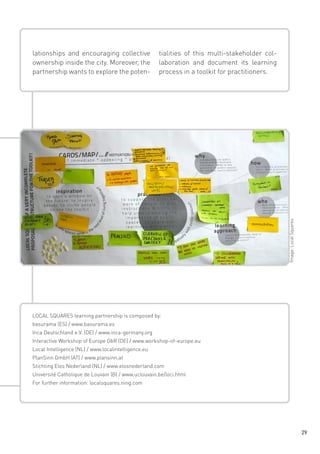
tialities of this multi-stakeholder collaboration and document its learning
process in a toolkit for practitioners.

Image: Local Squares

lationships and encouraging collective
ownership inside the city. Moreover, the
partnership wants to explore the poten-

LOCAL SQUARES learning partnership is composed by:
basurama (ES) / www.basurama.es
Inca Deutschland e.V. (DE) / www.inca-germany.org
Interactive Workshop of Europe GbR (DE) / www.workshop-of-europe.eu
Local Intelligence (NL) / www.localintelligence.eu
PlanSinn GmbH (AT) / www.plansinn.at
Stichting Elos Nederland (NL) / www.elosnederland.com
Université Catholique de Louvain (B) / www.uclouvain.be/loci.html
For further information: localsquares.ning.com

29
PLAN E[XTINCTION]
PKMN Achitectures, Cienfuegos
(ES)
Plan E[xtintion] is a project that searches to link the collective identity of endangered settlements in Asturias with
that of their surviving inhabitants as a
way to stand out depopulation processes, turning the image of these citizens
into the representative image of this
phenomenon.
A pilot project of Plan E[xtintion] took
place in Cienfuegos [Asturias], a rural
settlement were only 10 people still
live permanently. All of the inhabitants
were reunited in an emblematic spot

and a collective portrait of them was taken. This photo has become the symbolic entrance of the village, as it happens
to be with the Osborne Bull or the Welcome to Fabulous Las Vegas entrance
sign. By reusing an obsolete PlanE sign
from the Spanish Economy and Employment Stimulus Plan, formerly used in
Gijón – a city where many of Cienfuegos’ inhabitants moved to live in - the
importance of the people living in these
settlements, which are bound to disappear, was underlined.

The Plan E[xtintion] was initiated in Cienfuegos (Asturias) Spain by the team PKMN [pacman] Architec-

Image: PKMN

tures. For further information: www.pkmn,es

30
Suburban storytelling
Onorthodox, Amsterdam (NL)
& Vienna (AT)
collective photo and video exhibition in
Rajka (HU) and a big three-village festivity for which the mayor decided to
close the street to car traffic (a third,
indirect intervention). Nostalgia re-established social ties from the past
and gave space to those who are rarely included in the social and spatial
discourse – the elderly. An in-between
use or action does not necessarily
need to be created by those with an
initial idea. Co-creation and -operation are important tools to enhance and
nurture community life, hence offering
a self-maintaining, resilient condition.

Image: Onorthodox

The sub- and ex-urban cross-border
area of Austria, Hungary and Slovakia is
connected with a common history, culture and languages, however separated
it may be when it comes to social ties.
Nostalgia, an intervention developed
in this area had a physical and social dimension. We used the abandoned
customs duty building, once separating
the countries, as an attractor, an object
of exhibition. The social layer of our
intervention lied in participation and
empowerment. We interviewed about
100 elderly people where we collected
personal stories and photographs from
the past. The intervention ended with a

ONORTHODOX is a young established group of urban researchers from different fields and countries that aim
at tackling urban issues. ONORTHODOX is an open project space founded by Margot Deerenberg [NL] and
Thomas Stini [AT] in 2009 in Amsterdam  Vienna. The current project was realised by Margot Deerenberg,
/ 
Veronika Kovacsova, Thomas Stini. For further information: www.onorthodox.com

31
Interview with Volkmar Pamer
from the planning department
of the City of Vienna
Vienna (AT)
With every project we have, we organize citizens’ information days where we
talk to the people, and usually there are
very few complaints. When there are
complaints, we try to explain what our
point of view is. Some time ago we had
the presentation of a project in Liesing1
and I started speaking at 10 in the morning and finished at 6 in the afternoon
with no breaks! But I think it’s necessary, you need to talk to everybody, you
need to speak to smaller groups and
larger groups to explain things.
An additional necessity is that you need
the support of the politicians, but sometimes they don’t think in the same way
or they are too afraid and not willing to
think on a bigger scale.
In the Cablewire Factory2 we were backed
up by the local politicians and they also
played an important role in explaining
things to the people who trust the district, such as the mayor, for example.
An important role is also played by private investors, who people sometimes
are against as blamed for pursuing
only their interests in making profit,
but this is not the case when we speak
about affordable housing. For this, there

has to be a density, a certain number
of apartments, otherwise they would
not be affordable and we would end
up segregating the city. If this were
the case, one would have to look for
cheaper land further out from the city
and these would end up being ghettos,
badly connected to the city, maybe with
social problems and so on. We want to
explain to people and to investors that
these initiatives are not for making large profits. For example, in Liesing we
are working on a large urban gardening
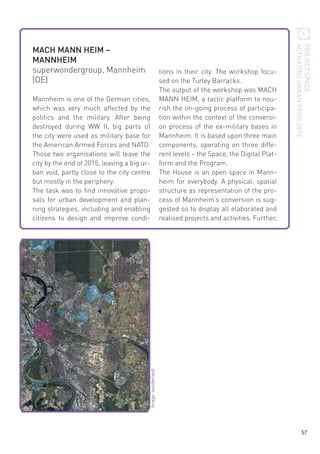
project where we thought of connecting
a large supermarket store.
We are developing a workshop format
where we have the planners from the
city, the investors and we also invite the
district mayors, this works perfectly.
On specific projects, we are also now
inviting citizen representatives of the
areas we work on. In each project, it is
always challenging to figure out who we
should invite to join the discussion, you
can’t have a recipe for that, you have to
consider each case.
In the Cablewire Factory, it was easier
because the people already knew themselves and the situation of the aban-

1. Liesing is an area of the south-west of Vienna
2. Kabelwerk was a housing project on the place of the previous Cablewire Factory: www.kabelwerk.at

32
stopped for 7 years and then city council proposed a horrible project. We proposed something different, which then
got approved, it was a good project,
unfortunately not very dense but nevertheless... We were told we would have
had numerous problems with this project , so my colleague and I went with
a ‘Bürger-bus’ to the site for 3 days.
120 people came and 112 applied for an
apartment, 8 people were really angry.
One guy that was there on the first day
would not stop complaining about the
project, saying that it was horrible. On
the third day he came again and said
to us “I still don’t like this project but
at least now I understand why you are
doing it”. This was a success for me.

Image: Volkmar Pamer

doned factory that can’t stay there like
that. So we told them that there would
be 1000 new apartments and they accepted it, it wasn’t always easy, but
there wasn’t an immediate resistance.
We were lucky because had there been
even a few people with a citizens initiative against the project, things would
have been very different.
You can’t have a solution that is the
same for each case but that’s the challenge.There was another area in Liesing
where there was a project for 280 apartments, and I had lived there for 14 years so I knew the people very well. The
local citizens opposed the project very
much, there were also corruption issues related to it, so the initial project

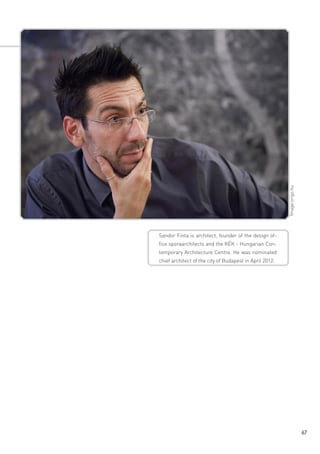
Volkmar Pamer has been working for the City of Vienna as an urban planner since 1994.
He is responsible for zoning plans for Vienna’s south, he is coordinator for the target area ‘Liesing Mitte’
in the South of Vienna, focusing on urban farming.

33
Test & Intervene
Daniela Patti, Rome (IT) & Levente Polyak, Budapest (HU)

In the past decades, the inflexible planning system characteristic of the modernist era has been gradually replaced by ‘soft urbanism‘, allowing for
experimentation and for trying possible functions at test-sites, before fixing
them through large investments. This
open-ended planning system also gives
more emphasis to the temporal dimension of developments, enabling temporary uses and successive phases in the
development process. To consider the
‘in-between time‘ opening between the
moment a property goes vacant and its
new use as an opportunity, design professions were also helped by new considerations of the limits of the shrinking market.
The professional and political acceptance of temporary uses opens great

34

opportunities for neighbourhoods: experiments with new functions and reacts to the needs and expectations of
the local communities in a more sensitive way, and thus benefit the space,
local businesses, users, conviviality and
the social cohesion. The success of these experiments depends largely on the
people involved and their personal qualities; the duration of the interventions
and the functions put in place.
The aim of a testing phase is to experiment, push boundaries of the well
known towards open-ended scenarios
where failure is accepted as an outcome, on the basis of which a learning
process can be established in order to
optimise future results.
What is important is to try…
PROJECT SPACE
THE OTHER CITY 2010

THE WONDERLAND PAVILION VENICE
Hannes Schreckensberger/
Celia - Hannes, Montpelier (FR)
was the so called ‘wonderland pavilion‘
which provided young European architects, inhabitants of Castello as well as
local associations with a vibrant platform fostering international exchange
in the course of the opening week of the
Biennale of Architecture in Venice.
The Other City - Venice will be part of
a highly diversified program presented
and organised by the social centre of
Morion, located directly in the neighbourhood of Castello. The project space is a result of the engagement of the
local association ‘re-biennale‘ to recycle left over materials from the Biennale, as well as the initiative of the wonderland team ‘exyzt‘ to reactivate this
idle community space.

Image: wonderland

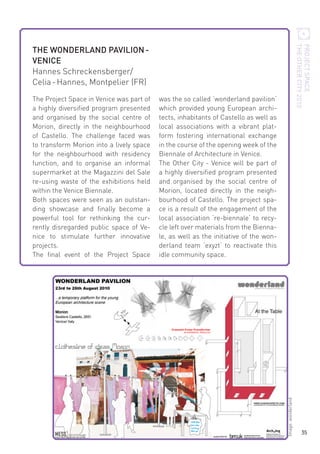
The Project Space in Venice was part of
a highly diversified program presented
and organised by the social centre of
Morion, directly in the neighbourhood
of Castello. The challenge faced was
to transform Morion into a lively space
for the neighbourhood with residency
function, and to organise an informal
supermarket at the Magazzini del Sale
re-using waste of the exhibitions held
within the Venice Biennale.
Both spaces were seen as an outstanding showcase and finally become a
powerful tool for rethinking the currently disregarded public space of Venice to stimulate further innovative
projects.
The final event of the Project Space

35
Together, they face the challenge of
transforming Morion into a lively space
for the neighbourhood with a residency
function, and to organise an informal
supermarket at the Magazzini del Sale,
reusing waste from the exhibitions
of the Biennale. Both spaces will be
seen as an outstanding showcase and
will finally become a powerful tool for
rethinking currently disregarded public
spaces of Venice to stimulate further
innovative projects.
Workshop
The Idea of the ‘wonderland pavilion‘
emerged through wide ranged collaborations between the Venetian organisation Re-Biennale (which recycles useful leftovers of the past Biennales), the
initiative of French architecture team
exyzt together with the Austrian team
zirup, the engagement of the architecture student group IKA from Linz  (AT),
and the support and encouragement
of wonderland platform for european
architecture.
Together, they aspired to revitalise
Morion, an idyll social centre. They faced
the challenge of transforming the social centre into a lively common space for
the local inhabitants of the surrounding
quarter Castello, by reusing collected
materials from the past years to construct a common kitchen, a dormitory,
a multi-functional space and a public
garden.
The ‘wonderland pavilion‘ was held
during the Venice architecture Biennale

36

opening week. The newly refurbished
social centre became a temporary platform over the course of several days for
young European architects to exchange
ideas and network with the purpose
of starting a critical reflection on the
current urban situation of the Morion
neighbourhood.
Self-organised lectures, round table
discussions and workshops involving
international architecture teams, urban planners, local occupants and associations enabled all participants to
work collectively towards finding a new
role and a possible future development
concept for Morion’s new community
space. Such engagement and exchange made it necessary for wonderland
teams to organise a reopening party
for the neighbourhood with a so called
‘bella tavola‘, a huge table bringing all
actors together in the Morion. During
this period, the Morion transformed
into a stage for a round table meeting
organised by the European Forum For
Architectural Policies with representatives of the European institutions,
architectural policies institutions and
young European architecture teams, to
discuss the importance of mobility in
architectural practice, and to emphasise the role of architecture in the social, cultural, economic context of urban
territories in Europe. At the same time,
the ‘wonderland pavilion‘ also hosted
an exhibition titled ‘urban loft‘, displaying the results of an international com-
petition for students initiated by ‘gau:di
‘and ‘Cité de l’architecture et du patrimoine‘ based in Paris.
The programs were completed with several festive events such as the opening
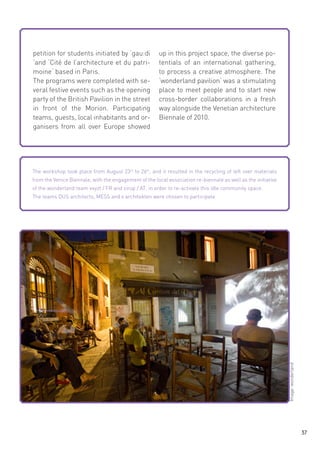
party of the British Pavilion in the street
in front of the Morion. Participating
teams, guests, local inhabitants and organisers from all over Europe showed

up in this project space, the diverse potentials of an international gathering,
to process a creative atmosphere. The
‘wonderland pavilion‘ was a stimulating
place to meet people and to start new
cross-border collaborations in a fresh
way alongside the Venetian architecture
Biennale of 2010.

The workshop took place from August 23rd to 26th, and it resulted in the recycling of left over materials
from the Venice Biennale, with the engagement of the local association re-biennale as well as the initiative
of the wonderland team exyzt / FR and zirup / AT, in order to re-activate this idle community space.

Image: wonderland

The teams DUS architects, MESS and x architekten were chosen to participate

37
PROJECT SPACE
ACTIVATING URBAN VOIDS 2012

PROJECT SPACE AMSTERDAM
placemakers, Amsterdam (NL)
The Project Space Amsterdam took
place in the fast changing and upcoming area Amsterdam Noord. This
neighbourhood exists mainly of middle
and high-rise buildings, almost all of
the social rented sector (95 %).
The neighbourhood still looks exactly
the same as it did in the beginning of
the sixties: There is plenty of greenery,
the buildings still seem to be in good
condition and hardly any vacancies
exist. In recent decades however, hardly
any investments were made to regenerate the area, and there are no places
for young people to go. The physical
situation is virtually unchanged, whilst
the residents have changed. The inhabitants of the first hour are older now
and their children have moved from the
neighbourhood. The number of people moving out in Nieuwendam Noord
increases while many new residents
move in, often with different (ethnic)
backgrounds. Nieuwendam Noord has
become a multicultural neighbourhood.
One consequence is that neighbours
do not always know one another or understand each other anymore. It appears that the involvement of residents in

Find a detailed
description of the
workshop context and
challenges in our
magazine titled
‘Represent & Reflect‘.
38

their neighbourhood decreases while
the feeling of insecurity on the streets
increases.
On the first day of the workshop, local
students took the participants on a
guided tour of the neighbourhood. The
message to the planners was clear:
There is a need for a place for people to
meet each other in public.
Following two intensive days of lectures
and tours, the group obtained a significant amount of useful information.
Using the information as a basis, the
group could start designing. Because
of the Dutch weather, it was soon decided that the structure designed should
have a roof, and be a shelter for the
user of the street. They combined these two needs and decided on building a
house enabling encounters.
The construction part was now taking
place. The participants divided into two
groups, the construction group and the
function group, and worked towards
quickly reaching the goal of creating a
public-shelter-space. The construction
group evaluated the material and construction tricks while the function group
decided on the function of the house.
Besides a space enabling people to
meet each other, it was decided that
the house should also fulfil the purpose of allowing the broadcasting and
statement of opinions on upcoming decisions. Initially, voting was about what
citizens of the area would like to do or
see if there were to be a public stage in
Amsterdam Noord.
The choice could be made by picking one
of the prepared symbols – from ballet to
bingo – or by drawing something new
on one of the empty papers and pinning
them on the inner wall of the house.
The shelters themselves, as well as the
symbols on color-coded sheets of paper
were prepared in co-operation with the
local students (of the Bredero Lyceum).
The students and architects started in
the early morning hours to finish the
house construction on time.

Applause arose when the house was
finally erected on all four pillars. The
teams were ready for the public intervention on the market square in Waterlandplein / Amsterdam Noord.
Walking to the square while carrying
the house generated a lot of attention.
The infamous Dutch weather also showed signs of mercy, and it stayed dry
throughout the whole intervention.
People were instantly curious about
the neon coloured-walking-house and
were willing to share their opinions.
Following the intervention, the house
looked fully packed with various symbols hanging on the inner walls of the
temporary shelter. It was a great success and helped us obtain valuable information about the needs and wishes
of the residents.

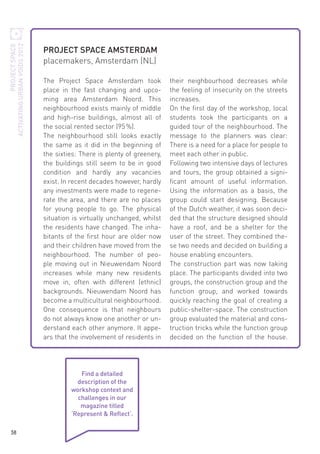
The workshop took place between 15th and 19th October 2012 in Amsterdam in collaboration with placemakers. Participants were SPACEPILOTS, PKMN [pac-man], Elana Bos, Veronika Kovacsova, Mara Pellizzari

Image: wonderland

Image: wonderland

and the Students of the Bredero Lyceum.

39
THE URBAN ISLANDS PROJECT
SPACEPILOTS, Aachen (DE)
The Urban Islands Project is part of
an on-going project SPACEPILOTS introduced in 2009 under the title of Unlocking the City, aiming to excite young
people about their city, engage them
with their environment, and empower
them to get involved in the actual shaping of places.
We are inviting young people to participate in the research and development of
design ideas for Urban Islands. Therefore, by nature, the testing, analysing, and
constant adjusting of ideas is inherent to
the project and its aims. The resulting
works are interventions, installations, or
actions hinting at a particular potential
of an urban space while – temporarily offering a different use.
In a first phase, prior to the project, a city-wide survey has been run in London
in 2009 asking young people about their
local environment and the interventions
they would like to see put in place to improve their lives. The Urban Islands Project is a direct response to their call to
create places where they can meet each
other and feel safe.
In 2010 we launched the project at the
London Festival of Architecture [LFA
2010], in the Borough of Southwark,
South London. During the LFA 2010 we
have been running a series of workshops with nine young people living in
the area, exploring possible ways to de-

40

tect, map and animate places through
urban interventions and architectural
actions. The youngsters set out scanning the neighbourhood to find overlooked spots and niches in their environment that might allow for an island to
unfold and act – be it as a meeting point,
a playground, a picnic corner…
Within three weeks they built urban
furniture, tested ways of mapping and
learned about the process of designing
in the public realm, planted seeds, created a light garden, exchanged ideas with
various local experts from the fields of
architecture, urban planning and lighting design, and made a documentary
– working with a photographer and filmmaker during the festival events.
In the last 3 years we have been testing
and developing The Urban Islands Project in various collaboration and cultural
contexts in London, Madrid, Bucharest
and Cologne.
The importance of such projects lies, I
think, in direct contrast to traditional architectural work in its limited temporality: as
they exists only for a short period of time,
the before and after appearance, use or
disuse of an area is brought to peoples
attention. This sharpened perception of
their neighbourhood, in return, most often prompts for debate - if not further
actions, and that way establishing the
idea.
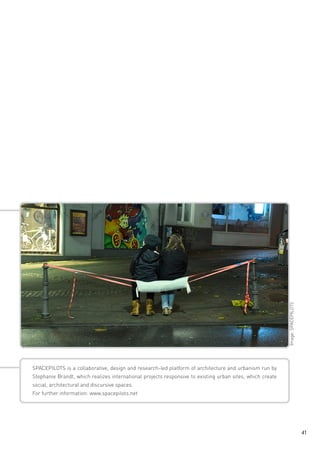
Image: SPACEPILOTS

SPACEPILOTS is a collaborative, design and research-led platform of architecture and urbanism run by
Stephanie Brandt, which realizes international projects responsive to existing urban sites, which create
social, architectural and discursive spaces.
For further information: www.spacepilots.net

41
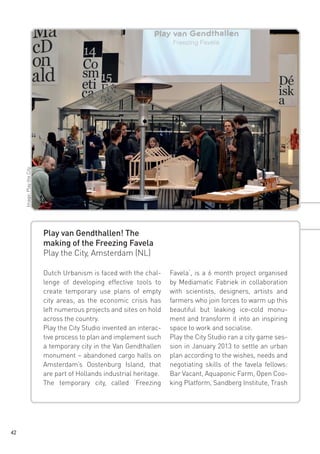
Image: Play the City

Play van Gendthallen! The
making of the Freezing Favela
Play the City, Amsterdam (NL)
Dutch Urbanism is faced with the challenge of developing effective tools to
create temporary use plans of empty
city areas, as the economic crisis has
left numerous projects and sites on hold
across the country.
Play the City Studio invented an interactive process to plan and implement such
a temporary city in the Van Gendthallen
monument – abandoned cargo halls on
Amsterdam’s Oostenburg Island, that
are part of Hollands industrial heritage.
The temporary city, called ‘Freezing

42

Favela‘, is a 6 month project organised
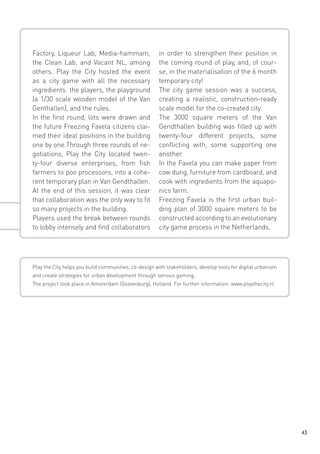
by Mediamatic Fabriek in collaboration
with scientists, designers, artists and
farmers who join forces to warm up this
beautiful but leaking ice-cold monument and transform it into an inspiring
space to work and socialise.
Play the City Studio ran a city game session in January 2013 to settle an urban
plan according to the wishes, needs and
negotiating skills of the favela fellows:
Bar Vacant, Aquaponic Farm, Open Cooking Platform, Sandberg Institute, Trash
Factory, Liqueur Lab, Media-hammam,
the Clean Lab, and Vacant NL, among
others. Play the City hosted the event
as a city game with all the necessary
ingredients: the players, the playground
(a 1/30 scale wooden model of the Van
Genthallen), and the rules.
In the first round, lots were drawn and
the future Freezing Favela citizens claimed their ideal positions in the building
one by one.Through three rounds of negotiations, Play the City located twenty-four diverse enterprises, from fish
farmers to poo processors, into a coherent temporary plan in Van Gendthallen.
At the end of this session, it was clear
that collaboration was the only way to fit
so many projects in the building.
Players used the break between rounds
to lobby intensely and find collaborators

in order to strengthen their position in
the coming round of play, and, of course, in the materialisation of the 6 month
temporary city!
The city game session was a success,
creating a realistic, construction-ready
scale model for the co-created city.
The 3000 square meters of the Van
Gendthallen building was filled up with
twenty-four different projects, some
conflicting with, some supporting one
another.
In the Favela you can make paper from
cow dung, furniture from cardboard, and
cook with ingredients from the aquaponics farm.
Freezing Favela is the first urban building plan of 3000 square meters to be
constructed according to an evolutionary
city game process in the Netherlands.

Play the City helps you build communities, co-design with stakeholders, develop tools for digital urbanism
and create strategies for urban development through serious gaming.
The project took place in Amsterdam (Oostenburg), Holland. For further information: www.playthecity.nl

43
Park[haus]
superwondergroup,
Mannheim (DE)
The top floor of the a car park in the city
centre of Stuttgart will be transformed
into a temporary community garden.
The design, realization and programme
is developed collectively with residents,
pupils and interested groups. The programme of the Park[haus] is composed
of urban gardening farming, flower/ 
beds, a lawn, a small kiosk and a community kitchen. Additionally a cultural
programme including workshops, discussions, film screenings and so on will
be organised by the participants.
The Leonhardsviertel in Stuttgart where
the car park is located is nowadays best
known as the red light district of Stuttgart. Right in front of the parking deck,
prostitution takes place. The neighbourhood is, however, also a residential area,
where you can find some of the oldest
houses in Stuttgart, the Jakobschule –
an elementary school rich in tradition. In
the narrow streets of the old town, some
well-known wine taverns are hidden.
However, the number of the brothels
increased over the last years and the
‘balance‘ of the neighbourhood is threatened. The City of Stuttgart tries to
buy uninhabited houses in order to rent
them, but financial means are limited. A
lot of children and adolescents live there, most of the families have low incomes, and leisure facilities are rare.

44

Stakeholders are:
superwondergroup
Initiator / Planning / Development of the
supporting programme / moderating
workshops & round table discussions /
setting up the 2-year-programme
Ebene 0 e.V.
Co-Initiator and organizer of the project.
The ‘Ebene 0’ is a non-profit art association with a focus on urban topics such as
temporary uses and alternative planning
approaches.
Parkservice Hüfner
Private enterprise, which is the tenant of
the car park and has interests in ‚upgrading‘ the typology of the car park.
Administration of the Neighbourhood /
Mayor of the Neighbourhood
Responsible for regulations and administrative issues. Provided initial financial support as well as a helping hand by
dealing with other departments.
The Project is divided into two phases,
differing mainly in the size of the used
parking space and the uses.
The first phase already started in April
2013 as an urban gardening project, with
around 80 interested citizens, in a sub
area of the top floor of the car park, and
will last until September / October 2013
when the urban garden will be dismantled. This phase is accompanied by a programme consisting of workshops (dea-
ling with planting and gardening), film
screenings and round table discussions. Urban gardeners and experts from
Stuttgart as well as from other cities are
invited to present and discuss their projects experiences and approaches.
The second phase will start in the spring
of 2014 with the construction of the urban garden, the park area and a small
stage for bands and artists from the
neighbourhood, all on the top floor of
the car park. For this phase, the whole top floor (approximately 2500 square
meters) will be transformed into an urban park area. Until October 2014, the
project will serve as a cultural platform,
a park and an urban innovation lab where different topics concerning current

urban urgencies are presented and
discussed and workshops addressing
these problems and challenges are organised.
The project‘s success is based on the
engagement of the citizens and their
will to contribute and to take part. Through the accompanying programme we
want to foster a lively discourse among
participants and invited lecturers. This
discourse will then be used as a tool
to create and build up a community, as
well as to initiate a debate about who is
creating the city / what kind of alternative
methods of government can occur and
work / and who is willing to take responsibility for their neighbourhood.

The superwondergroup, founded in 2010 by Frane Bettac, Leo Grosswendt and Wulf Kramer, deals with
topics such as participation and interventions implementing them in a mixture of temporary structures,

Image: superwondergroup

art and space in everyday life. For further information: www.superwondergroup.com

45
Creating ordinary utopia
Cochenko, Paris (FR)
Each project of Cochenko has a specific communication strategy at different scale. At first, the inhabitant gets
involved in a ludic and creative process, such as a teasing of the project,
a street game, questioning people in
the public space, as many invitations
to look at his environment as possible
by taking his eyes off everyday life and
getting involved in the project. Then,
‘signal-objects‘ are created as a scenographic installation facilitating interactions between inhabitants, neighbours,
workers, etc. These objects create surprise and amazement in their everyday
environment, and invite them to enter
the space of the project on site. Finally,

Find a project
description of the
team in our
magazine titled
‘Combine & Link‘.

46

Image: Collectif Cochenko

Image: Collectif Cochenko

Cochenko’s projects are closely linked
with social and urban fields: in order to
create an ‘ordinary utopia‘, Cochenko
develops a cross-disciplinary approach
through the content of the projects as
much as in the methodology used and
the great variety of skills of its team.
Cochenko aims at accounting and developing the uses in building the city,
the public and private spaces.
Whether the project is about co-designing spaces or objects with inhabitants,
experimentation at scale 1, or open urban
improvement site workings, Cochenko
always pays special attention to the active involvement of inhabitants in the
transformation processes.
print outs (posters, postcards, fanzine,
etc.  come along with the project out)
puts, making for keeping record of the
action but also for sharing the story and
promoting everyone’s participation. These aesthetic objects also contribute to
giving visibility to the project on a larger
scale.
In order to co-build the city with its
inhabitants, Cochenko’s methodology
mostly relies on participation, before,
during and after the transformations.
The objective is to establish a real process of iterative design, especially for
urban street furniture, making the best
out of user’s instant feedbacks, which
allows modifying or reorienting the project almost in real time.
Cochenko cares about how inhabitants
can be involved, about the process itself
as much as the quality of the final product. Cochenko stands for permanent
testing as an overriding condition, ensuring adjustment and ownership of all,
at any moment.
On-site presence activates public space
in taking into account, and also disturbing, uses. Cochenko develops several
tools, such as the ‘Guitounes’, these
are mobile machines with multiple
functions: surprising objects, they first
lead to meeting, to reactions and debates, and gradually become a signal in
the neighbourhood, contributing to its
identity. Taking part in the transforma-

tion of public spaces like in the project
‘Made In Joliot’ requires the promotion
of new tools and testing new uses, which
often leads to inventing hybridization
and new ways of organising social life.
Cochenko aims at accounting and developing the uses in building the city,
the public and private spaces.
Cochenko’s main partners and sponsors have been so far, cities and local
authorities (cultural services, urban
policies, social cohesion) and the private sector (social housing landlords,
services of social development related
with housing issues, architecture agencies, foundations).
Depending on the context, Cochenko
adapts its approach to answer the concerns of its partners. As an example,
the project ‘Made in Joliot’ has been
designed in cooperation with the City of
Saint Denis following a call for projects
aiming at accompanying Joliot-Curie
neighbourhood urban redevelopment
workings. Cochenko proposed an experimental project on the co-building of
social housing collective spaces.
As for the ‘Da-ta-place’ project, new
participation processes are developed.
Throughout this project, Cochenko advises and supports local authorities
enhancing their understanding of the
districts (challenges, tensions, etc. 
)
prior to the implementation of urban
redevelopment workings.

Established in 2007 in Paris, Cochenko explores various spaces involved with people in a public place,
place of living and meeting, in order to build ‘ordinary utopias‘. Further information: www.cochenko.fr
47
Interview with Stefanie Raab from Coopolis, Berlin

Levente Polyak:
You have a three-step scheme that
helps you to establish contact and cooperation between potential users and
property owners. How do you coordinate all these actors, how do you
handle this amount of information?

Stefanie Raab:
We have an ingenious database structure that collects information on the empty
spaces, the interested people and the informal contacts to politics, etc. We created
the software for it ourselves, because there was nothing available on the market
for what we do. We make our own research as well, walking around the city, taking
pictures, finding out who the owner is and so on.
After this, you begin to talk to the owner, to open up to the owner, until the owner
says: what do you imagine we could do here? At this moment, you need well-prepared users, with a proper concept. So you have two processes that you have to
manage: you have to prepare the user and the property owner for one another.
After this, you have a first get-to-know moment, we make these meetings on our
Moderierte Objektbegehungen (Moderated Property Inspection), where we have 5
or 6 or 10 properties, after another, and a group of ‘marriable‘ owners and users
– whose concepts are so good that you can present them to an owner, because
an owner always expects a well conceptualised economic project. And the user
only sees his creative idea, so you have to prepare them for one another so that
they talk a more similar language and can understand one another. So we are the
transporters between them. And this is the secret of ‘Zwischennutzungsagentur‘,
this is how it functions.

48
Levente Polyak:
You organise a marriage between the
owners and the users – how can you
calculate the proper timeframe?

Stefanie Raab:
You can’t calculate it at all. You can have successful processes in a few days, but in
a few years as well. For instance, we had a migrant Kurdish woman who wanted to
make a bilingual Kindergarten and she needed three years to clear up her concept.
Then we needed a half more year to create a good contract for her.
In another case there was a woman who makes ceramics and she knew very precisely what she needed. We had a databank, with more then 1000 empty shops,
we went through this databank and we found the only possible setting within three
hours. She made a perfect little concept with photos of her very nice ceramics and
she also said: “I can guarantee 3 euros/m2, but I can never pay significantly more.
I will live there and I will work there. In change, I will make a very nice area with a
nice little shop window, it will be attractive.” And she made her concept so convincing, that two days later she had her contract. Because she was a very experienced
woman, who knew exactly that she will never earn much money, but she wants to
do this – so she really went for it. She was so clear with her goals that we could
help her within a few days.

Levente Polyak:
What can you offer the owner, so that
he decreases the price?

Stefanie Raab is an architect. In 2002 she founded the Berlin-based ‘Zwischennutzungagentur ‘with Maris
Richarz. They were pioneers of introducing and consolidating the concept of in-between use to address
the problem of shrinking cities and vacancy. Since 2010 the organization is called Coopolis. For more
information, visit: coopolis.de

49
Levente Polyak:
What can you offer the owner, so that
he decreases the price?

Image: Coopolis

Stefanie Raab:
Advice and experience in a special area – this is very important, you always have
to be very local. If we have projects in different places, we always have a project
manager for each one of them, so that the contact between the owners and the
users is enriched by the local knowledge of this person.
In fifty percent of the cases, neither the users nor the owners know what they need
in the beginning. So we have an open door once a week, a consultation process
with the users and also the owners of the real estates. If they [the owners] would
know what they wanted with it, it wouldn’t be empty. You have to find it out and give
them advice.
And if you have an owner who imagines 10 euro/m2 rent, we tell him, that this is
a very poor district here, there will be no activity that can bring so much money.
So you have to talk to him, so that he can also feel that his goals are unrealistic,
because the only reason for emptiness is that there is no market for a product, so
you have to create a market and bring someone who creates this product as well
as someone who needs this product.

50

The interview was conducted in the frame of
the Lakatlan Budapest project, initiated by the
KÉK - Hungarian Contemporary Architecture
Centre.
Interview with Jesper Koefoed-Melson from givrum.nu, Copenhagen

Julia Oravecz:
Your overall aim is to connect makers, doers, artists in order
to enhance a different kind of approach to culture and to support a user driven urban development. Supporting temporary
use in vacant properties is only a way to realise this.

Jesper Koefoed-Melson:
We primary want to create user-driven communities, because we see that this is
where democratic processes and city life in general starts. This is the way to making
more people engaged in society. Our primary focus is empty buildings, but from our
perspective, empty buildings are pretty much just a framework, in which these communities can grow.
This framework works really well, because we can borrow the buildings for a temporary period, then we can invite people and let them decide which activities they
want. The only thing we decide is that it should be in some way a cultural or social
project and that they are all obligated to be a part of an association, which is being
developed for the place. We also try to motivate the users to take active part in the
local area as well. But we also have other strategies to make user driven urban
development more visible and accessible for the people. We also create activities in
public spaces – which is of course a completely different thing, because its much
more temporary.
We make an annual conference called Think Space where the goal is to gather everyone we know of, nationally or internationally, with projects that we can be inspired
of. This is also a way to make more projects like this happen – to create a movement
around them by showing good examples. We like to focus the conference each year
on a specific location that we think has some potential – an empty building that has
been taken into use or that we would like to be taken into use – by attracting a lot of
awareness or resources on this specific site, we can help accelerate a process. By the
City Link project, the overall goal is also to create a relationship between two different
cities, different project makers, to be inspired by the different perspectives.

51
Julia Oravecz:
You often choose huge factories for
your projects, that need a lot more
effort and investment than, let’s say,
a line of empty shops in the inner
city. Your very first project was also
in a candy factory in Copenhagen. Is
there a specific reason behind this?

Jesper Koefoed-Melson:
Factories are quite unique in the sense that they have been standing empty for a
longer period, and the longer the period you have to create these activities, the
stronger communities you can get.
In the case of a shop, maybe it is not that easy to create different activities other
then commercial sales, because this is how the room is designed. In a factory we
can invite people in and there can be so many different kinds of projects: it’s only
your imagination that sets the boundaries – we can have workshops, galleries, ateliers, office places, ceramic workshops, bicycle workshops, urban gardening…This
also contributes to a better community: if you have all kinds of different projects,
that can learn from each other, that can inspire each other, that can collaborate.

Julia Oravecz:
What happens more often, that the
owners come to you or the users?

52
Image: Giv Rum Nu

Jesper Koefoed-Melson:
In the beginning we had a lot of attention because we had a different approach to
urban development and I think that the owners saw that here was a potential to
get some renters into their empty buildings. When they found out that we would
actually like money from them, and that they cannot profit, they were not that interested anymore.
This is not what we do; we want to create communities that are cheaper and more
flexible, so thereby they cannot pay full rent. So now, we don’t have a lot of private
owners contacting us, it is more the other way around…much more the other way
around. We like this actually, because we’d like to work for the users. And if there’s
a user who found an empty building and wants to start something up, it is more
likely to be a success, than when we go in and take over the process.
From the public sector on the other hand, we get more and more requests to help.
The reason for this, I think, is that when we have to develop an area in Denmark we
have the words ‘citizen engagement‘ or involvement written all over like a password, everybody has to do it, but nobody knows how. When a municipality gets governmental support for developing an area and for creating a citizen involvement
process but they don’t know how to do this task themselves, then they contact us.
Sometimes with an empty building, sometimes with a public space.

53
Julia Oravecz:
Could you describe how a typical
project of yours looks like, what are
the main steps?

Jesper Koefoed-Melson:
First of all, we create the legal framework with the owner, we make a contract
so we know exactly what the premises of the use of this building are. We argue
that we should get a high degree of independence in defining how to fill these
buildings. Then we invite people in and we do that by making open calls in our
network. And then by word of mouth, people start turning up and then we show the
place to a lot of people all the time, and they say I want that room, I want this room,
and all of the sudden we have a lot of users.
Then together with the users we try to create an organisational platform, an association, where we find out the purpose of this place. We can discuss what we want
with the place, what is our common goal, what is our interest, what are the local
area’s needs…
Then we create a budget, because of course there has to be some rent. The good
thing about rent is when everybody is paying something that can be used for common investments for the buildings as well. So if we are not publicly supported, we
can create our own economy. This is what has happened to the Prags Boulevard 43
where they have taken over the contract, they have an association, they are paying
rent and they actually have a really healthy economy now. They created a completely
self-organised and self-financed community.

Jesper Koefoed-Melson founded the Giv Rum Nu (‘Give Room Now‘ in Danish) in 2010 with Christian
Fumz, after working together on the revitalization of Copenhagen’s Bolsjefabrikken. Give Rum Nu acts as
facilitators to provide artists and entrepreneurs the temporary use of buildings that are currently empty.
More information at givrum.nu

54
Julia Oravecz:
What happens to a community like
this, when a project ends?

Jesper Koefoed-Melson:
There was a project in a new part of Copenhagen, where when we left, the activities
stopped. In that case, we played a role too important in creating the activities. In
the candy factory, when my partner Christian left and the community was thrown
out from there, they moved on to other empty buildings. This is what we try to work
for, that even when the building is torn down, the relationships, collaborations and
sense of community remain. We also try to motivate people to invest in things that
can be brought to other places.At the case of Prags Boulevard 43, we got the building for two years until the end of 2012, and then we established contact between
the owner and the user, and the users took over the contract with the owner and
they have had it now for three more years. So we always borrow the place for a
temporary period, we also build in the stability of permanent use into the narrative
of the place.Someone argues of course with the gentrification theory, that we are
just a tool for the capitalists, which may be true, but if we – in a period when there
is no money for big investment – can create a framework for alternative communities, alternative ways of organising and creating arts and culture, I find that to
be okay…

The interview was conducted in the frame of
the Lakatlan Budapest project, initiated by the
KÉK - Hungarian Contemporary Architecture
Centre.

55
EMBED & ENDURE
Daniela Patti, Rome (IT) & Levente Polyak, Budapest (HU)

After attempts to establish temporary
uses, some initiatives manage to gain
permanency, although permanency has
to be understood here in a very different
manner from how traditional architecture might define the term. In fact, this
achievement has to be seen as a phase
in a process permanently generating
new situations that respond better to
the needs of the moment.
In order for uses and functions to
bypass the temporary phase, a series
of parameters have to be in place: stakeholders, funding, human resource,
political support and a good dose of
luck and passion! The more various and
interconnected the parameters are, the

56

more overall aims can also be pursued
in changing conditions. This requires
the collaborations of all stakeholders
involved, putting on the table all the
means they dispose of. In recent years
we can see that what used to be bottom-up initiatives are now dialoguing
with public administrations in order to
reduce the conflicts and reach a better
result.
To embed change with actions and projects so to bring results into the future
is a common aspiration of architects,
but considerations today look at flexibility and resilience in order to grant
stability...
Image: wonderland

Mannheim is one of the German cities,
which was very much affected by the
politics and the military. After being
destroyed during WW II, big parts of
the city were used as military base for
the American Armed Forces and NATO.
Those two organisations will leave the
city by the end of 2015, leaving a big urban void, partly close to the city centre
but mostly in the periphery.
The task was to find innovative proposals for urban development and planning strategies, including and enabling
citizens to design and improve condi-

tions in their city. The workshop focused on the Turley Barracks.
The output of the workshop was MACH
MANN HEIM, a tactic platform to nourish the on-going process of participation within the context of the conversion process of the ex-military bases in
Mannheim. It is based upon three main
components, operating on three different levels – the Space, the Digital Platform and the Program.
The House is an open space in Mannheim for everybody. A physical, spatial
structure as representation of the process of Mannheim’s conversion is suggested so to display all elaborated and
realised projects and activities. Further,

PROJECT SPACE
ACTIVATING URBAN VOIDS 2012

MACH MANN HEIM –
MANNHEIM
superwondergroup, Mannheim
(DE)

57
Image: wonderland

the architectural measure is meant to
be a contact point and a drop-in centre
where citizens can get any information
on the process of Mannheim’s conversion. Located close to the actual conversion area, it aims to link the administrative process with local citizens. It
is a visible point of reference.
MACH MANN HEIM proposes a digital platform to connect all actors of
the conversion process. Cities as well
as whole regions are nowadays driven
and connected by digital networks. The
on-going process of strengthening the
urban network between Frankfurt and
Stuttgart is mostly driven by the virtual
network between Mannheim and Heidelberg. The region is already ‘bestpractice‘ in crossing borders on the
communal and federal level and has
just started to cooperate with other
cities and regions along the ‘Blue Banana‘ on a European level. For future
urban participation, we recommend to

develop an experimental and innovative process empowering the citizens
in urban decision-making. New tools
are needed so to open the process of
urban planning and enable a participative co-creation of the city. The relation between inhabitants and citizens,
consumer and producer, user and actor, needs to be shifted. To enable this
essential shift and to avoid only strategic development or superficial consulting, we need to shape the participation
process with emphasis on the empowerment of Mannheim’s citizens.
MACH MANN HEIM can be at the same
time regarded as a useful case study
for many initiatives that are currently
taking place in so many places.
The interrelation between space, networks and activities is a valuable experience that needs to be further developed
in the near future via experience and
exchange.

For more
information about
vacancy tendencies
have a look at our
magazine titled
‘Represent & Reflect‘.

The workshop was held between October 3rd -7th 2012 in Mannheim in collaboration with superwondergroup. Participants were Vivero de Iniciativas Ciudadanas, Hot Knödle, Radostina Radulova, Jaro Eiermann
and many other local participants that dropped by during the process.
58
Image: wonderland

Budapest has suffered more from the
economic crises than many other European cities. The recession, combined
with the mismanagement of real estate properties owned by private as well
as public owners, has emptied a significant proportion of the city from its
previous functions and use. Over 30 
%
of office spaces are vacant in Budapest
alone, adding up to an estimated million square meters of wasted space, not
to mention the countless empty storefronts, abandoned residential buildings
and even commercial complexes.
The possible responses given to the
problem of empty properties appear
at various levels of urban planning and
architecture. In many cities, the inflexible planning system characteristic of
the modernist era has been gradually
replaced by ‘soft urbanism‘, allowing
for experimentation and for trying possible functions at test-sites, before fixing them by large investments. This
open-ended planning system also gives
more emphasis to the temporal dimension of developments, enabling tempo-

rary uses and successive phases in the
development process. This is the methodology we wish to apply to the Budapest sites we chose for the Budapest
Project Space.
The economic crisis of 2008 brought
an abrupt end to a period of unfettered
optimism. Suddenly confronted with a
collapsing real estate market and the
collapse of the financial institutions it
had once relied on, cities faced a situation where the very fabric of its existence was unravelling. Vacancy had begun, and while not unique to the city of
Budapest, its position at the very edge
of Eastern Europe is also indicative of
its position in the progress of economic
recovery. The ruthless self-preservation that exposed itself in the frantic aftermath of the crisis had left Budapest
behind, suffering at the whim of more
powerful economic powers with more
mercenary interests in the development of the city. Left to it’s own devices,
the situation of vacancy in Budapest
has reached a critical point. The continual fragmentation of the urban fabric,
coupled with the sustained neglect of
vacant properties in the core of the city
has made it economically prudent for
investors to focus elsewhere for potential development.

PROJECT SPACE
RETHINKING URBANITY 2013

Vacancy – Budapest
KÉK – Hungarian Contemporary
Architecture Centre, Budapest
(HU)

59
The Vacant Budapest workshop
Leonard Ma / Small Design
Office, Helsinki (FI)
In early 2013, Wonderland in cooperation with KEK organised a competition
and workshop titled Urban Vacancy, to
challenge international teams to come
up with model solutions for vacant sites
around the city. Selected teams of participants were gathered together in a
workshop to discuss not only the situations that led to the condition of vacancy,
but more importantly to determine why
vacancy has persisted and what can
be done to counteract it’s effects. The
workshop commenced with a degree of
expediency as the city of Budapest has
allocated funds specifically for interested municipalities in collaboration with
NGO’s to renovate vacant sites around
the city. Suddenly what ostensibly began as a response to the aftermath of the
economic crisis became an opportunity
for the radical reconsideration of traditional models of development.
The weeklong workshop progressed
with a mutual understanding that in
order to ensure the diversity required for the revitalisation of the vacant
properties, it was vital to create the
infrastructure and framework to involve the local community in the process.
Throughout the workshop, various social groups came forward with proposals to renovate and occupy these va-

60

cant sites. Though many of the groups
had difficulty making a sound economic
case for the sustained occupation of the
sites, the needs of these groups highlighted an underlying shortage of community spaces in the city.
A proposal was made, to not only consider the individual needs of these social
groups, but to use the renovated sites
as a key part of a strategy to address
the broader issue of vacancy. By pooling their resources together into the
creation of diverse community rooms
distributed throughout the district, the
social groups not only create economical models for community properties,
but they also create social hubs that
bring activity into the district.
Following an agency model, the district
would support a local agency directed
by representatives from the community. This local agency is tasked with the
creation and operation of these social
hubs, which bring in the critical mass of
traffic and activity to make occupation
of the surrounding vacant sites viable.
The agency is also better equipped to
deal with the administration and logistical support of potential occupants in
the area, providing the tools required
for sustained development in the area.
This approach to vacancy not only pro-
tions at its core. These social functions
not only activate the community, but
help the locals regenerate district life.

Image: wonderland

vides the framework for a diverse and
durable model of development, but integrates community and social func-

The workshop took place in Budapest between May 27th - 31st 2013, in collaboration with KÉK- Hungarian
Contemporary Architecture Centre. Participants were SDO (Leonard Ma), SKINN (Goran Vodicka, Jekaterina Porohina, Ivan Rabodzeenko), A01 (Machiel Crielaard), Klara Muranyi, Zuzana Kerekretyova, Urbmath
(Mathis Bout, Zico Lopes, Manon Mastik).

61
The V-House
MILK TRAIN, Rome (IT)

Image: THE MILK TRAIN

What if you have no client yet? What if
the chances to be built are strictly linked on how much it costs?
The idea of V-House is a generic project
to achieve specific buildings in a short
time. It is designed to last as long as
needed, produced in collaboration with
the developer in order to minimise waste of materials, easily un-buildable and
re-buildable somewhere else, integrated with its surroundings and recyclable.
The V-House project is no unsolicited
architecture, rather a feasibility proposal that inverts the common procedure of first having a client and then the

62

project. This is a shortcut procedure
that eventually may influence the whole
production process and its outcome adapting to circumstances.
The V-House is an experimental building with minimal footprint on the
ground. Its form is given by optimisation of internal functions and sun orientation. The plan is nearly symmetrical:
functions can be swopped. It has no
foundations: a concrete platform supports a steel plate suspended on trusses. The upper part can be cladded with
lightweight materials (wood, hay bales,
prefabricated modules, adobe).

THE MILK TRAIN is a group of architects, historians and urban designers. Each member of
the team brings his knowledge to tackle specific
concerns and adapt their designs to the ever-changing world, providing a contextual sensibility
and a practical flexibility.
Dragon Dryer
András Cseh / Hello Wood,
Budapest (HU)
As part of the social architecture workshop of Hello Wood festival in 2012, we
discovered Bódvalenke, a village in the
North-eastern part of Hungary; with a
lot of problems (poverty, unemployment)
and a great community that has already come up with some solutions (fresco
village, Dragon Festival). We wanted to
strengthen these ... and help a bit with
what we had – 1 km of wooden battens
and an eager international team of architects and architecture students. We
designed and built a permanent installation that solves many problems of

the central site of the village, the well
that works as the water-source for the
community. Our spatial installation is a
deck for washing clothes, a bench for
meeting, a hanger to dry the laundry, a
playground for kids and a Dragon – so
the locals can identify themselves with
it easily, since the legend of the village is
about a protecting dragon. We not just
assembled it with the local community,
but spent an incredible time together
– working, celebrating, discussing and
learning from each other.

Team Hello Wood Dragon Team was lead by Péter Borbás, András Cseh, Endre Ványolós / team
members: Dóri Czakó, Niki Dendel, Tímea Ferth,
Zuzana Kerekretyova, Péter Krompáczki, Roland
For further information: hellowood.eu

Image: András Cseh

Lipusz, Anna Lugbauer and Regina Nemecz.

63
De Ceuvel
space & matter,
Amsterdam (NL)
De Ceuvel is a planned workplace for
creative and social enterprises adjacent to the van Hasselt kanaal off the
river IJ in Amsterdam North. The land
was secured for a 10-year lease from
the city of Amsterdam after a group of
initiators won a tender to turn the site
into a regenerative urban oasis. The former industrial plot will be turned into a
site for the most unique and sustainable urban developments in Europe. The
site, which is now heavily polluted, will
feature imaginatively retrofitted houseboats placed around a winding bamboo
walkway and surrounded by an undulating landscape of soil-cleaning plants.
Each of the upgraded boats will house
offices, ateliers, or workshops for creative and social enterprises, and the plan
also includes a public teahouse and bed
& breakfast.
The communication campaign for this
project was crucial. We made a website,
wrote press releases and worked on a
documentary. This campaign helped us
to find supporting partners and volunteers.
As architects, you always work on spatial prototypes, never done before. Of
course, every project is built up on the
experiences and knowledge of previous ones. We believe in iterative tests
and experiments and therefore test our

64

designs in real. Temporal designs help
us perform these tests. Within the above-mentioned project, we started very
early to build a pilot boat, together with
the artist and future tenant. It helped us
make mistakes and we learned how to
retrofit a run down houseboat to a very
sustainable autarkic atelier. The second
boat was already done in a smarter
and more efficient way. There are still
14 houseboats to rebuild. I guess with
each one, you get faster and better. The
temporal projects we do in public space
work the same way. We experiment with
installations and gain experience of how
design can activate.
This project is an example of an integrated design process. We initiated a
team of architects, an urban planner, a
landscape designer, a researcher, endusers, the municipality, and engineers.
In order to develop a temporal project,
the design and planning process also
has to be fast, maybe faster then usual.
This has to do with the shortage of time
and often money. In order to fasten the
process we work with building teams
and discuss and decide together.
Image: space&matter, DELVA landscape architects

Space&matter is an Amsterdam based office for architecture, urban planning and concept development.
After it‘s foundation in early 2009, the office has developed itself rapidly. Led by its founding partners
Sascha Glasl, Tjeerd Haccou and Marthijn Pool, a skilled team of seven international designers work on a
wide range of projects of various scales.
For further information: www.spaceandmatter.nl

65
Interview with Sandor Finta,
Chief Architect of Budapest
(HU)
Until now, in Hungary, the urban planning profession mainly served politicians’ top-down policy initiatives. The
European Union, however, defines its
priorities in helping the emergence of
bottom-up initiatives, community-planning programs; and the establishment
of innovative development processes,
experimental urban laboratories. It is
clear today that the era of earlier urban
development practices when subventions were used for the bare renovation
of main-square fountains is over. In the
following budget cycle, funding will only
be allocated for integrated, sustainable
territorial development projects where
social, economic, environmental and
management aspects will be taken into
account simultaneously. I believe that
before we launch long-term, large and
expensive development projects, we
need to bring life into the unused urban
spaces and buildings, making life more
pleasant at a low cost.
One of the key problems of Budapest
is the emptying of downtown shops,
partly caused by the recent proliferation of shopping malls both in the city
and in the agglomeration. This process
could be reversed if small shops could
sell unique products of quality – be it
food or products of the creative industry – that cannot be found in the malls.

66

Of course, this would also require an important number of people with adequate purchasing power. As a first step, we
could help young creatives settle down
in the areas in need of activity. Starting
with a low rent, these initiatives could
gain strength over a longer term. Inner
city districts could become famous for
hosting creative quarters so that both
inhabitants and tourists know where to
go if they’re searching for local brands
and products. It is surprising that none
of the districts have seriously considered this possibility.
As a chief architect, I would like to examine the organisational and structural
means of bringing this new attitude to
City Hall, in order to respond better to
civil initiatives and to create better relationships with universities and research
centres. It is crucial that the City Hall
follows and encourages the initiatives
growing out of small events (like the Critical Mass that first gathered only 20-40
people, and a few years later, 80.000),
identifying them as starting points of
important developments. The potentials
of these energies have not been seen by
the City, even if many things that we like
today in Budapest grew out of these initiatives. We have to understand and make
it understood that little improvements
have undeniable social benefits.
Image:origo.hu

Sandor Finta is architect, founder of the design office sporaarchitects and the KÉK - Hungarian Contemporary Architecture Centre. He was nominated
chief architect of the city of Budapest in April 2012.

67
Interview with
Jurgen Hoogendoorn,
Policy advisor at the
Municipality of Amsterdam (NL)
In the Netherlands, the spatial planning
and real estate management always
happened through parties with much
capital. Since 2008 it’s been over. We
have to find new partners and they will
be smaller and not as rich. We have to
say goodbye to old systems and to old
ways of working. We earned a lot of money by selling ground and everyone had
the idea that real estate would always
rise in price. But from that situation of
scarcity and high prices, we now shift
into a situation of surplus, and the only
capital we have are the people in the
city. The shift is from money-triggered
development to people-triggered development, with new concerns such as
energy, water, and the climate crisis.
We always dealt with a limited number
of parties such as the housing corporations and project developers. They
have no investment power anymore
and we have to go outside of this circle.
For the next 10 years, nothing is going
to happen. The banks don‘t put money
in real estate, housing or city development anymore, so we have a lot of emptiness, a lot of wastelands, and a lot of
empty offices and we try to seduce the
owners of the offices to do something,
to create solutions to use them. It‘s not
a linear strategy, because uncertainties

68

are so great that it‘s more of a search
for windows of opportunities, there is no
planning system or one-way route to a
solution. It’s a matter of experiments.
It‘s a way of seducing structures to move
out of their comfort zones. If you call it
a pilot or temporary project, it isn‘t a
threat for the system as a whole. And it‘s
also a situation where you allow yourself
to make mistakes. Because the innovation paradox is that if you want 30 
%
success, you need 70 % failure. You have
to do both. If you don‘t do that you will
reach nothing.
We have a breeding place project; breeding places are for people who work
in the creative economy and we try to
help them to find some cheap room.
In the 1990s, artist and squatters began to demonstrate against being driven
out of the town because of the high-rising real estate prices. I met them and
proposed to go out and find vacant
spaces. Then the breeding policy was
founded during the process. The main
argument was that squatters, artists,
creative people always bring innovation
in to town: social innovation, cultural innovation and economic innovation. And
later, due to the fashion of the „creative
city“ concept, it became very attractive
to have a breeding place policy. What
to sue us if we published it as a map of
vacancy. So we called it the discussion
map. The ownership of wastelands is
in 90  the local administration. In the
%
case of empty offices the owners are
financial parties from all over the world, especially Germany. We have a little
team formed and what we do is, we try to
seduce the owners to do something with
the empty or partly empty buildings; on
the other hand we created some regulations that imply a fine for those not using
their properties. The value of offices is
sharply declining. So if you want to keep
the value of your real estate it‘s smarter
to move and invent new ways of using it.

Image: Jurgen Hoogendoorn

was once avant-garde is now happening
on a much greater scale: it‘s not about
squatters and youngsters anymore.
We launched an internet map with
wastelands suggesting „welcome in our
backyard, if you have a good idea, come
and do it here.“ Every wasteland has a
contact person whom you can contact if
you have an idea for that specific area.
We update the map every two months
but we have a disclaimer if the map
is not correct, you can help to make it
more accurate. We also have a map of
empty office buildings that we call the
discussion map because the owners of
the offices got angry and they wanted

Jurgen Hoogendoorn works as a researcher,
policy advisor and developer in the think tank
of the Amsterdam Development Cooperation
(OGA) His task is to obtain subsidies for the
development of the City and to search for new
business models, adding value models after
the economic crisis hits in.

69
Thanks
Many thanks to all the teams, persons and institutions who contributed to this
magazine.
Camelia and Tamás Sisak (RO)
Claudia Hernandez-Nass (FR)
Cochenko (FR) /www.cochenko.fr
collectif Exyzt (FR) / www.exyzt.org
collectiva ika (AT) / www.collective-ika.org
coop pe strada (RO) / cooppestrada.eu
Cremascoli Okumura Rodrigues Arquitectos (PT) / www.corarquitectos.com
DUS architects (NL) / www.dusarchitects.com
Elana Bos (NL) / www.elanabos.com
Frank Gassner (AT) / www.frankgassner.org
glocalstudio (FR/HU) / www.glocalstudio.com
Goran Vodicka, Jekaterina Porohina, Ivan Rabodzeenko (UK) / www.skinn.org.uk
Gruber Lenart Opel architects (AT)
Hellowood (HU) / hellowood.eu
Hot Knödle (DE)
Indira van’t Klooster / A10 (NL) / www.a10.eu
islant (NL) / www.islant.nl
Jaro Eiermann (DE)
Jesper Koefoed-Melson (DK) / givrum.nu
Julia Oravecz (HU) / kek.org.hu/lakatlan
Jurgen Hoogendoorn (NL)
Klara Muranyi (HU)
Leonard Ma from Small Design Office (FI) Local Squares / localsquares.ning.com
ZUS (NL) / zus.cc
Machiel Crielaard (NL) / www.a-01.net
Mara Pellizzari (IT) / www.marapellizzari.eu
Margot Deerenberg, Veronika Kovacsova, Thomas Stini (NL/AT) / www.onorthodox.com
Marius Moga from M.A.S.S. Architects (RO) / ateliermass.ro/
Mathis Bout, Zico Lopes, Manon Mastik (NL) / www.urbmath.com
MESS and x architekten (DE/AT) / www.m-e-s-s.de / www.xarchitekten.at
Miguel Georgieff, Pablo Georgieff and Nicolas Bonnenfant / COLOCO (F) / www.coloco.org
PKMN (ES) / www.pkmn.es

70
placemakers (NL) / www.placemakers.nl
Play the City (NL) / www.playthecity.nl
Radostina Radulova (DE) / www.studiod3r.com
Sandor Finta (HU)
Sebastian Ionescu and Zsolt Szénási / AREA3 (RO) / www.area3.ro
Space&Matter (NL) / www.spaceandmatter.nl
SPACEPILOTS (DE) / www.spacepilots.net
Stephanie Brandt (DE) / www.spacepilots.net
Stefanie Raab (DE) / coopolis.de
Students of the Bredero Lyceum (NL) / www.brederolyceum.nl
superwondergroup (DE) / www.superwondergroup.com
The milk train (IT) / http://themilktrain.com/
urban issues (AT) / www.urbanissues.net
Vivero de Iniciativas Ciudadanas (ES) / viveroiniciativasciudadanas.net
Volkmar Pamer (AT)
Yilmaz Vurucu (CAN) / www.xsentrikarts.com
zirup (AT) / www.zirup.at
Zuzana Kerekretyova (SK)
and many others

71
Wonderland’s mission –
a growing European agenda
Wonderland started in 2002 as the collaboration of 11 young and emerging
Austrian teams, with the wish of exhibiting contemporary architecture. Following their successful tour, a concept to
extend the network and include further
architects from neighboring countries
was instantly created. With the touring exhibition, the network of young
and emerging architects grew within
a short term to 99 teams and various
collaborators from 9 European countries. The exhibition was accompanied
with workshops on the topic of ‘HOW to
practice architecture in different contexts‘. Questions such as: ‘How do deal
with local regulations?‘, ‘How to do public relations?‘ and ‘How to establish
an office?‘ dominated the workshops.
A new assignment for wonderland was
born: Researching the HOW’s of the
daily architecture practice.
The first research results were published in magazine format under titles
such as: ‘getting started‘, ‘making mistakes‘ and ‘going public‘. The publication series was further developed into
a ‘manual for emerging architects‘.
The contacts and network continued to
grow and expand throughout Europe.
Young teams were especially looking
for opportunities to initiate projects and
take on social responsibility. ‘Project
Space‘ is the format where teams from

72

all around Europe come together to develop future-proof solutions to problematic issues in an urban setting.
‘Blind Date‘ offers young teams with
often not so popular/profitable ideas/
practices/visions a stage, and an interested audience to help them develop
the discourse further.
Soon enough, wonderland had to come
to the realization that it needed to establish a bigger circle of activity to help
young teams to initiate future-proof
and integrated projects, and so it did.
Wonderland undertook a research project in order to provide a basis for the
development of a regulation proposal
for the E.U. parliament with various
partners. In ‘underconstructions‘, the
best bottom up projects in Europe were
analysed and discussed with experts
from various European institutions. The
results were published in a book titled
‘alter architecture‘ and shared with the
public.
Wonderland also utilizes public
screenings of movies, which deal with
architecture and urban planning. The
main idea behind the ‘movies in wonderland’ activity is to share and discuss
planning issues with non-architects.
The aim is to involve/engage citizens in
the topics of the built environment.
Once launched, ‘SkillBill‘ will enable
planners to exchange knowledge and
experience, as well as initiate new projects on a digital platform. This new
format is in development and will easily match wanted and offered skills
amongst the network members.
For it’s anniversary, wonderland will be
organizing wonderlab, an event which
incorporates all of the wonderland formats (Project Space, Blind Date, Exhi-

bition and movies in wonderland) in a
single location and showcases the multiple approaches contemporary teams
are following in Europe . In order to also
include the youngest amongst us, the
wonderland children’s workshop will
allow us to attract children’s visions towards an ‘all inclusive city‘.

73
Interested in getting connected?
Wonderland is thought as an open network, where information and know-how
is shared both among active participants
in the network and individual, teams or
organizations interested in the ongoing
debates. We see ourselves as a mix of
both a core network, defined by the ‚active teams’ and a bigger loose network
where exchange can happen.

Address
wonderland – platform for european
architecture
Weyringergasse 36/8
A-1040 Vienna
Austria
Phone: +43 680 32 599 06
www.wonderland.cx

74

Register today and be a part of the wonderland family. All wonderland teams
are also presented on our website!
www.wonderland.cx
office@wonderland.cx
Masthead
Editors
Daniela Patti & Levente Polyák / wonderland, Vienna (AT)
Layout
Julia Rogner, Vienna (AT)
Cover
Ádám Albert, Budapest (HU)
Corporate Identity
100+1, Vienna (AT )
Copy-editing
Yilmaz Vurucu / xsentrikarts, Vienna (AT)
Printing & Binding
MA21 - REPRO

© wonderland – platform for European
architecture, 2013
Rights:
All rights are reserved, whether the whole or part of the materials is concerned,
specifically those of translations, reprinting, re-use of illustrations, broadcasting,
reproduction by photocopying machines
or similar means, and storage in data
banks.

Product liability:
The publisher can give no guarantee in
regards to all of the information contained in this book. The use of registered
names, trademarks, etc. in this publication does not imply, even in the absence
of a specific statement, that such names
are exempt from the relevant protective
laws and regulations and therefore free
for general use.


Supported by

75
Wonderland Magazine Activate & Involve

Wonderland Magazine Activate & Involve

  • 2.
    ACTIVATE & INVOLVE content Content Editorial 2 4 Activate & Involve 8 Reactivate! 12 MobileFertile 14 Share & Communicate 18 Architecture for public - Budapest 19 Vacancy - Cluj 22 Social Coherence - Paris 24 The case of ‘The Sea in me‘‘ 26 LOCAL SQUARES: connecting and training participation experts in Europe 28 PLAN E[XTINCTION] 30 Suburban Storytelling 31 Interview with Volkmar Pamer, planning department City of Vienna 32 Test & Intervene 34 The wonderland pavilion - Venice 35 Project Space - Amsterdam 38 The Urban Islands Project 40 Play van Gendthallen! The making of the Freezing Favela 42 Park[haus] 44 Creating ordinary utopia 46 Interview with Stefanie Raab, Coopolis, Berlin 48 Interview with Jesper Koefoed-Melson, givrum.nu, Copenhagen 51 2
  • 3.
    Embed & Endure 56 MachMann Heim - Mannheim 57 Vacancy - Budapest 59 The Vacant Budapest workshop 60 The V-House 62 Dragon Dryer 63 De Ceuvel 64 Interview with Sandor Finta, Chief Architect, Budapest 66 Interview with Jurgen Hoogendoorn, Policy advisor, Amsterdam 68 Thanks Wonderland’s mission – a growing European agenda Masthead 70 72 75 3
  • 4.
    Activate &Involve editorial Wonderland – platformfor European architecture is a network fostering the exchange of experiences, information and knowledge between young European architecture practices, based in Vienna, Austria. Wonderland’s journey started in 2002, with the exhibition of 11 young Austrian offices. The goal was to show how the young generation practices architecture and interprets the roles and tasks of architects. In the following years, wonderland expanded to various countries throughout Europe and offered young offices, groups and organizations a platform to exchange knowledge, test ideas and find collaborators for international projects. With this expansion, the focus shifted from what architects do, to how architects operate. Throughout its 11 years of existence, wonderland established new formats which bring emerging practices to- 4 gether in various locations to address dilemmas of the discipline, both at the local as well as the international level. Blind Dates, matched architecture offices and organisations along a defined theme and helped them identify parallel issues and challenges in their practices. Project Spaces, site-specific workshops selecting teams through competitions and encouraging them to work together on a local problem, brought new perspectives in local planning and sometimes inspired decision-makers to rethink their strategies. Movies in wonderland, films screenings in public spaces, brought life to peculiar locations in the form of site-specific documentaries and experimental films. These frameworks offered by wonderland helped young practitioners experiment with new tools, test new uses, and learn new skills about cooperation, participation, strategy making and
  • 5.
    Image: Levente Polyák processdesign. But more importantly, they served as seismographs of the current state of emerging architectural practices, revealing the convergence of ideas and professional strategies among young offices. If these events highlighted these new perspectives and ambitions, wonderland‘s research went beyond this in identifying patterns and statistical evidence of how young practices operate; with two recent publications, Underconstructions and the Manual for Emerging Architects, wonderland offered practical guidelines to those venturing into the field. Wonderlab, the 11th anniversary exhibition of wonderland and the three magazines published for its occasion follow this evolution. The issues interact with the exhibition in various ways: while being exposed as elements of the exhibit, they also define its themes and orientations. By giving samples of the past years of wonderland’s activities and the works of member offices, the magazines invite the reader to explore where architecture goes today and where it might head tomorrow. June 2013 Daniela Patti, Levente Polyák 5
  • 6.
    Interview with JurgenHoogendoorn Reactivate! Indira van ’t Klooster City of Amsterdam A10, Amsterdam (NL) Amsterdam (NL) p. 68 p. 12 De Ceuvel ACTIVATING URBAN VOIDS 2012 space&matter PROJECT SPACE AMSTERDAM placemakers, Amsterdam (NL) p. 38 Amsterdam (NL) p. 64 The Urban Islands Spacepilots Aachen (DE) p. 40 Interv Jespe Givru p. 51 Play van Gendthallen! Play the City Amsterdam (NL) p. 42 Park[haus] ACTIVATING URBAN VOIDS superwondergroup MACH MANN HEIM Mannheim (DE) p. 44 Mannheim (DE) p. 57 Mobile Fertile Coloco Paris (FR) p. 14 THE OTHER CITY 2011 SOCIAL COHERENCE - PARIS Zirup, Vienna (AT) p. 24 Creating ordinary utopia Cochenko Paris (FR) p. 46 THE OTHER CITY 2010 THE WONDERLAND PAVILION – VENICE celia & Hannes, Montpelier (FR) p. 35 PLAN E[XTINCTION] PKMN Madrid (ES) p. 30 6 The V-House The Milk Train Rome (IT) p. 62 Int Co Be
  • 7.
    view with er Koefoed-Melson um,Copenhagen (DK) terview with Stefanie Raab oopolis erlin (DE) p.48 Connecting and training participation experts in Europe, Local Squares Berlin (DE) p. 28 Interview with Sandor Finta RETHINKING URBANITY 2013 THE OTHER CITY 2010 Vacancy - Budapest ARCHITECTURE FOR PUBLIC City of Budapest KÉK, Budapest (HU) p. 59 Niteo, Budapest (HU) p. 19 Budapest (HU) p. 66 THE OTHER CITY 2011 VACANCY - CLUJ AREA3, Cluj (RO) p.22 Dragon Dryer Hello Wood Bódvalenke (HU) p. 61 The sea in me Yilmaz Vurucu Xsentrikartst Sinop (TR) p. 26 Interview with Volkmar Pamer City of Vienna Vienna (AT) p. 32 Image: wonderland Suburban storytelling Onorthodox, Amsterdam, NL & Vienna (AT) p. 31 7
  • 8.
    Activate & Involve Daniela Patti, Rome(IT) & Levente Polyak, Budapest (HU) Architecture has in recent years witnessed an extension in its interests, subjects and preoccupations, as well as in its spectrum of tools, instruments and methodologies. As opposed to exclusively designing and building, architects developed new instruments and methodologies to bring sense and life into dysfunctional elements of the built environment, such as participative interventions in space, the involvement of different groups of stakeholders and moderation / communication strategies in order to foster process-oriented projects. The role of architects and planners is changing as they are gaining more active roles in collaboratively rational processes which engage communities, public administrations and other main actors into collectively managing often conflicting information and interests, ultimately guiding governance towards resilient solutions.1 Before this, for a long time the professional role of the architect had, to a large degree, remained unchanged, “founded on an assumed expertise in thinking and forming space that simply 8 has been handed down since early modernity.”2 Architecture’s concept of autonomy arose from the disillusionment with modern architecture’s social engineering enterprise.3 In the excess of postmodern experimentations with language and form, the increasing visibility of iconic architecture helped architects “distance themselves from such ‘hard’ economic process by emphasising their status as artists engaged in the production of aesthetically and socially meaningful form”4, “emphasising the aesthetic and the semiotic at the expense of the political-economic.”5 Architecture’s autonomy, however, has been increasingly questioned in the past decade. The profession’s intra-disciplinary dynamisms gave way to the “expansion of the architectural field” with a new focus on the idea of the program as a means “to create the basis for an architecture that realistically confronts the present global political, social, and economic reality.”6 In this expanded field, architecture is “a way of negotiating the real, (…) a specific kind of socially symbolic production whose primary task is 1. Judith Innes and David Booher, ‘Planning With Complexity‘ (Routledge, 2010) 2. Catharina Gabrielsson, ‘The necessity of distance. Setting the position for critical spatial practice‘, in Curating Architecture and the City, ed.  Sarah Chaplin and Alexandra Stara (London and New York, NY: Routledge, 2009), 219. 3. Andrew Leach and John MacArthur, ‘Architecture, Disciplinarity, and the Arts: Considering the Issues‘, in Architecture, Disciplinarity, and the Arts, ed. Andrew Leach and John MacArthur (Ghent: A&S Books, 2009), 9. 4. Paul Jones, ‘Putting Architecture in its Social Place: A Cultural Political Economy of Architecture‘,
  • 9.
    the construction ofconcepts and subject positions rather than the making of things.”7 It is also in this expanded field that “liberated from the obligation to construct, architecture can become a way of thinking about anything – a discipline that represents relationships, proportions, connections, effects, the diagram of everything.”8 The economic crisis emphasised and accelerated this professional transformation. The devastating effect of the crisis on the construction industry made architects painfully aware of the unsustainability of previous concepts of funding mechanisms and development processes. Finding themselves in the midst of landscapes of unfinished constructions and vacant complexes, a generation of architects began to think critically about the speculation-based economy and to take into account the limitations of the shrunk market, started to notice the opportunities of the urban areas neglected by the official planning mechanisms, and grew more inclined to respond to the needs of local citizens, giving preference to small-scale, community-oriented and often temporary interventions over large-scale construction projects, clearly responding to the reduction of services and funding previously provided by public adminis trations. For this generation, the task of architecture is less to produce pretty objects than to create spatial impacts. Led by their rediscovery of the critical potentiality of architecture and spatial interventions, architects in the past years began to turn increasingly towards practices that had been elaborated by avant-garde architecture collectives in the 1960s and 1970s, and quickly gained recognition by the art-world, but never made their way into mainstream architecture and planning. If architects increasingly chose the means of communication campaigns, performances, participatory processes, temporary installations or in-between use programs to intervene in the built environment, this phenomenon shows how ineffective conventional architectural instruments can be in unconventional situations. For this reason it can be noticed also in Europe how many of those which used to be niche practices are now being partially integrated into more official planning and decision making processes, in order to tackle the real urban challenges. In recent years, architectural projects concentrating on disaffected public spaces, vacant lots, empty buildings or temporary situations found their way not only into the more progressive state and municipal development programs but also to the mainstream Urban Studies, 46 (2009): 2519. 5. Paul Jones, 2519. 6. Anthony Vidler, “Architecture‘s expanded field: finding inspiration in jellyfish and geopolitics, architects today are working within radically new frames of reference,” ArtForum April (2004) 7. Michael K. Hays, “Architecture‘s Desire: Reading the Late Avant-Garde,” (Cambridge, MA: MIT Press, 2009), 1. 8. Rem Koolhaas, “Editorial,” in Content, ed. Rem Koolhaas, (New York: Taschen, 2003), 20. 9
  • 10.
    discourse defined bythe most important architectural exhibition spaces. A few years after the Actions: ‘What You Can Do With the City‘ exhibition presenting 99 bottom-up architectural initiatives at the Canadian Centre for Architecture, Europe’s leading institutions were suddenly flooded with exhibitions displaying various forms of community architecture and urbanism. Exhibitions like ‘Hands-On Urbanism‘ at the Architekturzentrum Wien, ‘Re:Architecture‘ at the Pavillon de l’Arsenal in Paris, ‘Spontaneous Interventions‘ in the American Pavilion of the 2012 Venice Biennial of Architecture or ‘Reactivate!‘ at Bureau Europa in Maastricht are all manifestations of a movement that redraws the boundaries of the architectural profession. Wonderland - platform for European Architecture, through its events and the activities of its member offices, embraces this movement. The three issues of the wonderland magazine published for the 11th anniversary wonderlab exhibition, are veritable showcases of architectural innovation at various scales and by various means. The three chapters of this issue, ‘Activate & Involve‘ offer a brief inventory of the variety of positions, methods and instruments offices, organisations and 10 decision-makers from and around the Wonderland network use in their quest to activate disaffected spaces and involve various stakeholders. The chapter ‘Share &  Communicate‘ shows the importance of generating discourse around a spatial problem or possibility, making the issue visible for a broader audience and using architecture to create communities via of a variety of specific communication tools. The chapter ‘Test & Intervene‘ suggests that in contrast to deterministic concepts of planning and designing, open-ended processes give value to the time in-between, identifying it as an opportunity to generate temporary uses and situations. And finally, the chapter ‘Embed & Endure‘ depicts the processes in which successful uses elaborated through tests and experiments are fixed in space and time not statically, but allowing constant changes that respond to the surrounding. Sometimes parts of larger development schemes, but just as often isolated actions, examples of design and planning innovation presented here are precursors of an alternative logic of developing the contemporary city, revealing new ways of thinking space, time and people, producing connections through architectural situations.  
  • 11.
    city City helps userswith tax breaks advertisement investors City sees empty building as a problem Supports new uses and temporary frameworks Helps the contract Gives guarantees users City encourages owner with incentives to offer its property for temporary use owner Users move in the spaces Experiment with uses Cooperate Maintain the building Owner signs agreement and contract with users vacant space NGO/Architect contacts the owner: - seduces with arguments - proposes uses - proposes framework - proposes contract NGO/Architect gets in touch with potential users Connects them to owner Helps them negotiate cheap rent Incubates and mentors activities Helps them elaborate a business plan Encourages synergies of various uses Includes them in the renovation NGO/Architect finds property Analyses - physical condition - urban context - potential uses Renovates NGO/Architect Image: Adam Albert Owner can't rent building but pays: Maintenance costs Property tax Degradation 11
  • 12.
    Reactivate! Indira van’t Klooster/A10, Amsterdam(NL) The post-starchitect is not working on iconic concepts, or on mass-produced façades in the suburbs. At the beginning of the twenty-first century, ideas about how society should function on a social, economic and cultural level have changed dramatically. And so the latest generation in The Netherlands does not talk about programmes of requirements and planning, but about economic engineering, Lofthomes, open-source urbanism, urban bio logic, Freemium, performative urbanism, crowdfunding and the Ideal Day method. These are the instruments for new financing constructs, product development for do-it-yourself builders, energy flows and closed cycles, soil decontamination and social regeneration in vacant properties. Oh well, say the older architects, we used to do that too; it was just called something else. Oh well, say the cynics, those big words are nothing more than labels to disguise a lack of big ideas and powerful funding streams. Is this true? What is going on with the latest generation of architects? Not just in the Netherlands, but elsewhere in Europe as well? To understand the present generation of architects, we should not start with Mies van der Rohe, or with Rem Koolhaas. We might start with a 12 quotation from Kristian Koreman of ZUS architecten. “We designed a 300-m bridge because we wanted to create a new context now. You can’t wait for a client who’s going to take 30 years to do it. So you have to get the population involved. But we didn’t ask: What do you think would be a nice bridge, and how would you like to have it? We designed something that contributed to a sense of community and asked what they would want to pay for it.“ Crowdfunding in fact. Koreman: “Yes, but not out of political drive, just out of the deadlock that now exists in traditional planning.“ This is how many young architects in The Netherlands approach their practice: What can I do now? How much architecture is needed? Not of political drive, but ‘just’ to force jammed planning machines. (...) All of this is not an exclusively Dutch development. Architects are addressing social challenges and rezoning problems all over Europe. In the spring of 2012, Failed Architecture investigated the Savamala district in Belgrade, Serbia, with students and young professionals. In Estonia, KOKO Architects gave huge hangars in Tallinn a second life as a maritime museum. In Krakow, Poland, a communist housing district is
  • 13.
    new technologies, newchallenges and user desires. In the process they are seeking solutions for problems that are greater than themselves, which they cannot tackle on their own: vacant buildings, rezoning, energy-neutral construction. But also: How can contaminated soil be made fit for habitation? How can food cycles be established an as large a scale as possible, and what does this mean for other flows? How can I involve the user better? Or, more business-like: How do I regain control over my projects? (...) Image: ZUS (Zones Urbaines Sensibles) being turned into a tourist attraction. The Scottish firm Pidgin Perfect is venturing into the slums of Glasgow. Architecture for Humanity has already released a second volume to document all kinds of initiatives worldwide. It is a phenomenon that is growing in strength and size, and there certainly seems to be a worldwide trend. Their projects are actually mini-laboratories to test ideas, looking for alternatives for the now-passé architecture of icons. From the basics, on the one hand: responding to demands from society. In a visionary way, on the other: visualizing the possibilities of Schieblock by ZUS architecten Location: Rotterdam, Netherlands year: 2009-2013 Client: n.a. Cooperation with Municipality of Rotterdam, LSI, CODUM, Milieucentrum Rotterdam, Binder Groen, GrootLemmer, 75b, Mangrove 13
  • 14.
    be established onas large a scale as possible, and what does this mean for other flows? How can I involve the user better? Or, more business-like: How do I regain control over my projects?   Indira van’t Klooster (1971) is editor in chief of A10 new European architecture and the author of various architecture publications in the Netherlands and beyond. In addition, she works with Architectuur Lokaal and as a visiting lecturer at the Academy of Architecture in Amsterdam. For further information: www.a10.eu Mobile Fertile Miguel Georgieff, Pablo Georgieff and Nicolas Bonnenfant/ Coloco, Paris (FR) Coloco’s activities connect research, strategy, experimentation, artistic actions, gardening, project supervision and party – to celebrate life. We founded Coloco, which refers to our double practice as landscape architects and a collective of artists and constructors. We face the challenge to maintain these practices in parallel and to be able to adapt to different contexts of making the city. This is the solution that we found, to be 14 able to realize a wide variety of projects and to host a large team that grows and renews itself over time. Our trio is responsible for the economic, artistic and legal aspects of the project coordination. Coloco’s team is open and polymorphic, and reconfigures itself at every opportunity to realize a project. It is not obvious to classify our work in a category, even for ourselves. We ended up saying that this is an opportunity.
  • 15.
    Because it forcesus to discuss the relevance of each situation, each project, and to find out what connects them. Even though it draws a meandering path, our practice is guided by our desire to establish fertile relationships between urban space and living, being in the very wide expression of their forms. The sites of our actions are spread all over the world as we are essentially mobile. Mobile between fields of knowledge and fields of practice. Mobile also between all scales of landscape. We claim to be able to give value to all projects regardless of their magnitude and their geographical location. Whether it comes unexpectedly or from a long process, we analyse the commission carefully in order to broaden the opportunities of decision-makers through our proposals for collective construction. We consider this questioning essential, because we have to act, individually and in groups, to change at all scales our predatory behaviour, our relationship to consumption and our delegation of action to institutions that maintain the collective inertia. The right to appropriate public space, to build by weaving friendships or to meet in the street; we claim all this. Since the first research for Skeletons to live and Aerial Gardens, we travelled the world to meet people who build their own homes and invent their gardens themselves. We recognized the geniality of DIY, the intelligence of the just effort and the wisdom of reuse. The results of the projects undertaken by informal communities in Rio de Janeiro, Havana or Jakarta are to be judged from the aspect of inventiveness, and not from the viewpoint of spending. With these lessons of ingeniousness rather than engineering, we understand that we control so little the most complex creation of humanity, the cities where we live: they are in perpetual transformation and hardly obey to projections. Coloco develops both a reflection and practice on the transformation of public spaces, through projects for which we are invited as thinkers, designers, or constructors. Aware of the limitations of the modes of planning, we are questioning our approach to imagine broader possibilities. The current structure of public commissions hardly integrates the specificities of the use of places. The stiffness of the procedures and the strict documentation processes make it difficult to adapt the initiatives on site and in the construction. Therefore the development is not organised to maximise the collective investment in the production of the city but to produce indefinitely planning mechanisms. In our understanding, these procedures are dissipating the creative energy and financial resources. We developed a practice of discovering the territories and meeting their inhabitants that cannot be formulated in 15
  • 16.
    a protocol, butis engaged in everyday spaces and everyday life. This recognition leads us to converge the forces in place in contributive actions where we support the realisation of development imagined collectively. These actions are sometimes adopting a command, acting as a catalyst and revealing the aspirations of citizens; in other cases, after an investigation, demonstrating and testing the developed hypotheses at a real scale. An essential part of our work is to establish a platform for negotiation where new possi- bilities are opened for the developers, institutions, and suitable to the desires of people who can speak their minds and hands about the transformation of their living spaces. Convinced that collective action plays the role of the engine in the dynamics of urban projects, we include these practices in the creative process. Waking up the potential of dormant sites, these activations create desire, essential lever for change. In this context of appropriate construction, we wish to integrate the possibility of existing reuse Coloco is a team of explorers of urban diversity through urban projects, landscapes, films and installations. Further information: www.coloco.org 16
  • 17.
    the adaptation capacityof actors and projects represents the best guarantee for living spaces. The operations using these processes are henceforth not only necessary and desirable. Programs cannot be dictated by the assumptions of scholars and instrumentalised by politicians, they must be defined on the ground to enrich and increase accuracy and brevity. In the activation of these areas, our job is to give shape and meaning to poetic transformations, even for a brief time, to participate with enthusiasm in the evolution of our cities. Image: Claudia Hernandez-Nass of the available materials, together with the tools and local talents. The passage to the action accepts trial and error as the engine of transformation. The cities adjust according to a slow build-up of power coming by strategic operations. Active site locations, while maintaining capabilities to accommodate future relevant opportunities, remain an object of desire for the population. Considering the space from its processing capacity is dynamic planning and the creation of the city defines a collective action. In this sense, 17
  • 18.
    Share & Communicate Daniela Patti, Rome(IT) & Levente Polyak, Budapest (HU) Since public and private commissions grew thinner with the crisis, architects, in their search for new opportunities, acquired a variety of new roles: they became researchers, real estate developers, consultation experts or mediators. Instead of waiting for assignments, architects began to embrace the entire process of development, becoming initiators of new projects, with the support of many actors such as public administrations, private investors but especially citizens, NGOs, local representatives, users etc. In these cooperations, architects often occupy a central position. This is radically different in comparison to previous roles architects identified themselves with. The first change has to do with the flow of information: how it is generated, expressed and received. The profession of organising space 18 has gradually turned into organising information. Architects developed new skills in order to tackle these challenges: from expertise in communication methodologies and information campaigns to competence in funding mechanisms and interventions. And there is a certain, if subtle difference between informing, communicating and sharing information and knowledge, as the level of commitment and involvement of the various actors gradually increases. Commitment and involvement are crucial in today’s development processes: they can only be considered socially sustainable when representing the interest of a larger community. Feeling part of the space you live in and having a voice in the decisions that mould it are one of the current challenges of democracy…
  • 19.
    PROJECT SPACE THE OTHERCITY 2010 Architecture for public Gábor Zimborás / niteo, Budapest (HU) city habitat, the Roma city dwelling. However, after spending the first two days on exploring the site and establishing a dialogue with the local community (inside the houses, on the streets, in the local wine shops and in the community centre) we realised that the people living in this district do not have one single dream. They are very fragmented and they have very different aspirations. However, we found that this neighbourhood has a hidden identity. It is a hidden district. There are hidden and empty places. Time is a non-existing dimension for this place. It is a ‘sleeping community‘ with a lot of ghosts, unstructured life in space and time. The only common positive thing is the interest in the traditional music, and local Image: wonderland The aim of this collaborative planning experience was to encourage a community space for Romanies in one of the most underprivileged districts of Budapest. The Project Space was located in the Magdolna Neighbourhood of the 8th District of Budapest, one of the most underprivileged areas of the Hungarian capital. This is a neighbourhood populated by a big percentage of the Roma minority, living in city blocks that are hardest hit by unemployment, social conflicts and everyday crime. This part of the city population is hardly ever asked about their ideas on architecture. Therefore, the project space was originally seeking the dream house of the Roma. We were looking for the ‘ideal’ 19
  • 20.
    knowledge to playmusic does exist. Consequently, we realised that we had to propose a project that establishes the pride of the district. Another objective was ‘making places’ on the empty lots. We wanted to do something that gives a sense of structured time and space for the inhabitants and establishes the connection between themselves, and communication with other parts of the capital. So, our idea was a design of symbolic stages. The stage structure is a symbolic one-cubic-metre cage structure made of the materials found after the demolition of the old houses (one cubic metre of Józsefváros) multiplied for several players. The structures are erected on empty lots, next to the existing dead walls. Lightweight ‘mega-lampions‘ are attached to the walls above the stages so they could act as landmarks on the territory of the demolished land. A microphone wire with a plug is integrated into the structure. Microphones and instruments could be borrowed from the Kesztyűgyár Community Centre for the locals who want to perform. The 8th District stages are complemented with the design of special benches with integrated loudspeakers in selected places in the downtown of Budapest, where you can listen to the ‘Voice of the 8th District’. The spontaneous performances on the stages could be integrated into the programmes of the official Spring Music Festivals in Budapest. Simultaneously, the project space group also proposed an art project to be photographed on the empty lots of the 8th District with the local people posing with simple but thoughtful statements or questions. We designed the photomontage images of the pictures with the wordings and the real scenes of the empty lots.   This project space took place between September 7th and 10th 2010 and was hosted by UIArchitects and Niteo Projects & Architecture teams. The participating teams were Cremascoli Okumura Rodrigues Arquitecto, glocalstudio and Gruber/ Lenart/ Opel architects. 20
  • 21.
  • 22.
    PROJECT SPACE THE OTHERCITY 2011 22 VACANCY – CLUJ AREA3, Cluj (RO) The shift from an industrially productive society to a service-based model in modern Europe has had many implications for the use of buildings. Instead of utilising the heritage of Europe’s industrial age, enormous areas are unused, left to decay. The Project Space Cluj workshop is searching for unique and adequate approaches for the revitalisation of vacant zones in the city. Two projects were framed. One group processed images into three sets of collectible postcards as promotional material for a campaign providing solutions. The first set attracts the attention to current problems in the industrial vacant fields, the second portrays potentials of the area, while the third shows possible solutions which can lead to a unique vision for Cluj. The first part deals with the critique and assets of the existing situation in Cluj, mostly the lack of a general urban vision and of a plan on how to deal with the vacant areas on the industrial strip on one hand, and lack of policies dealing with the economic crisis on the other. The industrial strip is isolated and vacant since the city is separated into two parts, creating a huge barrier with little possibilities to cross. Industrial buildings are empty and hundreds of hectares of industrial land are vacant and fragmented in terms of property titles. Some of the buildings are architectonical beauties reflecting the art of design throughout the last century. A set of eight postcards display the second part: an analysis of the opportunities for the development of Cluj. The economic crisis is, as a starting point, an opportunity for a new business model: small businesses and the activation of entrepreneurship. The diversity in culture (multi-linguistic, ethnic, etc.) a huge number of university students (know-why), a certain survival instinct and a talent for improvisation (knowhow) on the one hand, a rich heritage and history in buildings and monuments together with the position and available areas in the industrial strip close to the central area and the beauties of industrial architecture on the other. The third and final part is about offering an urban vision or visionary conceptual proposals for the development of the city while emphasising economic policies and spatial interventions. A new business model is being introduced for decentralised economic development, including funding the start-up of innovative small businesses. These business incubators are business agencies that support the companies with networking activities, marketing assistance, help with accounting/financial management, access to bank loans, loan funds and guarantee programs, etc.
  • 23.
    Image: wonderland Image: wonderland ‘anurban initiative – 29 postcards to the mayor‘ The workshop took place from September 1st to 3rd 2011, at SPACE in Cluj (RO) in collaboration with AREA3. Participants were placemakers, urban issues, coop pe strada. Camelia and Tamás Sisak, Marius Moga from M.A.S.S. Architects, Sebastian Ionescu and Zsolt Szénási from AREA3 as local teams. Find a detailed descrition of the workshop and challenges in our magazine titled ‘Represent & Reflect‘. 23
  • 24.
    PROJECT SPACE THE OTHERCITY 2011 ‘Gare Saint-Denis‘ and the surrounding district unrecognisable. The goal of the transformation happening at the station is to turn it into one of the key traffic junctions in the Parisian Banlieue. Numerous new housing and office buildings will be erected in the area accompanying the new train station, attracting new residents and businesses along with their entire workforces. For the current inhabitants of the area, this will be a radical change. “Therefore it’s one of the ideal districts to develop and implement innovative ideas of a better living together in the Parisian Banlieue” explains Hannes Schreckensberger from zirup, the initiator of the workshop and the chairman of wonderland. The train station ‘Gare Saint-Denis‘ currently serves as a hub for 60.000 commuters on a daily basis. The new pro- Image: wonderland Social coherence is one of the vitally urgent issues of our cities. Parisian suburbs, more specifically those with high migrant rates and/or high unemployed teen rates, have a host of social problems which need to be dealt with. Driven by prejudice, portions of the French society exacerbate the problem by alienating them and causing them to be segregated from public life. The case study for this Project Space takes place in the underprivileged Quarter of Gare in Saint-Denis. This area is one of the most important development areas in the Northeast Parisian Banlieue and is currently undergoing an enormous transformation process. The teams focused on creating ideas for the area stretching around the RER train which is currently undergoing a big change. Only 6 months of construction has made the station named Image: wonderland 24 SOCIAL COHERENCE – PARIS Zirup, Vienna (AT)
  • 25.
    “To make afair city you need to work with the people who live in it – master planning is not going to do the job. Therefore we developed an approach rather than a plan or strategy of how to do something. The approach is based on the idea of Open Source Placemaking: an informal, open source approach to occupation, enterprise and the building of collective identity.” Superwondergroup from Stuttgart (DE) thinks that through the creation of temporary ‘community kitchens‘ in the quarter, dialogue among the communities would increase and improve. The bad reputation of the suburbs was the target for the Austrian team IKA (AT). They adapted the idea of a bike tour, naming it ‘Tour de Banlieue‘, lasting several days with various stopovers in unexplored peripheral areas. The Project Space took place from August 16th to 19th 2011 in cooperatoion with zirup. Participating teams were superwondergroup (DE), collectiva IKA (AT), islant (NL), Cochenko, Fertile, range ta chambre and START XXI as local teams. Image: wonderland Image: wonderland jects will ensure that this number will increase and more people will frequent it. The French team Range ta Chambre questions the current situation of the public transports in the suburbs of Paris. Currently, the public transportation system is centralised, meaning one has to pass through the city centre in order to reach other suburbs, resulting in a waste of money and time; whereas a local organisation of the transportation system would improve the situation on many levels. “How we move in a city is socially and culturally determined, that means not natural at all and has to undergo a fundamental change” explains architect Alexis Lautier. “Besides renewing the public transportation in the Banlieus, local communities also have to be strengthened”, says Ellen Holleman (Team Islant / NL). 25
  • 26.
    MOVIES IN WONDERLAND2013 The case of ‘The Sea In Me‘ Yilmaz Vurucu, Vienna (AT) Image: Yilmaz Vurucu When we were initially approached and offered an artist in residency in Sinop, a small town on the Turkish Black Sea coast, we began conducting research on the ecological changes in the Black Sea, the situation of the fisheries, the local culture, and urbanization patterns. During the initial stage of our research and in the pre-interviews we conducted with the locals, we realized that a big portion of the population was aware of many of the issues arising from unplanned rapid urbanization as well as the dramatic shift in the ecological balance of the Black Sea. 26 Most importantly however, despite the awareness exhibited by the residents, we also noticed that most of them felt helpless, and didn’t see or find in themselves, the power or influence to change things, or make a difference. From the viewpoint of the documentary, one of the major issues arising in Sinop were problems related to city development. Construction companies as big businesses were powerful, had influence, and were unstoppable, despite the damage they caused through their projects to the environment, the reserves, protected areas and historical sites.
  • 27.
    The necessity ofpublic space was another particular concern. Common areas/public spaces were being plundered by construction companies, reducing the amount of public spaces available to the people, restricting social interaction among the locals. We even documented the transformation of a public beach into a private beach as a result of a hotel blocking it off to the public. Other processes seemed to threaten directly the livelihood of Sinop residents, like the problems related to pollution and excessive fishing. The effects of pollution and the fishing industry disregarding laws has lowered the number of fish in the Sea, and it seems to be getting worse. What‘s more, many fish species, which were once native to the Black Sea, seem to have gone extinct or migrated away to other seas. The biggest surprise for us was the awareness exhibited among members of the younger generation. There were many youngsters who had dedicated whole summers to help change their hometown for the better. The youngsters were politically and economically independent enough to be able to reflect on their built environment and demand very basic necessities such as ‘having public spaces‘. We of course do not know if the awareness process evolved during the making process of the documentary, or if they were already aware and surprised us when we turned our lenses on them. In fact, it comes to us as no surprise that the same generation, which we were delightfully surprised to find so enlightened and aware, were among the instigators of the Turkish protests. This generation seemed to want more, and had no qualms about demanding better conditions. Yilmaz Vurucu was born in Canada in 1975. He attended Temple University Film school, where he studied to obtain his B.A. in Film and Media Arts. Following University, he worked for over a decade as director/ creative director in commercials, music videos and television spots. Since 2009, he has been focusing on writing and producing movies. He has directed and produced ‘Dr. Zack‘, ‘Borders‘, ‘The Sea In Me‘ and ‘Gematria‘ to date. Yilmaz currently resides in Vienna. Image: Yilmaz Vurucu For further information: www.xsentrikarts.com Find a description of the artist in residency program in our magazine titled ‘Combine & Link‘. 27
  • 28.
    Connecting and trainingparticipation experts in Europe LOCAL SQAUES, International What happens if you put in the same room, urban planners, activists, researchers, facilitators and community managers, architects, public administration officers – all with a passion for a participatory planning of public spaces in the city? LOCAL SQUARES: connecting and training participation experts in Europe embraces this adventure with a two-year project that brings seven organisations from five different countries (Spain, Germany, Netherlands, Belgium, Austria) together to work and exchange strategies in order to involve a greater diversity of people and communities in the management of public spaces. One of the assumptions behind this EU-funded Leonardo da Vinci project is that, in order to work on the future shape of public spaces in a sustainable and inclusive way, it is fundamental to gain awareness on the diversity of the actors active in the field and to better connect their synergies by acknowledging their different roles in and by trying to combine the methods and approaches used daily. In other words, learning from each other. LOCAL SQUARES wants to recreate a micro arena of collaboration among different actors and find ways to 28 bring this strategy outside of its circle to promote a co-learning and co-acting culture. When it comes to participation, LOCAL SQUARES aims, first of all, to live it within its own structure. The design of the two-year process has been co-designed with all partners, who have been invited to identify their own resources, methods and ideas to be shared in the project. Each partner is hosting one meeting in its own city (Berlin, Madrid, Vienna, Amsterdam, Brussels and Twello). The division of tasks (e.g. documentation, tool-kit development, coordination) organises itself around the principle of “taking initiative”, so that participants gather around small trans-national working groups, on the basis of which aspect they are interested in cultivating. Among the expected results, LOCAL SQUARES aims to benefit from its focused local visits by mapping and offering a panorama of various participation processes in public spaces in different national contexts, by highlighting common patterns and identifying specific ways of coping with the national structures; it aims at keeping track of how the constantly evolving concept of public space serves the idea of fostering re-
  • 29.
    tialities of thismulti-stakeholder collaboration and document its learning process in a toolkit for practitioners. Image: Local Squares lationships and encouraging collective ownership inside the city. Moreover, the partnership wants to explore the poten- LOCAL SQUARES learning partnership is composed by: basurama (ES) / www.basurama.es Inca Deutschland e.V. (DE) / www.inca-germany.org Interactive Workshop of Europe GbR (DE) / www.workshop-of-europe.eu Local Intelligence (NL) / www.localintelligence.eu PlanSinn GmbH (AT) / www.plansinn.at Stichting Elos Nederland (NL) / www.elosnederland.com Université Catholique de Louvain (B) / www.uclouvain.be/loci.html For further information: localsquares.ning.com 29
  • 30.
    PLAN E[XTINCTION] PKMN Achitectures,Cienfuegos (ES) Plan E[xtintion] is a project that searches to link the collective identity of endangered settlements in Asturias with that of their surviving inhabitants as a way to stand out depopulation processes, turning the image of these citizens into the representative image of this phenomenon. A pilot project of Plan E[xtintion] took place in Cienfuegos [Asturias], a rural settlement were only 10 people still live permanently. All of the inhabitants were reunited in an emblematic spot and a collective portrait of them was taken. This photo has become the symbolic entrance of the village, as it happens to be with the Osborne Bull or the Welcome to Fabulous Las Vegas entrance sign. By reusing an obsolete PlanE sign from the Spanish Economy and Employment Stimulus Plan, formerly used in Gijón – a city where many of Cienfuegos’ inhabitants moved to live in - the importance of the people living in these settlements, which are bound to disappear, was underlined. The Plan E[xtintion] was initiated in Cienfuegos (Asturias) Spain by the team PKMN [pacman] Architec- Image: PKMN tures. For further information: www.pkmn,es 30
  • 31.
    Suburban storytelling Onorthodox, Amsterdam(NL) & Vienna (AT) collective photo and video exhibition in Rajka (HU) and a big three-village festivity for which the mayor decided to close the street to car traffic (a third, indirect intervention). Nostalgia re-established social ties from the past and gave space to those who are rarely included in the social and spatial discourse – the elderly. An in-between use or action does not necessarily need to be created by those with an initial idea. Co-creation and -operation are important tools to enhance and nurture community life, hence offering a self-maintaining, resilient condition. Image: Onorthodox The sub- and ex-urban cross-border area of Austria, Hungary and Slovakia is connected with a common history, culture and languages, however separated it may be when it comes to social ties. Nostalgia, an intervention developed in this area had a physical and social dimension. We used the abandoned customs duty building, once separating the countries, as an attractor, an object of exhibition. The social layer of our intervention lied in participation and empowerment. We interviewed about 100 elderly people where we collected personal stories and photographs from the past. The intervention ended with a ONORTHODOX is a young established group of urban researchers from different fields and countries that aim at tackling urban issues. ONORTHODOX is an open project space founded by Margot Deerenberg [NL] and Thomas Stini [AT] in 2009 in Amsterdam  Vienna. The current project was realised by Margot Deerenberg, /  Veronika Kovacsova, Thomas Stini. For further information: www.onorthodox.com 31
  • 32.
    Interview with VolkmarPamer from the planning department of the City of Vienna Vienna (AT) With every project we have, we organize citizens’ information days where we talk to the people, and usually there are very few complaints. When there are complaints, we try to explain what our point of view is. Some time ago we had the presentation of a project in Liesing1 and I started speaking at 10 in the morning and finished at 6 in the afternoon with no breaks! But I think it’s necessary, you need to talk to everybody, you need to speak to smaller groups and larger groups to explain things. An additional necessity is that you need the support of the politicians, but sometimes they don’t think in the same way or they are too afraid and not willing to think on a bigger scale. In the Cablewire Factory2 we were backed up by the local politicians and they also played an important role in explaining things to the people who trust the district, such as the mayor, for example. An important role is also played by private investors, who people sometimes are against as blamed for pursuing only their interests in making profit, but this is not the case when we speak about affordable housing. For this, there has to be a density, a certain number of apartments, otherwise they would not be affordable and we would end up segregating the city. If this were the case, one would have to look for cheaper land further out from the city and these would end up being ghettos, badly connected to the city, maybe with social problems and so on. We want to explain to people and to investors that these initiatives are not for making large profits. For example, in Liesing we are working on a large urban gardening project where we thought of connecting a large supermarket store. We are developing a workshop format where we have the planners from the city, the investors and we also invite the district mayors, this works perfectly. On specific projects, we are also now inviting citizen representatives of the areas we work on. In each project, it is always challenging to figure out who we should invite to join the discussion, you can’t have a recipe for that, you have to consider each case. In the Cablewire Factory, it was easier because the people already knew themselves and the situation of the aban- 1. Liesing is an area of the south-west of Vienna 2. Kabelwerk was a housing project on the place of the previous Cablewire Factory: www.kabelwerk.at 32
  • 33.
    stopped for 7years and then city council proposed a horrible project. We proposed something different, which then got approved, it was a good project, unfortunately not very dense but nevertheless... We were told we would have had numerous problems with this project , so my colleague and I went with a ‘Bürger-bus’ to the site for 3 days. 120 people came and 112 applied for an apartment, 8 people were really angry. One guy that was there on the first day would not stop complaining about the project, saying that it was horrible. On the third day he came again and said to us “I still don’t like this project but at least now I understand why you are doing it”. This was a success for me. Image: Volkmar Pamer doned factory that can’t stay there like that. So we told them that there would be 1000 new apartments and they accepted it, it wasn’t always easy, but there wasn’t an immediate resistance. We were lucky because had there been even a few people with a citizens initiative against the project, things would have been very different. You can’t have a solution that is the same for each case but that’s the challenge.There was another area in Liesing where there was a project for 280 apartments, and I had lived there for 14 years so I knew the people very well. The local citizens opposed the project very much, there were also corruption issues related to it, so the initial project Volkmar Pamer has been working for the City of Vienna as an urban planner since 1994. He is responsible for zoning plans for Vienna’s south, he is coordinator for the target area ‘Liesing Mitte’ in the South of Vienna, focusing on urban farming. 33
  • 34.
    Test & Intervene Daniela Patti, Rome(IT) & Levente Polyak, Budapest (HU) In the past decades, the inflexible planning system characteristic of the modernist era has been gradually replaced by ‘soft urbanism‘, allowing for experimentation and for trying possible functions at test-sites, before fixing them through large investments. This open-ended planning system also gives more emphasis to the temporal dimension of developments, enabling temporary uses and successive phases in the development process. To consider the ‘in-between time‘ opening between the moment a property goes vacant and its new use as an opportunity, design professions were also helped by new considerations of the limits of the shrinking market. The professional and political acceptance of temporary uses opens great 34 opportunities for neighbourhoods: experiments with new functions and reacts to the needs and expectations of the local communities in a more sensitive way, and thus benefit the space, local businesses, users, conviviality and the social cohesion. The success of these experiments depends largely on the people involved and their personal qualities; the duration of the interventions and the functions put in place. The aim of a testing phase is to experiment, push boundaries of the well known towards open-ended scenarios where failure is accepted as an outcome, on the basis of which a learning process can be established in order to optimise future results. What is important is to try…
  • 35.
    PROJECT SPACE THE OTHERCITY 2010 THE WONDERLAND PAVILION VENICE Hannes Schreckensberger/ Celia - Hannes, Montpelier (FR) was the so called ‘wonderland pavilion‘ which provided young European architects, inhabitants of Castello as well as local associations with a vibrant platform fostering international exchange in the course of the opening week of the Biennale of Architecture in Venice. The Other City - Venice will be part of a highly diversified program presented and organised by the social centre of Morion, located directly in the neighbourhood of Castello. The project space is a result of the engagement of the local association ‘re-biennale‘ to recycle left over materials from the Biennale, as well as the initiative of the wonderland team ‘exyzt‘ to reactivate this idle community space. Image: wonderland The Project Space in Venice was part of a highly diversified program presented and organised by the social centre of Morion, directly in the neighbourhood of Castello. The challenge faced was to transform Morion into a lively space for the neighbourhood with residency function, and to organise an informal supermarket at the Magazzini del Sale re-using waste of the exhibitions held within the Venice Biennale. Both spaces were seen as an outstanding showcase and finally become a powerful tool for rethinking the currently disregarded public space of Venice to stimulate further innovative projects. The final event of the Project Space 35
  • 36.
    Together, they facethe challenge of transforming Morion into a lively space for the neighbourhood with a residency function, and to organise an informal supermarket at the Magazzini del Sale, reusing waste from the exhibitions of the Biennale. Both spaces will be seen as an outstanding showcase and will finally become a powerful tool for rethinking currently disregarded public spaces of Venice to stimulate further innovative projects. Workshop The Idea of the ‘wonderland pavilion‘ emerged through wide ranged collaborations between the Venetian organisation Re-Biennale (which recycles useful leftovers of the past Biennales), the initiative of French architecture team exyzt together with the Austrian team zirup, the engagement of the architecture student group IKA from Linz  (AT), and the support and encouragement of wonderland platform for european architecture. Together, they aspired to revitalise Morion, an idyll social centre. They faced the challenge of transforming the social centre into a lively common space for the local inhabitants of the surrounding quarter Castello, by reusing collected materials from the past years to construct a common kitchen, a dormitory, a multi-functional space and a public garden. The ‘wonderland pavilion‘ was held during the Venice architecture Biennale 36 opening week. The newly refurbished social centre became a temporary platform over the course of several days for young European architects to exchange ideas and network with the purpose of starting a critical reflection on the current urban situation of the Morion neighbourhood. Self-organised lectures, round table discussions and workshops involving international architecture teams, urban planners, local occupants and associations enabled all participants to work collectively towards finding a new role and a possible future development concept for Morion’s new community space. Such engagement and exchange made it necessary for wonderland teams to organise a reopening party for the neighbourhood with a so called ‘bella tavola‘, a huge table bringing all actors together in the Morion. During this period, the Morion transformed into a stage for a round table meeting organised by the European Forum For Architectural Policies with representatives of the European institutions, architectural policies institutions and young European architecture teams, to discuss the importance of mobility in architectural practice, and to emphasise the role of architecture in the social, cultural, economic context of urban territories in Europe. At the same time, the ‘wonderland pavilion‘ also hosted an exhibition titled ‘urban loft‘, displaying the results of an international com-
  • 37.
    petition for studentsinitiated by ‘gau:di ‘and ‘Cité de l’architecture et du patrimoine‘ based in Paris. The programs were completed with several festive events such as the opening party of the British Pavilion in the street in front of the Morion. Participating teams, guests, local inhabitants and organisers from all over Europe showed up in this project space, the diverse potentials of an international gathering, to process a creative atmosphere. The ‘wonderland pavilion‘ was a stimulating place to meet people and to start new cross-border collaborations in a fresh way alongside the Venetian architecture Biennale of 2010. The workshop took place from August 23rd to 26th, and it resulted in the recycling of left over materials from the Venice Biennale, with the engagement of the local association re-biennale as well as the initiative of the wonderland team exyzt / FR and zirup / AT, in order to re-activate this idle community space. Image: wonderland The teams DUS architects, MESS and x architekten were chosen to participate 37
  • 38.
    PROJECT SPACE ACTIVATING URBANVOIDS 2012 PROJECT SPACE AMSTERDAM placemakers, Amsterdam (NL) The Project Space Amsterdam took place in the fast changing and upcoming area Amsterdam Noord. This neighbourhood exists mainly of middle and high-rise buildings, almost all of the social rented sector (95 %). The neighbourhood still looks exactly the same as it did in the beginning of the sixties: There is plenty of greenery, the buildings still seem to be in good condition and hardly any vacancies exist. In recent decades however, hardly any investments were made to regenerate the area, and there are no places for young people to go. The physical situation is virtually unchanged, whilst the residents have changed. The inhabitants of the first hour are older now and their children have moved from the neighbourhood. The number of people moving out in Nieuwendam Noord increases while many new residents move in, often with different (ethnic) backgrounds. Nieuwendam Noord has become a multicultural neighbourhood. One consequence is that neighbours do not always know one another or understand each other anymore. It appears that the involvement of residents in Find a detailed description of the workshop context and challenges in our magazine titled ‘Represent & Reflect‘. 38 their neighbourhood decreases while the feeling of insecurity on the streets increases. On the first day of the workshop, local students took the participants on a guided tour of the neighbourhood. The message to the planners was clear: There is a need for a place for people to meet each other in public. Following two intensive days of lectures and tours, the group obtained a significant amount of useful information. Using the information as a basis, the group could start designing. Because of the Dutch weather, it was soon decided that the structure designed should have a roof, and be a shelter for the user of the street. They combined these two needs and decided on building a house enabling encounters. The construction part was now taking place. The participants divided into two groups, the construction group and the function group, and worked towards quickly reaching the goal of creating a public-shelter-space. The construction group evaluated the material and construction tricks while the function group decided on the function of the house.
  • 39.
    Besides a spaceenabling people to meet each other, it was decided that the house should also fulfil the purpose of allowing the broadcasting and statement of opinions on upcoming decisions. Initially, voting was about what citizens of the area would like to do or see if there were to be a public stage in Amsterdam Noord. The choice could be made by picking one of the prepared symbols – from ballet to bingo – or by drawing something new on one of the empty papers and pinning them on the inner wall of the house. The shelters themselves, as well as the symbols on color-coded sheets of paper were prepared in co-operation with the local students (of the Bredero Lyceum). The students and architects started in the early morning hours to finish the house construction on time. Applause arose when the house was finally erected on all four pillars. The teams were ready for the public intervention on the market square in Waterlandplein / Amsterdam Noord. Walking to the square while carrying the house generated a lot of attention. The infamous Dutch weather also showed signs of mercy, and it stayed dry throughout the whole intervention. People were instantly curious about the neon coloured-walking-house and were willing to share their opinions. Following the intervention, the house looked fully packed with various symbols hanging on the inner walls of the temporary shelter. It was a great success and helped us obtain valuable information about the needs and wishes of the residents. The workshop took place between 15th and 19th October 2012 in Amsterdam in collaboration with placemakers. Participants were SPACEPILOTS, PKMN [pac-man], Elana Bos, Veronika Kovacsova, Mara Pellizzari Image: wonderland Image: wonderland and the Students of the Bredero Lyceum. 39
  • 40.
    THE URBAN ISLANDSPROJECT SPACEPILOTS, Aachen (DE) The Urban Islands Project is part of an on-going project SPACEPILOTS introduced in 2009 under the title of Unlocking the City, aiming to excite young people about their city, engage them with their environment, and empower them to get involved in the actual shaping of places. We are inviting young people to participate in the research and development of design ideas for Urban Islands. Therefore, by nature, the testing, analysing, and constant adjusting of ideas is inherent to the project and its aims. The resulting works are interventions, installations, or actions hinting at a particular potential of an urban space while – temporarily offering a different use. In a first phase, prior to the project, a city-wide survey has been run in London in 2009 asking young people about their local environment and the interventions they would like to see put in place to improve their lives. The Urban Islands Project is a direct response to their call to create places where they can meet each other and feel safe. In 2010 we launched the project at the London Festival of Architecture [LFA 2010], in the Borough of Southwark, South London. During the LFA 2010 we have been running a series of workshops with nine young people living in the area, exploring possible ways to de- 40 tect, map and animate places through urban interventions and architectural actions. The youngsters set out scanning the neighbourhood to find overlooked spots and niches in their environment that might allow for an island to unfold and act – be it as a meeting point, a playground, a picnic corner… Within three weeks they built urban furniture, tested ways of mapping and learned about the process of designing in the public realm, planted seeds, created a light garden, exchanged ideas with various local experts from the fields of architecture, urban planning and lighting design, and made a documentary – working with a photographer and filmmaker during the festival events. In the last 3 years we have been testing and developing The Urban Islands Project in various collaboration and cultural contexts in London, Madrid, Bucharest and Cologne. The importance of such projects lies, I think, in direct contrast to traditional architectural work in its limited temporality: as they exists only for a short period of time, the before and after appearance, use or disuse of an area is brought to peoples attention. This sharpened perception of their neighbourhood, in return, most often prompts for debate - if not further actions, and that way establishing the idea.
  • 41.
    Image: SPACEPILOTS SPACEPILOTS isa collaborative, design and research-led platform of architecture and urbanism run by Stephanie Brandt, which realizes international projects responsive to existing urban sites, which create social, architectural and discursive spaces. For further information: www.spacepilots.net 41
  • 42.
    Image: Play theCity Play van Gendthallen! The making of the Freezing Favela Play the City, Amsterdam (NL) Dutch Urbanism is faced with the challenge of developing effective tools to create temporary use plans of empty city areas, as the economic crisis has left numerous projects and sites on hold across the country. Play the City Studio invented an interactive process to plan and implement such a temporary city in the Van Gendthallen monument – abandoned cargo halls on Amsterdam’s Oostenburg Island, that are part of Hollands industrial heritage. The temporary city, called ‘Freezing 42 Favela‘, is a 6 month project organised by Mediamatic Fabriek in collaboration with scientists, designers, artists and farmers who join forces to warm up this beautiful but leaking ice-cold monument and transform it into an inspiring space to work and socialise. Play the City Studio ran a city game session in January 2013 to settle an urban plan according to the wishes, needs and negotiating skills of the favela fellows: Bar Vacant, Aquaponic Farm, Open Cooking Platform, Sandberg Institute, Trash
  • 43.
    Factory, Liqueur Lab,Media-hammam, the Clean Lab, and Vacant NL, among others. Play the City hosted the event as a city game with all the necessary ingredients: the players, the playground (a 1/30 scale wooden model of the Van Genthallen), and the rules. In the first round, lots were drawn and the future Freezing Favela citizens claimed their ideal positions in the building one by one.Through three rounds of negotiations, Play the City located twenty-four diverse enterprises, from fish farmers to poo processors, into a coherent temporary plan in Van Gendthallen. At the end of this session, it was clear that collaboration was the only way to fit so many projects in the building. Players used the break between rounds to lobby intensely and find collaborators in order to strengthen their position in the coming round of play, and, of course, in the materialisation of the 6 month temporary city! The city game session was a success, creating a realistic, construction-ready scale model for the co-created city. The 3000 square meters of the Van Gendthallen building was filled up with twenty-four different projects, some conflicting with, some supporting one another. In the Favela you can make paper from cow dung, furniture from cardboard, and cook with ingredients from the aquaponics farm. Freezing Favela is the first urban building plan of 3000 square meters to be constructed according to an evolutionary city game process in the Netherlands. Play the City helps you build communities, co-design with stakeholders, develop tools for digital urbanism and create strategies for urban development through serious gaming. The project took place in Amsterdam (Oostenburg), Holland. For further information: www.playthecity.nl 43
  • 44.
    Park[haus] superwondergroup, Mannheim (DE) The topfloor of the a car park in the city centre of Stuttgart will be transformed into a temporary community garden. The design, realization and programme is developed collectively with residents, pupils and interested groups. The programme of the Park[haus] is composed of urban gardening farming, flower/  beds, a lawn, a small kiosk and a community kitchen. Additionally a cultural programme including workshops, discussions, film screenings and so on will be organised by the participants. The Leonhardsviertel in Stuttgart where the car park is located is nowadays best known as the red light district of Stuttgart. Right in front of the parking deck, prostitution takes place. The neighbourhood is, however, also a residential area, where you can find some of the oldest houses in Stuttgart, the Jakobschule – an elementary school rich in tradition. In the narrow streets of the old town, some well-known wine taverns are hidden. However, the number of the brothels increased over the last years and the ‘balance‘ of the neighbourhood is threatened. The City of Stuttgart tries to buy uninhabited houses in order to rent them, but financial means are limited. A lot of children and adolescents live there, most of the families have low incomes, and leisure facilities are rare. 44 Stakeholders are: superwondergroup Initiator / Planning / Development of the supporting programme / moderating workshops & round table discussions / setting up the 2-year-programme Ebene 0 e.V. Co-Initiator and organizer of the project. The ‘Ebene 0’ is a non-profit art association with a focus on urban topics such as temporary uses and alternative planning approaches. Parkservice Hüfner Private enterprise, which is the tenant of the car park and has interests in ‚upgrading‘ the typology of the car park. Administration of the Neighbourhood / Mayor of the Neighbourhood Responsible for regulations and administrative issues. Provided initial financial support as well as a helping hand by dealing with other departments. The Project is divided into two phases, differing mainly in the size of the used parking space and the uses. The first phase already started in April 2013 as an urban gardening project, with around 80 interested citizens, in a sub area of the top floor of the car park, and will last until September / October 2013 when the urban garden will be dismantled. This phase is accompanied by a programme consisting of workshops (dea-
  • 45.
    ling with plantingand gardening), film screenings and round table discussions. Urban gardeners and experts from Stuttgart as well as from other cities are invited to present and discuss their projects experiences and approaches. The second phase will start in the spring of 2014 with the construction of the urban garden, the park area and a small stage for bands and artists from the neighbourhood, all on the top floor of the car park. For this phase, the whole top floor (approximately 2500 square meters) will be transformed into an urban park area. Until October 2014, the project will serve as a cultural platform, a park and an urban innovation lab where different topics concerning current urban urgencies are presented and discussed and workshops addressing these problems and challenges are organised. The project‘s success is based on the engagement of the citizens and their will to contribute and to take part. Through the accompanying programme we want to foster a lively discourse among participants and invited lecturers. This discourse will then be used as a tool to create and build up a community, as well as to initiate a debate about who is creating the city / what kind of alternative methods of government can occur and work / and who is willing to take responsibility for their neighbourhood. The superwondergroup, founded in 2010 by Frane Bettac, Leo Grosswendt and Wulf Kramer, deals with topics such as participation and interventions implementing them in a mixture of temporary structures, Image: superwondergroup art and space in everyday life. For further information: www.superwondergroup.com 45
  • 46.
    Creating ordinary utopia Cochenko,Paris (FR) Each project of Cochenko has a specific communication strategy at different scale. At first, the inhabitant gets involved in a ludic and creative process, such as a teasing of the project, a street game, questioning people in the public space, as many invitations to look at his environment as possible by taking his eyes off everyday life and getting involved in the project. Then, ‘signal-objects‘ are created as a scenographic installation facilitating interactions between inhabitants, neighbours, workers, etc. These objects create surprise and amazement in their everyday environment, and invite them to enter the space of the project on site. Finally, Find a project description of the team in our magazine titled ‘Combine & Link‘. 46 Image: Collectif Cochenko Image: Collectif Cochenko Cochenko’s projects are closely linked with social and urban fields: in order to create an ‘ordinary utopia‘, Cochenko develops a cross-disciplinary approach through the content of the projects as much as in the methodology used and the great variety of skills of its team. Cochenko aims at accounting and developing the uses in building the city, the public and private spaces. Whether the project is about co-designing spaces or objects with inhabitants, experimentation at scale 1, or open urban improvement site workings, Cochenko always pays special attention to the active involvement of inhabitants in the transformation processes.
  • 47.
    print outs (posters,postcards, fanzine, etc.  come along with the project out) puts, making for keeping record of the action but also for sharing the story and promoting everyone’s participation. These aesthetic objects also contribute to giving visibility to the project on a larger scale. In order to co-build the city with its inhabitants, Cochenko’s methodology mostly relies on participation, before, during and after the transformations. The objective is to establish a real process of iterative design, especially for urban street furniture, making the best out of user’s instant feedbacks, which allows modifying or reorienting the project almost in real time. Cochenko cares about how inhabitants can be involved, about the process itself as much as the quality of the final product. Cochenko stands for permanent testing as an overriding condition, ensuring adjustment and ownership of all, at any moment. On-site presence activates public space in taking into account, and also disturbing, uses. Cochenko develops several tools, such as the ‘Guitounes’, these are mobile machines with multiple functions: surprising objects, they first lead to meeting, to reactions and debates, and gradually become a signal in the neighbourhood, contributing to its identity. Taking part in the transforma- tion of public spaces like in the project ‘Made In Joliot’ requires the promotion of new tools and testing new uses, which often leads to inventing hybridization and new ways of organising social life. Cochenko aims at accounting and developing the uses in building the city, the public and private spaces. Cochenko’s main partners and sponsors have been so far, cities and local authorities (cultural services, urban policies, social cohesion) and the private sector (social housing landlords, services of social development related with housing issues, architecture agencies, foundations). Depending on the context, Cochenko adapts its approach to answer the concerns of its partners. As an example, the project ‘Made in Joliot’ has been designed in cooperation with the City of Saint Denis following a call for projects aiming at accompanying Joliot-Curie neighbourhood urban redevelopment workings. Cochenko proposed an experimental project on the co-building of social housing collective spaces. As for the ‘Da-ta-place’ project, new participation processes are developed. Throughout this project, Cochenko advises and supports local authorities enhancing their understanding of the districts (challenges, tensions, etc.  ) prior to the implementation of urban redevelopment workings. Established in 2007 in Paris, Cochenko explores various spaces involved with people in a public place, place of living and meeting, in order to build ‘ordinary utopias‘. Further information: www.cochenko.fr 47
  • 48.
    Interview with StefanieRaab from Coopolis, Berlin Levente Polyak: You have a three-step scheme that helps you to establish contact and cooperation between potential users and property owners. How do you coordinate all these actors, how do you handle this amount of information? Stefanie Raab: We have an ingenious database structure that collects information on the empty spaces, the interested people and the informal contacts to politics, etc. We created the software for it ourselves, because there was nothing available on the market for what we do. We make our own research as well, walking around the city, taking pictures, finding out who the owner is and so on. After this, you begin to talk to the owner, to open up to the owner, until the owner says: what do you imagine we could do here? At this moment, you need well-prepared users, with a proper concept. So you have two processes that you have to manage: you have to prepare the user and the property owner for one another. After this, you have a first get-to-know moment, we make these meetings on our Moderierte Objektbegehungen (Moderated Property Inspection), where we have 5 or 6 or 10 properties, after another, and a group of ‘marriable‘ owners and users – whose concepts are so good that you can present them to an owner, because an owner always expects a well conceptualised economic project. And the user only sees his creative idea, so you have to prepare them for one another so that they talk a more similar language and can understand one another. So we are the transporters between them. And this is the secret of ‘Zwischennutzungsagentur‘, this is how it functions. 48
  • 49.
    Levente Polyak: You organisea marriage between the owners and the users – how can you calculate the proper timeframe? Stefanie Raab: You can’t calculate it at all. You can have successful processes in a few days, but in a few years as well. For instance, we had a migrant Kurdish woman who wanted to make a bilingual Kindergarten and she needed three years to clear up her concept. Then we needed a half more year to create a good contract for her. In another case there was a woman who makes ceramics and she knew very precisely what she needed. We had a databank, with more then 1000 empty shops, we went through this databank and we found the only possible setting within three hours. She made a perfect little concept with photos of her very nice ceramics and she also said: “I can guarantee 3 euros/m2, but I can never pay significantly more. I will live there and I will work there. In change, I will make a very nice area with a nice little shop window, it will be attractive.” And she made her concept so convincing, that two days later she had her contract. Because she was a very experienced woman, who knew exactly that she will never earn much money, but she wants to do this – so she really went for it. She was so clear with her goals that we could help her within a few days. Levente Polyak: What can you offer the owner, so that he decreases the price? Stefanie Raab is an architect. In 2002 she founded the Berlin-based ‘Zwischennutzungagentur ‘with Maris Richarz. They were pioneers of introducing and consolidating the concept of in-between use to address the problem of shrinking cities and vacancy. Since 2010 the organization is called Coopolis. For more information, visit: coopolis.de 49
  • 50.
    Levente Polyak: What canyou offer the owner, so that he decreases the price? Image: Coopolis Stefanie Raab: Advice and experience in a special area – this is very important, you always have to be very local. If we have projects in different places, we always have a project manager for each one of them, so that the contact between the owners and the users is enriched by the local knowledge of this person. In fifty percent of the cases, neither the users nor the owners know what they need in the beginning. So we have an open door once a week, a consultation process with the users and also the owners of the real estates. If they [the owners] would know what they wanted with it, it wouldn’t be empty. You have to find it out and give them advice. And if you have an owner who imagines 10 euro/m2 rent, we tell him, that this is a very poor district here, there will be no activity that can bring so much money. So you have to talk to him, so that he can also feel that his goals are unrealistic, because the only reason for emptiness is that there is no market for a product, so you have to create a market and bring someone who creates this product as well as someone who needs this product. 50 The interview was conducted in the frame of the Lakatlan Budapest project, initiated by the KÉK - Hungarian Contemporary Architecture Centre.
  • 51.
    Interview with JesperKoefoed-Melson from givrum.nu, Copenhagen Julia Oravecz: Your overall aim is to connect makers, doers, artists in order to enhance a different kind of approach to culture and to support a user driven urban development. Supporting temporary use in vacant properties is only a way to realise this. Jesper Koefoed-Melson: We primary want to create user-driven communities, because we see that this is where democratic processes and city life in general starts. This is the way to making more people engaged in society. Our primary focus is empty buildings, but from our perspective, empty buildings are pretty much just a framework, in which these communities can grow. This framework works really well, because we can borrow the buildings for a temporary period, then we can invite people and let them decide which activities they want. The only thing we decide is that it should be in some way a cultural or social project and that they are all obligated to be a part of an association, which is being developed for the place. We also try to motivate the users to take active part in the local area as well. But we also have other strategies to make user driven urban development more visible and accessible for the people. We also create activities in public spaces – which is of course a completely different thing, because its much more temporary. We make an annual conference called Think Space where the goal is to gather everyone we know of, nationally or internationally, with projects that we can be inspired of. This is also a way to make more projects like this happen – to create a movement around them by showing good examples. We like to focus the conference each year on a specific location that we think has some potential – an empty building that has been taken into use or that we would like to be taken into use – by attracting a lot of awareness or resources on this specific site, we can help accelerate a process. By the City Link project, the overall goal is also to create a relationship between two different cities, different project makers, to be inspired by the different perspectives. 51
  • 52.
    Julia Oravecz: You oftenchoose huge factories for your projects, that need a lot more effort and investment than, let’s say, a line of empty shops in the inner city. Your very first project was also in a candy factory in Copenhagen. Is there a specific reason behind this? Jesper Koefoed-Melson: Factories are quite unique in the sense that they have been standing empty for a longer period, and the longer the period you have to create these activities, the stronger communities you can get. In the case of a shop, maybe it is not that easy to create different activities other then commercial sales, because this is how the room is designed. In a factory we can invite people in and there can be so many different kinds of projects: it’s only your imagination that sets the boundaries – we can have workshops, galleries, ateliers, office places, ceramic workshops, bicycle workshops, urban gardening…This also contributes to a better community: if you have all kinds of different projects, that can learn from each other, that can inspire each other, that can collaborate. Julia Oravecz: What happens more often, that the owners come to you or the users? 52
  • 53.
    Image: Giv RumNu Jesper Koefoed-Melson: In the beginning we had a lot of attention because we had a different approach to urban development and I think that the owners saw that here was a potential to get some renters into their empty buildings. When they found out that we would actually like money from them, and that they cannot profit, they were not that interested anymore. This is not what we do; we want to create communities that are cheaper and more flexible, so thereby they cannot pay full rent. So now, we don’t have a lot of private owners contacting us, it is more the other way around…much more the other way around. We like this actually, because we’d like to work for the users. And if there’s a user who found an empty building and wants to start something up, it is more likely to be a success, than when we go in and take over the process. From the public sector on the other hand, we get more and more requests to help. The reason for this, I think, is that when we have to develop an area in Denmark we have the words ‘citizen engagement‘ or involvement written all over like a password, everybody has to do it, but nobody knows how. When a municipality gets governmental support for developing an area and for creating a citizen involvement process but they don’t know how to do this task themselves, then they contact us. Sometimes with an empty building, sometimes with a public space. 53
  • 54.
    Julia Oravecz: Could youdescribe how a typical project of yours looks like, what are the main steps? Jesper Koefoed-Melson: First of all, we create the legal framework with the owner, we make a contract so we know exactly what the premises of the use of this building are. We argue that we should get a high degree of independence in defining how to fill these buildings. Then we invite people in and we do that by making open calls in our network. And then by word of mouth, people start turning up and then we show the place to a lot of people all the time, and they say I want that room, I want this room, and all of the sudden we have a lot of users. Then together with the users we try to create an organisational platform, an association, where we find out the purpose of this place. We can discuss what we want with the place, what is our common goal, what is our interest, what are the local area’s needs… Then we create a budget, because of course there has to be some rent. The good thing about rent is when everybody is paying something that can be used for common investments for the buildings as well. So if we are not publicly supported, we can create our own economy. This is what has happened to the Prags Boulevard 43 where they have taken over the contract, they have an association, they are paying rent and they actually have a really healthy economy now. They created a completely self-organised and self-financed community. Jesper Koefoed-Melson founded the Giv Rum Nu (‘Give Room Now‘ in Danish) in 2010 with Christian Fumz, after working together on the revitalization of Copenhagen’s Bolsjefabrikken. Give Rum Nu acts as facilitators to provide artists and entrepreneurs the temporary use of buildings that are currently empty. More information at givrum.nu 54
  • 55.
    Julia Oravecz: What happensto a community like this, when a project ends? Jesper Koefoed-Melson: There was a project in a new part of Copenhagen, where when we left, the activities stopped. In that case, we played a role too important in creating the activities. In the candy factory, when my partner Christian left and the community was thrown out from there, they moved on to other empty buildings. This is what we try to work for, that even when the building is torn down, the relationships, collaborations and sense of community remain. We also try to motivate people to invest in things that can be brought to other places.At the case of Prags Boulevard 43, we got the building for two years until the end of 2012, and then we established contact between the owner and the user, and the users took over the contract with the owner and they have had it now for three more years. So we always borrow the place for a temporary period, we also build in the stability of permanent use into the narrative of the place.Someone argues of course with the gentrification theory, that we are just a tool for the capitalists, which may be true, but if we – in a period when there is no money for big investment – can create a framework for alternative communities, alternative ways of organising and creating arts and culture, I find that to be okay… The interview was conducted in the frame of the Lakatlan Budapest project, initiated by the KÉK - Hungarian Contemporary Architecture Centre. 55
  • 56.
    EMBED & ENDURE Daniela Patti, Rome(IT) & Levente Polyak, Budapest (HU) After attempts to establish temporary uses, some initiatives manage to gain permanency, although permanency has to be understood here in a very different manner from how traditional architecture might define the term. In fact, this achievement has to be seen as a phase in a process permanently generating new situations that respond better to the needs of the moment. In order for uses and functions to bypass the temporary phase, a series of parameters have to be in place: stakeholders, funding, human resource, political support and a good dose of luck and passion! The more various and interconnected the parameters are, the 56 more overall aims can also be pursued in changing conditions. This requires the collaborations of all stakeholders involved, putting on the table all the means they dispose of. In recent years we can see that what used to be bottom-up initiatives are now dialoguing with public administrations in order to reduce the conflicts and reach a better result. To embed change with actions and projects so to bring results into the future is a common aspiration of architects, but considerations today look at flexibility and resilience in order to grant stability...
  • 57.
    Image: wonderland Mannheim isone of the German cities, which was very much affected by the politics and the military. After being destroyed during WW II, big parts of the city were used as military base for the American Armed Forces and NATO. Those two organisations will leave the city by the end of 2015, leaving a big urban void, partly close to the city centre but mostly in the periphery. The task was to find innovative proposals for urban development and planning strategies, including and enabling citizens to design and improve condi- tions in their city. The workshop focused on the Turley Barracks. The output of the workshop was MACH MANN HEIM, a tactic platform to nourish the on-going process of participation within the context of the conversion process of the ex-military bases in Mannheim. It is based upon three main components, operating on three different levels – the Space, the Digital Platform and the Program. The House is an open space in Mannheim for everybody. A physical, spatial structure as representation of the process of Mannheim’s conversion is suggested so to display all elaborated and realised projects and activities. Further, PROJECT SPACE ACTIVATING URBAN VOIDS 2012 MACH MANN HEIM – MANNHEIM superwondergroup, Mannheim (DE) 57
  • 58.
    Image: wonderland the architecturalmeasure is meant to be a contact point and a drop-in centre where citizens can get any information on the process of Mannheim’s conversion. Located close to the actual conversion area, it aims to link the administrative process with local citizens. It is a visible point of reference. MACH MANN HEIM proposes a digital platform to connect all actors of the conversion process. Cities as well as whole regions are nowadays driven and connected by digital networks. The on-going process of strengthening the urban network between Frankfurt and Stuttgart is mostly driven by the virtual network between Mannheim and Heidelberg. The region is already ‘bestpractice‘ in crossing borders on the communal and federal level and has just started to cooperate with other cities and regions along the ‘Blue Banana‘ on a European level. For future urban participation, we recommend to develop an experimental and innovative process empowering the citizens in urban decision-making. New tools are needed so to open the process of urban planning and enable a participative co-creation of the city. The relation between inhabitants and citizens, consumer and producer, user and actor, needs to be shifted. To enable this essential shift and to avoid only strategic development or superficial consulting, we need to shape the participation process with emphasis on the empowerment of Mannheim’s citizens. MACH MANN HEIM can be at the same time regarded as a useful case study for many initiatives that are currently taking place in so many places. The interrelation between space, networks and activities is a valuable experience that needs to be further developed in the near future via experience and exchange. For more information about vacancy tendencies have a look at our magazine titled ‘Represent & Reflect‘. The workshop was held between October 3rd -7th 2012 in Mannheim in collaboration with superwondergroup. Participants were Vivero de Iniciativas Ciudadanas, Hot Knödle, Radostina Radulova, Jaro Eiermann and many other local participants that dropped by during the process. 58
  • 59.
    Image: wonderland Budapest hassuffered more from the economic crises than many other European cities. The recession, combined with the mismanagement of real estate properties owned by private as well as public owners, has emptied a significant proportion of the city from its previous functions and use. Over 30  % of office spaces are vacant in Budapest alone, adding up to an estimated million square meters of wasted space, not to mention the countless empty storefronts, abandoned residential buildings and even commercial complexes. The possible responses given to the problem of empty properties appear at various levels of urban planning and architecture. In many cities, the inflexible planning system characteristic of the modernist era has been gradually replaced by ‘soft urbanism‘, allowing for experimentation and for trying possible functions at test-sites, before fixing them by large investments. This open-ended planning system also gives more emphasis to the temporal dimension of developments, enabling tempo- rary uses and successive phases in the development process. This is the methodology we wish to apply to the Budapest sites we chose for the Budapest Project Space. The economic crisis of 2008 brought an abrupt end to a period of unfettered optimism. Suddenly confronted with a collapsing real estate market and the collapse of the financial institutions it had once relied on, cities faced a situation where the very fabric of its existence was unravelling. Vacancy had begun, and while not unique to the city of Budapest, its position at the very edge of Eastern Europe is also indicative of its position in the progress of economic recovery. The ruthless self-preservation that exposed itself in the frantic aftermath of the crisis had left Budapest behind, suffering at the whim of more powerful economic powers with more mercenary interests in the development of the city. Left to it’s own devices, the situation of vacancy in Budapest has reached a critical point. The continual fragmentation of the urban fabric, coupled with the sustained neglect of vacant properties in the core of the city has made it economically prudent for investors to focus elsewhere for potential development. PROJECT SPACE RETHINKING URBANITY 2013 Vacancy – Budapest KÉK – Hungarian Contemporary Architecture Centre, Budapest (HU) 59
  • 60.
    The Vacant Budapestworkshop Leonard Ma / Small Design Office, Helsinki (FI) In early 2013, Wonderland in cooperation with KEK organised a competition and workshop titled Urban Vacancy, to challenge international teams to come up with model solutions for vacant sites around the city. Selected teams of participants were gathered together in a workshop to discuss not only the situations that led to the condition of vacancy, but more importantly to determine why vacancy has persisted and what can be done to counteract it’s effects. The workshop commenced with a degree of expediency as the city of Budapest has allocated funds specifically for interested municipalities in collaboration with NGO’s to renovate vacant sites around the city. Suddenly what ostensibly began as a response to the aftermath of the economic crisis became an opportunity for the radical reconsideration of traditional models of development. The weeklong workshop progressed with a mutual understanding that in order to ensure the diversity required for the revitalisation of the vacant properties, it was vital to create the infrastructure and framework to involve the local community in the process. Throughout the workshop, various social groups came forward with proposals to renovate and occupy these va- 60 cant sites. Though many of the groups had difficulty making a sound economic case for the sustained occupation of the sites, the needs of these groups highlighted an underlying shortage of community spaces in the city. A proposal was made, to not only consider the individual needs of these social groups, but to use the renovated sites as a key part of a strategy to address the broader issue of vacancy. By pooling their resources together into the creation of diverse community rooms distributed throughout the district, the social groups not only create economical models for community properties, but they also create social hubs that bring activity into the district. Following an agency model, the district would support a local agency directed by representatives from the community. This local agency is tasked with the creation and operation of these social hubs, which bring in the critical mass of traffic and activity to make occupation of the surrounding vacant sites viable. The agency is also better equipped to deal with the administration and logistical support of potential occupants in the area, providing the tools required for sustained development in the area. This approach to vacancy not only pro-
  • 61.
    tions at itscore. These social functions not only activate the community, but help the locals regenerate district life. Image: wonderland vides the framework for a diverse and durable model of development, but integrates community and social func- The workshop took place in Budapest between May 27th - 31st 2013, in collaboration with KÉK- Hungarian Contemporary Architecture Centre. Participants were SDO (Leonard Ma), SKINN (Goran Vodicka, Jekaterina Porohina, Ivan Rabodzeenko), A01 (Machiel Crielaard), Klara Muranyi, Zuzana Kerekretyova, Urbmath (Mathis Bout, Zico Lopes, Manon Mastik). 61
  • 62.
    The V-House MILK TRAIN,Rome (IT) Image: THE MILK TRAIN What if you have no client yet? What if the chances to be built are strictly linked on how much it costs? The idea of V-House is a generic project to achieve specific buildings in a short time. It is designed to last as long as needed, produced in collaboration with the developer in order to minimise waste of materials, easily un-buildable and re-buildable somewhere else, integrated with its surroundings and recyclable. The V-House project is no unsolicited architecture, rather a feasibility proposal that inverts the common procedure of first having a client and then the 62 project. This is a shortcut procedure that eventually may influence the whole production process and its outcome adapting to circumstances. The V-House is an experimental building with minimal footprint on the ground. Its form is given by optimisation of internal functions and sun orientation. The plan is nearly symmetrical: functions can be swopped. It has no foundations: a concrete platform supports a steel plate suspended on trusses. The upper part can be cladded with lightweight materials (wood, hay bales, prefabricated modules, adobe). THE MILK TRAIN is a group of architects, historians and urban designers. Each member of the team brings his knowledge to tackle specific concerns and adapt their designs to the ever-changing world, providing a contextual sensibility and a practical flexibility.
  • 63.
    Dragon Dryer András Cseh/ Hello Wood, Budapest (HU) As part of the social architecture workshop of Hello Wood festival in 2012, we discovered Bódvalenke, a village in the North-eastern part of Hungary; with a lot of problems (poverty, unemployment) and a great community that has already come up with some solutions (fresco village, Dragon Festival). We wanted to strengthen these ... and help a bit with what we had – 1 km of wooden battens and an eager international team of architects and architecture students. We designed and built a permanent installation that solves many problems of the central site of the village, the well that works as the water-source for the community. Our spatial installation is a deck for washing clothes, a bench for meeting, a hanger to dry the laundry, a playground for kids and a Dragon – so the locals can identify themselves with it easily, since the legend of the village is about a protecting dragon. We not just assembled it with the local community, but spent an incredible time together – working, celebrating, discussing and learning from each other. Team Hello Wood Dragon Team was lead by Péter Borbás, András Cseh, Endre Ványolós / team members: Dóri Czakó, Niki Dendel, Tímea Ferth, Zuzana Kerekretyova, Péter Krompáczki, Roland For further information: hellowood.eu Image: András Cseh Lipusz, Anna Lugbauer and Regina Nemecz. 63
  • 64.
    De Ceuvel space & matter, Amsterdam (NL) DeCeuvel is a planned workplace for creative and social enterprises adjacent to the van Hasselt kanaal off the river IJ in Amsterdam North. The land was secured for a 10-year lease from the city of Amsterdam after a group of initiators won a tender to turn the site into a regenerative urban oasis. The former industrial plot will be turned into a site for the most unique and sustainable urban developments in Europe. The site, which is now heavily polluted, will feature imaginatively retrofitted houseboats placed around a winding bamboo walkway and surrounded by an undulating landscape of soil-cleaning plants. Each of the upgraded boats will house offices, ateliers, or workshops for creative and social enterprises, and the plan also includes a public teahouse and bed & breakfast. The communication campaign for this project was crucial. We made a website, wrote press releases and worked on a documentary. This campaign helped us to find supporting partners and volunteers. As architects, you always work on spatial prototypes, never done before. Of course, every project is built up on the experiences and knowledge of previous ones. We believe in iterative tests and experiments and therefore test our 64 designs in real. Temporal designs help us perform these tests. Within the above-mentioned project, we started very early to build a pilot boat, together with the artist and future tenant. It helped us make mistakes and we learned how to retrofit a run down houseboat to a very sustainable autarkic atelier. The second boat was already done in a smarter and more efficient way. There are still 14 houseboats to rebuild. I guess with each one, you get faster and better. The temporal projects we do in public space work the same way. We experiment with installations and gain experience of how design can activate. This project is an example of an integrated design process. We initiated a team of architects, an urban planner, a landscape designer, a researcher, endusers, the municipality, and engineers. In order to develop a temporal project, the design and planning process also has to be fast, maybe faster then usual. This has to do with the shortage of time and often money. In order to fasten the process we work with building teams and discuss and decide together.
  • 65.
    Image: space&matter, DELVAlandscape architects Space&matter is an Amsterdam based office for architecture, urban planning and concept development. After it‘s foundation in early 2009, the office has developed itself rapidly. Led by its founding partners Sascha Glasl, Tjeerd Haccou and Marthijn Pool, a skilled team of seven international designers work on a wide range of projects of various scales. For further information: www.spaceandmatter.nl 65
  • 66.
    Interview with SandorFinta, Chief Architect of Budapest (HU) Until now, in Hungary, the urban planning profession mainly served politicians’ top-down policy initiatives. The European Union, however, defines its priorities in helping the emergence of bottom-up initiatives, community-planning programs; and the establishment of innovative development processes, experimental urban laboratories. It is clear today that the era of earlier urban development practices when subventions were used for the bare renovation of main-square fountains is over. In the following budget cycle, funding will only be allocated for integrated, sustainable territorial development projects where social, economic, environmental and management aspects will be taken into account simultaneously. I believe that before we launch long-term, large and expensive development projects, we need to bring life into the unused urban spaces and buildings, making life more pleasant at a low cost. One of the key problems of Budapest is the emptying of downtown shops, partly caused by the recent proliferation of shopping malls both in the city and in the agglomeration. This process could be reversed if small shops could sell unique products of quality – be it food or products of the creative industry – that cannot be found in the malls. 66 Of course, this would also require an important number of people with adequate purchasing power. As a first step, we could help young creatives settle down in the areas in need of activity. Starting with a low rent, these initiatives could gain strength over a longer term. Inner city districts could become famous for hosting creative quarters so that both inhabitants and tourists know where to go if they’re searching for local brands and products. It is surprising that none of the districts have seriously considered this possibility. As a chief architect, I would like to examine the organisational and structural means of bringing this new attitude to City Hall, in order to respond better to civil initiatives and to create better relationships with universities and research centres. It is crucial that the City Hall follows and encourages the initiatives growing out of small events (like the Critical Mass that first gathered only 20-40 people, and a few years later, 80.000), identifying them as starting points of important developments. The potentials of these energies have not been seen by the City, even if many things that we like today in Budapest grew out of these initiatives. We have to understand and make it understood that little improvements have undeniable social benefits.
  • 67.
    Image:origo.hu Sandor Finta isarchitect, founder of the design office sporaarchitects and the KÉK - Hungarian Contemporary Architecture Centre. He was nominated chief architect of the city of Budapest in April 2012. 67
  • 68.
    Interview with Jurgen Hoogendoorn, Policyadvisor at the Municipality of Amsterdam (NL) In the Netherlands, the spatial planning and real estate management always happened through parties with much capital. Since 2008 it’s been over. We have to find new partners and they will be smaller and not as rich. We have to say goodbye to old systems and to old ways of working. We earned a lot of money by selling ground and everyone had the idea that real estate would always rise in price. But from that situation of scarcity and high prices, we now shift into a situation of surplus, and the only capital we have are the people in the city. The shift is from money-triggered development to people-triggered development, with new concerns such as energy, water, and the climate crisis. We always dealt with a limited number of parties such as the housing corporations and project developers. They have no investment power anymore and we have to go outside of this circle. For the next 10 years, nothing is going to happen. The banks don‘t put money in real estate, housing or city development anymore, so we have a lot of emptiness, a lot of wastelands, and a lot of empty offices and we try to seduce the owners of the offices to do something, to create solutions to use them. It‘s not a linear strategy, because uncertainties 68 are so great that it‘s more of a search for windows of opportunities, there is no planning system or one-way route to a solution. It’s a matter of experiments. It‘s a way of seducing structures to move out of their comfort zones. If you call it a pilot or temporary project, it isn‘t a threat for the system as a whole. And it‘s also a situation where you allow yourself to make mistakes. Because the innovation paradox is that if you want 30  % success, you need 70 % failure. You have to do both. If you don‘t do that you will reach nothing. We have a breeding place project; breeding places are for people who work in the creative economy and we try to help them to find some cheap room. In the 1990s, artist and squatters began to demonstrate against being driven out of the town because of the high-rising real estate prices. I met them and proposed to go out and find vacant spaces. Then the breeding policy was founded during the process. The main argument was that squatters, artists, creative people always bring innovation in to town: social innovation, cultural innovation and economic innovation. And later, due to the fashion of the „creative city“ concept, it became very attractive to have a breeding place policy. What
  • 69.
    to sue usif we published it as a map of vacancy. So we called it the discussion map. The ownership of wastelands is in 90  the local administration. In the % case of empty offices the owners are financial parties from all over the world, especially Germany. We have a little team formed and what we do is, we try to seduce the owners to do something with the empty or partly empty buildings; on the other hand we created some regulations that imply a fine for those not using their properties. The value of offices is sharply declining. So if you want to keep the value of your real estate it‘s smarter to move and invent new ways of using it. Image: Jurgen Hoogendoorn was once avant-garde is now happening on a much greater scale: it‘s not about squatters and youngsters anymore. We launched an internet map with wastelands suggesting „welcome in our backyard, if you have a good idea, come and do it here.“ Every wasteland has a contact person whom you can contact if you have an idea for that specific area. We update the map every two months but we have a disclaimer if the map is not correct, you can help to make it more accurate. We also have a map of empty office buildings that we call the discussion map because the owners of the offices got angry and they wanted Jurgen Hoogendoorn works as a researcher, policy advisor and developer in the think tank of the Amsterdam Development Cooperation (OGA) His task is to obtain subsidies for the development of the City and to search for new business models, adding value models after the economic crisis hits in. 69
  • 70.
    Thanks Many thanks toall the teams, persons and institutions who contributed to this magazine. Camelia and Tamás Sisak (RO) Claudia Hernandez-Nass (FR) Cochenko (FR) /www.cochenko.fr collectif Exyzt (FR) / www.exyzt.org collectiva ika (AT) / www.collective-ika.org coop pe strada (RO) / cooppestrada.eu Cremascoli Okumura Rodrigues Arquitectos (PT) / www.corarquitectos.com DUS architects (NL) / www.dusarchitects.com Elana Bos (NL) / www.elanabos.com Frank Gassner (AT) / www.frankgassner.org glocalstudio (FR/HU) / www.glocalstudio.com Goran Vodicka, Jekaterina Porohina, Ivan Rabodzeenko (UK) / www.skinn.org.uk Gruber Lenart Opel architects (AT) Hellowood (HU) / hellowood.eu Hot Knödle (DE) Indira van’t Klooster / A10 (NL) / www.a10.eu islant (NL) / www.islant.nl Jaro Eiermann (DE) Jesper Koefoed-Melson (DK) / givrum.nu Julia Oravecz (HU) / kek.org.hu/lakatlan Jurgen Hoogendoorn (NL) Klara Muranyi (HU) Leonard Ma from Small Design Office (FI) Local Squares / localsquares.ning.com ZUS (NL) / zus.cc Machiel Crielaard (NL) / www.a-01.net Mara Pellizzari (IT) / www.marapellizzari.eu Margot Deerenberg, Veronika Kovacsova, Thomas Stini (NL/AT) / www.onorthodox.com Marius Moga from M.A.S.S. Architects (RO) / ateliermass.ro/ Mathis Bout, Zico Lopes, Manon Mastik (NL) / www.urbmath.com MESS and x architekten (DE/AT) / www.m-e-s-s.de / www.xarchitekten.at Miguel Georgieff, Pablo Georgieff and Nicolas Bonnenfant / COLOCO (F) / www.coloco.org PKMN (ES) / www.pkmn.es 70
  • 71.
    placemakers (NL) /www.placemakers.nl Play the City (NL) / www.playthecity.nl Radostina Radulova (DE) / www.studiod3r.com Sandor Finta (HU) Sebastian Ionescu and Zsolt Szénási / AREA3 (RO) / www.area3.ro Space&Matter (NL) / www.spaceandmatter.nl SPACEPILOTS (DE) / www.spacepilots.net Stephanie Brandt (DE) / www.spacepilots.net Stefanie Raab (DE) / coopolis.de Students of the Bredero Lyceum (NL) / www.brederolyceum.nl superwondergroup (DE) / www.superwondergroup.com The milk train (IT) / http://themilktrain.com/ urban issues (AT) / www.urbanissues.net Vivero de Iniciativas Ciudadanas (ES) / viveroiniciativasciudadanas.net Volkmar Pamer (AT) Yilmaz Vurucu (CAN) / www.xsentrikarts.com zirup (AT) / www.zirup.at Zuzana Kerekretyova (SK) and many others 71
  • 72.
    Wonderland’s mission – agrowing European agenda Wonderland started in 2002 as the collaboration of 11 young and emerging Austrian teams, with the wish of exhibiting contemporary architecture. Following their successful tour, a concept to extend the network and include further architects from neighboring countries was instantly created. With the touring exhibition, the network of young and emerging architects grew within a short term to 99 teams and various collaborators from 9 European countries. The exhibition was accompanied with workshops on the topic of ‘HOW to practice architecture in different contexts‘. Questions such as: ‘How do deal with local regulations?‘, ‘How to do public relations?‘ and ‘How to establish an office?‘ dominated the workshops. A new assignment for wonderland was born: Researching the HOW’s of the daily architecture practice. The first research results were published in magazine format under titles such as: ‘getting started‘, ‘making mistakes‘ and ‘going public‘. The publication series was further developed into a ‘manual for emerging architects‘. The contacts and network continued to grow and expand throughout Europe. Young teams were especially looking for opportunities to initiate projects and take on social responsibility. ‘Project Space‘ is the format where teams from 72 all around Europe come together to develop future-proof solutions to problematic issues in an urban setting. ‘Blind Date‘ offers young teams with often not so popular/profitable ideas/ practices/visions a stage, and an interested audience to help them develop the discourse further. Soon enough, wonderland had to come to the realization that it needed to establish a bigger circle of activity to help young teams to initiate future-proof and integrated projects, and so it did. Wonderland undertook a research project in order to provide a basis for the development of a regulation proposal for the E.U. parliament with various partners. In ‘underconstructions‘, the best bottom up projects in Europe were analysed and discussed with experts from various European institutions. The results were published in a book titled ‘alter architecture‘ and shared with the public. Wonderland also utilizes public screenings of movies, which deal with architecture and urban planning. The main idea behind the ‘movies in wonderland’ activity is to share and discuss planning issues with non-architects. The aim is to involve/engage citizens in the topics of the built environment. Once launched, ‘SkillBill‘ will enable planners to exchange knowledge and
  • 73.
    experience, as wellas initiate new projects on a digital platform. This new format is in development and will easily match wanted and offered skills amongst the network members. For it’s anniversary, wonderland will be organizing wonderlab, an event which incorporates all of the wonderland formats (Project Space, Blind Date, Exhi- bition and movies in wonderland) in a single location and showcases the multiple approaches contemporary teams are following in Europe . In order to also include the youngest amongst us, the wonderland children’s workshop will allow us to attract children’s visions towards an ‘all inclusive city‘. 73
  • 74.
    Interested in gettingconnected? Wonderland is thought as an open network, where information and know-how is shared both among active participants in the network and individual, teams or organizations interested in the ongoing debates. We see ourselves as a mix of both a core network, defined by the ‚active teams’ and a bigger loose network where exchange can happen. Address wonderland – platform for european architecture Weyringergasse 36/8 A-1040 Vienna Austria Phone: +43 680 32 599 06 www.wonderland.cx 74 Register today and be a part of the wonderland family. All wonderland teams are also presented on our website! www.wonderland.cx office@wonderland.cx
  • 75.
    Masthead Editors Daniela Patti &Levente Polyák / wonderland, Vienna (AT) Layout Julia Rogner, Vienna (AT) Cover Ádám Albert, Budapest (HU) Corporate Identity 100+1, Vienna (AT ) Copy-editing Yilmaz Vurucu / xsentrikarts, Vienna (AT) Printing & Binding MA21 - REPRO © wonderland – platform for European architecture, 2013 Rights: All rights are reserved, whether the whole or part of the materials is concerned, specifically those of translations, reprinting, re-use of illustrations, broadcasting, reproduction by photocopying machines or similar means, and storage in data banks. Product liability: The publisher can give no guarantee in regards to all of the information contained in this book. The use of registered names, trademarks, etc. in this publication does not imply, even in the absence of a specific statement, that such names are exempt from the relevant protective laws and regulations and therefore free for general use. Supported by 75