Digital Leaders South East
January 2016: Reading, Thames Valley
Women in Tech:
Transforming the DNA of our
organisations
3
A recent World
Economic Report,
entitled The Global
Gender Gap, highlighted
that the United
Kingdom is ranked 18
in the Global Rankings
behind countries such
as Germany, France,
Netherlands and the
Nordic Counties, etc.
It also highlighted that
the UK’s position is
primarily driven by its
ranking in Economic
Participation and
Opportunity and
Political Empowerment.
Source
In addition, the World
Economic Forum’s
recent report on The
Industry Gender Gap
Women and Work in
the Fourth Industrial
Revolution, which
forecasts that the
gender gap could be
further exacerbated
as the digital world
accelerates with the
development of AI /
Robotics, etc, where
some types of jobs
could be significantly
impacted.
Read more
Context
#DigitalByDesign
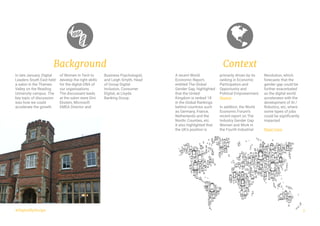
In late January, Digital
Leaders South East held
a salon in the Thames
Valley on the Reading
University campus. The
key topic of discussion
was how we could
accelerate the growth
of Women in Tech to
develop the right skills
for the digital DNA of
our organisations.
The discussant leads
at the salon were Gini
Ekstein, Microsoft
EMEA Director and
Business Psychologist,
and Leigh Smyth, Head
of Group Digital
Inclusion, Consumer
Digital, at Lloyds
Banking Group.
Background
5#DigitalByDesign
you are valued for what
you share and not
just what you know.
This view therefore
means that “culture
eats technology for
breakfast”.
The discussion
then focused on
how we could make
necessary changes
to our culture and
build in sustainability
to achieve a culture
that is conducive to
accelerating the growth
of women and bringing
greater value to the
organisation.
The key aspects to
facilitate cultural
change included:
•	 Reprogramming our
unconscious bias
•	 Developing expert
communication
skills
•	 Delivering grassroots
enablement
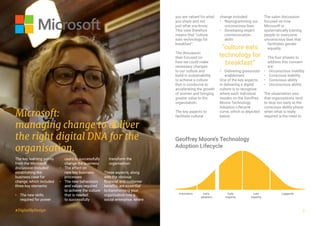
One of the key aspects
in delivering a digital
culture is to recognise
where each individual
resides on the Geoffrey
Moore Technology
Adoption Lifecycle
curve, which is depicted
below.
The salon discussion
focused on how
Microsoft is
systematically training
people to overcome
unconscious bias that
facilitates gender
equality.
The four phases to
address this concern
are:
•	 Unconscious inability
•	 Conscious inability
•	 Conscious ability
•	 Unconscious ability
The observation was
that organisations tend
to stop too early at the
conscious ability phase
when what is really
required is the need to
“culture eats
technology for
breakfast”
The key learning points
from the Microsoft
discussion included
establishing the
business case for
change, which included
three key elements:
•	 The new skills
required for power
users to successfully
change the business
•	 The effect on
new key business
processes
•	 The new behaviours
and values required
to achieve the culture
that is needed
to successfully
transform the
organisation
These aspects, along
with the obvious
financial and customer
benefits, are essential
to transforming your
organisation into a
social enterprise, where
Microsoft:
managing change to deliver
the right digital DNA for the
organisation.
#DigitalByDesign 7
“You are only as good as what people understand.”
achieve sustainability
of the final phase –
unconscious ability.
“Training does not equal
habit.”
The Microsoft
organisation challenges
itself on each hiring
decision in order
to ensure that an
unconscious bias does
not occur during the
hiring process.
Some of the key
measures of
showing progress
on unconscious bias
include improved
awareness, identifying
the right skills and
delivering the right
business ROI.
The salon then went on
to discuss how we need
to recognise the “fight
or flight response” when
managing change, and
how this affects each
member of the team
or group. Note 1. The
key approach to solving
this phenomenon is
to share each step on
the change journey
transparently and
communicate what it
means to us, even if we
are unsure of what each
specific step will be. It is
important to establish a
cadence for transparent
communication at
each step and use our
stories to gain both
an understanding
and a buy in. “You
are only as good as
how much people
understand what you
are communicating.”
9#DigitalByDesign
There will be a 1
million shortfall in
digital skills in the
UK, which represents
a major exposure to
our economy. Today,
only 18% percent
of women have a
technology-based role
and just 10% of women
are represented in
leadership roles.
Almost half (42%) of
the Digital team at
Lloyds are women. This
has been facilitated by
ensuring that 50% of the
candidates for each role
are female during the
hiring interview process.
The Lloyds Banking
Group has also used
a 3B approach to
obtaining the right
skills for the digital
environment.
The 3Bs are as follows:
1.	 Borrow the expertise
by using contractors
and consultants
during start-up.
2.	 Buying in the
expertise by using
the critical hires
process.
3.	 Building the expertise
by developing and
increasing the levels
of your own people’s
digital skills.
Lloyds has also
proactively formed
partnerships with
universities and
polytechnics to acquire
the right skills.
The salon went on to
discuss the importance
of mindset and culture,
and how integral they
are in the development
of digital skills, as well
as agility skills and
the ability to deal with
ambiguity.
Creating a very family
friendly environment
is the next key aspect
of the Lloyds digital
environment, as it
enables people to
manage both their
family and business life.
The routine sharing of
case studies in order
to inspire other women
is another aspect of
Lloyds’ success in
developing women.
It has also created a
Lloyds Banking Group:
Creating a digital family
friendly environment
#DigitalByDesign
We then discussed
how we could both
adopt and adapt the
Jacqueline de Rojas
11 Step Plan so that
it could include what
we had discussed
and learnt during the
salon, and how we
could then build this
into creating the right
platform to accelerate
the growth of women
in the organisation’s
Digital DNA. We then
discussed how we, as a
nation, could create the
specific steps required
to address the digital
gap for each generation,
so that all ages can
smoothly adapt to the
digital world.
11
11 Step Plan to building the
Nation’s Digital DNA
digital apprenticeship
and graduate scheme
to ensure that there
is a skilled pipeline
of women who are
available for future roles
in the organisation.
In addition, Lloyds has
created a “breakthrough
network” of circa
17,000 women that
focuses primarily on
life skills. The network
utilises typical digital
tools, which include
teleconferencing,
mobiles, Facetime, etc.
To accelerate its digital
culture, Lloyds has
developed 12,000 digital
champions whose role
is to enable the digital
lives of its customers
in their communities by
helping customers to
improve their ability to
save and manage their
money.
It has also integrated
digital into its
foundation training by
creating partnerships
with key external
organisations, and
launched both
innovation and
transformation projects
that are iterative and
subject to a six month
go / no go criteria.
In addition, Lloyds
recently introduced its
first Consumer Digital
Index, which revealed
that 11.1 million people
in the UK currently have
a low digital capability
and is reported to save
families an average of
£744 per annum.
Read more about Lloyds Digital Consumer Index
Find out more about the 11-step plan:
Jacqueline de Rojas speaks at DL Conference
11-step plan on Jacqueline de Rojas LinkedIn post
11 Step Plan to building the
Nation’s Digital DNA
#DigitalByDesign Source
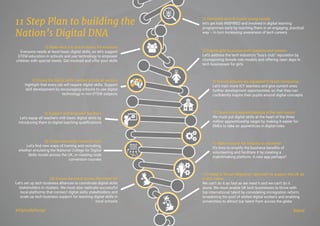
2) Make tech fun and inclusive for everyone
Everyone needs at least basic digital skills, so let’s support
STEM education in schools and use technology to empower
children with special needs. Get involved and offer your skills
4) Create the digital skills needed across all sectors
highlight that every job will require digital skills. Support
skill development by encouraging schools to use digital
technology in non-STEM subjects
10) Ensure we reach across the entire UK
Let’s set up tech business alliances to coordinate digital skills
stakeholders in clusters. We must also replicate successful
local platforms that connect digital skills stakeholders and
scale up tech business support for teaching digital skills in
local schools
6) Support and empower teachers
Let’s equip all teachers with basic digital skills by
introducing them to digital teaching qualifications
8) Create new entry routes to tech
Let’s find new ways of training and recruiting,
whether emulating the National College for Digital
Skills model across the UK, or creating code
conversion courses
1) Demystify tech & inspire young people
let’s get kids INSPIRED and involved in digital learning
programmes early by teaching them in an engaging, practical
way – in turn increasing awareness of tech careers
3) Inspire girls to pursue tech subjects and careers
Let’s address the tech industry’s “boy’s club” reputation by
championing female role models and offering open days in
tech businesses for girls
5) Ensure schools are equipped to teach computing
Let’s train more ICT teachers and give current ones
further development opportunities, so that they can
confidently inspire their pupils around digital concepts
7) Create more apprenticeships in the tech sector
We must put digital skills at the heart of the three
million apprenticeship target by making it easier for
SMEs to take on apprentices in digital roles
9) Make it easier for industry to volunteer
It’s time to amplify the business benefits of
volunteering and facilitate it by creating a
matchmaking platform. A new app perhaps?
11) Adopt a “Smart Migration” approach to support the UK as
a tech nation
We can’t do it as fast as we need it and we can’t do it
alone. We must enable UK tech businesses to thrive with
top international talent by considering immigration reform,
broadening the pool of skilled digital workers and enabling
universities to attract top talent from across the globe
#DigitalByDesign
•	 Encourage girls
at an early age to
challenge their own
unconscious bias,
which can limit their
own potential
•	 Consider the
proactive coaching
of girls from a
very early stage to
ensure that they will
optimise their career
and life
•	 Challenge the
organisation when
it makes hiring
decisions to ensure
that there is not an
unconscious bias in
the hiring process
•	 Integrate consultants
and contractors into
your organisation’s
digital ethos
•	 Utilise polytechnics,
as well as
universities, to hire
and develop the right
digital skills
•	 Develop a scholar’s
programme
that focuses on
developing the less
fortunate young
people in our society
•	 Recognise in your
cultural change
plan where each
individual is on
their digital journey
and support them
accordingly
•	 Proactively
involve men in the
development of
women so that we
can all become the
best that we can be
Key takeaways
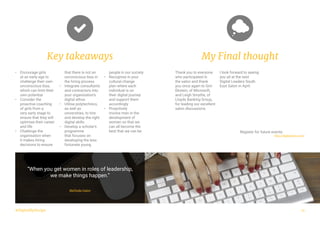
“When you get women in roles of leadership,
we make things happen.”
Melinda Gates
My Final thought
Thank you to everyone
who participated in
the salon and thank
you once again to Gini
Ekstein, of Microsoft,
and Leigh Smythe, of
Lloyds Banking Group,
for leading our excellent
salon discussions.
I look forward to seeing
you all at the next
Digital Leaders South
East Salon in April.
15
Register for future events:
http://digileaders.com/
© Digital Alchemist Consulting Services International Ltd 2015
Thank
you!
Contacts:
jim@the-digital-alchemist.com
paul.whiston@whiston-solutions.com
www.the-digital-alchemist.com

Women in Tech Flipbook

  • 1.
    Digital Leaders SouthEast January 2016: Reading, Thames Valley Women in Tech: Transforming the DNA of our organisations
  • 2.
    3 A recent World EconomicReport, entitled The Global Gender Gap, highlighted that the United Kingdom is ranked 18 in the Global Rankings behind countries such as Germany, France, Netherlands and the Nordic Counties, etc. It also highlighted that the UK’s position is primarily driven by its ranking in Economic Participation and Opportunity and Political Empowerment. Source In addition, the World Economic Forum’s recent report on The Industry Gender Gap Women and Work in the Fourth Industrial Revolution, which forecasts that the gender gap could be further exacerbated as the digital world accelerates with the development of AI / Robotics, etc, where some types of jobs could be significantly impacted. Read more Context #DigitalByDesign In late January, Digital Leaders South East held a salon in the Thames Valley on the Reading University campus. The key topic of discussion was how we could accelerate the growth of Women in Tech to develop the right skills for the digital DNA of our organisations. The discussant leads at the salon were Gini Ekstein, Microsoft EMEA Director and Business Psychologist, and Leigh Smyth, Head of Group Digital Inclusion, Consumer Digital, at Lloyds Banking Group. Background
  • 3.
    5#DigitalByDesign you are valuedfor what you share and not just what you know. This view therefore means that “culture eats technology for breakfast”. The discussion then focused on how we could make necessary changes to our culture and build in sustainability to achieve a culture that is conducive to accelerating the growth of women and bringing greater value to the organisation. The key aspects to facilitate cultural change included: • Reprogramming our unconscious bias • Developing expert communication skills • Delivering grassroots enablement One of the key aspects in delivering a digital culture is to recognise where each individual resides on the Geoffrey Moore Technology Adoption Lifecycle curve, which is depicted below. The salon discussion focused on how Microsoft is systematically training people to overcome unconscious bias that facilitates gender equality. The four phases to address this concern are: • Unconscious inability • Conscious inability • Conscious ability • Unconscious ability The observation was that organisations tend to stop too early at the conscious ability phase when what is really required is the need to “culture eats technology for breakfast” The key learning points from the Microsoft discussion included establishing the business case for change, which included three key elements: • The new skills required for power users to successfully change the business • The effect on new key business processes • The new behaviours and values required to achieve the culture that is needed to successfully transform the organisation These aspects, along with the obvious financial and customer benefits, are essential to transforming your organisation into a social enterprise, where Microsoft: managing change to deliver the right digital DNA for the organisation.
  • 4.
    #DigitalByDesign 7 “You areonly as good as what people understand.” achieve sustainability of the final phase – unconscious ability. “Training does not equal habit.” The Microsoft organisation challenges itself on each hiring decision in order to ensure that an unconscious bias does not occur during the hiring process. Some of the key measures of showing progress on unconscious bias include improved awareness, identifying the right skills and delivering the right business ROI. The salon then went on to discuss how we need to recognise the “fight or flight response” when managing change, and how this affects each member of the team or group. Note 1. The key approach to solving this phenomenon is to share each step on the change journey transparently and communicate what it means to us, even if we are unsure of what each specific step will be. It is important to establish a cadence for transparent communication at each step and use our stories to gain both an understanding and a buy in. “You are only as good as how much people understand what you are communicating.”
  • 5.
    9#DigitalByDesign There will bea 1 million shortfall in digital skills in the UK, which represents a major exposure to our economy. Today, only 18% percent of women have a technology-based role and just 10% of women are represented in leadership roles. Almost half (42%) of the Digital team at Lloyds are women. This has been facilitated by ensuring that 50% of the candidates for each role are female during the hiring interview process. The Lloyds Banking Group has also used a 3B approach to obtaining the right skills for the digital environment. The 3Bs are as follows: 1. Borrow the expertise by using contractors and consultants during start-up. 2. Buying in the expertise by using the critical hires process. 3. Building the expertise by developing and increasing the levels of your own people’s digital skills. Lloyds has also proactively formed partnerships with universities and polytechnics to acquire the right skills. The salon went on to discuss the importance of mindset and culture, and how integral they are in the development of digital skills, as well as agility skills and the ability to deal with ambiguity. Creating a very family friendly environment is the next key aspect of the Lloyds digital environment, as it enables people to manage both their family and business life. The routine sharing of case studies in order to inspire other women is another aspect of Lloyds’ success in developing women. It has also created a Lloyds Banking Group: Creating a digital family friendly environment
  • 6.
    #DigitalByDesign We then discussed howwe could both adopt and adapt the Jacqueline de Rojas 11 Step Plan so that it could include what we had discussed and learnt during the salon, and how we could then build this into creating the right platform to accelerate the growth of women in the organisation’s Digital DNA. We then discussed how we, as a nation, could create the specific steps required to address the digital gap for each generation, so that all ages can smoothly adapt to the digital world. 11 11 Step Plan to building the Nation’s Digital DNA digital apprenticeship and graduate scheme to ensure that there is a skilled pipeline of women who are available for future roles in the organisation. In addition, Lloyds has created a “breakthrough network” of circa 17,000 women that focuses primarily on life skills. The network utilises typical digital tools, which include teleconferencing, mobiles, Facetime, etc. To accelerate its digital culture, Lloyds has developed 12,000 digital champions whose role is to enable the digital lives of its customers in their communities by helping customers to improve their ability to save and manage their money. It has also integrated digital into its foundation training by creating partnerships with key external organisations, and launched both innovation and transformation projects that are iterative and subject to a six month go / no go criteria. In addition, Lloyds recently introduced its first Consumer Digital Index, which revealed that 11.1 million people in the UK currently have a low digital capability and is reported to save families an average of £744 per annum. Read more about Lloyds Digital Consumer Index Find out more about the 11-step plan: Jacqueline de Rojas speaks at DL Conference 11-step plan on Jacqueline de Rojas LinkedIn post
  • 7.
    11 Step Planto building the Nation’s Digital DNA #DigitalByDesign Source 2) Make tech fun and inclusive for everyone Everyone needs at least basic digital skills, so let’s support STEM education in schools and use technology to empower children with special needs. Get involved and offer your skills 4) Create the digital skills needed across all sectors highlight that every job will require digital skills. Support skill development by encouraging schools to use digital technology in non-STEM subjects 10) Ensure we reach across the entire UK Let’s set up tech business alliances to coordinate digital skills stakeholders in clusters. We must also replicate successful local platforms that connect digital skills stakeholders and scale up tech business support for teaching digital skills in local schools 6) Support and empower teachers Let’s equip all teachers with basic digital skills by introducing them to digital teaching qualifications 8) Create new entry routes to tech Let’s find new ways of training and recruiting, whether emulating the National College for Digital Skills model across the UK, or creating code conversion courses 1) Demystify tech & inspire young people let’s get kids INSPIRED and involved in digital learning programmes early by teaching them in an engaging, practical way – in turn increasing awareness of tech careers 3) Inspire girls to pursue tech subjects and careers Let’s address the tech industry’s “boy’s club” reputation by championing female role models and offering open days in tech businesses for girls 5) Ensure schools are equipped to teach computing Let’s train more ICT teachers and give current ones further development opportunities, so that they can confidently inspire their pupils around digital concepts 7) Create more apprenticeships in the tech sector We must put digital skills at the heart of the three million apprenticeship target by making it easier for SMEs to take on apprentices in digital roles 9) Make it easier for industry to volunteer It’s time to amplify the business benefits of volunteering and facilitate it by creating a matchmaking platform. A new app perhaps? 11) Adopt a “Smart Migration” approach to support the UK as a tech nation We can’t do it as fast as we need it and we can’t do it alone. We must enable UK tech businesses to thrive with top international talent by considering immigration reform, broadening the pool of skilled digital workers and enabling universities to attract top talent from across the globe
  • 8.
    #DigitalByDesign • Encourage girls atan early age to challenge their own unconscious bias, which can limit their own potential • Consider the proactive coaching of girls from a very early stage to ensure that they will optimise their career and life • Challenge the organisation when it makes hiring decisions to ensure that there is not an unconscious bias in the hiring process • Integrate consultants and contractors into your organisation’s digital ethos • Utilise polytechnics, as well as universities, to hire and develop the right digital skills • Develop a scholar’s programme that focuses on developing the less fortunate young people in our society • Recognise in your cultural change plan where each individual is on their digital journey and support them accordingly • Proactively involve men in the development of women so that we can all become the best that we can be Key takeaways “When you get women in roles of leadership, we make things happen.” Melinda Gates My Final thought Thank you to everyone who participated in the salon and thank you once again to Gini Ekstein, of Microsoft, and Leigh Smythe, of Lloyds Banking Group, for leading our excellent salon discussions. I look forward to seeing you all at the next Digital Leaders South East Salon in April. 15 Register for future events: http://digileaders.com/
  • 9.
    © Digital AlchemistConsulting Services International Ltd 2015 Thank you! Contacts: jim@the-digital-alchemist.com paul.whiston@whiston-solutions.com www.the-digital-alchemist.com