an
INSIGHTINTO
whitepaper
The Digital Skills Gap and How to
Attract & Keep the Best Candidates
Foreword
2
Gap
/gap/
noun
a break or hole in an object
or between two objects
3
A global declaration was made in
early 2011 by digital avant-gardes
everywhere – the world is
suffering from a skills gap and if
we don’t act now, innovation will
be halted and economies will fail.
In short, our demand for digital
expertise in the workplace far
exceeds the volume of candidates
with the right skills to deliver
the job. Thus, creating the
£63billion per annum Digital
Skills Gap.
4
Fast forward to 2018 and the threat
to UK businesses is growing – it is
estimated that the shortfall of
candidates has reached 40,000 people
and 75% of organisations believe that
addressing the skills shortage is the
only way they can stay competitive.
So, what does this mean for the
senior management teams, HR and IT
departments, and start-ups that are
trying to future-proof their business
through digital innovation?
75%
of organisations believe
that addressing the
skills shortage is the
only way they can stay
competitive
5
The very definition of a ‘gap’ in the
digital eco-system would suggest distance
between an employer of digital skills and
the talent itself.
This whitepaper will explore in detail the
impact the Digital Skills Gap can have on
profitability and expansion. Offering
insight and advice for how an organisation
can redevelop its recruitment strategy to
tackle ‘the war on talent’, the paper will
examine the challenge in remaining
competitive in our ever-changing digital
landscape.
6
Section 1 - Total
Impact: The Effect of
the Skills Gap on
Businesses Worldwide
7
Tech innovation has completely
reformed the business eco-system.
This is the era of 1-click shopping, AI
marketing automations and augmented
reality. Every element of a customer
experience is expected to be slick, quick
and above all else – digital.
8
If you want to accelerate your business
growth and profitability in the digital
decade, it is now integral that you keep up
with the Joneses and make sure a digital
transformation strategy is included in your
five-year plan.
For many businesses, this requires major
overhauls to process, profit and people
in order to maintain any kind of
competitive edge.
0101000100001001110
0101000100001001110 0101000100001001110
0101000100001001110
9
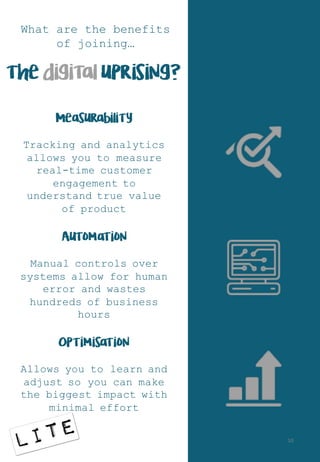
What are the benefits
of joining…
the digital uprising?
Measurability
Tracking and analytics
allows you to measure
real-time customer
engagement to
understand true value
of product
Automation
Manual controls over
systems allow for human
error and wastes
hundreds of business
hours
Optimisation
Allows you to learn and
adjust so you can make
the biggest impact with
minimal effort
10
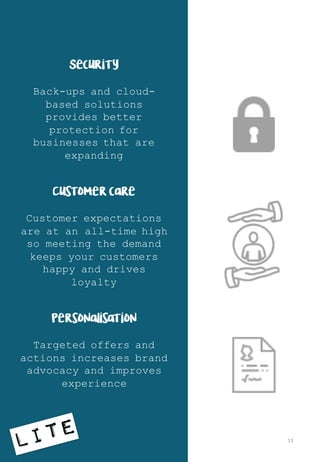
Security
Back-ups and cloud-
based solutions
provides better
protection for
businesses that are
expanding
Customer care
Customer expectations
are at an all-time high
so meeting the demand
keeps your customers
happy and drives
loyalty
Personalisation
Targeted offers and
actions increases brand
advocacy and improves
experience
11
It is now estimated that 20% of all
market leaders will lose dominant
positions within a sector to a company
founded after the year 2000 because of
the lack in digital advances.
Despite having a digital strategy in place,
the majority of these sectors profess to not
having the resource in their organisation to
drive the plan forward.
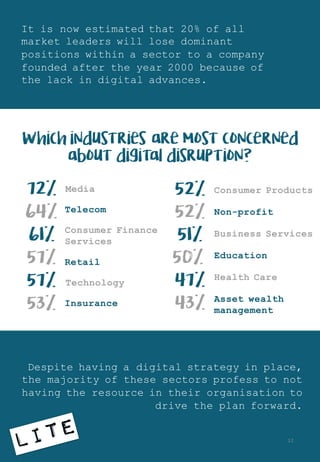
Which industries are most concerned
about digital disruption?
72%
53%
61%
57%
57%
64%
52%
43%
51%
50%
47%
52%
Media
Consumer Finance
Services
Technology
Consumer Products
Education
Health Care
Telecom
Retail
Insurance
Non-profit
Business Services
Asset wealth
management
12
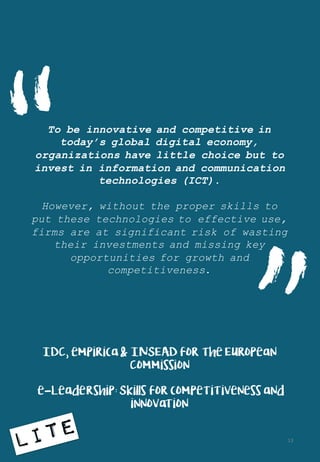
To be innovative and competitive in
today’s global digital economy,
organizations have little choice but to
invest in information and communication
technologies (ICT).
However, without the proper skills to
put these technologies to effective use,
firms are at significant risk of wasting
their investments and missing key
opportunities for growth and
competitiveness.
IDC, empirica & INSEAD for the European
Commission
e-Leadership: Skills for competitiveness and
innovation
“
13
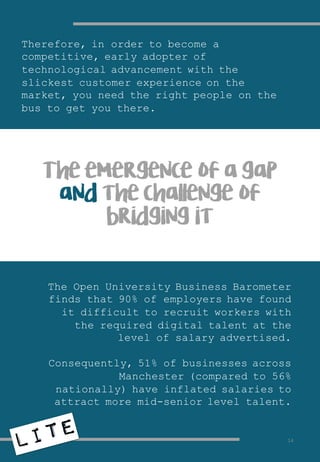
Therefore, in order to become a
competitive, early adopter of
technological advancement with the
slickest customer experience on the
market, you need the right people on the
bus to get you there.
The emergence of a gap
and the challenge of
bridging it
The Open University Business Barometer
finds that 90% of employers have found
it difficult to recruit workers with
the required digital talent at the
level of salary advertised.
Consequently, 51% of businesses across
Manchester (compared to 56%
nationally) have inflated salaries to
attract more mid-senior level talent.
14
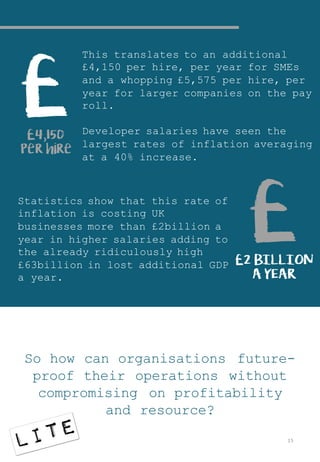
Statistics show that this rate of
inflation is costing UK
businesses more than £2billion a
year in higher salaries adding to
the already ridiculously high
£63billion in lost additional GDP
a year.
This translates to an additional
£4,150 per hire, per year for SMEs
and a whopping £5,575 per hire, per
year for larger companies on the pay
roll.
Developer salaries have seen the
largest rates of inflation averaging
at a 40% increase.
So how can organisations future-
proof their operations without
compromising on profitability
and resource?
££4,150
Per hire
££2 BILLION
A YEAR
15
To receive a free, exclusive copy of
the full Insight Into: The Digital
Skills Gap whitepaper, follow our
LinkedIn page today.
+44 (0)161 710 2317
Insight IT & Engineering
Recruitment LinkedIn
insight-rec.com
T:
W:
L:
16

Insight Into: The Digital Skills Gap

  • 1.
    an INSIGHTINTO whitepaper The Digital SkillsGap and How to Attract & Keep the Best Candidates
  • 2.
  • 3.
    Gap /gap/ noun a break orhole in an object or between two objects 3
  • 4.
    A global declarationwas made in early 2011 by digital avant-gardes everywhere – the world is suffering from a skills gap and if we don’t act now, innovation will be halted and economies will fail. In short, our demand for digital expertise in the workplace far exceeds the volume of candidates with the right skills to deliver the job. Thus, creating the £63billion per annum Digital Skills Gap. 4
  • 5.
    Fast forward to2018 and the threat to UK businesses is growing – it is estimated that the shortfall of candidates has reached 40,000 people and 75% of organisations believe that addressing the skills shortage is the only way they can stay competitive. So, what does this mean for the senior management teams, HR and IT departments, and start-ups that are trying to future-proof their business through digital innovation? 75% of organisations believe that addressing the skills shortage is the only way they can stay competitive 5
  • 6.
    The very definitionof a ‘gap’ in the digital eco-system would suggest distance between an employer of digital skills and the talent itself. This whitepaper will explore in detail the impact the Digital Skills Gap can have on profitability and expansion. Offering insight and advice for how an organisation can redevelop its recruitment strategy to tackle ‘the war on talent’, the paper will examine the challenge in remaining competitive in our ever-changing digital landscape. 6
  • 7.
    Section 1 -Total Impact: The Effect of the Skills Gap on Businesses Worldwide 7
  • 8.
    Tech innovation hascompletely reformed the business eco-system. This is the era of 1-click shopping, AI marketing automations and augmented reality. Every element of a customer experience is expected to be slick, quick and above all else – digital. 8
  • 9.
    If you wantto accelerate your business growth and profitability in the digital decade, it is now integral that you keep up with the Joneses and make sure a digital transformation strategy is included in your five-year plan. For many businesses, this requires major overhauls to process, profit and people in order to maintain any kind of competitive edge. 0101000100001001110 0101000100001001110 0101000100001001110 0101000100001001110 9
  • 10.
    What are thebenefits of joining… the digital uprising? Measurability Tracking and analytics allows you to measure real-time customer engagement to understand true value of product Automation Manual controls over systems allow for human error and wastes hundreds of business hours Optimisation Allows you to learn and adjust so you can make the biggest impact with minimal effort 10
  • 11.
    Security Back-ups and cloud- basedsolutions provides better protection for businesses that are expanding Customer care Customer expectations are at an all-time high so meeting the demand keeps your customers happy and drives loyalty Personalisation Targeted offers and actions increases brand advocacy and improves experience 11
  • 12.
    It is nowestimated that 20% of all market leaders will lose dominant positions within a sector to a company founded after the year 2000 because of the lack in digital advances. Despite having a digital strategy in place, the majority of these sectors profess to not having the resource in their organisation to drive the plan forward. Which industries are most concerned about digital disruption? 72% 53% 61% 57% 57% 64% 52% 43% 51% 50% 47% 52% Media Consumer Finance Services Technology Consumer Products Education Health Care Telecom Retail Insurance Non-profit Business Services Asset wealth management 12
  • 13.
    To be innovativeand competitive in today’s global digital economy, organizations have little choice but to invest in information and communication technologies (ICT). However, without the proper skills to put these technologies to effective use, firms are at significant risk of wasting their investments and missing key opportunities for growth and competitiveness. IDC, empirica & INSEAD for the European Commission e-Leadership: Skills for competitiveness and innovation “ 13
  • 14.
    Therefore, in orderto become a competitive, early adopter of technological advancement with the slickest customer experience on the market, you need the right people on the bus to get you there. The emergence of a gap and the challenge of bridging it The Open University Business Barometer finds that 90% of employers have found it difficult to recruit workers with the required digital talent at the level of salary advertised. Consequently, 51% of businesses across Manchester (compared to 56% nationally) have inflated salaries to attract more mid-senior level talent. 14
  • 15.
    Statistics show thatthis rate of inflation is costing UK businesses more than £2billion a year in higher salaries adding to the already ridiculously high £63billion in lost additional GDP a year. This translates to an additional £4,150 per hire, per year for SMEs and a whopping £5,575 per hire, per year for larger companies on the pay roll. Developer salaries have seen the largest rates of inflation averaging at a 40% increase. So how can organisations future- proof their operations without compromising on profitability and resource? ££4,150 Per hire ££2 BILLION A YEAR 15
  • 16.
    To receive afree, exclusive copy of the full Insight Into: The Digital Skills Gap whitepaper, follow our LinkedIn page today. +44 (0)161 710 2317 Insight IT & Engineering Recruitment LinkedIn insight-rec.com T: W: L: 16