WOMEN  IN  ANCIENT GREECE
 
 
In the 5th century BC,  Athens: Defeated  the Persian Empire and it became the leader of the Greeks. It prospered and became far richer It gave great philosophers and artists , such a Socrates, Platon, Aristoteles It beautyfied itself with buildings and statues. It invented the theatre as a genre It protected its citizens  with laws and let them  vote in the organization of the first democracy in the History  ... And it was proud of it.
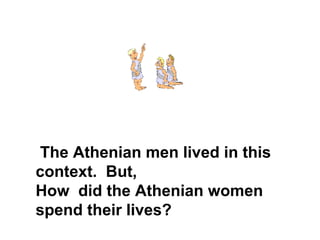
The Athenian men lived in this context.  But, How  did the Athenian women  spend their lives?
Athenian democracy  gave  no legal or politic rights  to women . What  society  expected from women   was that,  after marriege ,  they applied for  the care and the management of the home   and they were ...
And they were as invisible as possible
Marriage Fathers or  legal tutors arranged the marriages to her and to him.  The marriage was an economic matter.  Love was unimportant  to get married.
Wife ,  Concubine  and  Hetaera   Once a man appeared in court, saying: “  We have  hetaerai  for our pleasure,  concubines  for our daily cares and  wives   to have legal children with and they were faithful guardians of our home”  In PSEUDO-DEMOSTHENES’ oration:  AGAINST  NEAIRA
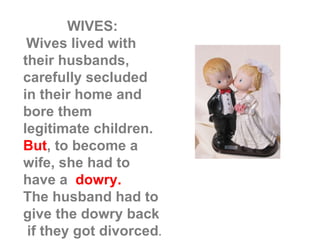
WIVES: Wives lived with their husbands, carefully secluded  in their home and bore them legitimate children.  But , to become a wife, she had to  have a  dowry. The husband had to give the dowry back  if they got divorced .
Concubines:  A concubine didn’t get married, but maintained personal and  sexual relations with a married man who she used to attract herself through  her beauty, cares and flattery, since he was  her protection and her sustenance. Her children didn’t  have the same rights as the legitimate children. The State or the law  took no part in this kind of  relationship
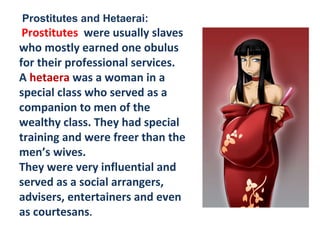
Prostitutes  and Hetaerai: Prostitutes  were usually slaves who mostly earned one obulus for their professional services. A  hetaera  was a woman in a special class who served as a companion to men of the wealthy class. They had special training and were freer than the men’s wives. They were very influential and served as a social arrangers, advisers, entertainers and even  as  courtesans .
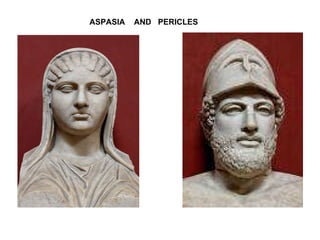
ASPASIA  AND  PERICLES
P. Mazon, editor of Aristophanes’ works, wrote: “ Nobody would have minded  If Pericles  had liked boys , if he hadn’t done well by his first wife ,  but to most people it was scandalous  that  he would consider his second woman as a human being , that he would live with her without secluding to the women’s room ,  that he would invited his friends with their wives.  That was all too surprising to be natural,  and Aspasia was too brilliant to be an honest woman.”

Women in a g

  • 1.
    WOMEN IN ANCIENT GREECE
  • 2.
  • 3.
  • 4.
    In the 5thcentury BC, Athens: Defeated the Persian Empire and it became the leader of the Greeks. It prospered and became far richer It gave great philosophers and artists , such a Socrates, Platon, Aristoteles It beautyfied itself with buildings and statues. It invented the theatre as a genre It protected its citizens with laws and let them vote in the organization of the first democracy in the History ... And it was proud of it.
  • 5.
    The Athenian menlived in this context. But, How did the Athenian women spend their lives?
  • 6.
    Athenian democracy gave no legal or politic rights to women . What society expected from women was that, after marriege , they applied for the care and the management of the home and they were ...
  • 7.
    And they wereas invisible as possible
  • 8.
    Marriage Fathers or legal tutors arranged the marriages to her and to him. The marriage was an economic matter. Love was unimportant to get married.
  • 9.
    Wife , Concubine and Hetaera Once a man appeared in court, saying: “ We have hetaerai for our pleasure, concubines for our daily cares and wives to have legal children with and they were faithful guardians of our home” In PSEUDO-DEMOSTHENES’ oration: AGAINST NEAIRA
  • 10.
    WIVES: Wives livedwith their husbands, carefully secluded in their home and bore them legitimate children. But , to become a wife, she had to have a dowry. The husband had to give the dowry back if they got divorced .
  • 11.
    Concubines: Aconcubine didn’t get married, but maintained personal and sexual relations with a married man who she used to attract herself through her beauty, cares and flattery, since he was her protection and her sustenance. Her children didn’t have the same rights as the legitimate children. The State or the law took no part in this kind of relationship
  • 12.
    Prostitutes andHetaerai: Prostitutes were usually slaves who mostly earned one obulus for their professional services. A hetaera was a woman in a special class who served as a companion to men of the wealthy class. They had special training and were freer than the men’s wives. They were very influential and served as a social arrangers, advisers, entertainers and even as courtesans .
  • 13.
    ASPASIA AND PERICLES
  • 14.
    P. Mazon, editorof Aristophanes’ works, wrote: “ Nobody would have minded If Pericles had liked boys , if he hadn’t done well by his first wife , but to most people it was scandalous that he would consider his second woman as a human being , that he would live with her without secluding to the women’s room , that he would invited his friends with their wives. That was all too surprising to be natural, and Aspasia was too brilliant to be an honest woman.”