Wobbles, Warbles &
Fish - the brain basis of
dyslexia
John Stein,John Stein, MagdalenMagdalen
College,College,
Oxford University, UKOxford University, UK
Supported by The Dyslexia Research Trust (www.dyslexic.org.uk),
Dyers & Colourists, Esmee Fairbairn, Garfield Weston and Wellcome
Trusts, BBC Children in Need
DDD
RRR
TTT
Wobbles,
Warbles & Fish -
the brain basis
of dyslexia
Supported by The Dyslexia Research Trust (www.dyslexic.org.uk),
Dyers & Colourists, Esmee Fairbairn, Garfield Weston and Wellcome
Trusts, BBC Children in Need
DDD
RRR
TTT
Brain systems
involved in reading
Differences in dyslexia
Controversies
How can we help?
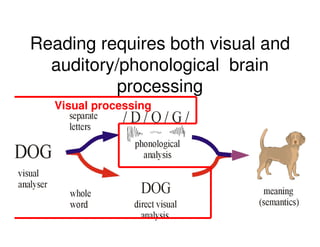
Reading requires both visual and
auditory/phonological brain
processing
Visual processing
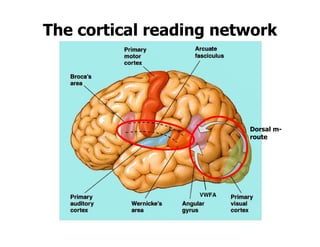
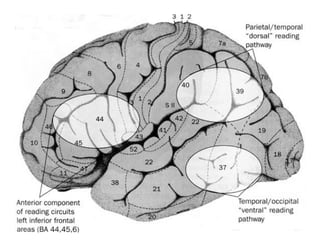
The cortical reading network
Dorsal m-
route
VWFA
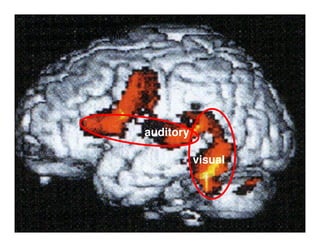
Left hemisphere language
areas that activate less in
dyslexics
auditory
visual
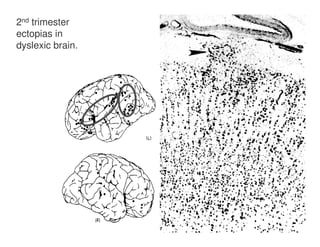
2nd trimester
ectopias in
dyslexic brain.
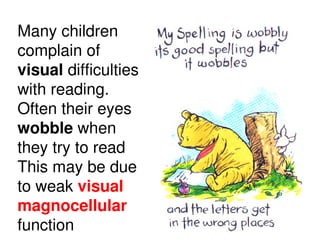
Many children
complain of
visual difficulties
with reading.
Often their eyes
wobble when
they try to read
This may be due
to weak visual
magnocellular
function
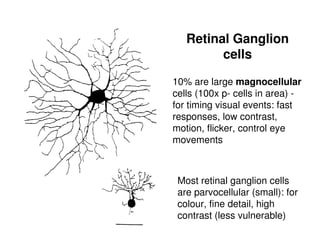
10% are large magnocellular
cells (100x p- cells in area) -
for timing visual events: fast
responses, low contrast,
motion, flicker, control eye
movements
Most retinal ganglion cells
are parvocellular (small): for
colour, fine detail, high
contrast (less vulnerable)
Retinal Ganglion
cells
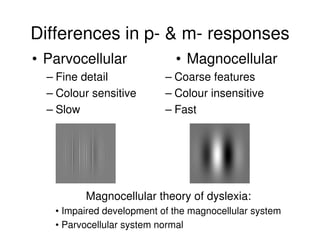
Differences in p- & m- responses
• Parvocellular
– Fine detail
– Colour sensitive
– Slow
• Magnocellular
– Coarse features
– Colour insensitive
– Fast
Magnocellular theory of dyslexia:
• Impaired development of the magnocellular system
• Parvocellular system normal
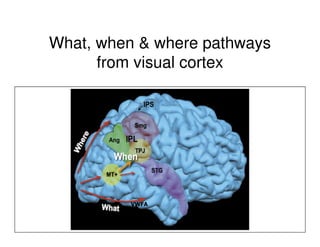
What, when & where pathways
from visual cortex
VWFA
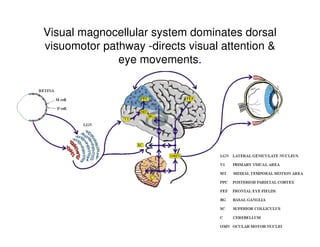
Visual magnocellular system dominates dorsal
visuomotor pathway -directs visual attention &
eye movements.
The visual magnocellular system
is impaired in poor readers
• 30% smaller LGN magnocells post
mortem
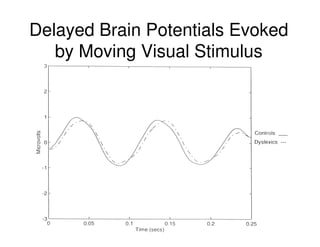
• Reduced and delayed evoked brain
waves
• Reduced visual motion sensitivity
• Poor eye control
• Lower sensitivity to flicker
• Lower sensitivity to low spatial, high
temporal frequency contrast gratings
• Reduced activation of cortical visual
motion areas (FMRI)
• Lower stereoacuity
• Poor visual sequential attention -
slower visual search
All these claims have been
opposed - 3 problems:
• Definition of magno- system;
only anatomically separate in
periphery
• Selectivity of stimuli
• Mild deficits require highly
sensitive test to reveal them
Nevertheless in the last 10 years
90% of new research has
found evidence of
magnocellular deficit
• One author has written 20
papers criticising others’ work
on the magnocellular
hypothesis!
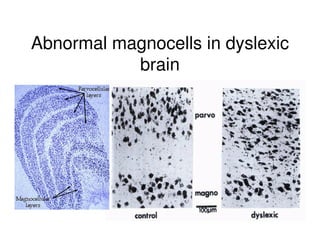
Abnormal magnocells in dyslexic
brain
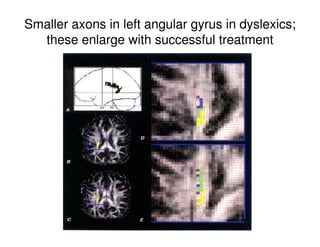
Smaller axons in left angular gyrus in dyslexics;
these enlarge with successful treatment
Delayed Brain Potentials Evoked
by Moving Visual Stimulus
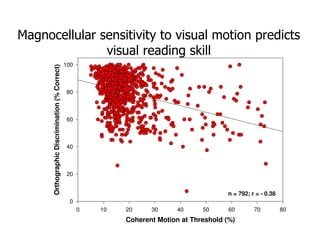
Coherent Motion at Threshold (%)
0 10 20 30 40 50 60 70 80
OrthographicDiscrimination(%Correct)
0
20
40
60
80
100
n = 792; r = - 0.38
Magnocellular sensitivity to visual motion predicts
visual reading skill
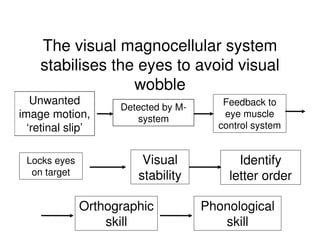
Unwanted
image motion,
‘retinal slip’
Locks eyes
on target
Visual
stability
Identify
letter order
Feedback to
eye muscle
control system
The visual magnocellular system
stabilises the eyes to avoid visual
wobble
Detected by M-
system
Orthographic
skill
Phonological
skill
Wobbly eyes!
The visual magnocellular
system stabilises the eyes
to avoid visual wobble
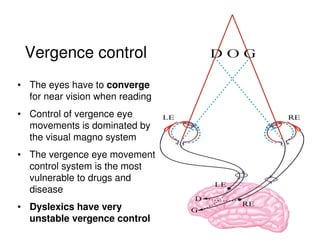
• The eyes have to converge
for near vision when reading
• Control of vergence eye
movements is dominated by
the visual magno system
• The vergence eye movement
control system is the most
vulnerable to drugs and
disease
• Dyslexics have very
unstable vergence control
Vergence control
Magnocellular processing sharpens:
into
Weak magnocellular system causes
unstable vision - oscillopsia
“The letters go all blurry”
“The letters move over each other, so I can’t tell
which is which”
“The letters seem to float all over the page”
“The letters move in and out of the page”
“The letters split and go double”
“The c moved over the r, so it looked like another c”
“The p joined up with the c”
“d’s and b’s sort of get the wrong way round”
“The page goes all glary and hurts my eyes”
“I keep on losing my place”
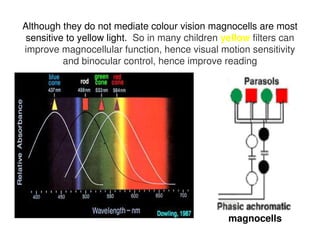
Although they do not mediate colour vision magnocells are most
sensitive to yellow light. So in many children yellow filters can
improve magnocellular function, hence visual motion sensitivity
and binocular control, hence improve reading
magnocells
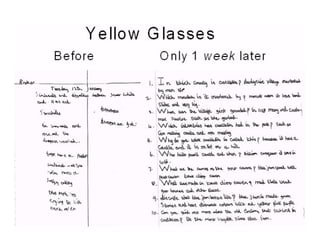
Yellow filters can improve reading
Increaseinliteracyin3months
0
1
2
3
4
5
6
7
8
reading spelling
months
yellow
placebo
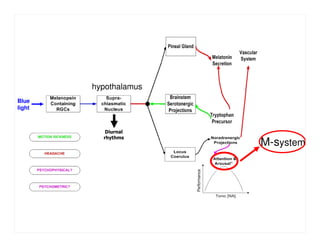
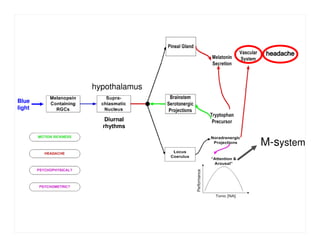
B - Dull Shifting Y - Highly Labile
Blue
light
M-system
hypothalamus
Diurnal
rhythms
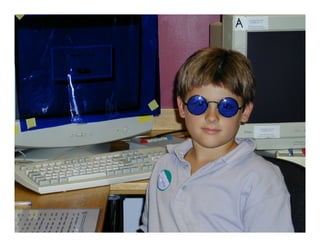
Blue makes the letters keep still!
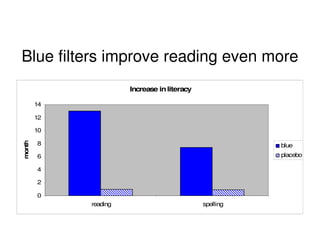
Blue filters improve reading even more
Increase inliteracy
0
2
4
6
8
10
12
14
reading spelling
months
blue
placebo
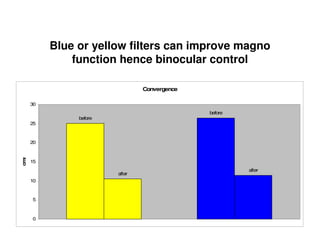
Blue or yellow filters can improve magno
function hence binocular control
Convergence
before
before
after
after
0
5
10
15
20
25
30
cms
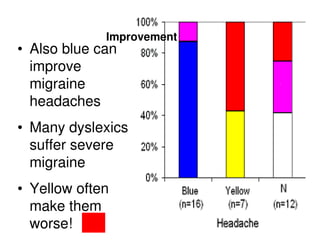
• Also blue can
improve
migraine
headaches
• Many dyslexics
suffer severe
migraine
• Yellow often
make them
worse!
Improvement
B - Dull Shifting Y - Highly Labile
Blue
light
M-system
headacheheadacheheadacheheadache
hypothalamus
Diurnal
rhythms
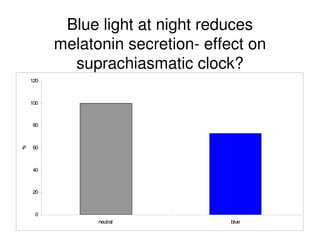
Blue light at night reduces
melatonin secretion- effect on
suprachiasmatic clock?
0
20
40
60
80
100
120
neutral blue
%
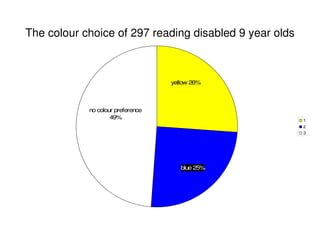
The colour choice of 297 reading disabled 9 year olds
no colour preference
49%
blue 25%
yellow 26%
1
2
3
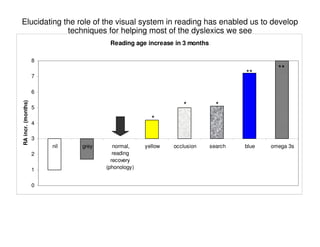
Reading age increase in 3 months
0
1
2
3
4
5
6
7
8
nil grey normal,
reading
recovery
(phonology)
yellow occlusion search blue omega 3s
RAincr.(months)
Elucidating the role of the visual system in reading has enabled us to develop
techniques for helping most of the dyslexics we see
*
* *
**
**
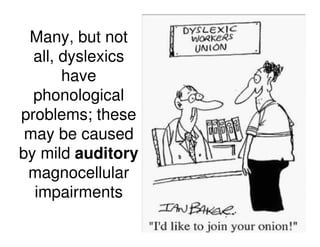
Many, but not
all, dyslexics
have
phonological
problems; these
may be caused
by mild auditory
magnocellular
impairments
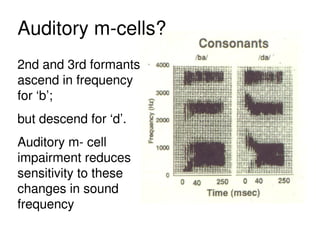
2nd and 3rd formants
ascend in frequency
for ‘b’;
but descend for ‘d’.
Auditory m- cell
impairment reduces
sensitivity to these
changes in sound
frequency
Auditory m-cells?
Impaired auditory magnocells
in dyslexia?
• Large neurones staining for CAT 301 in the
auditory brainstem signal changes in sound
frequency and amplitude
• Dyslexics have smaller magnocellular neurones in
medial geniculate N.
• Lower AM & FM sensitivity, correlate with
phonological deficit
• Reduced brainstem auditory evoked potentials
correlate with reading deficit
• Thus dyslexics’ poor phonology may result from
impaired development of auditory magnocells
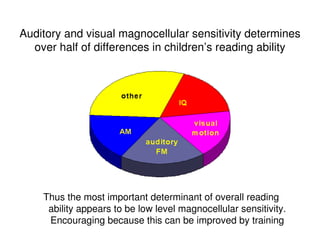
Auditory and visual magnocellular sensitivity determines
over half of differences in children’s reading ability
Thus the most important determinant of overall reading
ability appears to be low level magnocellular sensitivity.
Encouraging because this can be improved by training
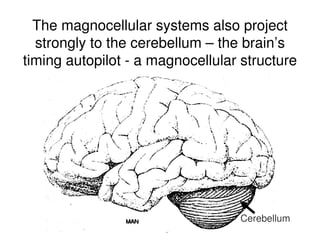
The magnocellular systems also project
strongly to the cerebellum – the brain’s
timing autopilot - a magnocellular structure
Cerebellum
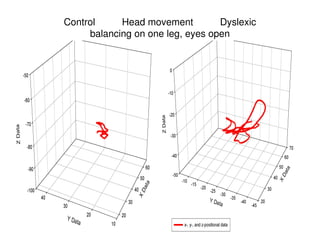
Control Head movement Dyslexic
balancing on one leg, eyes open
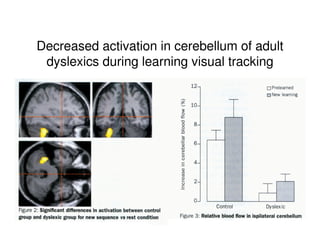
Decreased activation in cerebellum of adult
dyslexics during learning visual tracking
The Cerebellum & Balance
• The cerebellum is the brain’s autopilot for
timing and motor prediction, balance and
skilled movements
• Magnocellular systems all project to the
cerebellum
• Cerebellar neurones stain for CAT 301, part of
the magno system
• Cerebellum is underactive in many dyslexics
• Explains their coordination problems, but not all
their reading difficulties
• Balance exercises are unlikely to help many
dyslexics to learn to read
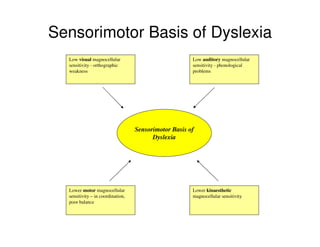
Sensorimotor Basis of
Dyslexia
Low visual magnocellular
sensitivity - orthographic
weakness
Low auditory magnocellular
sensitivity - phonological
problems
Lower motor magnocellular
sensitivity – in coordination,
poor balance
Lower kinaesthetic
magnocellular sensitivity
Sensorimotor Basis of Dyslexia
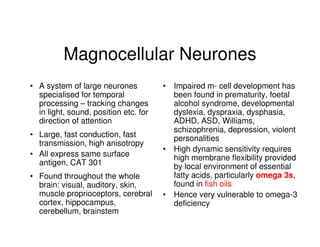
Magnocellular Neurones
• Impaired m- cell development has
been found in prematurity, foetal
alcohol syndrome, developmental
dyslexia, dyspraxia, dysphasia,
ADHD, ASD, Williams,
schizophrenia, depression, violent
personalities
• High dynamic sensitivity requires
high membrane flexibility provided
by local environment of essential
fatty acids, particularly omega 3s,
found in fish oils
• Hence very vulnerable to omega-3
deficiency
• A system of large neurones
specialised for temporal
processing – tracking changes
in light, sound, position etc. for
direction of attention
• Large, fast conduction, fast
transmission, high anisotropy
• All express same surface
antigen, CAT 301
• Found throughout the whole
brain: visual, auditory, skin,
muscle proprioceptors, cerebral
cortex, hippocampus,
cerebellum, brainstem
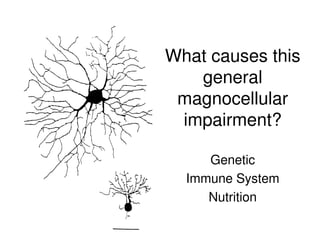
What causes this
general
magnocellular
impairment?
Genetic
Immune System
Nutrition
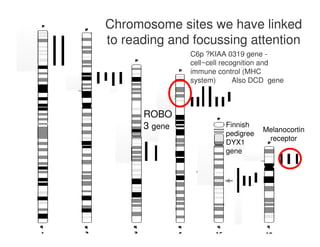
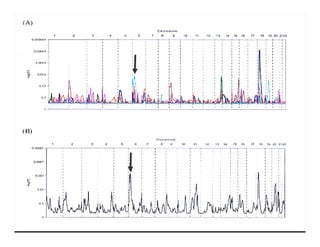
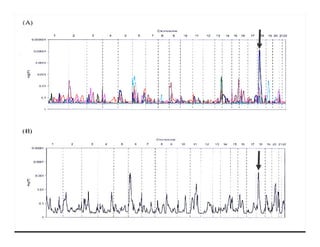
Chromosome sites we have linked
to reading and focussing attention
C6p ?KIAA 0319 gene -
cell~cell recognition and
immune control (MHC
system) Also DCD gene
Finnish
pedigree
DYX1
gene
ROBO
3 gene Melanocortin
receptor
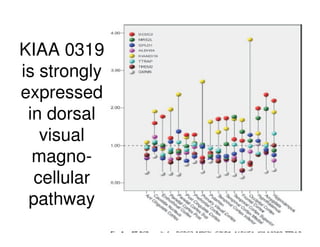
KIAA 0319
is strongly
expressed
in dorsal
visual
magno-
cellular
pathway
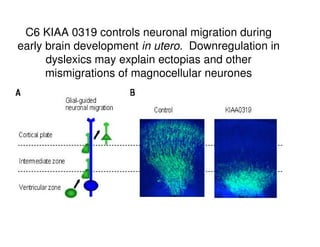
C6 KIAA 0319 controls neuronal migration during
early brain development in utero. Downregulation in
dyslexics may explain ectopias and other
mismigrations of magnocellular neurones
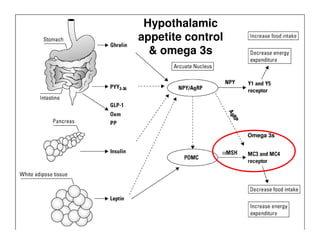
Omega 3s
Hypothalamic
appetite control
& omega 3s
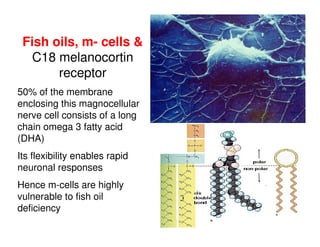
Fish oils, m- cells &
C18 melanocortin
receptor
50% of the membrane
enclosing this magnocellular
nerve cell consists of a long
chain omega 3 fatty acid
(DHA)
Its flexibility enables rapid
neuronal responses
Hence m-cells are highly
vulnerable to fish oil
deficiency
Modern Western diet is a
disaster!
• Too much: salt, sugar, saturated
fat, omega 6s (from corn and soya
bean oil)
• Too little: minerals, fibre, vitamins A
& D, omega 3s from fish
• Far too much omega 6 - ratio of
omega 6/omega 3 should be 1/1;
currently it is 7/1!
Not very romantic!
Fatty acid deficiency in
dyslexia and young
offenders?
• Many children with neuro-
developmental problems and young
offenders have omega 3 deficiency:
• Low blood and brain n-3 FAs
• Omega 3 FA (fish oil)
supplements can v. significantly
improve m- function, attention,
reading and violent offences
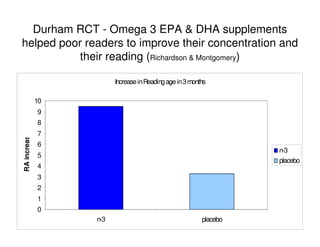
Durham RCT - Omega 3 EPA & DHA supplements
helped poor readers to improve their concentration and
their reading (Richardson & Montgomery)
IncreaseinReadingagein3months
0
1
2
3
4
5
6
7
8
9
10
n-3 placebo
RAincrease
n-3
placebo
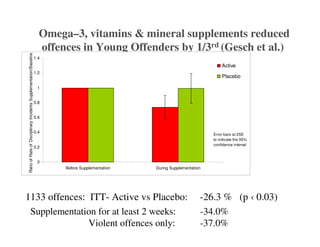
Omega–3, vitamins & mineral supplements reduced
offences in Young Offenders by 1/3rd (Gesch et al.)
1133 offences: ITT- Active vs Placebo: -26.3 % (p ‹ 0.03)
0
0.2
0.4
0.6
0.8
1
1.2
1.4
Before Supplementation During Supplementation
RatioofRateofDisciplinaryIncidentsSupplementation/Baseline
Active
Placebo
Error bars at 2SE
to indicate the 95%
confidence interval
Supplementation for at least 2 weeks: -34.0%
Violent offences only: -37.0%
ConclusionsConclusions
• Dyslexics have different brains due to mildly
impaired development of magnocells
• may result from:
GeneticGenetic vulnerability
NutritionalNutritional deficiency
• This knowledge is exciting because these
weaknesses cancan be remedied: visual and
auditory training, coloured filters, fish oil
supplements
• But m- weakness can be associated with p-
strengths in holistic perception
John SteinJohn Stein
Visit
The Dyslexia Research Trust
(www.dyslexic.org.uk)
Wobbles, warbles
& fish!
DDD
RRR
TTT

'Wobbles, Warbles & Fish – the brain basis of dyslexia' by John Stein

  • 1.
    Wobbles, Warbles & Fish- the brain basis of dyslexia John Stein,John Stein, MagdalenMagdalen College,College, Oxford University, UKOxford University, UK Supported by The Dyslexia Research Trust (www.dyslexic.org.uk), Dyers & Colourists, Esmee Fairbairn, Garfield Weston and Wellcome Trusts, BBC Children in Need DDD RRR TTT
  • 2.
    Wobbles, Warbles & Fish- the brain basis of dyslexia Supported by The Dyslexia Research Trust (www.dyslexic.org.uk), Dyers & Colourists, Esmee Fairbairn, Garfield Weston and Wellcome Trusts, BBC Children in Need DDD RRR TTT Brain systems involved in reading Differences in dyslexia Controversies How can we help?
  • 3.
    Reading requires bothvisual and auditory/phonological brain processing Visual processing
  • 4.
    The cortical readingnetwork Dorsal m- route VWFA
  • 5.
    Left hemisphere language areasthat activate less in dyslexics auditory visual
  • 6.
  • 8.
    Many children complain of visualdifficulties with reading. Often their eyes wobble when they try to read This may be due to weak visual magnocellular function
  • 9.
    10% are largemagnocellular cells (100x p- cells in area) - for timing visual events: fast responses, low contrast, motion, flicker, control eye movements Most retinal ganglion cells are parvocellular (small): for colour, fine detail, high contrast (less vulnerable) Retinal Ganglion cells
  • 10.
    Differences in p-& m- responses • Parvocellular – Fine detail – Colour sensitive – Slow • Magnocellular – Coarse features – Colour insensitive – Fast Magnocellular theory of dyslexia: • Impaired development of the magnocellular system • Parvocellular system normal
  • 11.
    What, when &where pathways from visual cortex VWFA
  • 12.
    Visual magnocellular systemdominates dorsal visuomotor pathway -directs visual attention & eye movements.
  • 13.
    The visual magnocellularsystem is impaired in poor readers • 30% smaller LGN magnocells post mortem • Reduced and delayed evoked brain waves • Reduced visual motion sensitivity • Poor eye control • Lower sensitivity to flicker • Lower sensitivity to low spatial, high temporal frequency contrast gratings • Reduced activation of cortical visual motion areas (FMRI) • Lower stereoacuity • Poor visual sequential attention - slower visual search All these claims have been opposed - 3 problems: • Definition of magno- system; only anatomically separate in periphery • Selectivity of stimuli • Mild deficits require highly sensitive test to reveal them Nevertheless in the last 10 years 90% of new research has found evidence of magnocellular deficit • One author has written 20 papers criticising others’ work on the magnocellular hypothesis!
  • 14.
    Abnormal magnocells indyslexic brain
  • 15.
    Smaller axons inleft angular gyrus in dyslexics; these enlarge with successful treatment
  • 16.
    Delayed Brain PotentialsEvoked by Moving Visual Stimulus
  • 17.
    Coherent Motion atThreshold (%) 0 10 20 30 40 50 60 70 80 OrthographicDiscrimination(%Correct) 0 20 40 60 80 100 n = 792; r = - 0.38 Magnocellular sensitivity to visual motion predicts visual reading skill
  • 18.
    Unwanted image motion, ‘retinal slip’ Lockseyes on target Visual stability Identify letter order Feedback to eye muscle control system The visual magnocellular system stabilises the eyes to avoid visual wobble Detected by M- system Orthographic skill Phonological skill
  • 19.
  • 20.
    The visual magnocellular systemstabilises the eyes to avoid visual wobble
  • 21.
    • The eyeshave to converge for near vision when reading • Control of vergence eye movements is dominated by the visual magno system • The vergence eye movement control system is the most vulnerable to drugs and disease • Dyslexics have very unstable vergence control Vergence control
  • 22.
  • 23.
    Weak magnocellular systemcauses unstable vision - oscillopsia “The letters go all blurry” “The letters move over each other, so I can’t tell which is which” “The letters seem to float all over the page” “The letters move in and out of the page” “The letters split and go double” “The c moved over the r, so it looked like another c” “The p joined up with the c” “d’s and b’s sort of get the wrong way round” “The page goes all glary and hurts my eyes” “I keep on losing my place”
  • 25.
    Although they donot mediate colour vision magnocells are most sensitive to yellow light. So in many children yellow filters can improve magnocellular function, hence visual motion sensitivity and binocular control, hence improve reading magnocells
  • 27.
    Yellow filters canimprove reading Increaseinliteracyin3months 0 1 2 3 4 5 6 7 8 reading spelling months yellow placebo
  • 29.
    B - DullShifting Y - Highly Labile Blue light M-system hypothalamus Diurnal rhythms
  • 30.
    Blue makes theletters keep still!
  • 31.
    Blue filters improvereading even more Increase inliteracy 0 2 4 6 8 10 12 14 reading spelling months blue placebo
  • 32.
    Blue or yellowfilters can improve magno function hence binocular control Convergence before before after after 0 5 10 15 20 25 30 cms
  • 34.
    • Also bluecan improve migraine headaches • Many dyslexics suffer severe migraine • Yellow often make them worse! Improvement
  • 35.
    B - DullShifting Y - Highly Labile Blue light M-system headacheheadacheheadacheheadache hypothalamus Diurnal rhythms
  • 36.
    Blue light atnight reduces melatonin secretion- effect on suprachiasmatic clock? 0 20 40 60 80 100 120 neutral blue %
  • 37.
    The colour choiceof 297 reading disabled 9 year olds no colour preference 49% blue 25% yellow 26% 1 2 3
  • 38.
    Reading age increasein 3 months 0 1 2 3 4 5 6 7 8 nil grey normal, reading recovery (phonology) yellow occlusion search blue omega 3s RAincr.(months) Elucidating the role of the visual system in reading has enabled us to develop techniques for helping most of the dyslexics we see * * * ** **
  • 39.
    Many, but not all,dyslexics have phonological problems; these may be caused by mild auditory magnocellular impairments
  • 40.
    2nd and 3rdformants ascend in frequency for ‘b’; but descend for ‘d’. Auditory m- cell impairment reduces sensitivity to these changes in sound frequency Auditory m-cells?
  • 41.
    Impaired auditory magnocells indyslexia? • Large neurones staining for CAT 301 in the auditory brainstem signal changes in sound frequency and amplitude • Dyslexics have smaller magnocellular neurones in medial geniculate N. • Lower AM & FM sensitivity, correlate with phonological deficit • Reduced brainstem auditory evoked potentials correlate with reading deficit • Thus dyslexics’ poor phonology may result from impaired development of auditory magnocells
  • 42.
    Auditory and visualmagnocellular sensitivity determines over half of differences in children’s reading ability Thus the most important determinant of overall reading ability appears to be low level magnocellular sensitivity. Encouraging because this can be improved by training
  • 43.
    The magnocellular systemsalso project strongly to the cerebellum – the brain’s timing autopilot - a magnocellular structure Cerebellum
  • 44.
    Control Head movementDyslexic balancing on one leg, eyes open
  • 45.
    Decreased activation incerebellum of adult dyslexics during learning visual tracking
  • 46.
    The Cerebellum &Balance • The cerebellum is the brain’s autopilot for timing and motor prediction, balance and skilled movements • Magnocellular systems all project to the cerebellum • Cerebellar neurones stain for CAT 301, part of the magno system • Cerebellum is underactive in many dyslexics • Explains their coordination problems, but not all their reading difficulties • Balance exercises are unlikely to help many dyslexics to learn to read
  • 47.
    Sensorimotor Basis of Dyslexia Lowvisual magnocellular sensitivity - orthographic weakness Low auditory magnocellular sensitivity - phonological problems Lower motor magnocellular sensitivity – in coordination, poor balance Lower kinaesthetic magnocellular sensitivity Sensorimotor Basis of Dyslexia
  • 48.
    Magnocellular Neurones • Impairedm- cell development has been found in prematurity, foetal alcohol syndrome, developmental dyslexia, dyspraxia, dysphasia, ADHD, ASD, Williams, schizophrenia, depression, violent personalities • High dynamic sensitivity requires high membrane flexibility provided by local environment of essential fatty acids, particularly omega 3s, found in fish oils • Hence very vulnerable to omega-3 deficiency • A system of large neurones specialised for temporal processing – tracking changes in light, sound, position etc. for direction of attention • Large, fast conduction, fast transmission, high anisotropy • All express same surface antigen, CAT 301 • Found throughout the whole brain: visual, auditory, skin, muscle proprioceptors, cerebral cortex, hippocampus, cerebellum, brainstem
  • 49.
  • 50.
    Chromosome sites wehave linked to reading and focussing attention C6p ?KIAA 0319 gene - cell~cell recognition and immune control (MHC system) Also DCD gene Finnish pedigree DYX1 gene ROBO 3 gene Melanocortin receptor
  • 52.
    KIAA 0319 is strongly expressed indorsal visual magno- cellular pathway
  • 53.
    C6 KIAA 0319controls neuronal migration during early brain development in utero. Downregulation in dyslexics may explain ectopias and other mismigrations of magnocellular neurones
  • 55.
  • 56.
    Fish oils, m-cells & C18 melanocortin receptor 50% of the membrane enclosing this magnocellular nerve cell consists of a long chain omega 3 fatty acid (DHA) Its flexibility enables rapid neuronal responses Hence m-cells are highly vulnerable to fish oil deficiency
  • 57.
    Modern Western dietis a disaster! • Too much: salt, sugar, saturated fat, omega 6s (from corn and soya bean oil) • Too little: minerals, fibre, vitamins A & D, omega 3s from fish • Far too much omega 6 - ratio of omega 6/omega 3 should be 1/1; currently it is 7/1!
  • 58.
  • 59.
    Fatty acid deficiencyin dyslexia and young offenders? • Many children with neuro- developmental problems and young offenders have omega 3 deficiency: • Low blood and brain n-3 FAs • Omega 3 FA (fish oil) supplements can v. significantly improve m- function, attention, reading and violent offences
  • 60.
    Durham RCT -Omega 3 EPA & DHA supplements helped poor readers to improve their concentration and their reading (Richardson & Montgomery) IncreaseinReadingagein3months 0 1 2 3 4 5 6 7 8 9 10 n-3 placebo RAincrease n-3 placebo
  • 61.
    Omega–3, vitamins &mineral supplements reduced offences in Young Offenders by 1/3rd (Gesch et al.) 1133 offences: ITT- Active vs Placebo: -26.3 % (p ‹ 0.03) 0 0.2 0.4 0.6 0.8 1 1.2 1.4 Before Supplementation During Supplementation RatioofRateofDisciplinaryIncidentsSupplementation/Baseline Active Placebo Error bars at 2SE to indicate the 95% confidence interval Supplementation for at least 2 weeks: -34.0% Violent offences only: -37.0%
  • 62.
    ConclusionsConclusions • Dyslexics havedifferent brains due to mildly impaired development of magnocells • may result from: GeneticGenetic vulnerability NutritionalNutritional deficiency • This knowledge is exciting because these weaknesses cancan be remedied: visual and auditory training, coloured filters, fish oil supplements • But m- weakness can be associated with p- strengths in holistic perception
  • 64.
    John SteinJohn Stein Visit TheDyslexia Research Trust (www.dyslexic.org.uk) Wobbles, warbles & fish! DDD RRR TTT