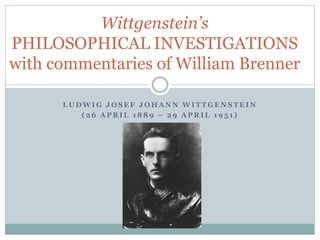
L U D W I G J O S E F J O H A N N W I T T G E N S T E I N
( 2 6 A P R I L 1 8 8 9 – 2 9 A P R I L 1 9 5 1 )
Wittgenstein’s
PHILOSOPHICAL INVESTIGATIONS
with commentaries of William Brenner
Words as Pointing Fingers (Sections 1-5)
 Augustine had “the idea of language more primitive
than ours” : Naming (every word has a meaning, it
stands for a particular object)
Words are more than just names, there are variety of
ways in which we operate with words:
 The Builder’s Language
 The Shopping Language
Language functions as a tool.
 Instruction in primitive forms
of language consists in
training, this is the “bedrock”
on which more sophisticated
forms of language can be built
up.
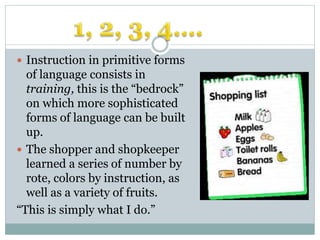
 The shopper and shopkeeper
learned a series of number by
rote, colors by instruction, as
well as a variety of fruits.
“This is simply what I do.”
Ostensive Teaching
(Sections 6-7)
 Language would have to be
learned by “ostension”
(pointing).
 Ostensive teaching is
training for the practice of
the use of language.
 “The children are brought
up to perform these actions,
to use these words as they
do so, and to react in this
way to the words of others.”
“The Language-Games”
 One calls out the words, the
other acts on them.
 The teacher names the
objects while pointing to it
and the pupil repeats the
words after the teacher
 “…the whole, consisting of
language and the actions
into which it is woven.”
Words as Tools (Section 10-17)
 “Think of the tools in a tool-
box: there is a hammer,
pliers, a saw, a screw-driver,
a rule, a glue-pot, glue, nails
and screws.—The functions
of words are as diverse as the
functions of these objects.”
 Nothing would be gained by
saying that all words have
the same function, “to
signify something.”
Life in the City of Language (Sections 18-24)
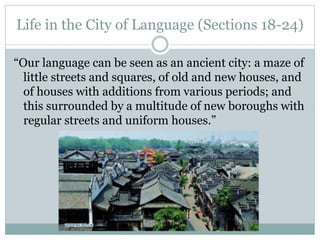
“Our language can be seen as an ancient city: a maze of
little streets and squares, of old and new houses, and
of houses with additions from various periods; and
this surrounded by a multitude of new boroughs with
regular streets and uniform houses.”
Learning a language is learning a form of life.
 Language is inseparable from
activities (e.g. commanding,
greeting, recounting, asking,
etc.). As we learn to
participate in these activities,
we learn our native language;
as we learn our native
language, we learn not only
forms of words but forms of
life.
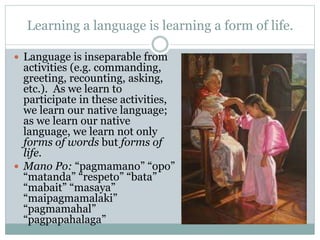
 Mano Po: “pagmamano” “opo”
“matanda” “respeto” “bata”
“mabait” “masaya”
“maipagmamalaki”
“pagmamahal”
“pagpapahalaga”
Learning a language is being initiated into
human life.
 The speaking (“the practice
of the use of language”) is
“part of an activity, or of a
form of life”
 There is no fixed, closed list
of language games
 Language is an enormous
fabric of activities that
involve the use of words,
sentences, and other
symbols
Talking and Thinking (Sec. 25)
 Language is founded on
thought.
 But there is a primitive
language resulting from
primitive thinking.
 The builder’s assistant
thinks when he obeys a
command, he does not just
do what he was trained to
do. Since, he may or may
not always do what he was
trained to do.

Wittgenstein

  • 1.
    L U DW I G J O S E F J O H A N N W I T T G E N S T E I N ( 2 6 A P R I L 1 8 8 9 – 2 9 A P R I L 1 9 5 1 ) Wittgenstein’s PHILOSOPHICAL INVESTIGATIONS with commentaries of William Brenner
  • 2.
    Words as PointingFingers (Sections 1-5)  Augustine had “the idea of language more primitive than ours” : Naming (every word has a meaning, it stands for a particular object) Words are more than just names, there are variety of ways in which we operate with words:  The Builder’s Language  The Shopping Language Language functions as a tool.
  • 3.
     Instruction inprimitive forms of language consists in training, this is the “bedrock” on which more sophisticated forms of language can be built up.  The shopper and shopkeeper learned a series of number by rote, colors by instruction, as well as a variety of fruits. “This is simply what I do.”
  • 4.
    Ostensive Teaching (Sections 6-7) Language would have to be learned by “ostension” (pointing).  Ostensive teaching is training for the practice of the use of language.  “The children are brought up to perform these actions, to use these words as they do so, and to react in this way to the words of others.”
  • 5.
    “The Language-Games”  Onecalls out the words, the other acts on them.  The teacher names the objects while pointing to it and the pupil repeats the words after the teacher  “…the whole, consisting of language and the actions into which it is woven.”
  • 6.
    Words as Tools(Section 10-17)  “Think of the tools in a tool- box: there is a hammer, pliers, a saw, a screw-driver, a rule, a glue-pot, glue, nails and screws.—The functions of words are as diverse as the functions of these objects.”  Nothing would be gained by saying that all words have the same function, “to signify something.”
  • 7.
    Life in theCity of Language (Sections 18-24) “Our language can be seen as an ancient city: a maze of little streets and squares, of old and new houses, and of houses with additions from various periods; and this surrounded by a multitude of new boroughs with regular streets and uniform houses.”
  • 8.
    Learning a languageis learning a form of life.  Language is inseparable from activities (e.g. commanding, greeting, recounting, asking, etc.). As we learn to participate in these activities, we learn our native language; as we learn our native language, we learn not only forms of words but forms of life.  Mano Po: “pagmamano” “opo” “matanda” “respeto” “bata” “mabait” “masaya” “maipagmamalaki” “pagmamahal” “pagpapahalaga”
  • 9.
    Learning a languageis being initiated into human life.  The speaking (“the practice of the use of language”) is “part of an activity, or of a form of life”  There is no fixed, closed list of language games  Language is an enormous fabric of activities that involve the use of words, sentences, and other symbols
  • 10.
    Talking and Thinking(Sec. 25)  Language is founded on thought.  But there is a primitive language resulting from primitive thinking.  The builder’s assistant thinks when he obeys a command, he does not just do what he was trained to do. Since, he may or may not always do what he was trained to do.