General Practices
working with
Young & Adults Carers
Ben White
Children’s Support Service Manager
COPYRIGHT HC/BW2013
Statistics
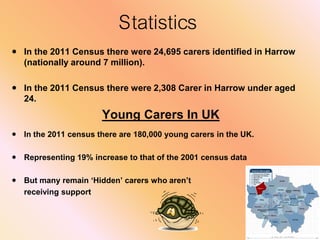
• In the 2011 Census there were 24,695 carers identified in Harrow
(nationally around 7 million).
• In the 2011 Census there were 2,308 Carer in Harrow under aged
24.
Young Carers In UK
• In the 2011 census there are 180,000 young carers in the UK.
• Representing 19% increase to that of the 2001 census data
• But many remain ‘Hidden’ carers who aren’t
receiving support
The value of caring
• The 1.25 million carers who provide care for more than 50
hours each week equate to a full-time workforce larger than
the entire National Health Service (NHS)
• £119 billion p.a. This is the value of the free care provided
by carers in the UK each year
• In Harrow it amounts to around £407m
• NHS Harrow's total expenditure for 2010/11 was £363.1m
So What Is A Young Carer?
Young carers are children and young people who look after
someone in their family who has an illness, a disability, or
is affected by mental ill-health or substance misuse.
Young carers often take on practical and/or emotional
caring responsibilities that would normally be expected of
an adult. The tasks undertaken can vary according to the
nature of the illness or disability, the level and frequency of
need for care and the structure of the family as a whole.
So Who Is A Carer?
• A Carer is any person who receives no
pay for supporting a parent or relative, an
elderly, physically and mentally ill or
disabled person or persons experiencing
substance abuse and those with terminal
conditions.
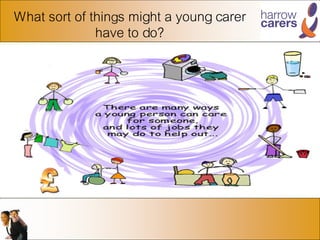
What sort of things might a young carer
have to do?
Carers role
• Carers’ knowledge about the person being cared for and co-
operation are vital for planning and implementing any patient care
plan successfully
• Carers often do nursing tasks such as giving medication, changing
dressings and helping with mobility.
• They may provide intimate care including washing the person cared
for, dressing and attending to toileting needs.
• This may include a great deal of lifting, or changing soiled clothes
many times throughout the day
• They may need to supervise medication or help with communication.
Carers role
Other carers, such as those caring for people with mental
health or substance misuse problems, or those caring
for people with dementia,
• may perform few physical tasks,
• but provide a great deal of emotional support, including
help to ensure that the person that they care for stays
safe.
• Carers may provide child care when parents are not
able to care for their children themselves.
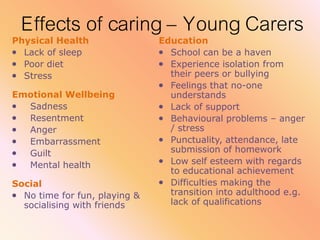
Effects of caring – Young Carers
Physical Health
• Lack of sleep
• Poor diet
• Stress
Emotional Wellbeing
• Sadness
• Resentment
• Anger
• Embarrassment
• Guilt
• Mental health
Social
• No time for fun, playing &
socialising with friends
Education
• School can be a haven
• Experience isolation from
their peers or bullying
• Feelings that no-one
understands
• Lack of support
• Behavioural problems – anger
/ stress
• Punctuality, attendance, late
submission of homework
• Low self esteem with regards
to educational achievement
• Difficulties making the
transition into adulthood e.g.
lack of qualifications
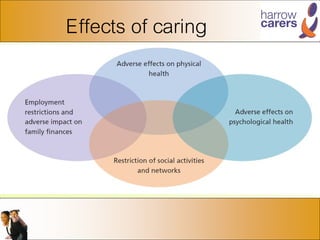
Effects of caring
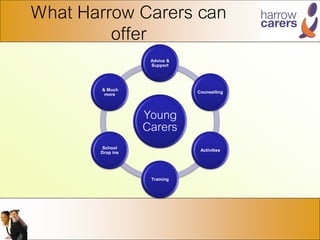
What Harrow Carers can
offer
Young
Carers
Advice &
Support
Counselling
Activities
Training
School
Drop ins
& Much
more
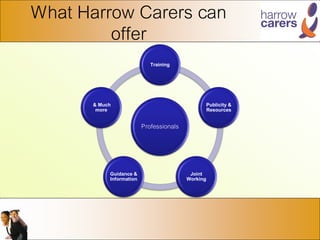
What Harrow Carers can
offer
Professionals
Training
Publicity &
Resources
Joint
Working
Guidance &
Information
& Much
more
Five key ways for professionals
to support carers
1. Just listen!
2. Observe
3. Ask Questions
4. Signpost to services
5. Refer to Local Carers Centre
Example Questions
?
• How many people do you live with?
• What sort of things do you do with them?
• Do you help at home?
• What sort of things do you help with?
• Is anyone at home sick often?
• Do you ever help someone with medicine?
• Does..... stay at home a lot?
• Does ..... go to the doctor/hospital often?
• Have you heard the phrase Young Carer?
Contact details
Harrow Carers Centre
376-378 Pinner Road
North Harrow
HA2 6DZ
Tel: 020 8868 5224
Email: ben.white@ harrowcarers.org
Fax: 020 8427 7764 www.harrowcarers.org

General_Practices_working_with_Young_and_Adults_Carers

  • 1.
    General Practices working with Young& Adults Carers Ben White Children’s Support Service Manager COPYRIGHT HC/BW2013
  • 2.
    Statistics • In the2011 Census there were 24,695 carers identified in Harrow (nationally around 7 million). • In the 2011 Census there were 2,308 Carer in Harrow under aged 24. Young Carers In UK • In the 2011 census there are 180,000 young carers in the UK. • Representing 19% increase to that of the 2001 census data • But many remain ‘Hidden’ carers who aren’t receiving support
  • 3.
    The value ofcaring • The 1.25 million carers who provide care for more than 50 hours each week equate to a full-time workforce larger than the entire National Health Service (NHS) • £119 billion p.a. This is the value of the free care provided by carers in the UK each year • In Harrow it amounts to around £407m • NHS Harrow's total expenditure for 2010/11 was £363.1m
  • 4.
    So What IsA Young Carer? Young carers are children and young people who look after someone in their family who has an illness, a disability, or is affected by mental ill-health or substance misuse. Young carers often take on practical and/or emotional caring responsibilities that would normally be expected of an adult. The tasks undertaken can vary according to the nature of the illness or disability, the level and frequency of need for care and the structure of the family as a whole.
  • 5.
    So Who IsA Carer? • A Carer is any person who receives no pay for supporting a parent or relative, an elderly, physically and mentally ill or disabled person or persons experiencing substance abuse and those with terminal conditions.
  • 6.
    What sort ofthings might a young carer have to do?
  • 7.
    Carers role • Carers’knowledge about the person being cared for and co- operation are vital for planning and implementing any patient care plan successfully • Carers often do nursing tasks such as giving medication, changing dressings and helping with mobility. • They may provide intimate care including washing the person cared for, dressing and attending to toileting needs. • This may include a great deal of lifting, or changing soiled clothes many times throughout the day • They may need to supervise medication or help with communication.
  • 8.
    Carers role Other carers,such as those caring for people with mental health or substance misuse problems, or those caring for people with dementia, • may perform few physical tasks, • but provide a great deal of emotional support, including help to ensure that the person that they care for stays safe. • Carers may provide child care when parents are not able to care for their children themselves.
  • 9.
    Effects of caring– Young Carers Physical Health • Lack of sleep • Poor diet • Stress Emotional Wellbeing • Sadness • Resentment • Anger • Embarrassment • Guilt • Mental health Social • No time for fun, playing & socialising with friends Education • School can be a haven • Experience isolation from their peers or bullying • Feelings that no-one understands • Lack of support • Behavioural problems – anger / stress • Punctuality, attendance, late submission of homework • Low self esteem with regards to educational achievement • Difficulties making the transition into adulthood e.g. lack of qualifications
  • 10.
  • 11.
    What Harrow Carerscan offer Young Carers Advice & Support Counselling Activities Training School Drop ins & Much more
  • 12.
    What Harrow Carerscan offer Professionals Training Publicity & Resources Joint Working Guidance & Information & Much more
  • 13.
    Five key waysfor professionals to support carers 1. Just listen! 2. Observe 3. Ask Questions 4. Signpost to services 5. Refer to Local Carers Centre
  • 14.
    Example Questions ? • Howmany people do you live with? • What sort of things do you do with them? • Do you help at home? • What sort of things do you help with? • Is anyone at home sick often? • Do you ever help someone with medicine? • Does..... stay at home a lot? • Does ..... go to the doctor/hospital often? • Have you heard the phrase Young Carer?
  • 15.
    Contact details Harrow CarersCentre 376-378 Pinner Road North Harrow HA2 6DZ Tel: 020 8868 5224 Email: ben.white@ harrowcarers.org Fax: 020 8427 7764 www.harrowcarers.org