EMPLOYMENT FIRST:
Modernizing Disability Policy
    in the 21st Century
                April 9, 2013
              Madison, Wisconsin

              Madeleine Will
The Collaboration to Promote Self-Determination
      National Down Syndrome Society
                 mwill@thecpsd.org


                                              1
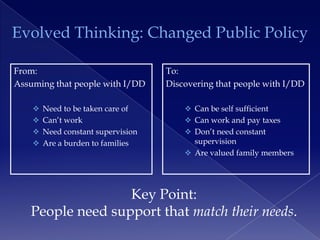
Evolved Thinking: Changed Public Policy

From:                             To:
Assuming that people with I/DD    Discovering that people with I/DD

     Need to be taken care of         Can be self sufficient
     Can’t work                       Can work and pay taxes
     Need constant supervision        Don’t need constant
     Are a burden to families          supervision
                                       Are valued family members


                  Key Point:
   People need support that match their needs.
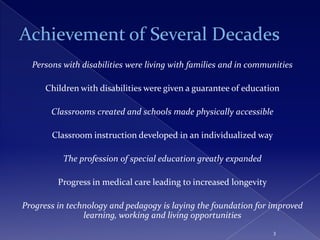
Persons with disabilities were living with families and in communities

      Children with disabilities were given a guarantee of education

       Classrooms created and schools made physically accessible

       Classroom instruction developed in an individualized way

          The profession of special education greatly expanded

         Progress in medical care leading to increased longevity

Progress in technology and pedagogy is laying the foundation for improved
                learning, working and living opportunities
                                                                   3
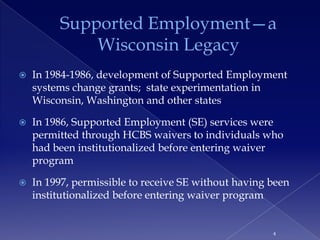
Supported Employment—a
             Wisconsin Legacy
   In 1984-1986, development of Supported Employment
    systems change grants; state experimentation in
    Wisconsin, Washington and other states

   In 1986, Supported Employment (SE) services were
    permitted through HCBS waivers to individuals who
    had been institutionalized before entering waiver
    program

   In 1997, permissible to receive SE without having been
    institutionalized before entering waiver program


                                                      4
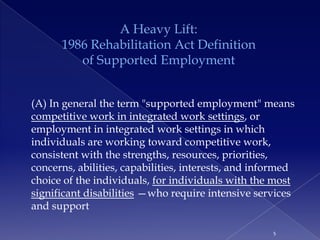
A Heavy Lift:
      1986 Rehabilitation Act Definition
         of Supported Employment


(A) In general the term "supported employment" means
competitive work in integrated work settings, or
employment in integrated work settings in which
individuals are working toward competitive work,
consistent with the strengths, resources, priorities,
concerns, abilities, capabilities, interests, and informed
choice of the individuals, for individuals with the most
significant disabilities —who require intensive services
and support

                                                     5
6
Moving into the New Millennium

    Expectations were high for
       continued progress…


          Not so fast…

                                 7
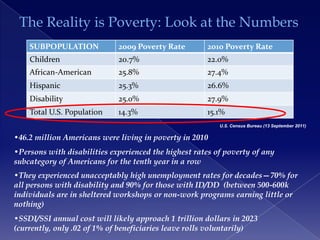
The Reality is Poverty: Look at the Numbers
    SUBPOPULATION            2009 Poverty Rate        2010 Poverty Rate
    Children                 20.7%                    22.0%
    African-American         25.8%                    27.4%
    Hispanic                 25.3%                    26.6%
    Disability               25.0%                    27.9%
    Total U.S. Population    14.3%                    15.1%
                                                          U.S. Census Bureau (13 September 2011)

•46.2 million Americans were living in poverty in 2010
•Persons with disabilities experienced the highest rates of poverty of any
subcategory of Americans for the tenth year in a row
•They experienced unacceptably high unemployment rates for decades—70% for
all persons with disability and 90% for those with ID/DD (between 500-600k
individuals are in sheltered workshops or non-work programs earning little or
nothing)
•SSDI/SSI annual cost will likely approach 1 trillion dollars in 2023
(currently, only .02 of 1% of beneficiaries leave rolls voluntarily)
Figure 1. Percentage of Estimated Federal and State Expenditures for
Working-Age People with Disabilities by Major Expenditure Category, Fiscal
Year 2008[1]

         Housing &                     Education, E Other
           Food                        mployment & Services
         Assistance                      Training    0%
            3%                              1%
                                                                            $357
                                                                            Billion
                        Income
                      Maintenance                                           in
                                                           Healthcare
                          41%
                                                             55%
                                                                            FY2008
                                                                           Also includes
                                                                           LTSS for PWD
                                                                           via Medicaid &
                                                                           Medicare


[1] Adapted from Livermore, Stapleton and O’Toole (2011, Health Affairs)
                                                                                            9
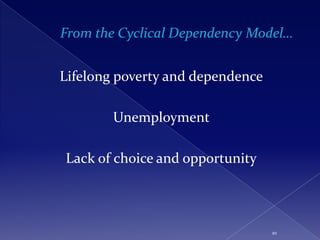
Lifelong poverty and dependence

        Unemployment

Lack of choice and opportunity


                                  10
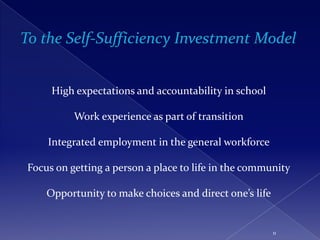
High expectations and accountability in school

          Work experience as part of transition

    Integrated employment in the general workforce

Focus on getting a person a place to life in the community

    Opportunity to make choices and direct one’s life


                                                        11
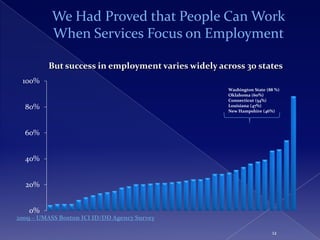
We Had Proved that People Can Work
           When Services Focus on Employment

         But success in employment varies widely across 30 states
 100%
                                                   Washington State (88 %)
                                                   Oklahoma (60%)
                                                   Connecticut (54%)
  80%                                              Louisiana (47%)
                                                   New Hampshire (46%)


  60%


  40%


  20%


   0%
2009 – UMASS Boston ICI ID/DD Agency Survey

                                                                      12
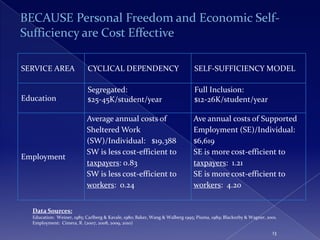
SERVICE AREA                CYCLICAL DEPENDENCY                               SELF-SUFFICIENCY MODEL

                            Segregated:                                       Full Inclusion:
Education                   $25-45K/student/year                              $12-26K/student/year

                           Average annual costs of                            Ave annual costs of Supported
                           Sheltered Work                                     Employment (SE)/Individual:
                           (SW)/Individual: $19,388                           $6,619
                           SW is less cost-efficient to                       SE is more cost-efficient to
Employment
                           taxpayers: 0.83                                    taxpayers: 1.21
                           SW is less cost-efficient to                       SE is more cost-efficient to
                           workers: 0.24                                      workers: 4.20


  Data Sources:
  Education: Weiner, 1985; Carlberg & Kavale, 1980; Baker, Wang & Walberg 1995; Piuma, 1989; Blackorby & Wagner, 2001.
  Employment: Cimera, R. (2007, 2008, 2009, 2010)

                                                                                                                   13
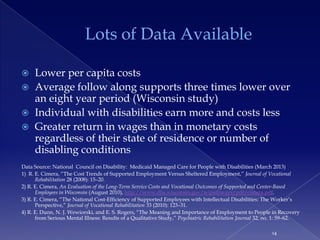
Lots of Data Available

    Lower per capita costs
    Average follow along supports three times lower over
     an eight year period (Wisconsin study)
    Individual with disabilities earn more and costs less
    Greater return in wages than in monetary costs
     regardless of their state of residence or number of
     disabling conditions
Data Source: National Council on Disability: Medicaid Managed Care for People with Disabilities (March 2013)
1) R. E. Cimera, ―The Cost Trends of Supported Employment Versus Sheltered Employment,‖ Journal of Vocational
      Rehabilitation 28 (2008): 15–20.
2) R. E. Cimera, An Evaluation of the Long-Term Service Costs and Vocational Outcomes of Supported and Center-Based
      Employees in Wisconsin (August 2010), http://www.dhs.wisconsin.gov/wipathways/pdf/cimera.pdf.
3) R. E. Cimera, ―The National Cost-Efficiency of Supported Employees with Intellectual Disabilities: The Worker’s
      Perspective,‖ Journal of Vocational Rehabilitation 33 (2010): 123–31.
4) R. E. Dunn, N. J. Wewiorski, and E. S. Rogers, ―The Meaning and Importance of Employment to People in Recovery
      from Serious Mental Illness: Results of a Qualitative Study,‖ Psychiatric Rehabilitation Journal 32, no. 1: 59–62.

                                                                                                            14
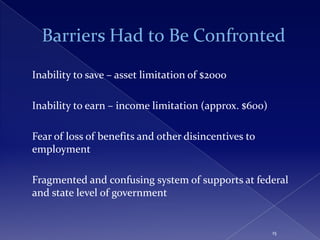
Inability to save – asset limitation of $2000

Inability to earn – income limitation (approx. $600)

Fear of loss of benefits and other disincentives to
employment

Fragmented and confusing system of supports at federal
and state level of government


                                                       15
New Thinking

Investing in the competency and value of persons with
disabilities to achieve economic and personal freedom

Not exchanging benefits for poverty and dependence

Spending public dollars more wisely to help build the
capacity of providers to make the transition to
employment and to the self sufficiency investment
model


                                                 16
An Concept Emerging From States:
        Employment First

 In general, employment in the workforce
needed to be the first and preferred outcome in
the provision of publicly funded services for
  all working age citizens with disabilities,
       regardless of level of disability.


                                            17
State Employment First Initiatives

› 30+ states have some type of ―Employment First‖
  effort

› At least 19 states have official Employment First
  legislation and/or polices

› Employment First is not just a policy – to do it right
  requires comprehensive systems modernization
Ohio Governor John Kasich


                            Delaware Governor Jack Markell


                                                      19
State Initiatives Influenced the
         National Disability Community

          The Collaboration to Promote
           Self-Determination (CPSD)

A national coalition that seeks to:
      Modernize federal programs so they maximize
      self-sufficiency and economic security;

      Eliminate barriers to work and savings while
      preserving vital, long-term public supports;

      Build on state and grass roots innovation
                                                     20
A Breakthrough:
Centers on Medicare and Medicaid (CMS)
     Guidance – September 16, 2011


 CMS addresses implementation of goal
   to promote integrated employment
 option through Medicaid (HCBS) waiver
                program
Medicare and Medicaid Guidance

   Acknowledges best practices in employment support,
    including self direction and peer support options

   Clarifies that reimbursements can be for outcomes, not
    service delivery

   Adds a new core service definition for individual and
    small group supported employment

   Includes a new service definition for career planning

                                                        22
Using Employment First Strategies
           The Collaboration to Promote
                Self-Determination
   Achieving a Better Life Experience (ABLE) Act (H.R.
    647/S.313)

   Transition toward Excellence Achievement & Mobility
    (TEAM) Act
    › TEAM – Employment (H.R. 509)
    › TEAM – Education (H.R. 510)
    › TEAM – Empowerment (H.R. 511)L

   Incentives for earning and saving (re-structuring asset
    and income limitations)
Allow individuals and families to create a tax
advantaged 529-education –like savings account that
does not jeopardize benefits

Encourage planning and saving for expenses incurred
across the lifespan—education, health care,
employment training and support, transportation
and housing

Requires a Medicaid pay-back when the individual
passes away

                                                   24
Establish a coordinated, comprehensive approach to the
investment of public resources based on Employment First
concept

Expand and improve the opportunities for youth with
significant disabilities who are transitioning into adulthood

Ensure meaningful postsecondary educational opportunities
and employment in integrated settings at a competitive wage


                                                          25
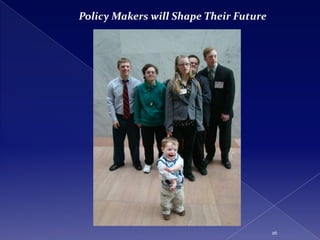
Policy Makers will Shape Their Future


                                        26
27

Wisconsin legislative breakfast ppt

  • 1.
    EMPLOYMENT FIRST: Modernizing DisabilityPolicy in the 21st Century April 9, 2013 Madison, Wisconsin Madeleine Will The Collaboration to Promote Self-Determination National Down Syndrome Society mwill@thecpsd.org 1
  • 2.
    Evolved Thinking: ChangedPublic Policy From: To: Assuming that people with I/DD Discovering that people with I/DD  Need to be taken care of  Can be self sufficient  Can’t work  Can work and pay taxes  Need constant supervision  Don’t need constant  Are a burden to families supervision  Are valued family members Key Point: People need support that match their needs.
  • 3.
    Persons with disabilitieswere living with families and in communities Children with disabilities were given a guarantee of education Classrooms created and schools made physically accessible Classroom instruction developed in an individualized way The profession of special education greatly expanded Progress in medical care leading to increased longevity Progress in technology and pedagogy is laying the foundation for improved learning, working and living opportunities 3
  • 4.
    Supported Employment—a Wisconsin Legacy  In 1984-1986, development of Supported Employment systems change grants; state experimentation in Wisconsin, Washington and other states  In 1986, Supported Employment (SE) services were permitted through HCBS waivers to individuals who had been institutionalized before entering waiver program  In 1997, permissible to receive SE without having been institutionalized before entering waiver program 4
  • 5.
    A Heavy Lift: 1986 Rehabilitation Act Definition of Supported Employment (A) In general the term "supported employment" means competitive work in integrated work settings, or employment in integrated work settings in which individuals are working toward competitive work, consistent with the strengths, resources, priorities, concerns, abilities, capabilities, interests, and informed choice of the individuals, for individuals with the most significant disabilities —who require intensive services and support 5
  • 6.
  • 7.
    Moving into theNew Millennium Expectations were high for continued progress… Not so fast… 7
  • 8.
    The Reality isPoverty: Look at the Numbers SUBPOPULATION 2009 Poverty Rate 2010 Poverty Rate Children 20.7% 22.0% African-American 25.8% 27.4% Hispanic 25.3% 26.6% Disability 25.0% 27.9% Total U.S. Population 14.3% 15.1% U.S. Census Bureau (13 September 2011) •46.2 million Americans were living in poverty in 2010 •Persons with disabilities experienced the highest rates of poverty of any subcategory of Americans for the tenth year in a row •They experienced unacceptably high unemployment rates for decades—70% for all persons with disability and 90% for those with ID/DD (between 500-600k individuals are in sheltered workshops or non-work programs earning little or nothing) •SSDI/SSI annual cost will likely approach 1 trillion dollars in 2023 (currently, only .02 of 1% of beneficiaries leave rolls voluntarily)
  • 9.
    Figure 1. Percentageof Estimated Federal and State Expenditures for Working-Age People with Disabilities by Major Expenditure Category, Fiscal Year 2008[1] Housing & Education, E Other Food mployment & Services Assistance Training 0% 3% 1% $357 Billion Income Maintenance in Healthcare 41% 55% FY2008 Also includes LTSS for PWD via Medicaid & Medicare [1] Adapted from Livermore, Stapleton and O’Toole (2011, Health Affairs) 9
  • 10.
    Lifelong poverty anddependence Unemployment Lack of choice and opportunity 10
  • 11.
    High expectations andaccountability in school Work experience as part of transition Integrated employment in the general workforce Focus on getting a person a place to life in the community Opportunity to make choices and direct one’s life 11
  • 12.
    We Had Provedthat People Can Work When Services Focus on Employment But success in employment varies widely across 30 states 100% Washington State (88 %) Oklahoma (60%) Connecticut (54%) 80% Louisiana (47%) New Hampshire (46%) 60% 40% 20% 0% 2009 – UMASS Boston ICI ID/DD Agency Survey 12
  • 13.
    SERVICE AREA CYCLICAL DEPENDENCY SELF-SUFFICIENCY MODEL Segregated: Full Inclusion: Education $25-45K/student/year $12-26K/student/year Average annual costs of Ave annual costs of Supported Sheltered Work Employment (SE)/Individual: (SW)/Individual: $19,388 $6,619 SW is less cost-efficient to SE is more cost-efficient to Employment taxpayers: 0.83 taxpayers: 1.21 SW is less cost-efficient to SE is more cost-efficient to workers: 0.24 workers: 4.20 Data Sources: Education: Weiner, 1985; Carlberg & Kavale, 1980; Baker, Wang & Walberg 1995; Piuma, 1989; Blackorby & Wagner, 2001. Employment: Cimera, R. (2007, 2008, 2009, 2010) 13
  • 14.
    Lots of DataAvailable  Lower per capita costs  Average follow along supports three times lower over an eight year period (Wisconsin study)  Individual with disabilities earn more and costs less  Greater return in wages than in monetary costs regardless of their state of residence or number of disabling conditions Data Source: National Council on Disability: Medicaid Managed Care for People with Disabilities (March 2013) 1) R. E. Cimera, ―The Cost Trends of Supported Employment Versus Sheltered Employment,‖ Journal of Vocational Rehabilitation 28 (2008): 15–20. 2) R. E. Cimera, An Evaluation of the Long-Term Service Costs and Vocational Outcomes of Supported and Center-Based Employees in Wisconsin (August 2010), http://www.dhs.wisconsin.gov/wipathways/pdf/cimera.pdf. 3) R. E. Cimera, ―The National Cost-Efficiency of Supported Employees with Intellectual Disabilities: The Worker’s Perspective,‖ Journal of Vocational Rehabilitation 33 (2010): 123–31. 4) R. E. Dunn, N. J. Wewiorski, and E. S. Rogers, ―The Meaning and Importance of Employment to People in Recovery from Serious Mental Illness: Results of a Qualitative Study,‖ Psychiatric Rehabilitation Journal 32, no. 1: 59–62. 14
  • 15.
    Inability to save– asset limitation of $2000 Inability to earn – income limitation (approx. $600) Fear of loss of benefits and other disincentives to employment Fragmented and confusing system of supports at federal and state level of government 15
  • 16.
    New Thinking Investing inthe competency and value of persons with disabilities to achieve economic and personal freedom Not exchanging benefits for poverty and dependence Spending public dollars more wisely to help build the capacity of providers to make the transition to employment and to the self sufficiency investment model 16
  • 17.
    An Concept EmergingFrom States: Employment First In general, employment in the workforce needed to be the first and preferred outcome in the provision of publicly funded services for all working age citizens with disabilities, regardless of level of disability. 17
  • 18.
    State Employment FirstInitiatives › 30+ states have some type of ―Employment First‖ effort › At least 19 states have official Employment First legislation and/or polices › Employment First is not just a policy – to do it right requires comprehensive systems modernization
  • 19.
    Ohio Governor JohnKasich Delaware Governor Jack Markell 19
  • 20.
    State Initiatives Influencedthe National Disability Community The Collaboration to Promote Self-Determination (CPSD) A national coalition that seeks to: Modernize federal programs so they maximize self-sufficiency and economic security; Eliminate barriers to work and savings while preserving vital, long-term public supports; Build on state and grass roots innovation 20
  • 21.
    A Breakthrough: Centers onMedicare and Medicaid (CMS) Guidance – September 16, 2011 CMS addresses implementation of goal to promote integrated employment option through Medicaid (HCBS) waiver program
  • 22.
    Medicare and MedicaidGuidance  Acknowledges best practices in employment support, including self direction and peer support options  Clarifies that reimbursements can be for outcomes, not service delivery  Adds a new core service definition for individual and small group supported employment  Includes a new service definition for career planning 22
  • 23.
    Using Employment FirstStrategies The Collaboration to Promote Self-Determination  Achieving a Better Life Experience (ABLE) Act (H.R. 647/S.313)  Transition toward Excellence Achievement & Mobility (TEAM) Act › TEAM – Employment (H.R. 509) › TEAM – Education (H.R. 510) › TEAM – Empowerment (H.R. 511)L  Incentives for earning and saving (re-structuring asset and income limitations)
  • 24.
    Allow individuals andfamilies to create a tax advantaged 529-education –like savings account that does not jeopardize benefits Encourage planning and saving for expenses incurred across the lifespan—education, health care, employment training and support, transportation and housing Requires a Medicaid pay-back when the individual passes away 24
  • 25.
    Establish a coordinated,comprehensive approach to the investment of public resources based on Employment First concept Expand and improve the opportunities for youth with significant disabilities who are transitioning into adulthood Ensure meaningful postsecondary educational opportunities and employment in integrated settings at a competitive wage 25
  • 26.
    Policy Makers willShape Their Future 26
  • 27.