Copyright in the material
contained in this document
 belongs to third parties. It
has been published by kind
permission of the owner(s)
  and provided for review
 only. This document may
    not be reproduced,
 amended or redistributed
   without prior written
permission of the copyright
         owner(s).
Role of Private Medical Insurance


Anusha Thavarajah
Deputy CEO / CFO
ING Insurance Malaysia, July 2011
Presentation Outline

• Malaysia’s Changing Healthcare Landscape
• Private Medical Insurance Gaining Prominence
• The Role of Private Medical Insurance
• Final Thought
• Q&A


                             2
Malaysia’s Changing Healthcare Landscape


ING                      3
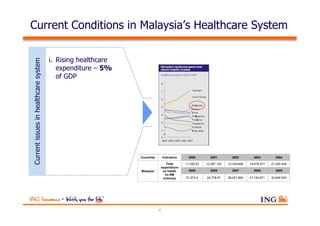
Current Conditions in Malaysia’s Healthcare System

                                      i. Rising healthcare
Current issues in healthcare system


                                         expenditure – 5%
                                         of GDP


                                                             Countries       Indicators      2000        2001         2002         2003         2004

                                                                                Total      11,330.93   12,287.152   13,339.608   19,478.917   21,200.439
                                                                             expenditure
                                                             Malaysia         on health      2005        2006         2007         2008         2009
                                                                               (in RM
                                                                              millions)    21,574.5    24,778.67    28,021.895   31,140.871   32,648.524


                                                                         4
Current Conditions in Malaysia’s Healthcare System

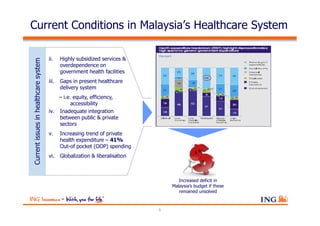
                                      ii.    Highly subsidized services &
Current issues in healthcare system


                                             overdependence on
                                             government health facilities
                                      iii.   Gaps in present healthcare
                                             delivery system
                                          – i.e. equity, efficiency,
                                                accessibility
                                      iv. Inadequate integration
                                          between public & private
                                          sectors
                                      v.     Increasing trend of private
                                             health expenditure – 41%
                                             Out-of pocket (OOP) spending
                                      vi.    Globalization & liberalisation


                                                                                     Increased deficit in
                                                                                  Malaysia’s budget if these
                                                                                     remained unsolved


                                                                              5
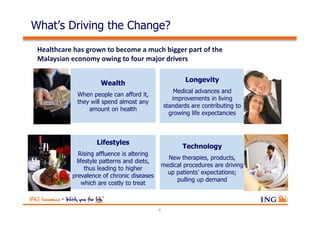
What’s Driving the Change?
 Healthcare has grown to become a much bigger part of the
 Malaysian economy owing to four major drivers


                     Wealth                              Longevity
                                                     Medical advances and
             When people can afford it,
                                                    improvements in living
             they will spend almost any
                                                 standards are contributing to
                 amount on health
                                                   growing life expectancies


                    Lifestyles
                                                        Technology
              Rising affluence is altering
                                                   New therapies, products,
             lifestyle patterns and diets,
                                                 medical procedures are driving
                 thus leading to higher
                                                   up patients’ expectations;
           prevalence of chronic diseases
                                                      pulling up demand
                which are costly to treat


                                             6
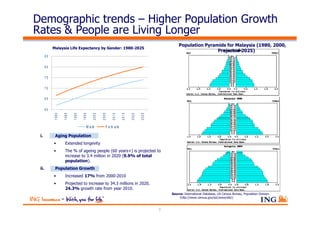
Demographic trends – Higher Population Growth
Rates & People are Living Longer
                                                                                              Population Pyramids for Malaysia (1980, 2000,
            Malaysia Life Expectancy by Gender: 1980-2025
                                                                                                              Projected 2025)
       85


       80


       75


       70


       65


       60
             1980

                    1985

                           1990

                                  1995

                                          2000

                                                 2005

                                                         2010

                                                                 2015

                                                                        2020

                                                                               2025
                                     M a le         F e m a le

 i.          Aging Population
            •       Extended longevity
            •       The % of ageing people (60 years+) is projected to
                    increase to 3.4 million in 2020 (9.9% of total
                    population).
 ii.         Population Growth
            •       Increased 17% from 2000-2010
            •       Projected to increase to 34.3 millions in 2020.
                    24.3% growth rate from year 2010.
                                                                                          Source: International Database, US Census Bureau, Population Division
                                                                                               (http://www.census.gov/ipc/www/idb/)


                                                                                      7
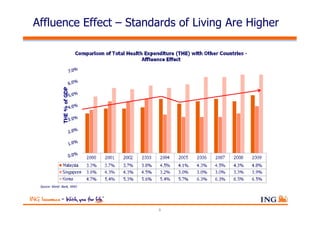
Affluence Effect – Standards of Living Are Higher


 Source: World Bank, WHO


                           8
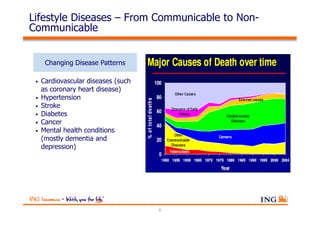
Lifestyle Diseases – From Communicable to Non-
Communicable


      Changing Disease Patterns

 •   Cardiovascular diseases (such
     as coronary heart disease)
 •   Hypertension
 •   Stroke
 •   Diabetes
 •   Cancer
 •   Mental health conditions
     (mostly dementia and
     depression)


                                     9
Private Medical Insurance Gaining Prominence


ING                   10
What’s Triggering the Need for Private Medical
Insurance?
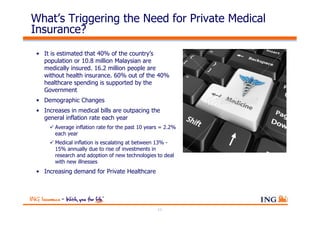
 • It is estimated that 40% of the country’s
   population or 10.8 million Malaysian are
   medically insured. 16.2 million people are
   without health insurance. 60% out of the 40%
   healthcare spending is supported by the
   Government
 • Demographic Changes
 • Increases in medical bills are outpacing the
   general inflation rate each year
       Average inflation rate for the past 10 years = 2.2%
       each year
       Medical inflation is escalating at between 13% -
       15% annually due to rise of investments in
       research and adoption of new technologies to deal
       with new illnesses
 • Increasing demand for Private Healthcare


                                                  11
How can we as a nation
address these needs?


       12
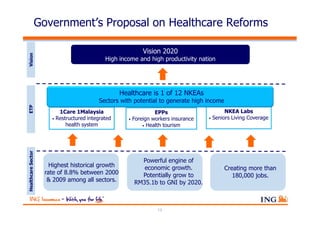
Government’s Proposal on Healthcare Reforms

                                                                Vision 2020
Vision


                                               High income and high productivity nation


                                                     Healthcare is 1 of 12 NKEAs
                                            Sectors with potential to generate high income
ETP


                            1Care 1Malaysia                          EPPs                        NKEA Labs
                       •   Restructured integrated      •   Foreign workers insurance   •   Seniors Living Coverage
                               health system                    • Health tourism
Healthcare Sector


                                                              Powerful engine of
                       Highest historical growth               economic growth.                 Creating more than
                     rate of 8.8% between 2000                Potentially grow to                  180,000 jobs.
                      & 2009 among all sectors.             RM35.1b to GNI by 2020.


                                                                      13
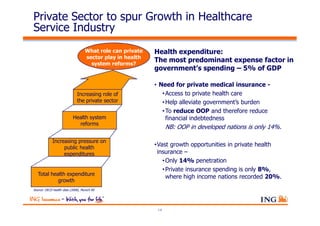
Private Sector to spur Growth in Healthcare
Service Industry
                                   What role can private   Health expenditure:
                                   sector play in health
                                     system reforms?
                                                           The most predominant expense factor in
                                                           government’s spending – 5% of GDP

                                                           • Need for private medical insurance -
                              Increasing role of              • Access to private health care
                              the private sector              • Help alleviate government’s burden
                                                              • To reduce OOP and therefore reduce
                           Health system                        financial indebtedness
                             reforms
                                                                 NB: OOP in developed nations is only 14%.

             Increasing pressure on
                  public health
                                                           •Vast growth opportunities in private health
                  expenditures                              insurance –
                                                              • Only 14% penetration
                                                              • Private insurance spending is only 8%,
   Total health expenditure
                                                                where high income nations recorded 20%.
            growth
Source: OECD health data (2008), Munich RE


                                                            14
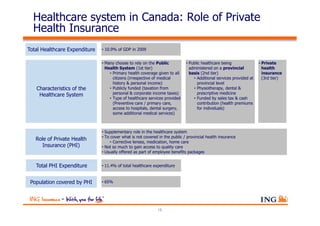
Healthcare system in Canada: Role of Private
  Health Insurance
Total Healthcare Expenditure   • 10.9% of GDP in 2009


                               • Many choose to rely on the Public           • Public healthcare being               • Private
                                 Health System (1st tier)                      administered on a provincial            health
                                   • Primary health coverage given to all      basis (2nd tier)                        insurance
                                     citizens (irrespective of medical           • Additional services provided at     (3rd tier)
                                     history & personal income)                    provincial level
   Characteristics of the          • Publicly funded (taxation from              • Physiotherapy, dental &
    Healthcare System                personal & corporate income taxes)            prescriptive medicine
                                   • Type of healthcare services provided        • Funded by sales tax & cash
                                     (Preventive care / primary care,              contribution (health premiums
                                     access to hospitals, dental surgery,          for individuals)
                                     some additional medical services)


                               • Supplementary role in the healthcare system
                               • To cover what is not covered in the public / provincial health insurance
   Role of Private Health
                                    • Corrective lenses, medication, home care
      Insurance (PHI)          • Not so much to gain access to quality care
                               • Usually offered as part of employee benefits packages


   Total PHI Expenditure       • 11.4% of total healthcare expenditure


 Population covered by PHI     • 65%


                                                             15
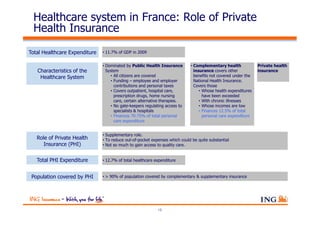
Healthcare system in France: Role of Private
  Health Insurance
Total Healthcare Expenditure   • 11.7% of GDP in 2009


                               • Dominated by Public Health Insurance        • Complementary health             Private health
   Characteristics of the        System                                        insurance covers other           insurance
    Healthcare System               • All citizens are covered                 benefits not covered under the
                                    • Funding – employee and employer          National Health Insurance.
                                      contributions and personal taxes         Covers those
                                    • Covers outpatient, hospital care,           • Whose health expenditures
                                      prescription drugs, home nursing              have been exceeded
                                      care, certain alternative therapies.        • With chronic illnesses
                                    • No gate-keepers regulating access to        • Whose incomes are low
                                      specialists & hospitals                     • Finances 12.5% of total
                                    • Finances 70-75% of total personal             personal care expenditure
                                      care expenditure


                               • Supplementary role.
   Role of Private Health      • To reduce out-of-pocket expenses which could be quite substantial
      Insurance (PHI)          • Not so much to gain access to quality care.


   Total PHI Expenditure       • 12.7% of total healthcare expenditure


 Population covered by PHI     • > 90% of population covered by complementary & supplementary insurance


                                                            16
The Role of Private Medical Insurance


ING                     17
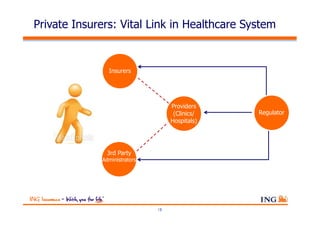
Private Insurers: Vital Link in Healthcare System


               Insurers


                                   Providers
                                    (Clinics/   Regulator
                                   Hospitals)


              3rd Party
             Administrators


                              18
                              18
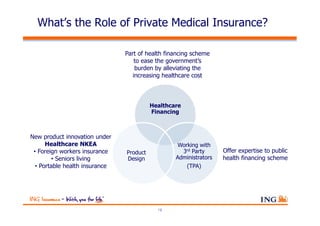
What’s the Role of Private Medical Insurance?

                                Part of health financing scheme
                                    to ease the government’s
                                    burden by alleviating the
                                   increasing healthcare cost


                                          Healthcare
                                          Financing


New product innovation under
      Healthcare NKEA                             Working with
 • Foreign workers insurance    Product             3rd Party      Offer expertise to public
        • Seniors living        Design            Administrators   health financing scheme
  • Portable health insurance                          (TPA)


                                            19
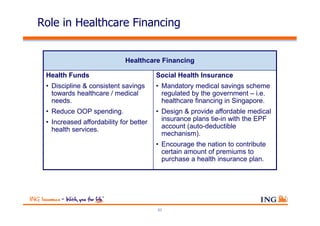
Role in Healthcare Financing


                             Healthcare Financing

 Health Funds                           Social Health Insurance
 • Discipline & consistent savings      • Mandatory medical savings scheme
   towards healthcare / medical           regulated by the government – i.e.
   needs.                                 healthcare financing in Singapore.
 • Reduce OOP spending.                 • Design & provide affordable medical
 • Increased affordability for better     insurance plans tie-in with the EPF
   health services.                       account (auto-deductible
                                          mechanism).
                                        • Encourage the nation to contribute
                                          certain amount of premiums to
                                          purchase a health insurance plan.


                                        20
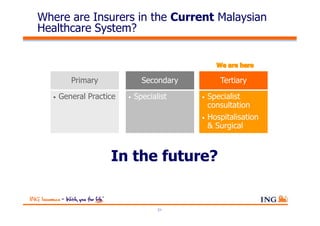
Where are Insurers in the Current Malaysian
Healthcare System?


         Primary               Secondary          Tertiary

  •   General Practice   •   Specialist    •   Specialist
                                               consultation
                                           •   Hospitalisation
                                               & Surgical


                    In the future?


                                    21
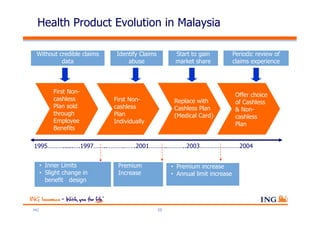
Health Product Evolution in Malaysia

 Without credible claims      Identify Claims            Start to gain           Periodic review of
          data                    abuse                  market share            claims experience


             First Non-
                                                                                  Offer choice
             cashless        First Non-                  Replace with             of Cashless
             Plan sold       cashless                    Cashless Plan            & Non-
             through         Plan                        (Medical Card)           cashless
             Employee        Individually                                         Plan
             Benefits

1995………......….1997……..……….…….2001………..………..2003……………………2004


      •   Inner Limits        Premium                •   Premium increase
      •   Slight change in    Increase               •   Annual limit increase
          benefit design


ING                                             22
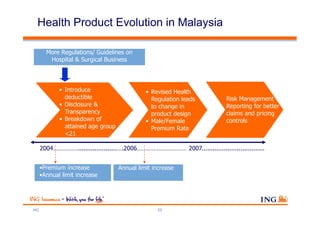
Health Product Evolution in Malaysia

        More Regulations/ Guidelines on
         Hospital & Surgical Business


             • Introduce                      • Revised Health
               deductible                       Regulation leads            Risk Management
             • Disclosure &                     to change in                Reporting for better
               Transparency                     product design              claims and pricing
             • Breakdown of                   • Male/Female                 controls
               attained age group               Premium Rate
               <21

      2004…………….....................….2006………………………… 2007..................................


      •Premium increase             Annual limit increase
      •Annual limit increase


ING                                               23
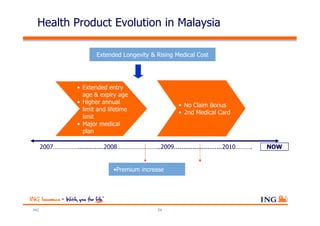
Health Product Evolution in Malaysia

                          Extended Longevity & Rising Medical Cost


                   • Extended entry
                     age & expiry age
                   • Higher annual
                                                       • No Claim Bonus
                     limit and lifetime
                                                       • 2nd Medical Card
                     limit
                   • Major medical
                     plan

      2007……………..............2008……………………..2009..........................2010……….   NOW


                                 •Premium increase


ING                                            24
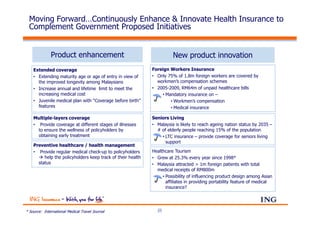
Moving Forward…Continuously Enhance & Innovate Health Insurance to
  Complement Government Proposed Initiatives


              Product enhancement                                      New product innovation
    Extended coverage                                        Foreign Workers Insurance
    • Extending maturity age or age of entry in view of      • Only 75% of 1.8m foreign workers are covered by
      the improved longevity among Malaysians                  workmen’s compensation schemes
    • Increase annual and lifetime limit to meet the         • 2005-2009, RM64m of unpaid healthcare bills
      increasing medical cost                                    • Mandatory insurance on –
    • Juvenile medical plan with “Coverage before birth”             • Workmen’s compensation
      features                                                       • Medical insurance

    Multiple-layers coverage                                 Seniors Living
    • Provide coverage at different stages of illnesses      • Malaysia is likely to reach ageing nation status by 2035 –
      to ensure the wellness of policyholders by               # of elderly people reaching 15% of the population
      obtaining early treatment                                  • LTC insurance – provide coverage for seniors living
                                                                   support
    Preventive healthcare / health management
    • Provide regular medical check-up to policyholders      Healthcare Tourism
         help the policyholders keep track of their health   • Grew at 25.3% every year since 1998*
      status                                                 • Malaysia attracted > 1m foreign patients with total
                                                               medical receipts of RM800m
                                                                  • Possibility of influencing product design among Asian
                                                                    affiliates in providing portability feature of medical
                                                                    insurance?


* Source: International Medical Travel Journal                 25
                                                               25
Final Thought


ING         26
In conclusion…

The future is all about
achieving greater synergies
among all parties for the
benefit of the public


                       27
Q&A


ING    28
THANK YOU


Disclaimer: Any views or opinions expressed in this presentation are those of the presenter and
do not necessarily reflect the official stand, policy or position of ING Insurance Berhad. Examples,
illustrations shared are based on the presenter’s views which may include information sourced from
publicly available information. They should not be taken as professional advice.


                                                  29

1115 c APHM - Anusha Thavarajah

  • 1.
    Copyright in thematerial contained in this document belongs to third parties. It has been published by kind permission of the owner(s) and provided for review only. This document may not be reproduced, amended or redistributed without prior written permission of the copyright owner(s).
  • 2.
    Role of PrivateMedical Insurance Anusha Thavarajah Deputy CEO / CFO ING Insurance Malaysia, July 2011
  • 3.
    Presentation Outline • Malaysia’sChanging Healthcare Landscape • Private Medical Insurance Gaining Prominence • The Role of Private Medical Insurance • Final Thought • Q&A 2
  • 4.
  • 5.
    Current Conditions inMalaysia’s Healthcare System i. Rising healthcare Current issues in healthcare system expenditure – 5% of GDP Countries Indicators 2000 2001 2002 2003 2004 Total 11,330.93 12,287.152 13,339.608 19,478.917 21,200.439 expenditure Malaysia on health 2005 2006 2007 2008 2009 (in RM millions) 21,574.5 24,778.67 28,021.895 31,140.871 32,648.524 4
  • 6.
    Current Conditions inMalaysia’s Healthcare System ii. Highly subsidized services & Current issues in healthcare system overdependence on government health facilities iii. Gaps in present healthcare delivery system – i.e. equity, efficiency, accessibility iv. Inadequate integration between public & private sectors v. Increasing trend of private health expenditure – 41% Out-of pocket (OOP) spending vi. Globalization & liberalisation Increased deficit in Malaysia’s budget if these remained unsolved 5
  • 7.
    What’s Driving theChange? Healthcare has grown to become a much bigger part of the Malaysian economy owing to four major drivers Wealth Longevity Medical advances and When people can afford it, improvements in living they will spend almost any standards are contributing to amount on health growing life expectancies Lifestyles Technology Rising affluence is altering New therapies, products, lifestyle patterns and diets, medical procedures are driving thus leading to higher up patients’ expectations; prevalence of chronic diseases pulling up demand which are costly to treat 6
  • 8.
    Demographic trends –Higher Population Growth Rates & People are Living Longer Population Pyramids for Malaysia (1980, 2000, Malaysia Life Expectancy by Gender: 1980-2025 Projected 2025) 85 80 75 70 65 60 1980 1985 1990 1995 2000 2005 2010 2015 2020 2025 M a le F e m a le i. Aging Population • Extended longevity • The % of ageing people (60 years+) is projected to increase to 3.4 million in 2020 (9.9% of total population). ii. Population Growth • Increased 17% from 2000-2010 • Projected to increase to 34.3 millions in 2020. 24.3% growth rate from year 2010. Source: International Database, US Census Bureau, Population Division (http://www.census.gov/ipc/www/idb/) 7
  • 9.
    Affluence Effect –Standards of Living Are Higher Source: World Bank, WHO 8
  • 10.
    Lifestyle Diseases –From Communicable to Non- Communicable Changing Disease Patterns • Cardiovascular diseases (such as coronary heart disease) • Hypertension • Stroke • Diabetes • Cancer • Mental health conditions (mostly dementia and depression) 9
  • 11.
    Private Medical InsuranceGaining Prominence ING 10
  • 12.
    What’s Triggering theNeed for Private Medical Insurance? • It is estimated that 40% of the country’s population or 10.8 million Malaysian are medically insured. 16.2 million people are without health insurance. 60% out of the 40% healthcare spending is supported by the Government • Demographic Changes • Increases in medical bills are outpacing the general inflation rate each year Average inflation rate for the past 10 years = 2.2% each year Medical inflation is escalating at between 13% - 15% annually due to rise of investments in research and adoption of new technologies to deal with new illnesses • Increasing demand for Private Healthcare 11
  • 13.
    How can weas a nation address these needs? 12
  • 14.
    Government’s Proposal onHealthcare Reforms Vision 2020 Vision High income and high productivity nation Healthcare is 1 of 12 NKEAs Sectors with potential to generate high income ETP 1Care 1Malaysia EPPs NKEA Labs • Restructured integrated • Foreign workers insurance • Seniors Living Coverage health system • Health tourism Healthcare Sector Powerful engine of Highest historical growth economic growth. Creating more than rate of 8.8% between 2000 Potentially grow to 180,000 jobs. & 2009 among all sectors. RM35.1b to GNI by 2020. 13
  • 15.
    Private Sector tospur Growth in Healthcare Service Industry What role can private Health expenditure: sector play in health system reforms? The most predominant expense factor in government’s spending – 5% of GDP • Need for private medical insurance - Increasing role of • Access to private health care the private sector • Help alleviate government’s burden • To reduce OOP and therefore reduce Health system financial indebtedness reforms NB: OOP in developed nations is only 14%. Increasing pressure on public health •Vast growth opportunities in private health expenditures insurance – • Only 14% penetration • Private insurance spending is only 8%, Total health expenditure where high income nations recorded 20%. growth Source: OECD health data (2008), Munich RE 14
  • 16.
    Healthcare system inCanada: Role of Private Health Insurance Total Healthcare Expenditure • 10.9% of GDP in 2009 • Many choose to rely on the Public • Public healthcare being • Private Health System (1st tier) administered on a provincial health • Primary health coverage given to all basis (2nd tier) insurance citizens (irrespective of medical • Additional services provided at (3rd tier) history & personal income) provincial level Characteristics of the • Publicly funded (taxation from • Physiotherapy, dental & Healthcare System personal & corporate income taxes) prescriptive medicine • Type of healthcare services provided • Funded by sales tax & cash (Preventive care / primary care, contribution (health premiums access to hospitals, dental surgery, for individuals) some additional medical services) • Supplementary role in the healthcare system • To cover what is not covered in the public / provincial health insurance Role of Private Health • Corrective lenses, medication, home care Insurance (PHI) • Not so much to gain access to quality care • Usually offered as part of employee benefits packages Total PHI Expenditure • 11.4% of total healthcare expenditure Population covered by PHI • 65% 15
  • 17.
    Healthcare system inFrance: Role of Private Health Insurance Total Healthcare Expenditure • 11.7% of GDP in 2009 • Dominated by Public Health Insurance • Complementary health Private health Characteristics of the System insurance covers other insurance Healthcare System • All citizens are covered benefits not covered under the • Funding – employee and employer National Health Insurance. contributions and personal taxes Covers those • Covers outpatient, hospital care, • Whose health expenditures prescription drugs, home nursing have been exceeded care, certain alternative therapies. • With chronic illnesses • No gate-keepers regulating access to • Whose incomes are low specialists & hospitals • Finances 12.5% of total • Finances 70-75% of total personal personal care expenditure care expenditure • Supplementary role. Role of Private Health • To reduce out-of-pocket expenses which could be quite substantial Insurance (PHI) • Not so much to gain access to quality care. Total PHI Expenditure • 12.7% of total healthcare expenditure Population covered by PHI • > 90% of population covered by complementary & supplementary insurance 16
  • 18.
    The Role ofPrivate Medical Insurance ING 17
  • 19.
    Private Insurers: VitalLink in Healthcare System Insurers Providers (Clinics/ Regulator Hospitals) 3rd Party Administrators 18 18
  • 20.
    What’s the Roleof Private Medical Insurance? Part of health financing scheme to ease the government’s burden by alleviating the increasing healthcare cost Healthcare Financing New product innovation under Healthcare NKEA Working with • Foreign workers insurance Product 3rd Party Offer expertise to public • Seniors living Design Administrators health financing scheme • Portable health insurance (TPA) 19
  • 21.
    Role in HealthcareFinancing Healthcare Financing Health Funds Social Health Insurance • Discipline & consistent savings • Mandatory medical savings scheme towards healthcare / medical regulated by the government – i.e. needs. healthcare financing in Singapore. • Reduce OOP spending. • Design & provide affordable medical • Increased affordability for better insurance plans tie-in with the EPF health services. account (auto-deductible mechanism). • Encourage the nation to contribute certain amount of premiums to purchase a health insurance plan. 20
  • 22.
    Where are Insurersin the Current Malaysian Healthcare System? Primary Secondary Tertiary • General Practice • Specialist • Specialist consultation • Hospitalisation & Surgical In the future? 21
  • 23.
    Health Product Evolutionin Malaysia Without credible claims Identify Claims Start to gain Periodic review of data abuse market share claims experience First Non- Offer choice cashless First Non- Replace with of Cashless Plan sold cashless Cashless Plan & Non- through Plan (Medical Card) cashless Employee Individually Plan Benefits 1995………......….1997……..……….…….2001………..………..2003……………………2004 • Inner Limits Premium • Premium increase • Slight change in Increase • Annual limit increase benefit design ING 22
  • 24.
    Health Product Evolutionin Malaysia More Regulations/ Guidelines on Hospital & Surgical Business • Introduce • Revised Health deductible Regulation leads Risk Management • Disclosure & to change in Reporting for better Transparency product design claims and pricing • Breakdown of • Male/Female controls attained age group Premium Rate <21 2004…………….....................….2006………………………… 2007.................................. •Premium increase Annual limit increase •Annual limit increase ING 23
  • 25.
    Health Product Evolutionin Malaysia Extended Longevity & Rising Medical Cost • Extended entry age & expiry age • Higher annual • No Claim Bonus limit and lifetime • 2nd Medical Card limit • Major medical plan 2007……………..............2008……………………..2009..........................2010………. NOW •Premium increase ING 24
  • 26.
    Moving Forward…Continuously Enhance& Innovate Health Insurance to Complement Government Proposed Initiatives Product enhancement New product innovation Extended coverage Foreign Workers Insurance • Extending maturity age or age of entry in view of • Only 75% of 1.8m foreign workers are covered by the improved longevity among Malaysians workmen’s compensation schemes • Increase annual and lifetime limit to meet the • 2005-2009, RM64m of unpaid healthcare bills increasing medical cost • Mandatory insurance on – • Juvenile medical plan with “Coverage before birth” • Workmen’s compensation features • Medical insurance Multiple-layers coverage Seniors Living • Provide coverage at different stages of illnesses • Malaysia is likely to reach ageing nation status by 2035 – to ensure the wellness of policyholders by # of elderly people reaching 15% of the population obtaining early treatment • LTC insurance – provide coverage for seniors living support Preventive healthcare / health management • Provide regular medical check-up to policyholders Healthcare Tourism help the policyholders keep track of their health • Grew at 25.3% every year since 1998* status • Malaysia attracted > 1m foreign patients with total medical receipts of RM800m • Possibility of influencing product design among Asian affiliates in providing portability feature of medical insurance? * Source: International Medical Travel Journal 25 25
  • 27.
  • 28.
    In conclusion… The futureis all about achieving greater synergies among all parties for the benefit of the public 27
  • 29.
  • 30.
    THANK YOU Disclaimer: Anyviews or opinions expressed in this presentation are those of the presenter and do not necessarily reflect the official stand, policy or position of ING Insurance Berhad. Examples, illustrations shared are based on the presenter’s views which may include information sourced from publicly available information. They should not be taken as professional advice. 29