WIRELESS POWER
TRANSMISSION
BY,
DHANSHA THAKUR
ANIRUDH K.N
GEETHU KRISHNAKUMAR
JITHU NAIR
INTRODUCTION
• Wireless power transfer can make electronic
devices like cell phones, household robots,
mp3 players, laptop computers and other
portable electronics wire-free.
• Resonant inductive coupling which is one of
the various power transmission techniques is
demonstrated here.
ABSTRACT
• Many researchers have developed several
techniques for moving electricity over long
distances without wires.
• Witricity is based upon coupled resonant objects.
• Two objects having same resonating frequency
and in magnetic resonance tend to exchange
energy, while dissipating relatively little energy to
the extraneous off-resonant objects.
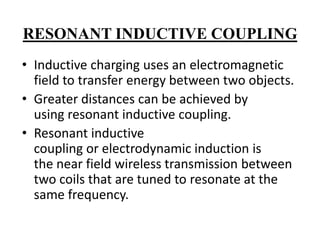
RESONANT INDUCTIVE COUPLING
• Inductive charging uses an electromagnetic
field to transfer energy between two objects.
• Greater distances can be achieved by
using resonant inductive coupling.
• Resonant inductive
coupling or electrodynamic induction is
the near field wireless transmission between
two coils that are tuned to resonate at the
same frequency.
RESONANT INDUCTIVE COUPLING

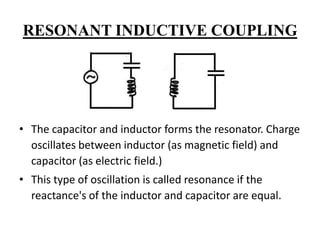
• The capacitor and inductor forms the resonator. Charge
oscillates between inductor (as magnetic field) and
capacitor (as electric field.)
• This type of oscillation is called resonance if the
reactance's of the inductor and capacitor are equal.
RESONANT INDUCTIVE COUPLING
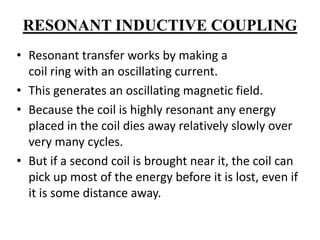
• Resonant transfer works by making a
coil ring with an oscillating current.
• This generates an oscillating magnetic field.
• Because the coil is highly resonant any energy
placed in the coil dies away relatively slowly over
very many cycles.
• But if a second coil is brought near it, the coil can
pick up most of the energy before it is lost, even if
it is some distance away.
BLOCK DIAGRAM
BLOCK DIAGRAM
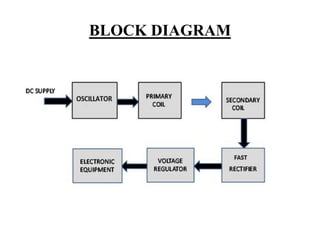
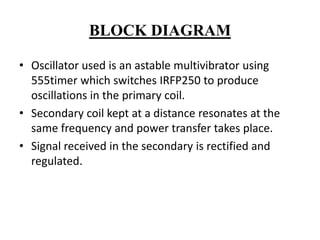
• Oscillator used is an astable multivibrator using
555timer which switches IRFP250 to produce
oscillations in the primary coil.
• Secondary coil kept at a distance resonates at the
same frequency and power transfer takes place.
• Signal received in the secondary is rectified and
regulated.
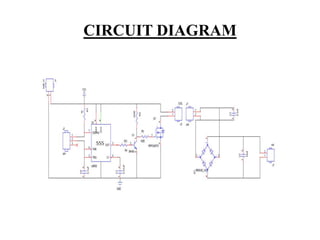
CIRCUIT DIAGRAM
PRIMARY CIRCUIT
PRIMARY CIRCUIT
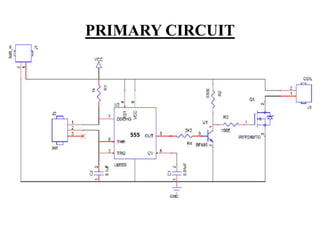
• Oscillator is an astable multivibrator using 555
timer a rectangular-wave generating circuit.
• A pot connected between the 6 and 7 terminals
of the timer is adjusted to tune the primary and
secondary coils at the same resonating frequency.
• The astable multivibrator causes an IRFP250
transistor to undergo switching to produce
oscillations of required strength.
• A primary coil made of 8 turns of a magnetic wire
is connected to IRFP250
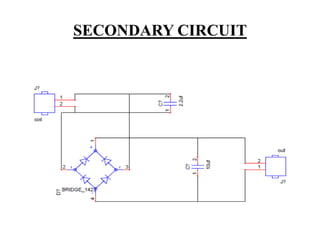
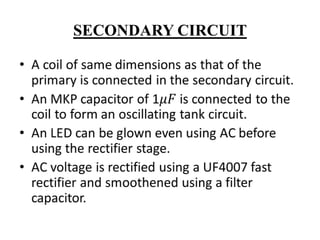
SECONDARY CIRCUIT
SECONDARY CIRCUIT
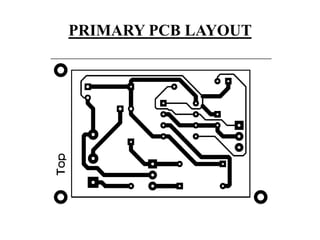
PRIMARY PCB LAYOUT
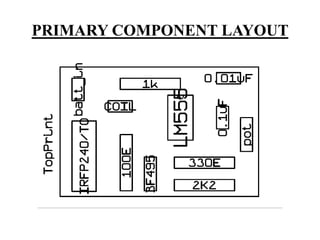
PRIMARY COMPONENT LAYOUT
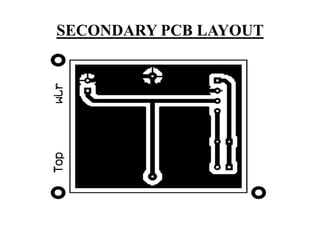
SECONDARY PCB LAYOUT
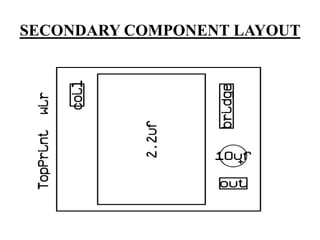
SECONDARY COMPONENT LAYOUT
APPLICATIONS
• Provides charging stations for handheld
devices like phones ex:powermat, removes
the need for multiple power sockets
• Can operate appliances like tv
• Electric car manufacturers consider it for
charging electric cars, currently using wires for
this purpose is not entirely practical
ADVANTAGES
• Non-radiative energy transfer is safe for
people and animals.
• Wastage of power is less.
• Highly resonant strong coupling provides high
efficiency over distance.
• Does not interfere with radio waves.
CONCLUSION
• Wireless power transfer is quickly becoming a
viable reality.
• This technology offers an extremely efficient
alternative to previous attempts at providing
wireless power.
• Future improvements in wireless technology
offer world changing implications.

Wirelesspowertransmission 120909130453-phpapp01

  • 1.
  • 2.
    INTRODUCTION • Wireless powertransfer can make electronic devices like cell phones, household robots, mp3 players, laptop computers and other portable electronics wire-free. • Resonant inductive coupling which is one of the various power transmission techniques is demonstrated here.
  • 3.
    ABSTRACT • Many researchershave developed several techniques for moving electricity over long distances without wires. • Witricity is based upon coupled resonant objects. • Two objects having same resonating frequency and in magnetic resonance tend to exchange energy, while dissipating relatively little energy to the extraneous off-resonant objects.
  • 4.
    RESONANT INDUCTIVE COUPLING •Inductive charging uses an electromagnetic field to transfer energy between two objects. • Greater distances can be achieved by using resonant inductive coupling. • Resonant inductive coupling or electrodynamic induction is the near field wireless transmission between two coils that are tuned to resonate at the same frequency.
  • 5.
    RESONANT INDUCTIVE COUPLING •The capacitor and inductor forms the resonator. Charge oscillates between inductor (as magnetic field) and capacitor (as electric field.) • This type of oscillation is called resonance if the reactance's of the inductor and capacitor are equal.
  • 6.
    RESONANT INDUCTIVE COUPLING •Resonant transfer works by making a coil ring with an oscillating current. • This generates an oscillating magnetic field. • Because the coil is highly resonant any energy placed in the coil dies away relatively slowly over very many cycles. • But if a second coil is brought near it, the coil can pick up most of the energy before it is lost, even if it is some distance away.
  • 7.
  • 8.
    BLOCK DIAGRAM • Oscillatorused is an astable multivibrator using 555timer which switches IRFP250 to produce oscillations in the primary coil. • Secondary coil kept at a distance resonates at the same frequency and power transfer takes place. • Signal received in the secondary is rectified and regulated.
  • 9.
  • 10.
  • 11.
    PRIMARY CIRCUIT • Oscillatoris an astable multivibrator using 555 timer a rectangular-wave generating circuit. • A pot connected between the 6 and 7 terminals of the timer is adjusted to tune the primary and secondary coils at the same resonating frequency. • The astable multivibrator causes an IRFP250 transistor to undergo switching to produce oscillations of required strength. • A primary coil made of 8 turns of a magnetic wire is connected to IRFP250
  • 12.
  • 13.
  • 14.
  • 15.
  • 16.
  • 17.
  • 18.
    APPLICATIONS • Provides chargingstations for handheld devices like phones ex:powermat, removes the need for multiple power sockets • Can operate appliances like tv • Electric car manufacturers consider it for charging electric cars, currently using wires for this purpose is not entirely practical
  • 19.
    ADVANTAGES • Non-radiative energytransfer is safe for people and animals. • Wastage of power is less. • Highly resonant strong coupling provides high efficiency over distance. • Does not interfere with radio waves.
  • 20.
    CONCLUSION • Wireless powertransfer is quickly becoming a viable reality. • This technology offers an extremely efficient alternative to previous attempts at providing wireless power. • Future improvements in wireless technology offer world changing implications.