International Research Journal of Engineering and Technology (IRJET) e-ISSN: 2395 -0056
Volume: 04 Issue: 03 | Mar -2017 www.irjet.net p-ISSN: 2395-0072
© 2017, IRJET | Impact Factor value: 5.181 | ISO 9001:2008 Certified Journal | Page 1133
Automation in Ticketing system for a Modern Transport
Tirupati Goskula1, Akanksha Jain2, Aliya Pathan 3, Ashwini Nasre 4
1Assistant Professor, Dept. of Electronics and Telecommunication Engineering, Anjuman college of Engineering
and Technology,Maharashtra,India
2Student of Graduation, Dept. of Electronics and Telecommunication Engineering, Anjuman college of Engineering
and Technology,Maharashtra,India
3Student of Graduation, Dept. of Electronics and Telecommunication Engineering, Anjuman college of Engineering
and Technology,Maharashtra,India
4Student of Graduation, Dept. of Electronics and Telecommunication Engineering, Anjuman college of Engineering
and Technology,Maharashtra,India
---------------------------------------------------------------------***---------------------------------------------------------------------
Abstract - In today’s scenario, the ticketing system is
more sophisticated. It has many demerits. People are waiting
in long queues for getting tickets especially in public mode of
transportation. This leads to inessential wastage of time and
energy. This paper presents an automatedsystemforticketing
in the Public Transport System (PTS) that relies on passenger
identification. This is a user friendly system, which will
automatically identify the passenger and debits the
passenger’s fare according to thedistancetravelled. TheRadio
Frequency Identification (RFID) cards are used to make the
identification of passenger and GPS is used to calculate the
distance travelled and to make the transaction very precise.
The cards being reusable and rechargable, they are much
more convenient as compared to the paper based ticketing
system. This method of ticket fare collectionismostinnovative
way tillnow.
Key Words: RFID Reader, RFID Card, GPS, LCD Display,
Modern Transport
1. INTRODUCTION
Public Transport System(PTS)remainsthemainsupply
of financial gain in most of the developing countries like
India. But PTS now faces severe malfunction and various
security issues. First, there is a lot of confusion between the
passengers regarding fares which lead to confrontation.
Additionally to the current, these days there is a severe
security crisis in PTS due to delinquent components. The
user friendly automated ticketing system suggested in this
paper will won't solely deduct the passenger’s fare in step
with the space traveled however conjointly sight the
passenger’s identification. This is often attainable by use of
RFID cards and GPS, and can be used tomakethetransaction
and travelling very precise.
1.1 PROPOSED METHODOLOGY
GPS is the latest technologyutilizedinvariesfieldssuch
as navigation, tracking and also in some of surveillance
application. Here we are progressing to use this GPS to
calculate the distance travelled by the passenger. GPS
module can be configured to generate the latitude and
longitude of the current position of the vehicle. The position
of the vehicle can be monitored continuously using this GPS
module.
RFID cards can provide identification, authentication,
data storage and application processing. These RFID cards
can be used as passenger identifications. Every passenger
carries a card. This card has the information such as user
identification number and accessible balance. These RFID
cards are capable of the recharging, so that the passenger
can use it again and again.
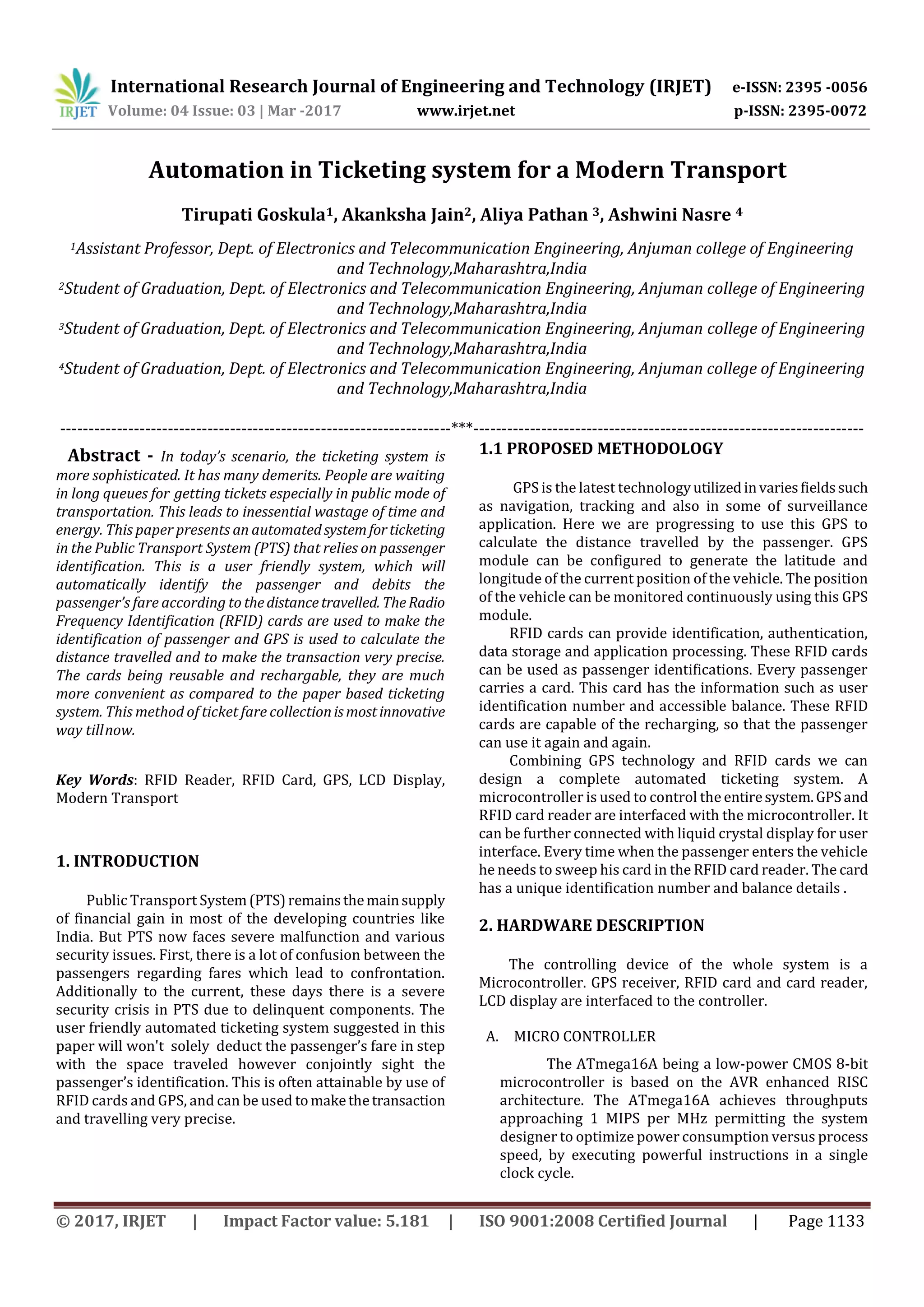
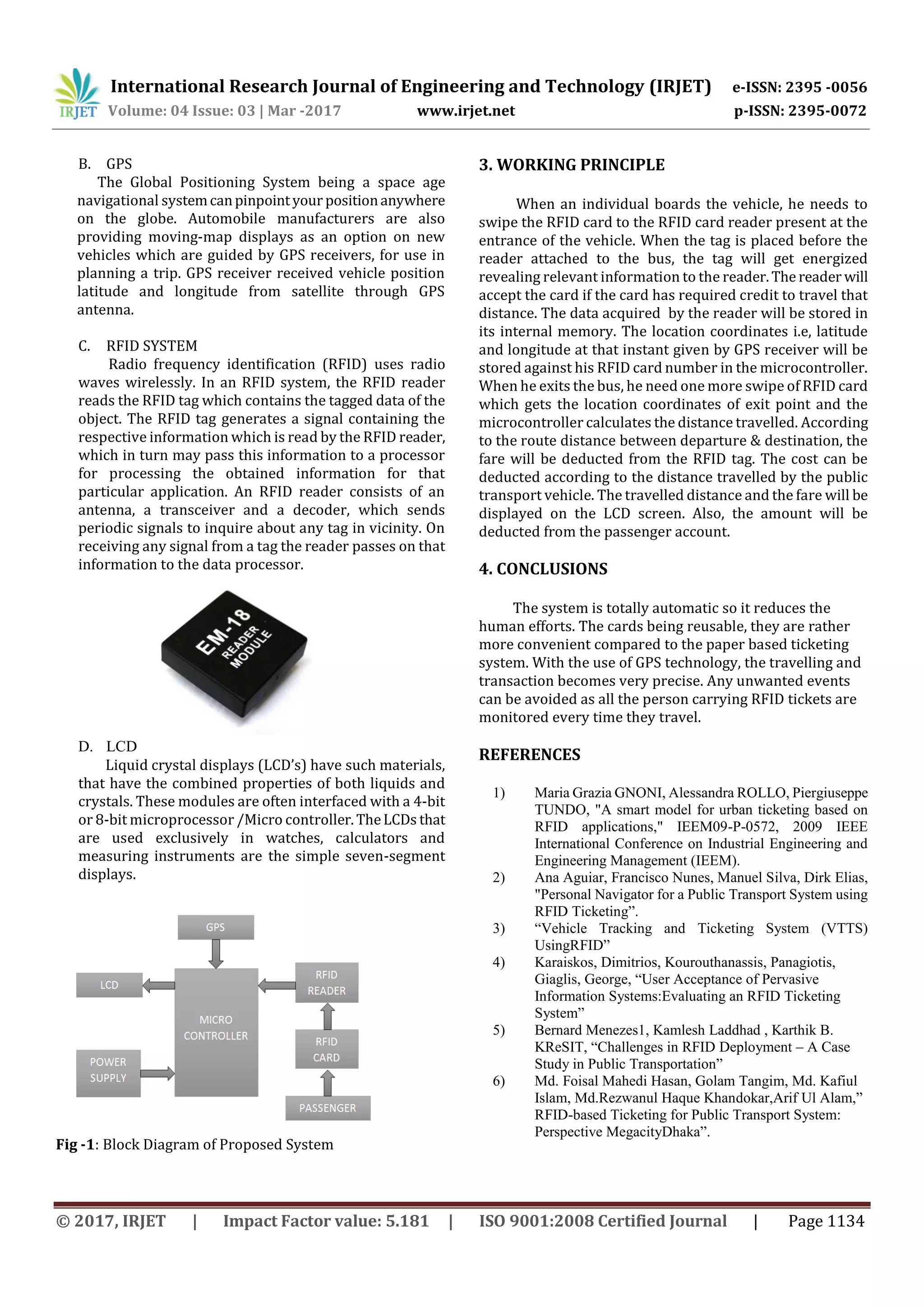
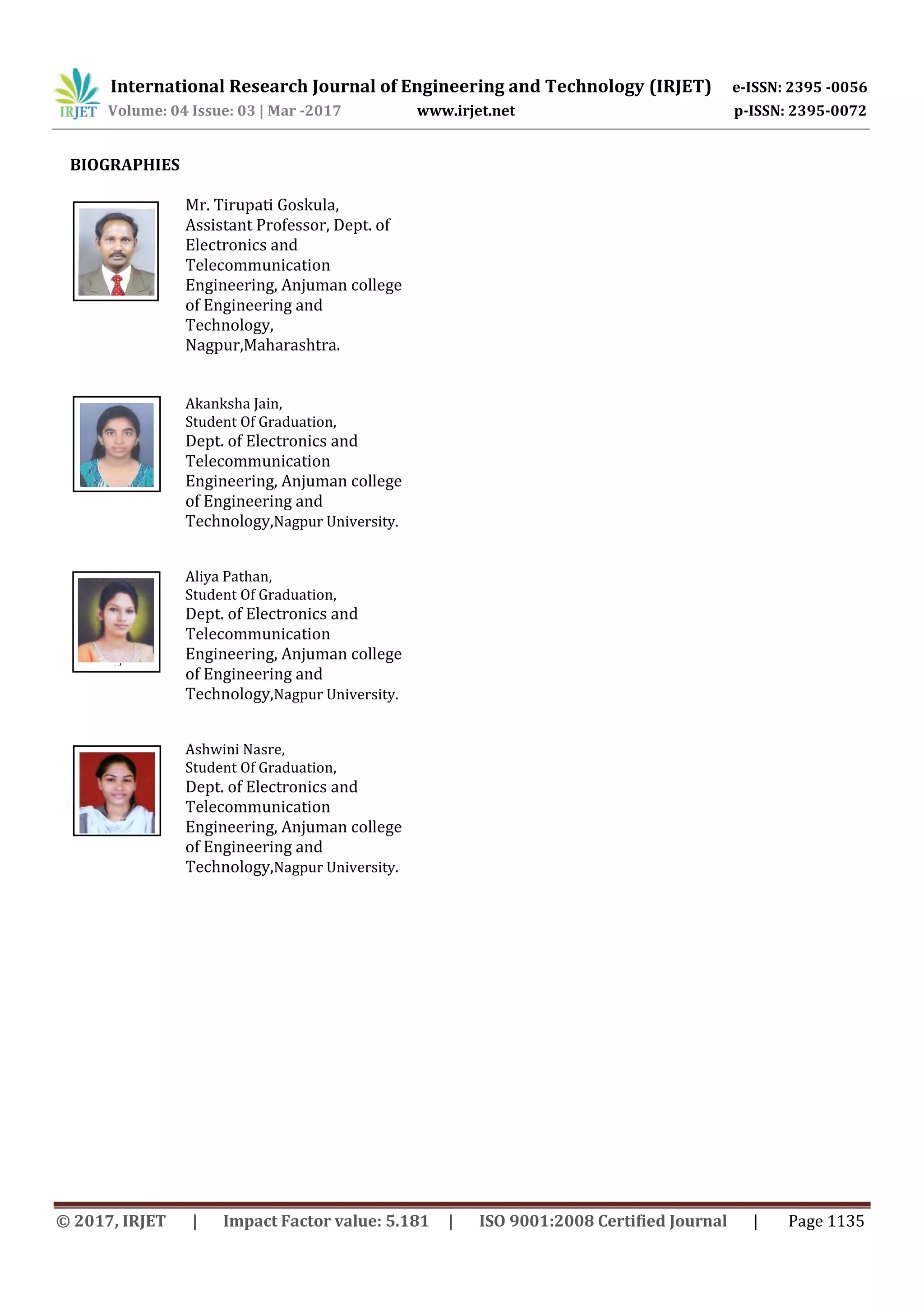
Combining GPS technology and RFID cards we can
design a complete automated ticketing system. A
microcontroller is used to control the entiresystem.GPSand
RFID card reader are interfaced with the microcontroller. It
can be further connected with liquid crystal display for user
interface. Every time when the passenger enters the vehicle
he needs to sweep his card in the RFID card reader. The card
has a unique identification number and balance details .
2. HARDWARE DESCRIPTION
The controlling device of the whole system is a
Microcontroller. GPS receiver, RFID card and card reader,
LCD display are interfaced to the controller.
A. MICRO CONTROLLER
The ATmega16A being a low-power CMOS 8-bit
microcontroller is based on the AVR enhanced RISC
architecture. The ATmega16A achieves throughputs
approaching 1 MIPS per MHz permitting the system
designer to optimize power consumption versus process
speed, by executing powerful instructions in a single
clock cycle.
International Research Journal of Engineering and Technology (IRJET) e-ISSN: 2395 -0056
Volume: 04 Issue: 03 | Mar -2017 www.irjet.net p-ISSN: 2395-0072
© 2017, IRJET | Impact Factor value: 5.181 | ISO 9001:2008 Certified Journal | Page 1134
B. GPS
The Global Positioning System being a space age
navigational systemcanpinpointyour positionanywhere
on the globe. Automobile manufacturers are also
providing moving-map displays as an option on new
vehicles which are guided by GPS receivers, for use in
planning a trip. GPS receiver received vehicle position
latitude and longitude from satellite through GPS
antenna.
C. RFID SYSTEM
Radio frequency identification (RFID) uses radio
waves wirelessly. In an RFID system, the RFID reader
reads the RFID tag which contains the tagged data of the
object. The RFID tag generates a signal containing the
respective information which is read by the RFID reader,
which in turn may pass this information to a processor
for processing the obtained information for that
particular application. An RFID reader consists of an
antenna, a transceiver and a decoder, which sends
periodic signals to inquire about any tag in vicinity. On
receiving any signal from a tag the reader passes on that
information to the data processor.
D. LCD
Liquid crystal displays (LCD’s) have such materials,
that have the combined properties of both liquids and
crystals. These modules are often interfaced with a 4-bit
or 8-bit microprocessor /Micro controller.TheLCDs that
are used exclusively in watches, calculators and
measuring instruments are the simple seven-segment
displays.
Fig -1: Block Diagram of Proposed System
3. WORKING PRINCIPLE
When an individual boards the vehicle, he needs to
swipe the RFID card to the RFID card reader present at the
entrance of the vehicle. When the tag is placed before the
reader attached to the bus, the tag will get energized
revealing relevant information to the reader.The reader will
accept the card if the card has required credit to travel that
distance. The data acquired by the reader will be stored in
its internal memory. The location coordinates i.e, latitude
and longitude at that instant given by GPS receiver will be
stored against his RFID card number in the microcontroller.
When he exits the bus, he need one more swipe of RFID card
which gets the location coordinates of exit point and the
microcontroller calculates the distance travelled. According
to the route distance between departure & destination, the
fare will be deducted from the RFID tag. The cost can be
deducted according to the distance travelled by the public
transport vehicle. The travelled distance and the fare will be
displayed on the LCD screen. Also, the amount will be
deducted from the passenger account.
4. CONCLUSIONS
The system is totally automatic so it reduces the
human efforts. The cards being reusable, they are rather
more convenient compared to the paper based ticketing
system. With the use of GPS technology, the travelling and
transaction becomes very precise. Any unwanted events
can be avoided as all the person carrying RFID tickets are
monitored every time they travel.
REFERENCES
1) Maria Grazia GNONI, Alessandra ROLLO, Piergiuseppe
TUNDO, "A smart model for urban ticketing based on
RFID applications," IEEM09-P-0572, 2009 IEEE
International Conference on Industrial Engineering and
Engineering Management (IEEM).
2) Ana Aguiar, Francisco Nunes, Manuel Silva, Dirk Elias,
"Personal Navigator for a Public Transport System using
RFID Ticketing”.
3) “Vehicle Tracking and Ticketing System (VTTS)
UsingRFID”
4) Karaiskos, Dimitrios, Kourouthanassis, Panagiotis,
Giaglis, George, “User Acceptance of Pervasive
Information Systems:Evaluating an RFID Ticketing
System”
5) Bernard Menezes1, Kamlesh Laddhad , Karthik B.
KReSIT, “Challenges in RFID Deployment – A Case
Study in Public Transportation”
6) Md. Foisal Mahedi Hasan, Golam Tangim, Md. Kafiul
Islam, Md.Rezwanul Haque Khandokar,Arif Ul Alam,”
RFID-based Ticketing for Public Transport System:
Perspective MegacityDhaka”.
International Research Journal of Engineering and Technology (IRJET) e-ISSN: 2395 -0056
Volume: 04 Issue: 03 | Mar -2017 www.irjet.net p-ISSN: 2395-0072
© 2017, IRJET | Impact Factor value: 5.181 | ISO 9001:2008 Certified Journal | Page 1135
BIOGRAPHIES
Mr. Tirupati Goskula,
Assistant Professor, Dept. of
Electronics and
Telecommunication
Engineering, Anjuman college
of Engineering and
Technology,
Nagpur,Maharashtra.
Akanksha Jain,
Student Of Graduation,
Dept. of Electronics and
Telecommunication
Engineering, Anjuman college
of Engineering and
Technology,Nagpur University.
Aliya Pathan,
Student Of Graduation,
Dept. of Electronics and
Telecommunication
Engineering, Anjuman college
of Engineering and
Technology,Nagpur University.
Ashwini Nasre,
Student Of Graduation,
Dept. of Electronics and
Telecommunication
Engineering, Anjuman college
of Engineering and
Technology,Nagpur University.
2nd
Author
Photo
4th
Author
Photo
3rd
Author
Photo
1’st
Author
Photo

Automation in Ticketing System for A Modern Transport

  • 1.
    International Research Journalof Engineering and Technology (IRJET) e-ISSN: 2395 -0056 Volume: 04 Issue: 03 | Mar -2017 www.irjet.net p-ISSN: 2395-0072 © 2017, IRJET | Impact Factor value: 5.181 | ISO 9001:2008 Certified Journal | Page 1133 Automation in Ticketing system for a Modern Transport Tirupati Goskula1, Akanksha Jain2, Aliya Pathan 3, Ashwini Nasre 4 1Assistant Professor, Dept. of Electronics and Telecommunication Engineering, Anjuman college of Engineering and Technology,Maharashtra,India 2Student of Graduation, Dept. of Electronics and Telecommunication Engineering, Anjuman college of Engineering and Technology,Maharashtra,India 3Student of Graduation, Dept. of Electronics and Telecommunication Engineering, Anjuman college of Engineering and Technology,Maharashtra,India 4Student of Graduation, Dept. of Electronics and Telecommunication Engineering, Anjuman college of Engineering and Technology,Maharashtra,India ---------------------------------------------------------------------***--------------------------------------------------------------------- Abstract - In today’s scenario, the ticketing system is more sophisticated. It has many demerits. People are waiting in long queues for getting tickets especially in public mode of transportation. This leads to inessential wastage of time and energy. This paper presents an automatedsystemforticketing in the Public Transport System (PTS) that relies on passenger identification. This is a user friendly system, which will automatically identify the passenger and debits the passenger’s fare according to thedistancetravelled. TheRadio Frequency Identification (RFID) cards are used to make the identification of passenger and GPS is used to calculate the distance travelled and to make the transaction very precise. The cards being reusable and rechargable, they are much more convenient as compared to the paper based ticketing system. This method of ticket fare collectionismostinnovative way tillnow. Key Words: RFID Reader, RFID Card, GPS, LCD Display, Modern Transport 1. INTRODUCTION Public Transport System(PTS)remainsthemainsupply of financial gain in most of the developing countries like India. But PTS now faces severe malfunction and various security issues. First, there is a lot of confusion between the passengers regarding fares which lead to confrontation. Additionally to the current, these days there is a severe security crisis in PTS due to delinquent components. The user friendly automated ticketing system suggested in this paper will won't solely deduct the passenger’s fare in step with the space traveled however conjointly sight the passenger’s identification. This is often attainable by use of RFID cards and GPS, and can be used tomakethetransaction and travelling very precise. 1.1 PROPOSED METHODOLOGY GPS is the latest technologyutilizedinvariesfieldssuch as navigation, tracking and also in some of surveillance application. Here we are progressing to use this GPS to calculate the distance travelled by the passenger. GPS module can be configured to generate the latitude and longitude of the current position of the vehicle. The position of the vehicle can be monitored continuously using this GPS module. RFID cards can provide identification, authentication, data storage and application processing. These RFID cards can be used as passenger identifications. Every passenger carries a card. This card has the information such as user identification number and accessible balance. These RFID cards are capable of the recharging, so that the passenger can use it again and again. Combining GPS technology and RFID cards we can design a complete automated ticketing system. A microcontroller is used to control the entiresystem.GPSand RFID card reader are interfaced with the microcontroller. It can be further connected with liquid crystal display for user interface. Every time when the passenger enters the vehicle he needs to sweep his card in the RFID card reader. The card has a unique identification number and balance details . 2. HARDWARE DESCRIPTION The controlling device of the whole system is a Microcontroller. GPS receiver, RFID card and card reader, LCD display are interfaced to the controller. A. MICRO CONTROLLER The ATmega16A being a low-power CMOS 8-bit microcontroller is based on the AVR enhanced RISC architecture. The ATmega16A achieves throughputs approaching 1 MIPS per MHz permitting the system designer to optimize power consumption versus process speed, by executing powerful instructions in a single clock cycle.
  • 2.
    International Research Journalof Engineering and Technology (IRJET) e-ISSN: 2395 -0056 Volume: 04 Issue: 03 | Mar -2017 www.irjet.net p-ISSN: 2395-0072 © 2017, IRJET | Impact Factor value: 5.181 | ISO 9001:2008 Certified Journal | Page 1134 B. GPS The Global Positioning System being a space age navigational systemcanpinpointyour positionanywhere on the globe. Automobile manufacturers are also providing moving-map displays as an option on new vehicles which are guided by GPS receivers, for use in planning a trip. GPS receiver received vehicle position latitude and longitude from satellite through GPS antenna. C. RFID SYSTEM Radio frequency identification (RFID) uses radio waves wirelessly. In an RFID system, the RFID reader reads the RFID tag which contains the tagged data of the object. The RFID tag generates a signal containing the respective information which is read by the RFID reader, which in turn may pass this information to a processor for processing the obtained information for that particular application. An RFID reader consists of an antenna, a transceiver and a decoder, which sends periodic signals to inquire about any tag in vicinity. On receiving any signal from a tag the reader passes on that information to the data processor. D. LCD Liquid crystal displays (LCD’s) have such materials, that have the combined properties of both liquids and crystals. These modules are often interfaced with a 4-bit or 8-bit microprocessor /Micro controller.TheLCDs that are used exclusively in watches, calculators and measuring instruments are the simple seven-segment displays. Fig -1: Block Diagram of Proposed System 3. WORKING PRINCIPLE When an individual boards the vehicle, he needs to swipe the RFID card to the RFID card reader present at the entrance of the vehicle. When the tag is placed before the reader attached to the bus, the tag will get energized revealing relevant information to the reader.The reader will accept the card if the card has required credit to travel that distance. The data acquired by the reader will be stored in its internal memory. The location coordinates i.e, latitude and longitude at that instant given by GPS receiver will be stored against his RFID card number in the microcontroller. When he exits the bus, he need one more swipe of RFID card which gets the location coordinates of exit point and the microcontroller calculates the distance travelled. According to the route distance between departure & destination, the fare will be deducted from the RFID tag. The cost can be deducted according to the distance travelled by the public transport vehicle. The travelled distance and the fare will be displayed on the LCD screen. Also, the amount will be deducted from the passenger account. 4. CONCLUSIONS The system is totally automatic so it reduces the human efforts. The cards being reusable, they are rather more convenient compared to the paper based ticketing system. With the use of GPS technology, the travelling and transaction becomes very precise. Any unwanted events can be avoided as all the person carrying RFID tickets are monitored every time they travel. REFERENCES 1) Maria Grazia GNONI, Alessandra ROLLO, Piergiuseppe TUNDO, "A smart model for urban ticketing based on RFID applications," IEEM09-P-0572, 2009 IEEE International Conference on Industrial Engineering and Engineering Management (IEEM). 2) Ana Aguiar, Francisco Nunes, Manuel Silva, Dirk Elias, "Personal Navigator for a Public Transport System using RFID Ticketing”. 3) “Vehicle Tracking and Ticketing System (VTTS) UsingRFID” 4) Karaiskos, Dimitrios, Kourouthanassis, Panagiotis, Giaglis, George, “User Acceptance of Pervasive Information Systems:Evaluating an RFID Ticketing System” 5) Bernard Menezes1, Kamlesh Laddhad , Karthik B. KReSIT, “Challenges in RFID Deployment – A Case Study in Public Transportation” 6) Md. Foisal Mahedi Hasan, Golam Tangim, Md. Kafiul Islam, Md.Rezwanul Haque Khandokar,Arif Ul Alam,” RFID-based Ticketing for Public Transport System: Perspective MegacityDhaka”.
  • 3.
    International Research Journalof Engineering and Technology (IRJET) e-ISSN: 2395 -0056 Volume: 04 Issue: 03 | Mar -2017 www.irjet.net p-ISSN: 2395-0072 © 2017, IRJET | Impact Factor value: 5.181 | ISO 9001:2008 Certified Journal | Page 1135 BIOGRAPHIES Mr. Tirupati Goskula, Assistant Professor, Dept. of Electronics and Telecommunication Engineering, Anjuman college of Engineering and Technology, Nagpur,Maharashtra. Akanksha Jain, Student Of Graduation, Dept. of Electronics and Telecommunication Engineering, Anjuman college of Engineering and Technology,Nagpur University. Aliya Pathan, Student Of Graduation, Dept. of Electronics and Telecommunication Engineering, Anjuman college of Engineering and Technology,Nagpur University. Ashwini Nasre, Student Of Graduation, Dept. of Electronics and Telecommunication Engineering, Anjuman college of Engineering and Technology,Nagpur University. 2nd Author Photo 4th Author Photo 3rd Author Photo 1’st Author Photo