PRESENTATION ON
WIRELESS COMMUNICATION
2/23/2015UTM
TABLE OF CONTENTS
 Overview
 Current Wireless Systems
 What is Wireless communication
 Types of Wireless communication
 The Wireless Spectrum
 Why wireless communication ..?
2/23/2015UTM
Overview
Wireless communications is the fastest growing segment of the communication industry. It has
captured the attention of media and the imagination so of the public. Many new applications
including wireless sensors networks, automated highways and factories, smart homes , factories ,
telemedicine are emerging research ideas to concrete the systems. The first wireless network was
developed in the pre-industrial age.
In 1895 ,Marconi first developed the first RADIO transmission.
2/23/2015UTM
Wireless Vision
The vision of wireless communication supporting information exchange between people or devices is
the communication frontier of the next few decades. This vision will allow multimedia
communication from any where in the world using a small handheld device or laptop. Wireless
network will connect palmtop, laptop and desktop computers any where within an office building,
campus as well as from the cafe corner.
Wireless sensors have an enormous range of both commercial and military applications. There have
been many failures along the way, including the first generation wireless LANs, the Iridium satellite
system ,wide area data services such as Metricom and fixed wireless access to the homes
2/23/2015UTM
What is wireless communication ?
 Wireless communication is transmitting/receiving voice and data using electromagnetic waves in
open space.
 The information from sender to receiver is carried over a well defined frequency band.
 Each channel has a fixed frequency bandwidth and capacity ( bit rate).
 Different channels can be used to transmit information in parallel and independently.
2/23/2015UTM
Example
Assume a spectrum of 120 KHz is allocated over a base frequency for communication between
station A and B . Each channel occupies 40 KHz ..?
2/23/2015UTM
Types of wireless communication
Basic broad level classification of wireless communication :
 Mobile
cellular phones (GSM /CDMA)
 Portable
Wi-Fi , UWB
 Fixed
wireless MAN
2/23/2015UTM
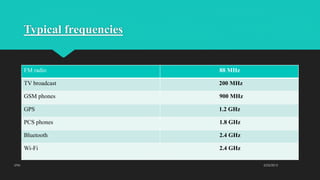
Typical frequencies
FM radio 88 MHz
TV broadcast 200 MHz
GSM phones 900 MHz
GPS 1.2 GHz
PCS phones 1.8 GHz
Bluetooth 2.4 GHz
Wi-Fi 2.4 GHz
2/23/2015UTM
Band width 2.4 is a free band also known as the ISM band , this band is given to the medicine
industry , institution to the scientific establishment with and a lot useful appliances have come out in
this frequency.
For instance , institutes like IIT in Delhi have laboratory where most of the experiments have been
designed around 2.4 GHz simply because it is a license free band.
Lets not be limited ourselves to 2.4 GHz there are frequency working at 28 GHz , 32 GHz, 40 GHz
and trial runs are being made at 100 GHz.
2/23/2015UTM
Example
Suppose that if we pump in 1 mili watt of power at 20 KHz it might go certain distance before getting
attenuated before reaching the receiver sensitivity, so wireless communication has work between A
and B which are not co-located they are separated by a distance otherwise there is no need of wireless
communication.
However if we need to communicate over large distance , one way is to increase the power but any
increase in the power comes at two specific costs :
 Money
 Radiation hazard
2/23/2015UTM
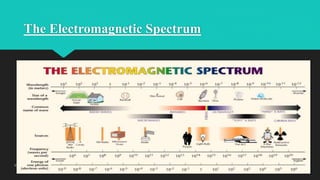
The Electromagnetic Spectrum
2/23/2015UTM
Since we are looking at the electromagnetic magnetic spectrum another way of doing wireless
communication is LIGHT . We can use simple visible light or infrared to do communication. All this
is indeed wireless communications we do not need wires at all .
What is the need to go to such high frequencies where attenuation is high..?
Today we are getting into more band width hungry applications , we not only want a SMS but also
MMS all these require a large band width . To go into a larger band width we have to translate
ourselves to upward to larger frequency . A higher band width will give you a larger data rate .
Therefore until the time we were using electromagnetic spectrum only for voice communication ,
lower frequencies were perfect .
2/23/2015UTM
Why wireless communication..?
Freedom from wires
 No cost of installing wires and no rewiring
 No branches of wires here and there
 “ Auto Magical “ instantaneous communications without physical connection ., Bluetooth , Wi-Fi
2/23/2015UTM
Global coverage
 Communication can reach where wiring is costly .,rural areas , old buildings , battlefields ,etc.
Stay connected
 Roaming allows flexibility to stay connected anywhere and any time.
 Rapid market growth
Flexibility
Services reach you wherever you go.
2/23/2015UTM
 Increasing dependence on telecommunication services for business and personal reason
 Consumers and business are wiling to pay for it.
 Basic Mantra : stay connected – anywhere , anytime .
2/23/2015UTM
Challenges
 Efficient hardware
low power Transmitters , Receivers
low power signal processing tool
 Efficient use of finite radio spectrum
 Integrated services
voice , data , multimedia over a single network services differentiation , priorities , resources
sharing
2/23/2015UTM
 Network support for user mobility .
 Maintaining quality of service over unreliable links
 Connectivity and coverage
 Cost efficiency
 Fading
 Higher probability of data corruption (hence need a stronger channel codes)
 Need for stronger security mechanism
2/23/2015UTM
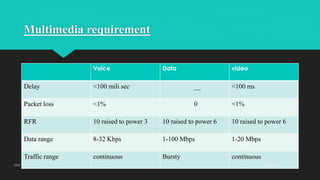
Multimedia requirement
Voice Data video
Delay <100 mili sec __ <100 ms
Packet loss <1% 0 <1%
RFR 10 raised to power 3 10 raised to power 6 10 raised to power 6
Data range 8-32 Kbps 1-100 Mbps 1-20 Mbps
Traffic range continuous Bursty continuous
2/23/2015UTM
Wireless vs Mobile
 Wireless do not necessarily mean mobile.
 Wireless systems may be:
- fixed
- portable
= mobile
2/23/2015UTM
THANK YOU
BY
SOMBARAN GUPTA
(R020112019)
4-SEMESTER
2/23/2015UTM

Wireless commication

  • 1.
  • 2.
    TABLE OF CONTENTS Overview  Current Wireless Systems  What is Wireless communication  Types of Wireless communication  The Wireless Spectrum  Why wireless communication ..? 2/23/2015UTM
  • 3.
    Overview Wireless communications isthe fastest growing segment of the communication industry. It has captured the attention of media and the imagination so of the public. Many new applications including wireless sensors networks, automated highways and factories, smart homes , factories , telemedicine are emerging research ideas to concrete the systems. The first wireless network was developed in the pre-industrial age. In 1895 ,Marconi first developed the first RADIO transmission. 2/23/2015UTM
  • 4.
    Wireless Vision The visionof wireless communication supporting information exchange between people or devices is the communication frontier of the next few decades. This vision will allow multimedia communication from any where in the world using a small handheld device or laptop. Wireless network will connect palmtop, laptop and desktop computers any where within an office building, campus as well as from the cafe corner. Wireless sensors have an enormous range of both commercial and military applications. There have been many failures along the way, including the first generation wireless LANs, the Iridium satellite system ,wide area data services such as Metricom and fixed wireless access to the homes 2/23/2015UTM
  • 5.
    What is wirelesscommunication ?  Wireless communication is transmitting/receiving voice and data using electromagnetic waves in open space.  The information from sender to receiver is carried over a well defined frequency band.  Each channel has a fixed frequency bandwidth and capacity ( bit rate).  Different channels can be used to transmit information in parallel and independently. 2/23/2015UTM
  • 6.
    Example Assume a spectrumof 120 KHz is allocated over a base frequency for communication between station A and B . Each channel occupies 40 KHz ..? 2/23/2015UTM
  • 7.
    Types of wirelesscommunication Basic broad level classification of wireless communication :  Mobile cellular phones (GSM /CDMA)  Portable Wi-Fi , UWB  Fixed wireless MAN 2/23/2015UTM
  • 8.
    Typical frequencies FM radio88 MHz TV broadcast 200 MHz GSM phones 900 MHz GPS 1.2 GHz PCS phones 1.8 GHz Bluetooth 2.4 GHz Wi-Fi 2.4 GHz 2/23/2015UTM
  • 9.
    Band width 2.4is a free band also known as the ISM band , this band is given to the medicine industry , institution to the scientific establishment with and a lot useful appliances have come out in this frequency. For instance , institutes like IIT in Delhi have laboratory where most of the experiments have been designed around 2.4 GHz simply because it is a license free band. Lets not be limited ourselves to 2.4 GHz there are frequency working at 28 GHz , 32 GHz, 40 GHz and trial runs are being made at 100 GHz. 2/23/2015UTM
  • 10.
    Example Suppose that ifwe pump in 1 mili watt of power at 20 KHz it might go certain distance before getting attenuated before reaching the receiver sensitivity, so wireless communication has work between A and B which are not co-located they are separated by a distance otherwise there is no need of wireless communication. However if we need to communicate over large distance , one way is to increase the power but any increase in the power comes at two specific costs :  Money  Radiation hazard 2/23/2015UTM
  • 11.
  • 12.
    Since we arelooking at the electromagnetic magnetic spectrum another way of doing wireless communication is LIGHT . We can use simple visible light or infrared to do communication. All this is indeed wireless communications we do not need wires at all . What is the need to go to such high frequencies where attenuation is high..? Today we are getting into more band width hungry applications , we not only want a SMS but also MMS all these require a large band width . To go into a larger band width we have to translate ourselves to upward to larger frequency . A higher band width will give you a larger data rate . Therefore until the time we were using electromagnetic spectrum only for voice communication , lower frequencies were perfect . 2/23/2015UTM
  • 13.
    Why wireless communication..? Freedomfrom wires  No cost of installing wires and no rewiring  No branches of wires here and there  “ Auto Magical “ instantaneous communications without physical connection ., Bluetooth , Wi-Fi 2/23/2015UTM
  • 14.
    Global coverage  Communicationcan reach where wiring is costly .,rural areas , old buildings , battlefields ,etc. Stay connected  Roaming allows flexibility to stay connected anywhere and any time.  Rapid market growth Flexibility Services reach you wherever you go. 2/23/2015UTM
  • 15.
     Increasing dependenceon telecommunication services for business and personal reason  Consumers and business are wiling to pay for it.  Basic Mantra : stay connected – anywhere , anytime . 2/23/2015UTM
  • 16.
    Challenges  Efficient hardware lowpower Transmitters , Receivers low power signal processing tool  Efficient use of finite radio spectrum  Integrated services voice , data , multimedia over a single network services differentiation , priorities , resources sharing 2/23/2015UTM
  • 17.
     Network supportfor user mobility .  Maintaining quality of service over unreliable links  Connectivity and coverage  Cost efficiency  Fading  Higher probability of data corruption (hence need a stronger channel codes)  Need for stronger security mechanism 2/23/2015UTM
  • 18.
    Multimedia requirement Voice Datavideo Delay <100 mili sec __ <100 ms Packet loss <1% 0 <1% RFR 10 raised to power 3 10 raised to power 6 10 raised to power 6 Data range 8-32 Kbps 1-100 Mbps 1-20 Mbps Traffic range continuous Bursty continuous 2/23/2015UTM
  • 19.
    Wireless vs Mobile Wireless do not necessarily mean mobile.  Wireless systems may be: - fixed - portable = mobile 2/23/2015UTM
  • 20.