BY
R.SRINIVASAN, DEEE, BE(EEE)
WIRELESS POWER TRANSMISSION
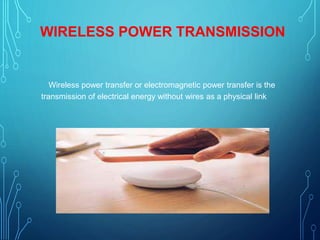
Wireless power transfer or electromagnetic power transfer is the
transmission of electrical energy without wires as a physical link
BASIC CONCEPT
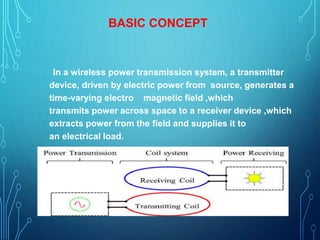
In a wireless power transmission system, a transmitter
device, driven by electric power from source, generates a
time-varying electro magnetic field ,which
transmits power across space to a receiver device ,which
extracts power from the field and supplies it to
an electrical load.
WIRE TECHNOLOGY
•As per studies, most electrical energy
transfer is through wires.
•Most of the energy loss is during
transmission On an average, more than
30% In India, it exceeds 40%.
WIRELLESS POWER
TRANSMISSION
•Reliable
•Environmentally Less sound
•Efficient
•To reduce the wiring.
•Can be Used for short-range or
long-range
HISTORY
Wireless Power Transmission
3/21/2013 5
⚫Nikola Tesla in late 1890s
proposed WPT concept
⚫Pioneer of induction techniques
⚫The 187 feet tall tower
⚫Accessible to everyone
⚫Government closed tower
INDUCTIVE COUPLING
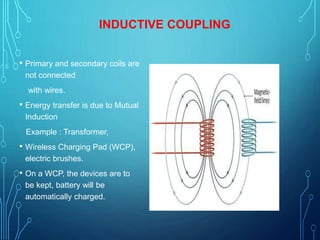
• Primary and secondary coils are
not connected
with wires.
• Energy transfer is due to Mutual
Induction
Example : Transformer,
• Wireless Charging Pad (WCP),
electric brushes.
• On a WCP, the devices are to
be kept, battery will be
automatically charged.
WITRICITY
•This project is based on RIC.
•It was led by Marvin professor from MIT
•In this project the energy was transferred
wirelessly for a distance just more than 2m.
• Efficiency achieved was around 40%
•Researches for decreasing the field strength and
to increase the range are in progress.
FAR-FIELD ENERGY
TRANSFER
• It aims at high power transfer.
• It can be a laser or microwave transmission.
• It needs line-of-sight.
• It is radiative in nature
MICROWAVE POWER TRANSMISSION
The Primary components of Wireless Power Transmission
are Microwave Generator, Transmitting antenna and. Receiving
antenna (Rectenna). A.1 Microwave Generator: It may be a
transmitter which emits microwave for mobile phone
communication. Or a. converter which converts electrical energy
into microwave.
LASER POWER TRANSMISSION
Laser power transmission (LPT) is one of the most promising
technologies in the long-range wireless power transfer field. LPT
research has been driven by the desire to remotely power unmanned
aerial vehicles, satellites, and other mobile electric facilities.
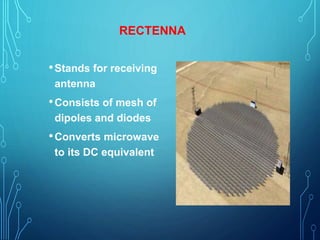
RECTENNA
•Stands for receiving
antenna
•Consists of mesh of
dipoles and diodes
•Converts microwave
to its DC equivalent
RECTENNA IN US
• Rectenna in US receives 5000MW of power from
SPS.
• It is about one and a half mile long
PROJECTS BASED ON WPT
• In 1993 a project was presented
about wireless power supply in
Alaska named "Alaska'21”.
• The system used for this
project consisted of a 2.45 GHz
phased array design. The
distances that should be
bridged are between 1 and 15
miles.
ALASKA’21
• The Grand Bassin project lead
by the local university will
supply electricity to a remote
isolated mountain village.
• A prototype was build and
presented at the Wireless
Power Transmission
conference in 2001, which was
held on the island.
DEVICES ON WIRELESS POWER
TRANSFER
• 1978 J.G. Bolger made United States an electric vehicle powered with
a system with the distance of 2meters and power of 20 kW.
• In 1981 Panasonic Corporation Wireless charger for electric
toothbrush.
• In 2011 Samsung introduced Droid Chargeback for mobile phones.
CONCLUSION
•In future transmission will be without wires.
•It would be more efficient.
•Low maintenance cost but high initial cost.
•Better than conventional wired transfer.
•Energy crisis can be decreased.
•In near future, world will be completely
wireless.
REFRENCES
• www.google.com
• www.wikipedia .com
• www.siemens.com
• www.spenergynetworks.co.uk
• https://www.prnewswire.com/
• https://ieeexplore.ieee.org/
• https://www.researchgate.net/
Wireless Power Transfer Technology

Wireless Power Transfer Technology

  • 1.
  • 2.
    WIRELESS POWER TRANSMISSION Wirelesspower transfer or electromagnetic power transfer is the transmission of electrical energy without wires as a physical link
  • 3.
    BASIC CONCEPT In awireless power transmission system, a transmitter device, driven by electric power from source, generates a time-varying electro magnetic field ,which transmits power across space to a receiver device ,which extracts power from the field and supplies it to an electrical load.
  • 4.
    WIRE TECHNOLOGY •As perstudies, most electrical energy transfer is through wires. •Most of the energy loss is during transmission On an average, more than 30% In India, it exceeds 40%.
  • 5.
    WIRELLESS POWER TRANSMISSION •Reliable •Environmentally Lesssound •Efficient •To reduce the wiring. •Can be Used for short-range or long-range
  • 6.
    HISTORY Wireless Power Transmission 3/21/20135 ⚫Nikola Tesla in late 1890s proposed WPT concept ⚫Pioneer of induction techniques ⚫The 187 feet tall tower ⚫Accessible to everyone ⚫Government closed tower
  • 7.
    INDUCTIVE COUPLING • Primaryand secondary coils are not connected with wires. • Energy transfer is due to Mutual Induction Example : Transformer, • Wireless Charging Pad (WCP), electric brushes. • On a WCP, the devices are to be kept, battery will be automatically charged.
  • 8.
    WITRICITY •This project isbased on RIC. •It was led by Marvin professor from MIT •In this project the energy was transferred wirelessly for a distance just more than 2m. • Efficiency achieved was around 40% •Researches for decreasing the field strength and to increase the range are in progress.
  • 9.
    FAR-FIELD ENERGY TRANSFER • Itaims at high power transfer. • It can be a laser or microwave transmission. • It needs line-of-sight. • It is radiative in nature
  • 10.
    MICROWAVE POWER TRANSMISSION ThePrimary components of Wireless Power Transmission are Microwave Generator, Transmitting antenna and. Receiving antenna (Rectenna). A.1 Microwave Generator: It may be a transmitter which emits microwave for mobile phone communication. Or a. converter which converts electrical energy into microwave.
  • 11.
    LASER POWER TRANSMISSION Laserpower transmission (LPT) is one of the most promising technologies in the long-range wireless power transfer field. LPT research has been driven by the desire to remotely power unmanned aerial vehicles, satellites, and other mobile electric facilities.
  • 12.
    RECTENNA •Stands for receiving antenna •Consistsof mesh of dipoles and diodes •Converts microwave to its DC equivalent
  • 13.
    RECTENNA IN US •Rectenna in US receives 5000MW of power from SPS. • It is about one and a half mile long
  • 14.
    PROJECTS BASED ONWPT • In 1993 a project was presented about wireless power supply in Alaska named "Alaska'21”. • The system used for this project consisted of a 2.45 GHz phased array design. The distances that should be bridged are between 1 and 15 miles.
  • 15.
    ALASKA’21 • The GrandBassin project lead by the local university will supply electricity to a remote isolated mountain village. • A prototype was build and presented at the Wireless Power Transmission conference in 2001, which was held on the island.
  • 16.
    DEVICES ON WIRELESSPOWER TRANSFER • 1978 J.G. Bolger made United States an electric vehicle powered with a system with the distance of 2meters and power of 20 kW. • In 1981 Panasonic Corporation Wireless charger for electric toothbrush. • In 2011 Samsung introduced Droid Chargeback for mobile phones.
  • 17.
    CONCLUSION •In future transmissionwill be without wires. •It would be more efficient. •Low maintenance cost but high initial cost. •Better than conventional wired transfer. •Energy crisis can be decreased. •In near future, world will be completely wireless.
  • 18.
    REFRENCES • www.google.com • www.wikipedia.com • www.siemens.com • www.spenergynetworks.co.uk • https://www.prnewswire.com/ • https://ieeexplore.ieee.org/ • https://www.researchgate.net/