Investing
- tame your fears and grow
          Gwen Becker, CIM, CFP, FCSI
  Vice-President, Associate Portfolio Manager
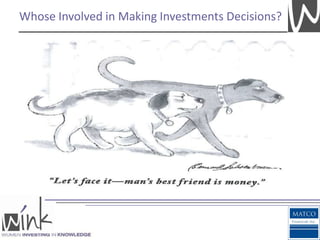
Whose Involved in Making Investments Decisions?
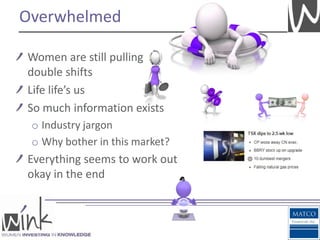
Overwhelmed

Women are still pulling
double shifts
Life life’s us
So much information exists
 o Industry jargon
 o Why bother in this market?
Everything seems to work out
okay in the end
The Factual Conversation
           Women influence 70% of consumer spending decisions in this
           country1
           In the next 10 to 20 years, many boomer women will inherit
           wealth twice – from their parents and their spouse1
           82% of Canadian wealth will eventually be managed by women1
           70% of women switch advisors after the death of a spouse1
           Average age of a widow is 562
           According to one Cornell study, 10 trillion dollars in inheritance
           will pass to baby boomers between now and 2040 – majority of
           inheritors will be women2
1   Source: TDWIS Newnet Article obtaining an uncommon understanding of your client interview with Dave Pickett: The Rise of High Net Worth Female Investors
2   Source: My Money Mindset (www.mymoneymindset.com) by Dr. Deborah Nixon
The Factual Conversation
        Women have been raised to be the keepers of the household
        purse, not the income generators. That legacy lives on for the majority
        of the population. Budgeting, borrowing and everyday saving is not a
        primary struggle for women – wise investing is.2
        Women want a financial advisement process that accounts for her
        heart, not her ego. In other words, a process that incorporates her
        feelings, her perceptions, her life situation and her desires to take care
        of others.2
        Two-thirds of women are single by the time they hit age 65—either
        because they never married, their spouses pass away, or they
        divorce.2
        Don’t know what you don’t know. Start with what should I know?
1   Source: TDWIS Newnet Article obtaining an uncommon understanding of your client interview with Dave Pickett: The Rise of High Net Worth Female Investors
2   Source: My Money Mindset (www.mymoneymindset.com) by Dr. Deborah Nixon
Solutions To Challenges
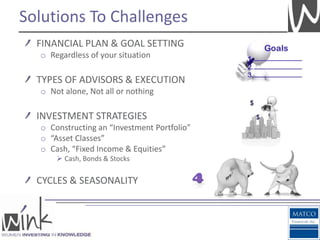
  FINANCIAL PLAN & GOAL SETTING
  o Regardless of your situation

  TYPES OF ADVISORS & EXECUTION
  o Not alone, Not all or nothing

  INVESTMENT STRATEGIES
  o Constructing an “Investment Portfolio”
  o “Asset Classes”
  o Cash, “Fixed Income & Equities”
       Cash, Bonds & Stocks


  CYCLES & SEASONALITY
Written Financial Plan -
30% of Women Have One

 Budget (www.mint.com)
 Cash Flow
 Goals vs. Ability
 Net Worth Statement
 Projected Net Worth
 Report Card       "You've got to be very
                        careful if you don't know
                        where you are going
                        because you might not get
                        there." Yogi Bear
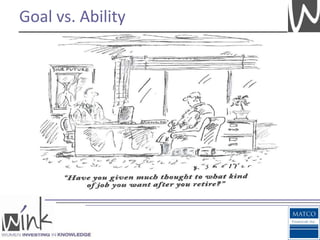
Goal vs. Ability
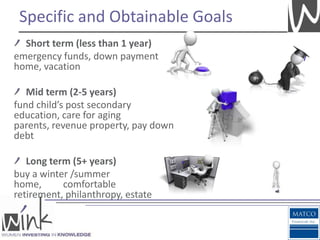
Specific and Obtainable Goals
  Short term (less than 1 year)
emergency funds, down payment
home, vacation

   Mid term (2-5 years)
fund child’s post secondary
education, care for aging
parents, revenue property, pay down
debt

   Long term (5+ years)
buy a winter /summer
home,      comfortable
retirement, philanthropy, estate
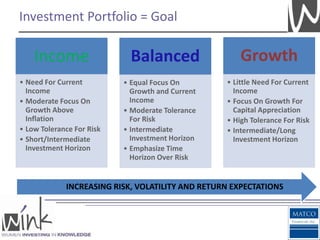
Investment Portfolio = Goal

    Income                   Balanced                 Growth
• Need For Current         • Equal Focus On       • Little Need For Current
  Income                     Growth and Current     Income
• Moderate Focus On          Income               • Focus On Growth For
  Growth Above             • Moderate Tolerance     Capital Appreciation
  Inflation                  For Risk             • High Tolerance For Risk
• Low Tolerance For Risk   • Intermediate         • Intermediate/Long
• Short/Intermediate         Investment Horizon     Investment Horizon
  Investment Horizon       • Emphasize Time
                             Horizon Over Risk


             INCREASING RISK, VOLATILITY AND RETURN EXPECTATIONS
Constructing an Investment Portfolio


       Diversification of Asset
       Classes
       Participating in the gains
       while managing the
       down side risk
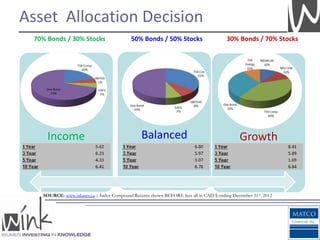
Asset Allocation Decision
 70% Bonds / 30% Stocks                    50% Bonds / 50% Stocks                      30% Bonds / 70% Stocks


     Income                                     Balanced                                     Growth


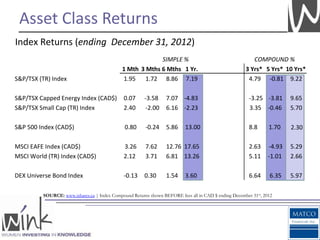
   SOURCE: www.ishares.ca | Index Compound Returns shown BEFORE fees all in CAD $ ending December 31st, 2012
Asset Class Returns
Index Returns (ending December 31, 2012)
                                                          SIMPLE %                                      COMPOUND %
                                             1 Mth 3 Mths 6 Mths 1 Yr.                               3 Yrs* 5 Yrs* 10 Yrs*
S&P/TSX (TR) Index                           1.95 1.72 8.86 7.19                                      4.79 -0.81 9.22

S&P/TSX Capped Energy Index (CAD$)           0.07      -3.58     7.07 -4.83                            -3.25 -3.81      9.65
S&P/TSX Small Cap (TR) Index                 2.40      -2.00     6.16 -2.23                            3.35 -0.46       5.70

S&P 500 Index (CAD$)                          0.80     -0.24     5.86     13.00                        8.8      1.70    2.30

MSCI EAFE Index (CAD$)                       3.26      7.62      12.76 17.65                           2.63     -4.93   5.29
MSCI World (TR) Index (CAD$)                 2.12      3.71      6.81 13.26                            5.11     -1.01   2.66

DEX Universe Bond Index                      -0.13     0.30      1.54     3.60                         6.64     6.35    5.97

         SOURCE: www.ishares.ca | Index Compound Returns shown BEFORE fees all in CAD $ ending December 31st, 2012
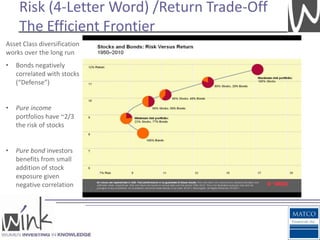
Risk (4-Letter Word) /Return Trade-Off
     The Efficient Frontier
Asset Class diversification
works over the long run
•   Bonds negatively
    correlated with stocks
    (“Defense”)


•   Pure income
    portfolios have ~2/3
    the risk of stocks


•   Pure bond investors
    benefits from small
    addition of stock
    exposure given
    negative correlation
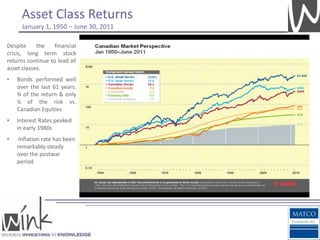
Asset Class Returns
      January 1, 1950 – June 30, 2011

Despite     the    financial
crisis, long term stock
returns continue to lead all
asset classes.
•   Bonds performed well
    over the last 61 years.
    ¾ of the return & only
    ¼ of the risk vs.
    Canadian Equities
•   Interest Rates peaked
    in early 1980s
•    Inflation rate has been
    remarkably steady
    over the postwar
    period
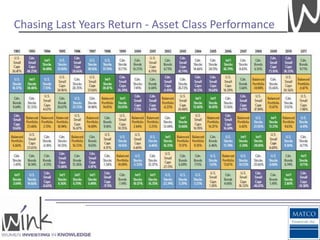
Chasing Last Years Return - Asset Class Performance
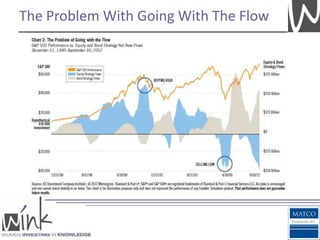
The Problem With Going With The Flow
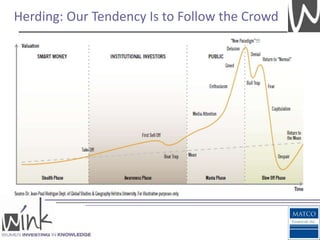
Herding: Our Tendency Is to Follow the Crowd
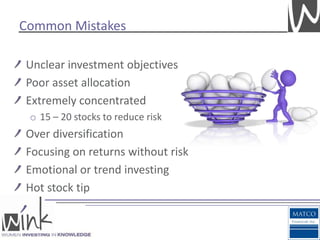
Common Mistakes

Unclear investment objectives
Poor asset allocation
Extremely concentrated
 o 15 – 20 stocks to reduce risk
Over diversification
Focusing on returns without risk
Emotional or trend investing
Hot stock tip
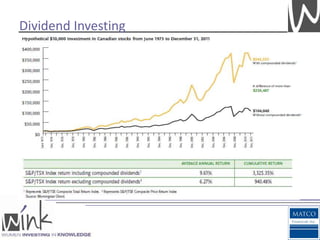
Dividend Investing
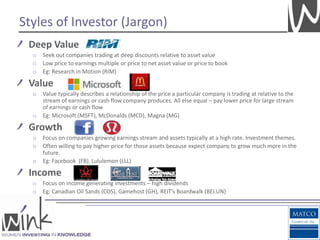
Styles of Investor (Jargon)
 Deep Value
  o   Seek out companies trading at deep discounts relative to asset value
  o   Low price to earnings multiple or price to net asset value or price to book
  o   Eg: Research in Motion (RIM)

 Value
  o   Value typically describes a relationship of the price a particular company is trading at relative to the
      stream of earnings or cash flow company produces. All else equal – pay lower price for large stream
      of earnings or cash flow
  o   Eg: Microsoft (MSFT), McDonalds (MCD), Magna (MG)

 Growth
  o   Focus on companies growing earnings stream and assets typically at a high rate. Investment themes.
  o   Often willing to pay higher price for those assets because expect company to grow much more in the
      future.
  o   Eg: Facebook (FB), Lululemon (LLL)

 Income
  o   Focus on income generating investments – high dividends
  o   Eg: Canadian Oil Sands (COS), Gamehost (GH), REIT’s Boardwalk (BEI.UN)
Cycles & Seasonality


                 “My ears cannot listen longer than my
                 behind can endure”
                                       -Ambrose Bierce
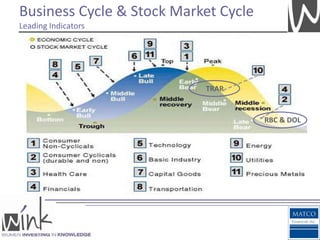
Business Cycle & Stock Market Cycle
Leading Indicators


                           TRAP


                                      RBC & DOL
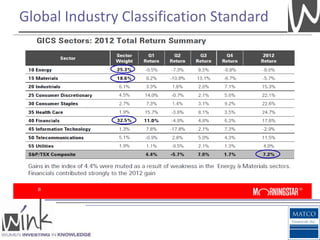
Global Industry Classification Standard
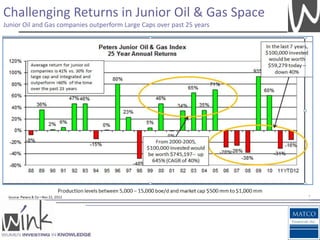
Challenging Returns in Junior Oil & Gas Space
Junior Oil and Gas companies outperform Large Caps over past 25 years
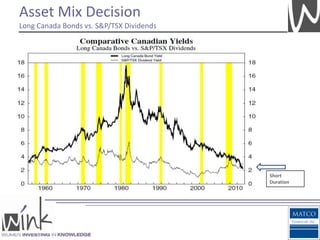
Asset Mix Decision
Long Canada Bonds vs. S&P/TSX Dividends


                                          Short
                                          Duration
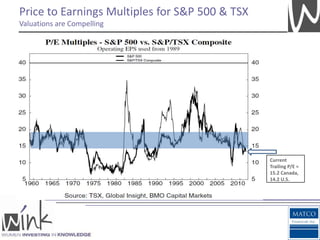
Price to Earnings Multiples for S&P 500 & TSX
Valuations are Compelling


                                                Current
                                                Trailing P/E =
                                                15.2 Canada,
                                                14.2 U.S.
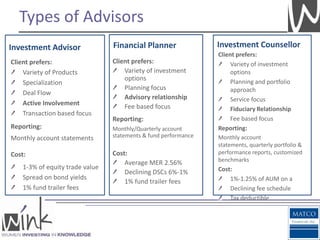
Types of Advisors
Investment Advisor               Financial Planner               Investment Counsellor
                                                                 Client prefers:
Client prefers:                  Client prefers:                      Variety of investment
    Variety of Products              Variety of investment            options
                                     options                          Planning and portfolio
    Specialization
                                     Planning focus                   approach
    Deal Flow
                                     Advisory relationship            Service focus
    Active Involvement               Fee based focus                  Fiduciary Relationship
    Transaction based focus
                                 Reporting:                           Fee based focus
Reporting:                       Monthly/Quarterly account       Reporting:
Monthly account statements       statements & fund performance   Monthly account
                                                                 statements, quarterly portfolio &
Cost:                            Cost:                           performance reports, customized
                                     Average MER 2.56%           benchmarks
    1-3% of equity trade value                                   Cost:
                                     Declining DSCs 6%-1%
    Spread on bond yields                                            1%-1.25% of AUM on a
                                     1% fund trailer fees
    1% fund trailer fees                                             Declining fee schedule
                                                                     Tax deductible
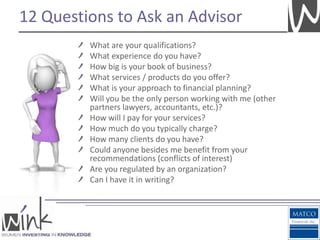
12 Questions to Ask an Advisor
         What are your qualifications?
         What experience do you have?
         How big is your book of business?
         What services / products do you offer?
         What is your approach to financial planning?
         Will you be the only person working with me (other
         partners lawyers, accountants, etc.)?
         How will I pay for your services?
         How much do you typically charge?
         How many clients do you have?
         Could anyone besides me benefit from your
         recommendations (conflicts of interest)
         Are you regulated by an organization?
         Can I have it in writing?
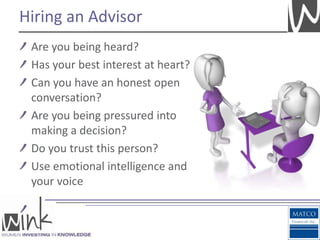
Hiring an Advisor
 Are you being heard?
 Has your best interest at heart?
 Can you have an honest open
 conversation?
 Are you being pressured into
 making a decision?
 Do you trust this person?
 Use emotional intelligence and
 your voice
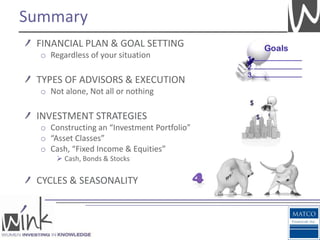
Summary
 FINANCIAL PLAN & GOAL SETTING
  o Regardless of your situation

 TYPES OF ADVISORS & EXECUTION
  o Not alone, Not all or nothing

 INVESTMENT STRATEGIES
  o Constructing an “Investment Portfolio”
  o “Asset Classes”
  o Cash, “Fixed Income & Equities”
       Cash, Bonds & Stocks


 CYCLES & SEASONALITY
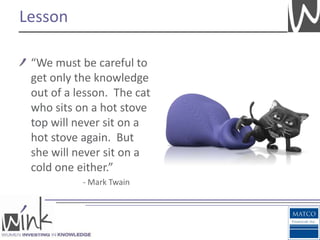
Lesson

 “We must be careful to
 get only the knowledge
 out of a lesson. The cat
 who sits on a hot stove
 top will never sit on a
 hot stove again. But
 she will never sit on a
 cold one either.”
           - Mark Twain
Questions & Answers
Personal & Private

Here until 2:00 ish

Or…….
Contact Information
  Email: gbecker@matcofinancial.ca

  Call: 403-718-2125

  Blog: www.matcofinancialinc.com

  Twitter: @Gwenbecker

  Website: www.winkcalgary.com

  WINK Facebook and LinkedIn Pages

  Survey Monkey        Honest Criticism is hard to take,
                       Particularly from a relative, a friend,
                       an acquaintance, or a stranger”
                                                  -Franklin P. Jones
Thank You
 Guests
 Directors
 Family, Friends & Matco
 BLG conference room
 Door Prize donated by Studio
 Gorgeous
 Next Speaker
 –Sharon Gray “Evaluating Assets”
Disclaimer
For your information:
MATCO FINANCIAL INC. is a privately owned and independent wealth management
    office. The material presented is intended to provide information to Matco
    Financial clients, contacts and affiliates. Readers should not act on this
    information without first consulting their investment advisor, tax advisor, financial
    planner or lawyer. This communication does not constitute an offer or solicitation
    by anyone in any jurisdiction in which such an offer or solicitation is not
    authorized or to any person to whom it is unlawful to make such an offer or
    solicitation.
    Management fees, commissions, and expenses may be associated with
    investment management services and mutual fund investments. Before
    investing, please read the applicable information such as the prospectus, which
    contains detailed investment information and is available from your advisor. Most
    marketable securities such as mutual funds are not guaranteed or insured, their
    values change frequently and past performance may not be repeated. All
    statements that look forward in time or include anything other than historical
    information are subject to risks and uncertainties, and are not guarantees of
    future performance. Investors should not rely on forward-looking statements.
    Actual results, actions or events, could differ materially from those set forth in the
    forward-looking statements.
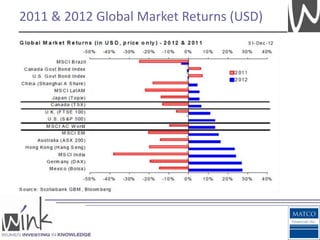
2011 & 2012 Global Market Returns (USD)
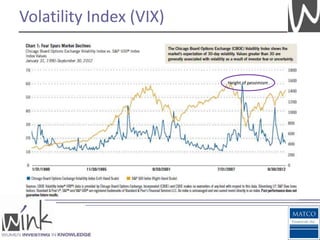
Volatility Index (VIX)


                         Height of pessimism
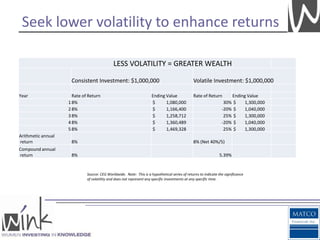
Seek lower volatility to enhance returns

                                             LESS VOLATILITY = GREATER WEALTH

                     Consistent Investment: $1,000,000                                         Volatile Investment: $1,000,000

Year                  Rate of Return                                 Ending Value              Rate of Return        Ending Value
                    1 8%                                             $      1,080,000                             30% $    1,300,000
                    2 8%                                             $      1,166,400                            -20% $    1,040,000
                    3 8%                                             $      1,258,712                             25% $    1,300,000
                    4 8%                                             $      1,360,489                            -20% $    1,040,000
                    5 8%                                             $      1,469,328                             25% $    1,300,000
Arithmetic annual
return               8%                                                                        8% (Net 40%/5)
Compound annual
return               8%                                                                                         5.39%


                             Source: CEG Worldwide. Note: This is a hypothetical series of returns to indicate the significance
                             of volatility and does not represent any specific investments at any specific time.
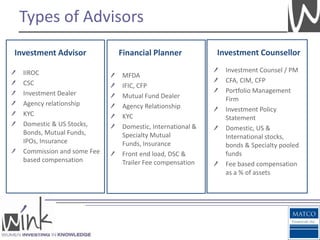
Types of Advisors
Investment Advisor          Financial Planner           Investment Counsellor

  IIROC                                                   Investment Counsel / PM
                            MFDA
  CSC                                                     CFA, CIM, CFP
                            IFIC, CFP
  Investment Dealer                                       Portfolio Management
                            Mutual Fund Dealer            Firm
  Agency relationship       Agency Relationship           Investment Policy
  KYC                       KYC                           Statement
  Domestic & US Stocks,     Domestic, International &     Domestic, US &
  Bonds, Mutual Funds,      Specialty Mutual              International stocks,
  IPOs, Insurance           Funds, Insurance              bonds & Specialty pooled
  Commission and some Fee   Front end load, DSC &         funds
  based compensation        Trailer Fee compensation      Fee based compensation
                                                          as a % of assets
Investor vs. Trader (doesn’t work with a Plan)
  Fundamental (Buy and Hold)
   o Look at everything from financial statements, industry statistics to
     broader economic environment to gain insight on company’s future
     performance
  Technical (Active)
   o Study historical stock price and market behaviour. Look for recurring
     patterns in charts to time purchases and sales of securities
  Quantitative
   o Screens and factors based on metrics and ratios drive investment
     selections. Agnostic to company specifics often
  Top Down vs. Bottom Up
   o Focus on macro environment or company specific
Current Asset Mix (tactical)

        Underweight Bonds

        Overweight Equities (Stocks)

        Market Weight (Canadian Equities)

        Overweight (Global Equities US in particular)
Market Outlook
 Bond Bull Ends
 Dividend growth over income
 China – Looking to Regain its Swagger
 Europe – Back from the Brink
 US Energy Independence
 LNG – Closer to reality
 US Recovery Gains Traction
 Canada Faces Headwinds
 Canadian Housing Feels the Chill
 Valuations Expand

Investing - Taming Your Fears

  • 1.
    Investing - tame yourfears and grow Gwen Becker, CIM, CFP, FCSI Vice-President, Associate Portfolio Manager
  • 2.
    Whose Involved inMaking Investments Decisions?
  • 3.
    Overwhelmed Women are stillpulling double shifts Life life’s us So much information exists o Industry jargon o Why bother in this market? Everything seems to work out okay in the end
  • 4.
    The Factual Conversation Women influence 70% of consumer spending decisions in this country1 In the next 10 to 20 years, many boomer women will inherit wealth twice – from their parents and their spouse1 82% of Canadian wealth will eventually be managed by women1 70% of women switch advisors after the death of a spouse1 Average age of a widow is 562 According to one Cornell study, 10 trillion dollars in inheritance will pass to baby boomers between now and 2040 – majority of inheritors will be women2 1 Source: TDWIS Newnet Article obtaining an uncommon understanding of your client interview with Dave Pickett: The Rise of High Net Worth Female Investors 2 Source: My Money Mindset (www.mymoneymindset.com) by Dr. Deborah Nixon
  • 5.
    The Factual Conversation Women have been raised to be the keepers of the household purse, not the income generators. That legacy lives on for the majority of the population. Budgeting, borrowing and everyday saving is not a primary struggle for women – wise investing is.2 Women want a financial advisement process that accounts for her heart, not her ego. In other words, a process that incorporates her feelings, her perceptions, her life situation and her desires to take care of others.2 Two-thirds of women are single by the time they hit age 65—either because they never married, their spouses pass away, or they divorce.2 Don’t know what you don’t know. Start with what should I know? 1 Source: TDWIS Newnet Article obtaining an uncommon understanding of your client interview with Dave Pickett: The Rise of High Net Worth Female Investors 2 Source: My Money Mindset (www.mymoneymindset.com) by Dr. Deborah Nixon
  • 6.
    Solutions To Challenges FINANCIAL PLAN & GOAL SETTING o Regardless of your situation TYPES OF ADVISORS & EXECUTION o Not alone, Not all or nothing INVESTMENT STRATEGIES o Constructing an “Investment Portfolio” o “Asset Classes” o Cash, “Fixed Income & Equities”  Cash, Bonds & Stocks CYCLES & SEASONALITY
  • 7.
    Written Financial Plan- 30% of Women Have One Budget (www.mint.com) Cash Flow Goals vs. Ability Net Worth Statement Projected Net Worth Report Card "You've got to be very careful if you don't know where you are going because you might not get there." Yogi Bear
  • 8.
  • 9.
    Specific and ObtainableGoals Short term (less than 1 year) emergency funds, down payment home, vacation Mid term (2-5 years) fund child’s post secondary education, care for aging parents, revenue property, pay down debt Long term (5+ years) buy a winter /summer home, comfortable retirement, philanthropy, estate
  • 10.
    Investment Portfolio =Goal Income Balanced Growth • Need For Current • Equal Focus On • Little Need For Current Income Growth and Current Income • Moderate Focus On Income • Focus On Growth For Growth Above • Moderate Tolerance Capital Appreciation Inflation For Risk • High Tolerance For Risk • Low Tolerance For Risk • Intermediate • Intermediate/Long • Short/Intermediate Investment Horizon Investment Horizon Investment Horizon • Emphasize Time Horizon Over Risk INCREASING RISK, VOLATILITY AND RETURN EXPECTATIONS
  • 11.
    Constructing an InvestmentPortfolio Diversification of Asset Classes Participating in the gains while managing the down side risk
  • 12.
    Asset Allocation Decision 70% Bonds / 30% Stocks 50% Bonds / 50% Stocks 30% Bonds / 70% Stocks Income Balanced Growth SOURCE: www.ishares.ca | Index Compound Returns shown BEFORE fees all in CAD $ ending December 31st, 2012
  • 13.
    Asset Class Returns IndexReturns (ending December 31, 2012) SIMPLE % COMPOUND % 1 Mth 3 Mths 6 Mths 1 Yr. 3 Yrs* 5 Yrs* 10 Yrs* S&P/TSX (TR) Index 1.95 1.72 8.86 7.19 4.79 -0.81 9.22 S&P/TSX Capped Energy Index (CAD$) 0.07 -3.58 7.07 -4.83 -3.25 -3.81 9.65 S&P/TSX Small Cap (TR) Index 2.40 -2.00 6.16 -2.23 3.35 -0.46 5.70 S&P 500 Index (CAD$) 0.80 -0.24 5.86 13.00 8.8 1.70 2.30 MSCI EAFE Index (CAD$) 3.26 7.62 12.76 17.65 2.63 -4.93 5.29 MSCI World (TR) Index (CAD$) 2.12 3.71 6.81 13.26 5.11 -1.01 2.66 DEX Universe Bond Index -0.13 0.30 1.54 3.60 6.64 6.35 5.97 SOURCE: www.ishares.ca | Index Compound Returns shown BEFORE fees all in CAD $ ending December 31st, 2012
  • 14.
    Risk (4-Letter Word)/Return Trade-Off The Efficient Frontier Asset Class diversification works over the long run • Bonds negatively correlated with stocks (“Defense”) • Pure income portfolios have ~2/3 the risk of stocks • Pure bond investors benefits from small addition of stock exposure given negative correlation
  • 15.
    Asset Class Returns January 1, 1950 – June 30, 2011 Despite the financial crisis, long term stock returns continue to lead all asset classes. • Bonds performed well over the last 61 years. ¾ of the return & only ¼ of the risk vs. Canadian Equities • Interest Rates peaked in early 1980s • Inflation rate has been remarkably steady over the postwar period
  • 16.
    Chasing Last YearsReturn - Asset Class Performance
  • 17.
    The Problem WithGoing With The Flow
  • 18.
    Herding: Our TendencyIs to Follow the Crowd
  • 19.
    Common Mistakes Unclear investmentobjectives Poor asset allocation Extremely concentrated o 15 – 20 stocks to reduce risk Over diversification Focusing on returns without risk Emotional or trend investing Hot stock tip
  • 20.
  • 21.
    Styles of Investor(Jargon) Deep Value o Seek out companies trading at deep discounts relative to asset value o Low price to earnings multiple or price to net asset value or price to book o Eg: Research in Motion (RIM) Value o Value typically describes a relationship of the price a particular company is trading at relative to the stream of earnings or cash flow company produces. All else equal – pay lower price for large stream of earnings or cash flow o Eg: Microsoft (MSFT), McDonalds (MCD), Magna (MG) Growth o Focus on companies growing earnings stream and assets typically at a high rate. Investment themes. o Often willing to pay higher price for those assets because expect company to grow much more in the future. o Eg: Facebook (FB), Lululemon (LLL) Income o Focus on income generating investments – high dividends o Eg: Canadian Oil Sands (COS), Gamehost (GH), REIT’s Boardwalk (BEI.UN)
  • 22.
    Cycles & Seasonality “My ears cannot listen longer than my behind can endure” -Ambrose Bierce
  • 23.
    Business Cycle &Stock Market Cycle Leading Indicators TRAP RBC & DOL
  • 24.
  • 25.
    Challenging Returns inJunior Oil & Gas Space Junior Oil and Gas companies outperform Large Caps over past 25 years
  • 26.
    Asset Mix Decision LongCanada Bonds vs. S&P/TSX Dividends Short Duration
  • 27.
    Price to EarningsMultiples for S&P 500 & TSX Valuations are Compelling Current Trailing P/E = 15.2 Canada, 14.2 U.S.
  • 28.
    Types of Advisors InvestmentAdvisor Financial Planner Investment Counsellor Client prefers: Client prefers: Client prefers: Variety of investment Variety of Products Variety of investment options options Planning and portfolio Specialization Planning focus approach Deal Flow Advisory relationship Service focus Active Involvement Fee based focus Fiduciary Relationship Transaction based focus Reporting: Fee based focus Reporting: Monthly/Quarterly account Reporting: Monthly account statements statements & fund performance Monthly account statements, quarterly portfolio & Cost: Cost: performance reports, customized Average MER 2.56% benchmarks 1-3% of equity trade value Cost: Declining DSCs 6%-1% Spread on bond yields 1%-1.25% of AUM on a 1% fund trailer fees 1% fund trailer fees Declining fee schedule Tax deductible
  • 29.
    12 Questions toAsk an Advisor What are your qualifications? What experience do you have? How big is your book of business? What services / products do you offer? What is your approach to financial planning? Will you be the only person working with me (other partners lawyers, accountants, etc.)? How will I pay for your services? How much do you typically charge? How many clients do you have? Could anyone besides me benefit from your recommendations (conflicts of interest) Are you regulated by an organization? Can I have it in writing?
  • 30.
    Hiring an Advisor Are you being heard? Has your best interest at heart? Can you have an honest open conversation? Are you being pressured into making a decision? Do you trust this person? Use emotional intelligence and your voice
  • 31.
    Summary FINANCIAL PLAN& GOAL SETTING o Regardless of your situation TYPES OF ADVISORS & EXECUTION o Not alone, Not all or nothing INVESTMENT STRATEGIES o Constructing an “Investment Portfolio” o “Asset Classes” o Cash, “Fixed Income & Equities”  Cash, Bonds & Stocks CYCLES & SEASONALITY
  • 32.
    Lesson “We mustbe careful to get only the knowledge out of a lesson. The cat who sits on a hot stove top will never sit on a hot stove again. But she will never sit on a cold one either.” - Mark Twain
  • 33.
    Questions & Answers Personal& Private Here until 2:00 ish Or…….
  • 34.
    Contact Information Email: gbecker@matcofinancial.ca Call: 403-718-2125 Blog: www.matcofinancialinc.com Twitter: @Gwenbecker Website: www.winkcalgary.com WINK Facebook and LinkedIn Pages Survey Monkey Honest Criticism is hard to take, Particularly from a relative, a friend, an acquaintance, or a stranger” -Franklin P. Jones
  • 35.
    Thank You Guests Directors Family, Friends & Matco BLG conference room Door Prize donated by Studio Gorgeous Next Speaker –Sharon Gray “Evaluating Assets”
  • 36.
    Disclaimer For your information: MATCOFINANCIAL INC. is a privately owned and independent wealth management office. The material presented is intended to provide information to Matco Financial clients, contacts and affiliates. Readers should not act on this information without first consulting their investment advisor, tax advisor, financial planner or lawyer. This communication does not constitute an offer or solicitation by anyone in any jurisdiction in which such an offer or solicitation is not authorized or to any person to whom it is unlawful to make such an offer or solicitation. Management fees, commissions, and expenses may be associated with investment management services and mutual fund investments. Before investing, please read the applicable information such as the prospectus, which contains detailed investment information and is available from your advisor. Most marketable securities such as mutual funds are not guaranteed or insured, their values change frequently and past performance may not be repeated. All statements that look forward in time or include anything other than historical information are subject to risks and uncertainties, and are not guarantees of future performance. Investors should not rely on forward-looking statements. Actual results, actions or events, could differ materially from those set forth in the forward-looking statements.
  • 37.
    2011 & 2012Global Market Returns (USD)
  • 38.
    Volatility Index (VIX) Height of pessimism
  • 39.
    Seek lower volatilityto enhance returns LESS VOLATILITY = GREATER WEALTH Consistent Investment: $1,000,000 Volatile Investment: $1,000,000 Year Rate of Return Ending Value Rate of Return Ending Value 1 8% $ 1,080,000 30% $ 1,300,000 2 8% $ 1,166,400 -20% $ 1,040,000 3 8% $ 1,258,712 25% $ 1,300,000 4 8% $ 1,360,489 -20% $ 1,040,000 5 8% $ 1,469,328 25% $ 1,300,000 Arithmetic annual return 8% 8% (Net 40%/5) Compound annual return 8% 5.39% Source: CEG Worldwide. Note: This is a hypothetical series of returns to indicate the significance of volatility and does not represent any specific investments at any specific time.
  • 40.
    Types of Advisors InvestmentAdvisor Financial Planner Investment Counsellor IIROC Investment Counsel / PM MFDA CSC CFA, CIM, CFP IFIC, CFP Investment Dealer Portfolio Management Mutual Fund Dealer Firm Agency relationship Agency Relationship Investment Policy KYC KYC Statement Domestic & US Stocks, Domestic, International & Domestic, US & Bonds, Mutual Funds, Specialty Mutual International stocks, IPOs, Insurance Funds, Insurance bonds & Specialty pooled Commission and some Fee Front end load, DSC & funds based compensation Trailer Fee compensation Fee based compensation as a % of assets
  • 41.
    Investor vs. Trader(doesn’t work with a Plan) Fundamental (Buy and Hold) o Look at everything from financial statements, industry statistics to broader economic environment to gain insight on company’s future performance Technical (Active) o Study historical stock price and market behaviour. Look for recurring patterns in charts to time purchases and sales of securities Quantitative o Screens and factors based on metrics and ratios drive investment selections. Agnostic to company specifics often Top Down vs. Bottom Up o Focus on macro environment or company specific
  • 42.
    Current Asset Mix(tactical) Underweight Bonds Overweight Equities (Stocks) Market Weight (Canadian Equities) Overweight (Global Equities US in particular)
  • 43.
    Market Outlook BondBull Ends Dividend growth over income China – Looking to Regain its Swagger Europe – Back from the Brink US Energy Independence LNG – Closer to reality US Recovery Gains Traction Canada Faces Headwinds Canadian Housing Feels the Chill Valuations Expand

Editor's Notes

  • #4 Media, Internet, PaperTimeLife eventsPuts, Calls, Hedge Funds, Acronyms,
  • #10 Use example from audience.
  • #12 Diversification15 – 25 stocks
  • #15 Efficient Frontier
  • #17 Choose a color – no single asset class performs at the top year after year.
  • #20 Poor asset allocationNo blueprintExtremely concentratedFocus on one asset class or sector etc.Over diversificationQuantity over qualityEmotional Investing
  • #21 Companies have better corporate disciplineInvestors ran to yield trade
  • #22 Value – 2 – 3% dividendGrowth 60 x multiple, no earnings, high expectations, past company Nortel, typically TechIncome- old royalty trust spinning out 10 – 14% dividends. Now 6 – 7%, little room for growthFacebook IPO’s at 67x P/E multiple – even now, close to 51x Forward . Lulu – 50x P/E
  • #24 Value of advice, takes the emotion out of it. Trough of economic cycle buy Dollorama, Alcohol, Tobacco
  • #26 If you had invested $100,000 in 2006 into the Jr. Oil and gas space, it would be worth $59,279 currently – Down 40% over the 7 years!CAGR of -7.3% per annum – but volatility has been significantContrast this with the period 2000 – 2005 which saw $100,000 grow to $745,197 or a CAGR of 40%
  • #27 First cross over in 60 yearsBonds are fear trade, piling back into bonds, not a good sign
  • #42 Fundamental analysis considers anything that goes beyond trading on the equity markets to determine price changes. Information, such as the outlook on the national economy, short and long-term prospects of different industries and capital market conditions all influence a company's stock performance. Financial ratios that measure a company's financial health help determine whether a company is worth investing in. For example, the price-earnings ratio, (or "P/E") one of the most commonly used ratios, shows what a company's stock is worth in relation to its competitors.Technical analysis, however, studies the historical stock prices and stock market behaviour. Although it's often overlooked by "fundamentalists" who believe that the process is too cumbersome and time consuming, technical research recognizes recurring patterns that may emerge with stock performance. Technical research, which is concerned with stock indices and trends, studies price movements of advancing or declining stocks in conjunction with trading volumes. By observing these price fluctuations, it may be possible to determine when it's a good time to buy or sell stock