Ferro Financial, LLC
        CLIENT EDUCATION SERIES
                              MARKET OVERVIEW
                                 SESSION 1


2121 N. Causeway Blvd Suite
160                           Ferro Financial, LLC
Metairie, LA 70001
Objectives of Presentation

• Provide a Basic Understanding of Capital
Markets
• Discuss Portfolio Construction
• The Importance of Diversifying Among Asset
  Classes
• Market Volatility and Long Term Investing
• Ferro Financial, LLC Investment Philosophy
Understanding the markets

    Stock
   Market
    Bond
   Market
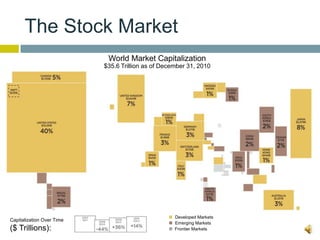
The Stock Market
                                    World Market Capitalization
                                   $35.6 Trillion as of December 31, 2010


     Bloomberg Index Affiliation


                                                           Developed Markets
Capitalization Over Time
                                                           Emerging Markets
($ Trillions):                                             Frontier Markets
The Stock Market
   Own shares in a publicly traded company
   IT IS OWNERSHIP
   Apple Computer, Home Depot, AT&T, GAP
    Clothing Store, Exxon
   Why own companies?
     Dividends

     Long  term capital growth
     Better than sitting in cash

     Beat rising prices (inflation)
The Bond Market
   Size - $95 Trillion vs. $35.6 Trillion Global
    Stock Market – MORE THAN TWICE THE
    SIZE
   Complexity – Government, Agency,
    Corporate, Municipal, Mortgage, Asset-Backed
   Risk – Generally less volatile than stocks
The Bond Market
   LENDER
     US  Government
     Foreign Government

     Company

     State

     Cities

   Why Lend Money?
     To   get your money back + Receive interest
Portfolio Construction
Asset Categories
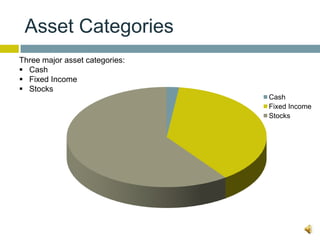
Three major asset categories:
 Cash
 Fixed Income
 Stocks
                                Cash
                                Fixed Income
                                Stocks
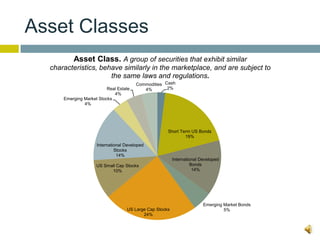
Asset Classes
          Asset Class. A group of securities that exhibit similar
  characteristics, behave similarly in the marketplace, and are subject to
                      the same laws and regulations.
                                        Commodities Cash
                          Real Estate      4%        2%
                             4%
      Emerging Market Stocks
               4%


                                                     Short Term US Bonds
                                                             19%
                     International Developed
                              Stocks
                               14%
                                                         International Developed
                     US Small Cap Stocks                          Bonds
                           10%                                     14%


                                                                        Emerging Market Bonds
                                   US Large Cap Stocks                           5%
                                          24%
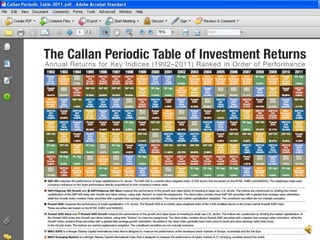
Table of Periodic Returns
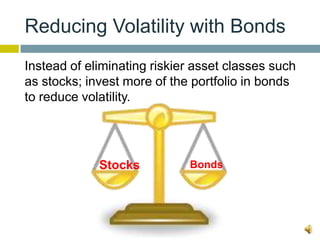
Reducing Volatility with Bonds
Instead of eliminating riskier asset classes such
as stocks; invest more of the portfolio in bonds
to reduce volatility.


             Stocks          Bonds
In Portfolio Construction…

   How asset classes work together is more
    important than how the components work
    individually.
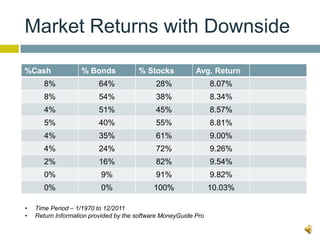
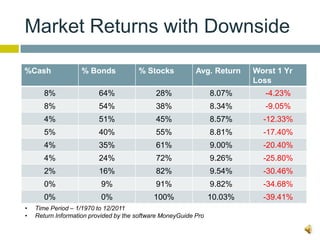
   Objective in portfolio construction - Enhance
    the overall performance of the portfolio, and
    reduce the downside risk.
Market Returns with Downside

%Cash              % Bonds             % Stocks            Avg. Return
       8%                64%                 28%                 8.07%
       8%                54%                 38%                 8.34%
       4%                51%                 45%                 8.57%
       5%                40%                 55%                 8.81%
       4%                35%                 61%                 9.00%
       4%                24%                 72%                 9.26%
       2%                16%                 82%                 9.54%
       0%                 9%                 91%                 9.82%
       0%                 0%                100%                 10.03%

•   Time Period – 1/1970 to 12/2011
•   Return Information provided by the software MoneyGuide Pro
Market Returns with Downside

%Cash              % Bonds             % Stocks            Avg. Return    Worst 1 Yr
                                                                          Loss
       8%                64%                 28%                 8.07%       -4.23%
       8%                54%                 38%                 8.34%       -9.05%
       4%                51%                 45%                 8.57%      -12.33%
       5%                40%                 55%                 8.81%      -17.40%
       4%                35%                 61%                 9.00%      -20.40%
       4%                24%                 72%                 9.26%      -25.80%
       2%                16%                 82%                 9.54%      -30.46%
       0%                 9%                 91%                 9.82%      -34.68%
       0%                 0%                100%                 10.03%     -39.41%
•   Time Period – 1/1970 to 12/2011
•   Return Information provided by the software MoneyGuide Pro
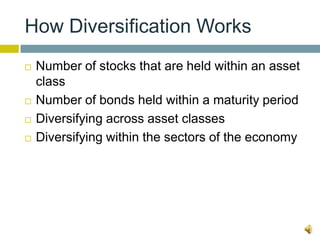
How Diversification Works
   Number of stocks that are held within an asset
    class
   Number of bonds held within a maturity period
   Diversifying across asset classes
   Diversifying within the sectors of the economy
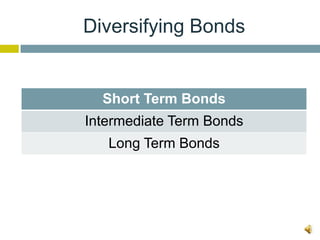
Diversifying Bonds


  Short Term Bonds
Intermediate Term Bonds
   Long Term Bonds
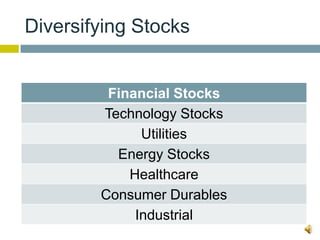
Diversifying Stocks


         Financial Stocks
        Technology Stocks
              Utilities
          Energy Stocks
            Healthcare
        Consumer Durables
             Industrial
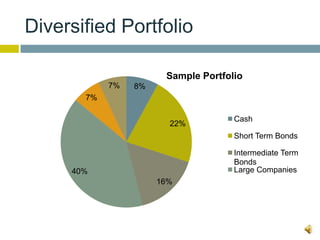
Diversified Portfolio

                       Sample Portfolio
            7%   8%
       7%

                                     Cash
                        22%
                                     Short Term Bonds

                                     Intermediate Term
                                     Bonds
     40%                             Large Companies
                      16%
Investment philosophy
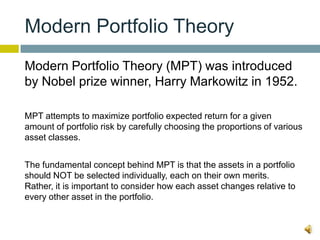
Modern Portfolio Theory
Modern Portfolio Theory (MPT) was introduced
by Nobel prize winner, Harry Markowitz in 1952.

MPT attempts to maximize portfolio expected return for a given
amount of portfolio risk by carefully choosing the proportions of various
asset classes.


The fundamental concept behind MPT is that the assets in a portfolio
should NOT be selected individually, each on their own merits.
Rather, it is important to consider how each asset changes relative to
every other asset in the portfolio.
Investment management
strategies
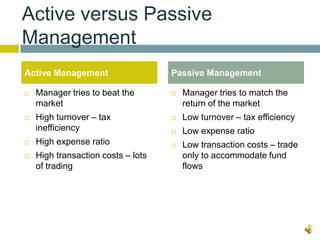
Active versus Passive
Management
Active Management                   Passive Management

   Manager tries to beat the          Manager tries to match the
    market                              return of the market
   High turnover – tax                Low turnover – tax efficiency
    inefficiency                       Low expense ratio
   High expense ratio                 Low transaction costs – trade
   High transaction costs – lots       only to accommodate fund
    of trading                          flows
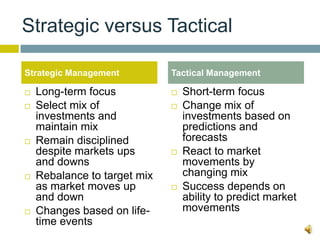
Strategic versus Tactical

Strategic Management          Tactical Management

   Long-term focus              Short-term focus
   Select mix of                Change mix of
    investments and               investments based on
    maintain mix                  predictions and
   Remain disciplined            forecasts
    despite markets ups          React to market
    and downs                     movements by
   Rebalance to target mix       changing mix
    as market moves up           Success depends on
    and down                      ability to predict market
   Changes based on life-        movements
    time events
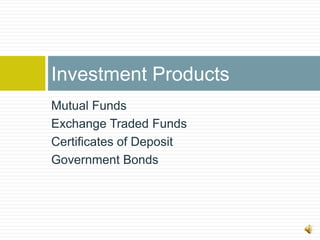
Investment Products
Mutual Funds
Exchange Traded Funds
Certificates of Deposit
Government Bonds
Summary
           Successful Long Term Investing:

   Have an Investment Strategy that is Based on a Disciplined
Process:
   Diversify among different Asset Classes
   Use Diversified Securities
   Diversification among different segments of the overall economy
   Keep a long term time horizon
Ferro Financial, LLC
                              “PLANNING TODAY FOR
                 THE LIVE YOU’LL LIVE TOMORROW”


2121 N. Causeway Blvd Suite
160                           Ferro Financial, LLC
Metairie, LA 70001

Client Education Session 1

  • 1.
    Ferro Financial, LLC CLIENT EDUCATION SERIES MARKET OVERVIEW SESSION 1 2121 N. Causeway Blvd Suite 160 Ferro Financial, LLC Metairie, LA 70001
  • 2.
    Objectives of Presentation •Provide a Basic Understanding of Capital Markets • Discuss Portfolio Construction • The Importance of Diversifying Among Asset Classes • Market Volatility and Long Term Investing • Ferro Financial, LLC Investment Philosophy
  • 3.
    Understanding the markets  Stock Market  Bond Market
  • 4.
    The Stock Market World Market Capitalization $35.6 Trillion as of December 31, 2010 Bloomberg Index Affiliation  Developed Markets Capitalization Over Time  Emerging Markets ($ Trillions):  Frontier Markets
  • 5.
    The Stock Market  Own shares in a publicly traded company  IT IS OWNERSHIP  Apple Computer, Home Depot, AT&T, GAP Clothing Store, Exxon  Why own companies?  Dividends  Long term capital growth  Better than sitting in cash  Beat rising prices (inflation)
  • 6.
    The Bond Market  Size - $95 Trillion vs. $35.6 Trillion Global Stock Market – MORE THAN TWICE THE SIZE  Complexity – Government, Agency, Corporate, Municipal, Mortgage, Asset-Backed  Risk – Generally less volatile than stocks
  • 7.
    The Bond Market  LENDER  US Government  Foreign Government  Company  State  Cities  Why Lend Money?  To get your money back + Receive interest
  • 8.
  • 9.
    Asset Categories Three majorasset categories:  Cash  Fixed Income  Stocks Cash Fixed Income Stocks
  • 10.
    Asset Classes Asset Class. A group of securities that exhibit similar characteristics, behave similarly in the marketplace, and are subject to the same laws and regulations. Commodities Cash Real Estate 4% 2% 4% Emerging Market Stocks 4% Short Term US Bonds 19% International Developed Stocks 14% International Developed US Small Cap Stocks Bonds 10% 14% Emerging Market Bonds US Large Cap Stocks 5% 24%
  • 11.
  • 12.
    Reducing Volatility withBonds Instead of eliminating riskier asset classes such as stocks; invest more of the portfolio in bonds to reduce volatility. Stocks Bonds
  • 13.
    In Portfolio Construction…  How asset classes work together is more important than how the components work individually.  Objective in portfolio construction - Enhance the overall performance of the portfolio, and reduce the downside risk.
  • 14.
    Market Returns withDownside %Cash % Bonds % Stocks Avg. Return 8% 64% 28% 8.07% 8% 54% 38% 8.34% 4% 51% 45% 8.57% 5% 40% 55% 8.81% 4% 35% 61% 9.00% 4% 24% 72% 9.26% 2% 16% 82% 9.54% 0% 9% 91% 9.82% 0% 0% 100% 10.03% • Time Period – 1/1970 to 12/2011 • Return Information provided by the software MoneyGuide Pro
  • 15.
    Market Returns withDownside %Cash % Bonds % Stocks Avg. Return Worst 1 Yr Loss 8% 64% 28% 8.07% -4.23% 8% 54% 38% 8.34% -9.05% 4% 51% 45% 8.57% -12.33% 5% 40% 55% 8.81% -17.40% 4% 35% 61% 9.00% -20.40% 4% 24% 72% 9.26% -25.80% 2% 16% 82% 9.54% -30.46% 0% 9% 91% 9.82% -34.68% 0% 0% 100% 10.03% -39.41% • Time Period – 1/1970 to 12/2011 • Return Information provided by the software MoneyGuide Pro
  • 16.
    How Diversification Works  Number of stocks that are held within an asset class  Number of bonds held within a maturity period  Diversifying across asset classes  Diversifying within the sectors of the economy
  • 17.
    Diversifying Bonds Short Term Bonds Intermediate Term Bonds Long Term Bonds
  • 18.
    Diversifying Stocks Financial Stocks Technology Stocks Utilities Energy Stocks Healthcare Consumer Durables Industrial
  • 19.
    Diversified Portfolio Sample Portfolio 7% 8% 7% Cash 22% Short Term Bonds Intermediate Term Bonds 40% Large Companies 16%
  • 20.
  • 21.
    Modern Portfolio Theory ModernPortfolio Theory (MPT) was introduced by Nobel prize winner, Harry Markowitz in 1952. MPT attempts to maximize portfolio expected return for a given amount of portfolio risk by carefully choosing the proportions of various asset classes. The fundamental concept behind MPT is that the assets in a portfolio should NOT be selected individually, each on their own merits. Rather, it is important to consider how each asset changes relative to every other asset in the portfolio.
  • 22.
  • 23.
    Active versus Passive Management ActiveManagement Passive Management  Manager tries to beat the  Manager tries to match the market return of the market  High turnover – tax  Low turnover – tax efficiency inefficiency  Low expense ratio  High expense ratio  Low transaction costs – trade  High transaction costs – lots only to accommodate fund of trading flows
  • 24.
    Strategic versus Tactical StrategicManagement Tactical Management  Long-term focus  Short-term focus  Select mix of  Change mix of investments and investments based on maintain mix predictions and  Remain disciplined forecasts despite markets ups  React to market and downs movements by  Rebalance to target mix changing mix as market moves up  Success depends on and down ability to predict market  Changes based on life- movements time events
  • 25.
    Investment Products Mutual Funds ExchangeTraded Funds Certificates of Deposit Government Bonds
  • 26.
    Summary Successful Long Term Investing: Have an Investment Strategy that is Based on a Disciplined Process: Diversify among different Asset Classes Use Diversified Securities Diversification among different segments of the overall economy Keep a long term time horizon
  • 27.
    Ferro Financial, LLC “PLANNING TODAY FOR THE LIVE YOU’LL LIVE TOMORROW” 2121 N. Causeway Blvd Suite 160 Ferro Financial, LLC Metairie, LA 70001

Editor's Notes

  • #24 Remove from presentation