Decision Trees for Differential Diagnosis. By clicking below I agree to not use this as an official diagnostic tool. I Agree
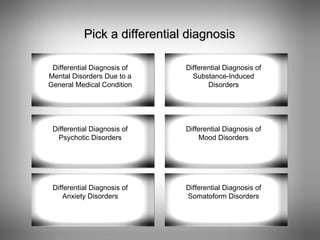
Pick a differential diagnosis Differential Diagnosis of Mental Disorders Due to a General Medical Condition Differential Diagnosis of Substance-Induced Disorders Differential Diagnosis of Psychotic Disorders Differential Diagnosis of Mood Disorders Differential Diagnosis of Anxiety Disorders Differential Diagnosis of Somatoform Disorders
Is there a disturbance of consciousness and a change in cognition Symptoms that are due to the direct physiological effects of a general medical condition Yes No
Evidence that the disturbance has more than one etiology (e.g., substance and general medical condition) Yes No
Memory impairment? Yes No
Delirium Due to a General Medical Condition Start Over
Delirium Due to Multiple Etiologies Start Over
At least one additional cognitive deficit Yes No
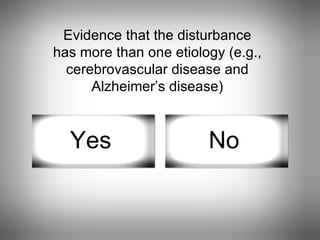
Evidence that the disturbance has more than one etiology (e.g., cerebrovascular disease and Alzheimer’s disease) Yes No
Dementia Due to Multiple Etiologies Start Over
Evidence that cerebrovascular disease is etiologically related to the disturbance Yes No
Vascular Dementia Start Over
Disturbance due to central nervous system condition or systemic condition known to cause dementia Yes No
Dementia Due to a General Medical Condition Start Over
Gradual onset and continuing cognitive decline Yes No
Dementia of the Alzheimer’s Type Start Over
Dementia Not Otherwise Specified Start Over
Amnestic Disorder due to a General Medical Condition Start Over
Prominent delusions or hallucinations predominate Yes No
Psychotic Disorder Due to a General Medical Condition Start Over
Prominent and persistent mood disturbance predominates Yes No
Mood Disorder Due to a General Medical Condition Start Over
Prominent anxiety, panic attacks, obsessions, or compulsions predominate Yes No
Anxiety Disorder due to a General Medical Condition Start Over
Clinically significant sexual dysfunction exclusively due to a general medical condition Yes No
Sexual Dysfunction Due to a General Medical Condition Start Over
Disturbance in sleep sufficiently severe to warrant independent clinical attention Yes No
Sleep Disorder Due to a General Medical Condition Start Over
Catatonia? Yes No
Catatonic Disorder Due to a General Medical Condition Start Over
Change in previous personal pattern Yes No
Personality Change Due to a General Medical Condition Start Over
Clinically significant symptoms etiologically related to a general medical condition that do not meet criteria for a specific Mental Disorder Due to a General Medical Condition Yes No
Mental Disorder Not Otherwise Specified Due to a General Medical Condition Start Over
No Mental Disorder (Symptoms that are not clinically significant) Start Over
Symptoms must be due to the direct physiological effects of a substance A disturbance of consciousness and a change in cognition that are in excess of that usually seen in intoxication or withdrawal and that warrant independent clinical attention Yes No
Evidence that the disturbance has more than one etiology (e.g., substance and general medical condition) Yes No
Persistent memory impairment Yes No
Onset of delirium during withdrawal from a substance Yes No
Substance-Induced Withdrawal Delirium Start Over
Substance Induced Intoxication Delirium Start Over
Delirium Due to Multiple Etiologies Start Over
At least one additional cognitive deficit Yes No
Evidence that the disturbance has more than one etiology (e.g., substance and general medical condition) Yes No
Substance-Induced Persisting Dementia Start Over
Dementia Due to Multiple Etiologies Start Over
Substance-Induced Persisting Amnestic Disorder Start Over
Delusions or hallucinations predominate, are in excess of that usually seen in intoxication or withdrawal, and warrant independent clinical attention Yes No
Substance-Induced Psychotic Disorder – Specify if onset during intoxication or withdrawal Start Over
A mood disturbance predominates, is in excess of that usually seen in intoxication or withdrawal, and warrants independent clinical attention. Yes No
Substance-Induced Mood Disorder – Specify if onset during intoxication or withdrawal Start Over
Anxiety, panic attacks, or obsessions or compulsions predominate; are in excess of that usually seen in intoxication or withdrawal; and warrant independent clinical attention Yes No
Substance-Induced Anxiety Disorder – Specify if onset during intoxication or withdrawal Start Over
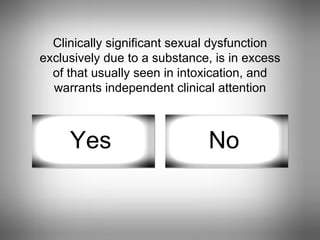
Clinically significant sexual dysfunction exclusively due to a substance, is in excess of that usually seen in intoxication, and warrants independent clinical attention Yes No
Substance-Induced Sexual Dysfunction Start Over
Disturbance is sleep that is sufficiently severe to warrant independent clinical attention and is in excess of that usually seen in intoxication or withdrawal Yes No
Substance-Induced Sleep Disorder – Specify if onset during intoxication or withdrawal Start Over
Development of a reversible syndrome due to recent use of a substance Yes No
Substance Intoxication Start Over
Development of a syndrome due to reduction or cessation of use of substance Yes No
Substance Withdrawal Start Over
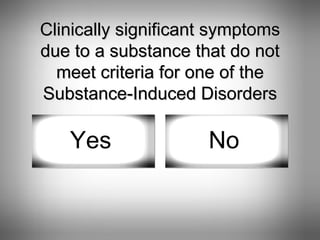
Clinically significant symptoms due to a substance that do not meet criteria for one of the Substance-Induced Disorders Yes No
Substance-Related Disorder Not Otherwise Specified Start Over
No Substance-Induced Disorder (substance-induced symptoms that are not clinically significant) Start Over
Delusions, hallucinations, disorganized speech, or grossly disorganized behavior Due to the direct physiological effects of a general medical condition Yes No
Psychotic Disorder Due to a General Medical Condition Start Over
Due to the direct physiological effects of a substance (e.g., a drug of abuse, a medication, or a toxin) Yes No
Substance-Induced Psychotic Disorder Start Over
Symptoms of active phase of Schizophrenia, lasting at least 1 month Yes No
Major Depressive or Manic Episode concurrent with active-phase symptoms Yes No
Total duration of mood episodes has been brief relative to duration of active and residual periods Yes No
Duration at least 6 months Yes No
Schizophrenia Start Over
Schizophreniform Disorder Start Over
At least 2 weeks of delusions or hallucinations in the absence of prominent mood symptoms Yes No
Schizoaffective Disorder Start Over
Mood Disorder with Psychotic Features (see  Mood Disorders tree ) Start Over
Nonbizarre delusions lasting at least 1 month Yes No
Total duration of mood episodes has been brief relative to duration of delusional periods Yes No
Apart from delusions, functioning not markedly impaired Yes No
Delusions occur only during mood episodes Yes No
Delusional Disorder Start Over
Psychotic Disorder Not Otherwise Specified Start Over
Mood Disorder with Psychotic Features (see  Mood Disorders tree ) Start Over
Duration more than 1 day but less than 1 month Yes No
Brief Psychotic Disorder Start Over
Psychotic Disorder Not Otherwise Specified Start Over
Depressed, elevated, expansive, or irritable mood Due to the direct physiological effects of a general medical condition Yes No
No Mood Disorder (mood symptoms that are not clinically significant) Start Over
Mood Disorder Due to a General Medical Condition Start Over
Due to the direct physiological effects of a substance (i.e., a drug of abuse, a medication, or a toxin) Yes No
Substance-Induced Mood Disorder Start Over
Determine type of present and past mood episodes Next
Elevated, expansive, or irritable mood, at least 1-week duration; marked impairment or hospitalization Yes No
Manic Episode Start Over Mixed Diagnosis
Elevate, expansive, or irritable mood, at least 4-day duration; changes observable by others but less severe than a Manic Episode Yes No
Hypomanic Episode Start Over Mixed Diagnosis
Major Depressive Episode Start Over Mixed Diagnosis
At least 2 weeks of depressed mood or loss of interest plus associated symptoms, and not better accounted for by Bereavement  Yes No
Criteria met for Manic Episode and Major Depressive Episode nearly every day for at least 1 week Yes No
Mixed Episode Start Over Mixed Diagnosis
Has ever had a Manic Episode or a Mixed Episode Yes No
Psychotic symptoms occur at times other than during Manic or Mixed Episodes Yes No
Bipolar I Disorder Start Over
Occurred exclusively during Schizoaffective Disorder (review  Psychotic Disorders tree ) Yes No
Schizoaffective Disorder, Bipolar Type Start Over
Bipolar Disorder Not Otherwise Specified (superimposed on a Psychotic Disorder) Start Over
Has ever had a Hypomanic Episode and at least one Major Depressive Episode Yes No
Bipolar II Disorder Start Over
2+ years of hypomanic symptoms and periods of depressed mood Yes No
Cyclothymic Disorder Start Over
Clinically significant manic/hypomanic symptoms that do not meet criteria for a specific Bipolar Disorder Yes No
Bipolar Disorder NOS Start Over
Has ever had a Major Depressive Episode Yes No
Psychotic symptoms occur at times other than during Major Depressive Episodes Yes No
Major Depressive Disorder Start Over
Occurred exclusively during Schizoaffective Disorder (review  Psychotic Disorders tree ) Yes No
Schizoaffective Disorder, Depressive Type Start Over
Depressive Disorder NOS (superimposed on Psychotic Disorder) Start Over
Depressed mood, more days than not, for at least 2 years with associated symptoms Yes No
Dysthymic Disorder Start Over
Depressed mood not meeting criteria for one of the previous Mood Disorders that develops in response to a stressor Yes No
Adjustment Disorder with Depressed Mood Start Over
Clinically significant depressive symptoms that do not meet criteria for a specific Mood Disorder Yes No
Depressive Disorder NOS Start Over
No Mood Disorder (mood symptoms that are not clinically significant) Start Over
Symptoms of anxiety, fear, avoidance, or increased arousal Due to the direct physiological effects of a general medical condition Yes No
Anxiety disorder due to a general medical condition Start Over
Due to the direct physiological effects of a substance (e.g., a drug of abuse, a medication, a toxin) Yes No
Substance-Induced Anxiety Disorder Start Over
Recurrent unexpected Panic Attacks plus a month of worry, concern about attacks, or change in behavior  Yes No
Agoraphobia, i.e., anxiety about being in places from which escape might be difficult or embarrassing in the event of having a Panic Attack Yes No
Panic Disorder with Agoraphobia Start Over
Panic Disorder Without Agoraphobia  Start Over
Agoraphobia, i.e., anxiety about being in places from which escape might be difficult or embarrassing in the event of having panic-like symptoms Yes No
Agoraphobia without History of Panic Disorder Start Over
Anxiety concerning separation from attachment figures with onset in childhood Yes No
Separation Anxiety Disorder Start Over
Fear of humiliation or embarrassment in social or performance  Yes No
Social Phobia (Social Anxiety Disorder) Start Over
Fear cued by object or situation Yes No
Specific Phobia Start Over
Obsessions or compulsions Yes No
Obsessive-Compulsive Disorder Start Over
6-month period of excessive anxiety and worry plus anxiety symptoms Yes No
Occurs exclusively during a Mood or Psychotic Disorder See mood disorders tree No
Generalized Anxiety Disorder Start Over
Anxiety in response to a severe traumatic event Yes No
Reexperiencing of event, increased arousal, and avoidance of stimuli associated with traumatic event  Yes No
Duration of more than 1 month Yes No
No Anxiety Disorder (symptoms of fear, anxiety, or avoidance that are not clinically significant) Start Over
Posttraumatic Stress Disorder Start Over
Acute Stress Disorder Start Over
Anxiety that does not meet criteria for one of the above Anxiety Disorders and develops in response to a stressor Yes No
Adjustment Disorder with Anxiety Start Over
Clinically significant symptoms that do not meet criteria for a specific Anxiety Disorder Yes No
Anxiety Disorder NOS Start Over
Physical Complaints or irrational anxiety about illness or appearance Physical complaints are fully explained by a general medical condition and complaints are not in excess of expected Yes No
No Anxiety Disorder (symptoms of fear, anxiety, or avoidance that are not clinically significant) Start Over
Specific General Medical Condition (no somatoform disorder) Next
Psychological factors adversely affect general medical condition Next
Psychological Factor Affecting Medical Condition Start Over
Physical symptoms are intentionally produced Yes No
External incentives are absent Yes No
Factitious Disorder Start Over
Malingering Start Over
History of multiple physical complaints with at least 4 pain symptoms, 2 gastrointestinal symptoms, 1 sexual symptom, and 1 pseudoneurological symptom Yes No
Somatization Disorder Start Over
Symptom or deficit affecting voluntary motor or sensory function Yes No
Conversion Disorder Start Over
Symptom or deficit affecting sexual functioning Yes No
Sexual Dysfunction Start Over
Pain is focus of clinical attention, and psychological factors have important role Yes No
Pain Disorder Start Over
Other physical complaints lasting at least 6 months Yes No
Undifferentiated Somatoform Disorder Start Over
Preoccupation with idea of having a serious disease Yes No
Belief is of delusional intensity Yes No
Hypochondriasis Start Over
See  Psychotic Disorders tree Start Over
Preoccupation with imagined defect in appearance Yes No
Body Dysmorphic Disorder (if delusional, also see  Psychotic Disorders tree ) Start Over
Clinically significant somatoform symptoms that do not meet criteria for a specific Somatoform Disorder Yes No
Somatoform Disorder NOS Start Over
No Somatoform Disorder (somatoform symptoms that are not clinically significant) Start Over

Decision Tree