Real-time Occupancy Detection
using Self-learning AI agent
- Team Aficionados
Need for Occupany Detection:
The ability to accurately determine localized building occupancy in
real time enables several compelling applications, including intelligent
control of building systems to minimize energy use and real-time
building visualization
There are several ways to perform occupancy driven detection using
various sensors such as augmented PIRs, CO2 sensors, etc,.
Drawbacks of current systems
The current methodology of occupancy detection employs several
Sensors which are not cost – efficient and also involves numerous
proprietary technologies in play.
The systems are also not `smart` enough to identify occupants inside
an environment.
Proposed System
Our Proposed system of using Self-learning AI agent utilizes camera
feeds from CCTV, Web cams to perform accurate estimation of
occupants inside an environment.
By employing `Internet of Things`, the system is smart to detect
occupants using Network activity and also classify the occupants for
real-time updating of occupants information.
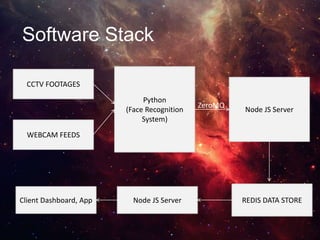
Software Stack
CCTV FOOTAGES
WEBCAM FEEDS
Python
(Face Recognition
System)
REDIS DATA STORE
Node JS Server
ZeroMQ
Node JS ServerClient Dashboard, App
Why Redis, not Mongo?
In-Memory NoSQL Key-Value store, offering soft real-time updation of
data.
Can utilize ā€œpub-subā€ service in Redis to subscribe for changes in
data in real-time from the client’s dashboard
Relatively Less overhead read and write, but volatile storage
Internet of Things at Play
Most devices in the present day are equipped with cameras and
networking features that can be utilized to communicate with each
other for estimation of occupants
Traces Network activity from devices also to determine the occupants
information for consideration
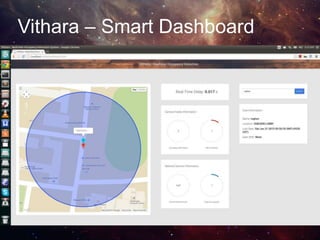
Vithara – Smart Dashboard
Our system comes with a smart dashboard called ā€œVitharaā€ that
allows to easily visualize occupants information
Occupants data can also be traced in real-time from maps and also
features a real-time search to target a particular occupant
Vithara – Smart Camera
The system processes the video feeds in a smarter way by
recognizing the Bar/QR codes from staff IDS and also classifies the
occupants as new visitors using Face Recognition technique.
Occupants data can also be traced in real-time from maps and also
features a real-time search to target a particular occupant.
Each camera also features a GPS co-ordinate to identify the users in
the map
Challenges
It is tedious to aggregate the data from various camera feeds. We
use and approach to merge the users’ data from different feed and
also employ machine learning technique to predict the occupants’
next location.
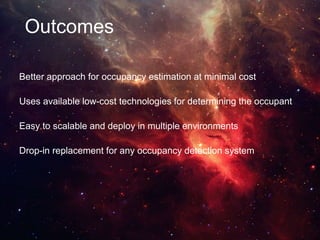
Outcomes
Better approach for occupancy estimation at minimal cost
Uses available low-cost technologies for determining the occupant
Easy to scalable and deploy in multiple environments
Drop-in replacement for any occupancy detection system
Thank You!

Real time occupancy detection using self-learning ai agent

  • 1.
    Real-time Occupancy Detection usingSelf-learning AI agent - Team Aficionados
  • 2.
    Need for OccupanyDetection: The ability to accurately determine localized building occupancy in real time enables several compelling applications, including intelligent control of building systems to minimize energy use and real-time building visualization There are several ways to perform occupancy driven detection using various sensors such as augmented PIRs, CO2 sensors, etc,.
  • 3.
    Drawbacks of currentsystems The current methodology of occupancy detection employs several Sensors which are not cost – efficient and also involves numerous proprietary technologies in play. The systems are also not `smart` enough to identify occupants inside an environment.
  • 4.
    Proposed System Our Proposedsystem of using Self-learning AI agent utilizes camera feeds from CCTV, Web cams to perform accurate estimation of occupants inside an environment. By employing `Internet of Things`, the system is smart to detect occupants using Network activity and also classify the occupants for real-time updating of occupants information.
  • 5.
    Software Stack CCTV FOOTAGES WEBCAMFEEDS Python (Face Recognition System) REDIS DATA STORE Node JS Server ZeroMQ Node JS ServerClient Dashboard, App
  • 6.
    Why Redis, notMongo? In-Memory NoSQL Key-Value store, offering soft real-time updation of data. Can utilize ā€œpub-subā€ service in Redis to subscribe for changes in data in real-time from the client’s dashboard Relatively Less overhead read and write, but volatile storage
  • 7.
    Internet of Thingsat Play Most devices in the present day are equipped with cameras and networking features that can be utilized to communicate with each other for estimation of occupants Traces Network activity from devices also to determine the occupants information for consideration
  • 8.
  • 9.
    Vithara – SmartDashboard Our system comes with a smart dashboard called ā€œVitharaā€ that allows to easily visualize occupants information Occupants data can also be traced in real-time from maps and also features a real-time search to target a particular occupant
  • 10.
    Vithara – SmartCamera The system processes the video feeds in a smarter way by recognizing the Bar/QR codes from staff IDS and also classifies the occupants as new visitors using Face Recognition technique. Occupants data can also be traced in real-time from maps and also features a real-time search to target a particular occupant. Each camera also features a GPS co-ordinate to identify the users in the map
  • 11.
    Challenges It is tediousto aggregate the data from various camera feeds. We use and approach to merge the users’ data from different feed and also employ machine learning technique to predict the occupants’ next location.
  • 12.
    Outcomes Better approach foroccupancy estimation at minimal cost Uses available low-cost technologies for determining the occupant Easy to scalable and deploy in multiple environments Drop-in replacement for any occupancy detection system
  • 13.