
More Related Content


Similar to Wilfred Owen - Javier


Wilfred Owen - Javier
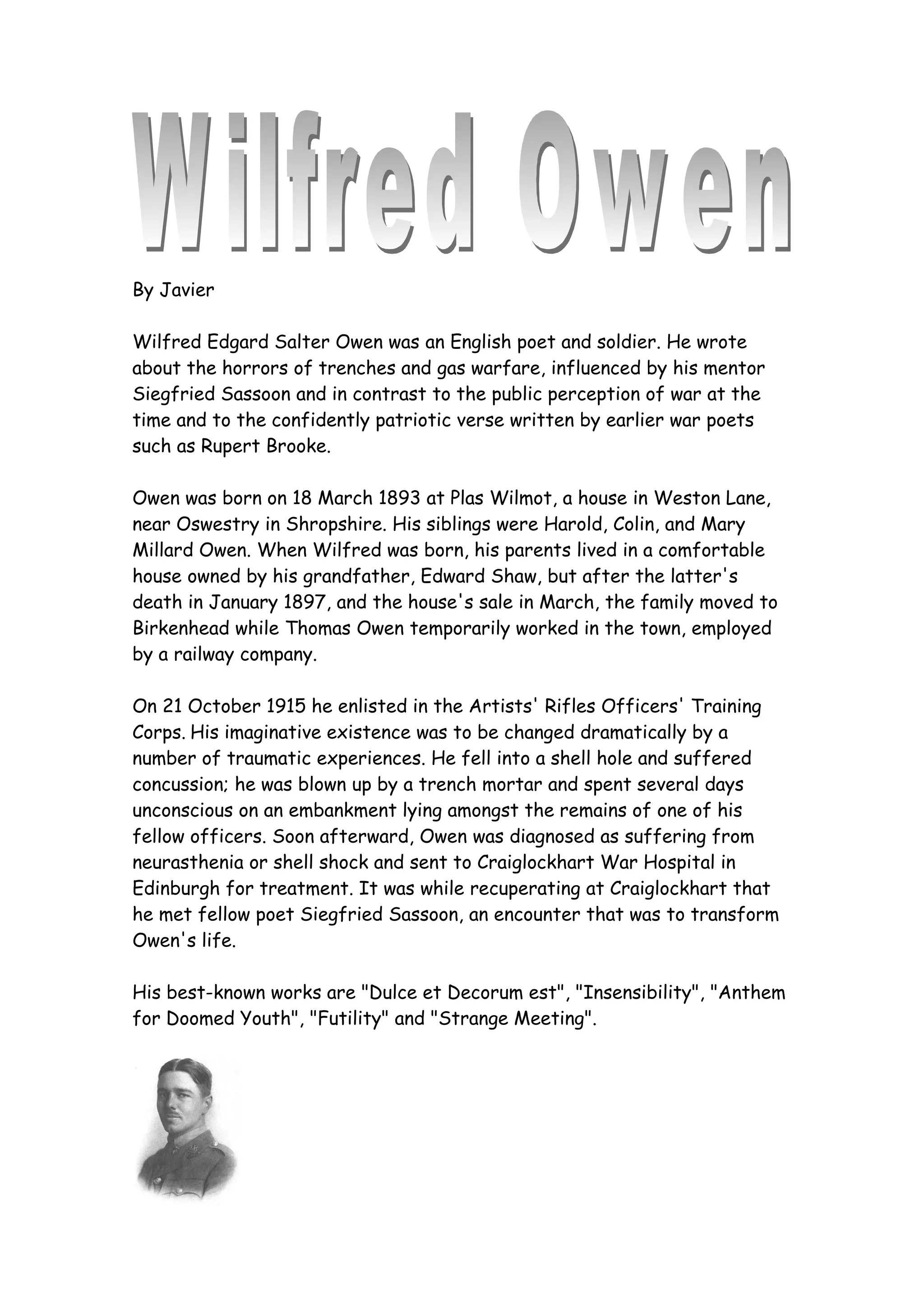
- 1. By Javier Wilfred EdgardSalter Owen was an English poet and soldier. He wrote about the horrors of trenches and gas warfare, influenced by his mentor Siegfried Sassoon and in contrast to the public perception of war at the time and to the confidently patriotic verse written by earlier war poets such as Rupert Brooke. Owen was born on 18 March 1893 at Plas Wilmot, a house in Weston Lane, near Oswestry in Shropshire. His siblings were Harold, Colin, and Mary Millard Owen. When Wilfred was born, his parents lived in a comfortable house owned by his grandfather, Edward Shaw, but after the latter's death in January 1897, and the house's sale in March, the family moved to Birkenhead while Thomas Owen temporarily worked in the town, employed by a railway company. On 21 October 1915 he enlisted in the Artists' Rifles Officers' Training Corps. His imaginative existence was to be changed dramatically by a number of traumatic experiences. He fell into a shell hole and suffered concussion; he was blown up by a trench mortar and spent several days unconscious on an embankment lying amongst the remains of one of his fellow officers. Soon afterward, Owen was diagnosed as suffering from neurasthenia or shell shock and sent to Craiglockhart War Hospital in Edinburgh for treatment. It was while recuperating at Craiglockhart that he met fellow poet Siegfried Sassoon, an encounter that was to transform Owen's life. His best-known works are "Dulce et Decorum est", "Insensibility", "Anthem for Doomed Youth", "Futility" and "Strange Meeting".