SHRI BALAJI
INFOTECH
By Payal Mudliar
You Tube Channel
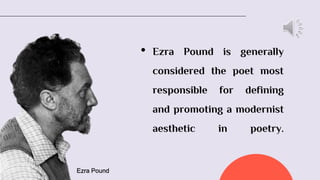
‱ Ezra Pound is generally
considered the poet most
responsible for defining
and promoting a modernist
aesthetic in poetry.
Ezra Pound
‱ In the early teens of the twentieth century, he opened a
seminal exchange of work and ideas between British and
American writers, and was famous for the generosity
with which he advanced the work of such major
contemporaries as W. B. Yeats, Robert Frost, William
Carlos Williams, Marianne Moore, H. D., James Joyce,
Ernest Hemingway, and especially T. S. Eliot.
‱ His own significant contributions to poetry begin
with his promulgation of Imagism, a movement in
poetry which derived its technique from classical
Chinese and Japanese poetry—stressing clarity,
precision, and economy of language, in Pound's
words, "compose in the sequence of the musical
phrase, not in the sequence of the metronome."
‱ His later work, for nearly fifty years, focused on
the encyclopedic epic poem he entitled The
Cantos.
 After teaching at Wabash College for two years,
he travelled abroad to Spain, Italy, and London,
where, as the literary executor of the scholar
Ernest Fenellosa, he became interested in
Japanese and Chinese poetry.
He married
Dorothy
Shakespeare in
1914 and became
London editor of
the Little
Review in 1917.
In 1924, he moved to Italy; during this period
of voluntary exile, Pound became involved in
Fascist politics, and did not return to the
United States until 1945, when he was
arrested on charges of treason for
broadcasting Fascist propaganda by radio to
the United States during World War II.
In 1946, he was acquitted, but declared mentally ill
and committed to St. Elizabeths Hospital in
Washington, D.C. During his confinement, the jury of
the Bollingen Prize for Poetry (which included a
number of the most eminent writers of the time)
decided to overlook Pound's political career in the
interest of recognizing his poetic achievements, and
awarded him the prize for the Pisan Cantos (1948).
After continuous appeals
from writers won his release
from the hospital in 1958,
Pound returned to Italy and
settled in Venice, where he
died, a semi-recluse, on
November 1, 1972.
CREDITS: This presentation template was created by
Slidesgo, including icons by Flaticon, infographics & images
by Freepik
Thanks!
Do you have any questions?
payalhdps@gmail.com
|+91 9860663446| shribalajiinfotech.com
SHRI BALAJI
INFOTECH
You Tube Channel

Ezra pound

  • 1.
    SHRI BALAJI INFOTECH By PayalMudliar You Tube Channel
  • 2.
    ‱ Ezra Poundis generally considered the poet most responsible for defining and promoting a modernist aesthetic in poetry. Ezra Pound
  • 3.
    ‱ In theearly teens of the twentieth century, he opened a seminal exchange of work and ideas between British and American writers, and was famous for the generosity with which he advanced the work of such major contemporaries as W. B. Yeats, Robert Frost, William Carlos Williams, Marianne Moore, H. D., James Joyce, Ernest Hemingway, and especially T. S. Eliot.
  • 4.
    ‱ His ownsignificant contributions to poetry begin with his promulgation of Imagism, a movement in poetry which derived its technique from classical Chinese and Japanese poetry—stressing clarity, precision, and economy of language, in Pound's words, "compose in the sequence of the musical phrase, not in the sequence of the metronome."
  • 5.
    ‱ His laterwork, for nearly fifty years, focused on the encyclopedic epic poem he entitled The Cantos.  After teaching at Wabash College for two years, he travelled abroad to Spain, Italy, and London, where, as the literary executor of the scholar Ernest Fenellosa, he became interested in Japanese and Chinese poetry.
  • 6.
    He married Dorothy Shakespeare in 1914and became London editor of the Little Review in 1917.
  • 7.
    In 1924, hemoved to Italy; during this period of voluntary exile, Pound became involved in Fascist politics, and did not return to the United States until 1945, when he was arrested on charges of treason for broadcasting Fascist propaganda by radio to the United States during World War II.
  • 8.
    In 1946, hewas acquitted, but declared mentally ill and committed to St. Elizabeths Hospital in Washington, D.C. During his confinement, the jury of the Bollingen Prize for Poetry (which included a number of the most eminent writers of the time) decided to overlook Pound's political career in the interest of recognizing his poetic achievements, and awarded him the prize for the Pisan Cantos (1948).
  • 9.
    After continuous appeals fromwriters won his release from the hospital in 1958, Pound returned to Italy and settled in Venice, where he died, a semi-recluse, on November 1, 1972.
  • 10.
    CREDITS: This presentationtemplate was created by Slidesgo, including icons by Flaticon, infographics & images by Freepik Thanks! Do you have any questions? payalhdps@gmail.com |+91 9860663446| shribalajiinfotech.com SHRI BALAJI INFOTECH You Tube Channel