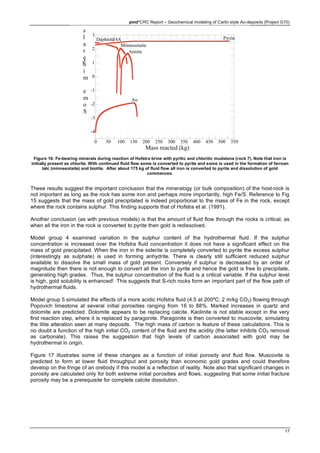
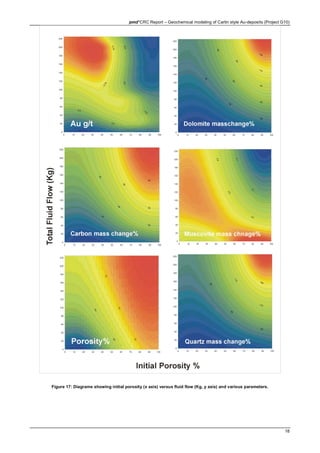
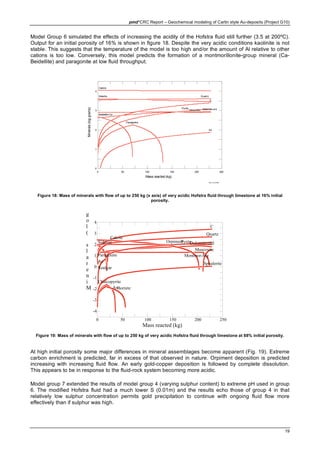
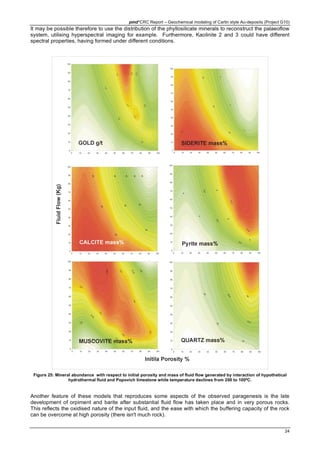
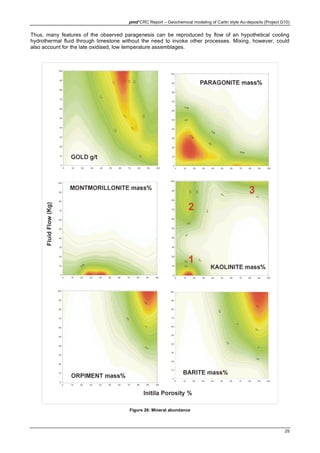
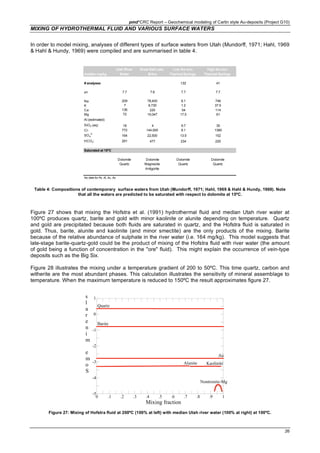
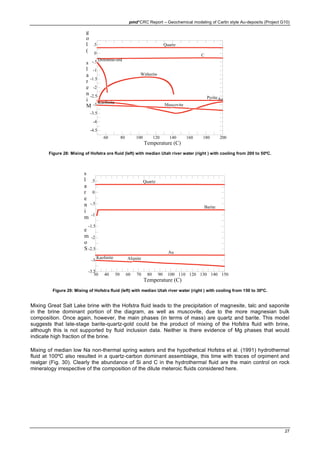
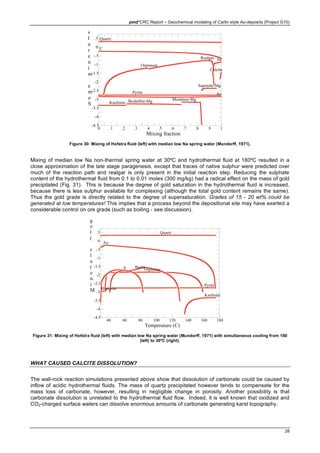
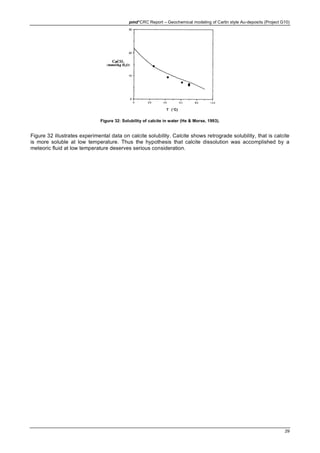
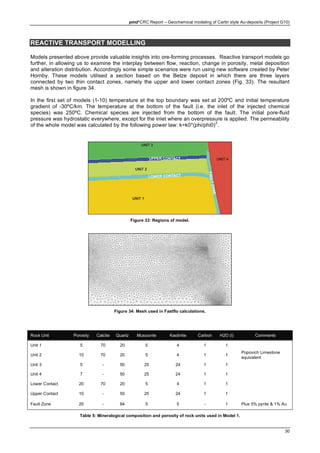
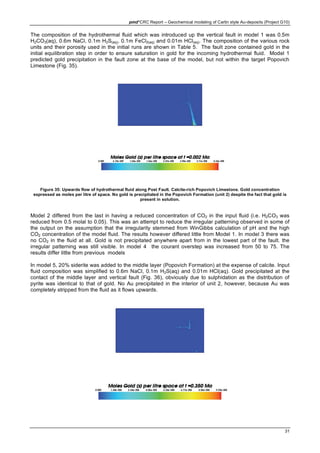
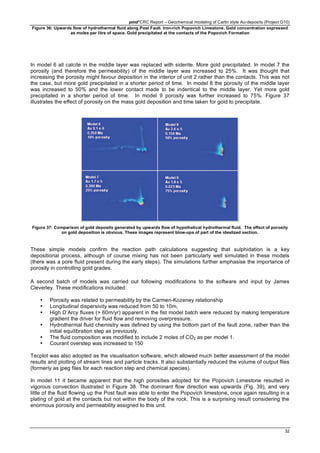
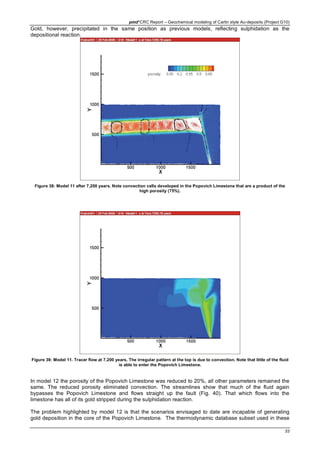
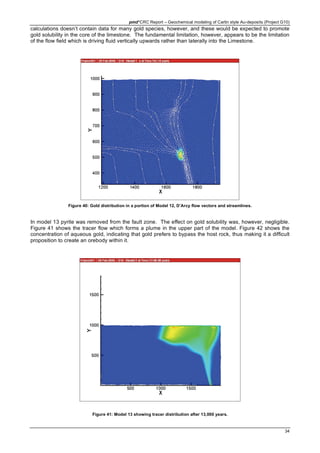
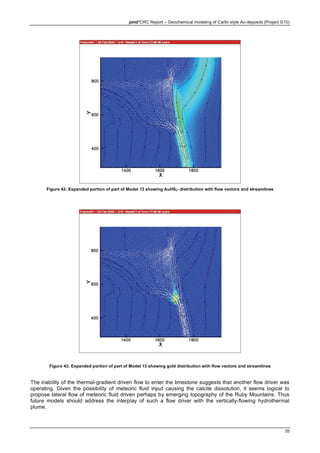
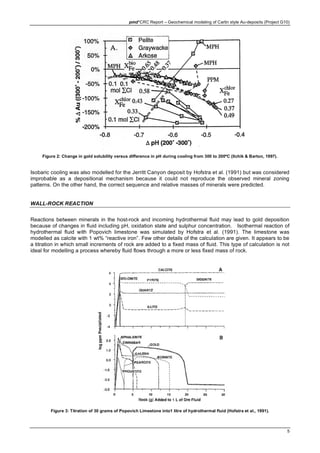
This document summarizes previous geochemical modeling studies of Carlin-type gold deposits and presents new reaction path modeling conducted by the author. Key findings of the new modeling include: 1) Wall-rock reaction with host limestone, involving iron sulphidation, best explains gold deposition; 2) Neither cooling nor fluid mixing appear to be significant depositional processes on their own; 3) Most rocks containing some iron could potentially host ore-grade gold if sufficient porosity existed during mineralization. The author proposes testing a model where a transient upwards pulse of hot hydrothermal fluid interacts with laterally flowing cooler meteoric fluid to explain deposit characteristics.
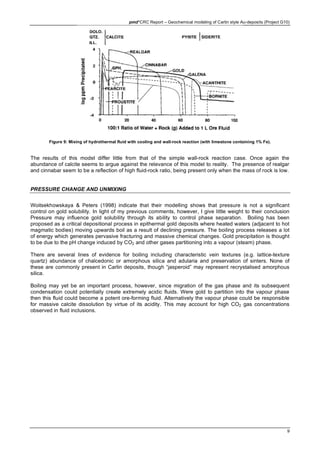
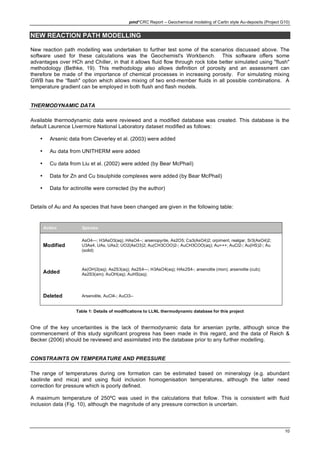
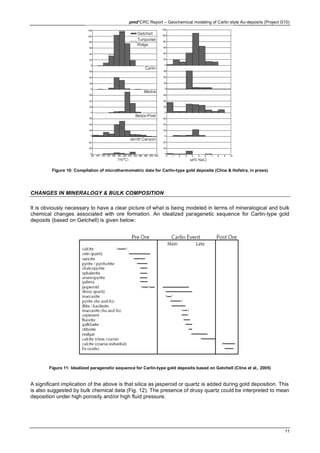
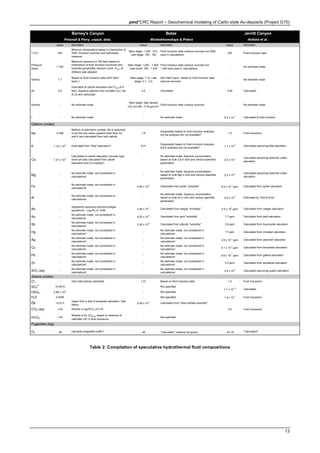
![pmd*CRC Report – Geochemical modeling of Carlin style Au-deposits (Project G10)
15
WALLROCK REACTION & THE IMPORTANCE OF ROCKTYPE
The first models of this study simulated flow of fluid through Popovich Limestone at constant temperature.
The fluid composition used was based on that in Hofstra et al. (1991; Table 2) but with the amount of CO2,
gold and arsenic reduced as these are probably too high (see Wilde, 2004). The Popovich Limestone
composition is shown in Table 3 with masses proportionately adjusted in order to define different initial
porosities.
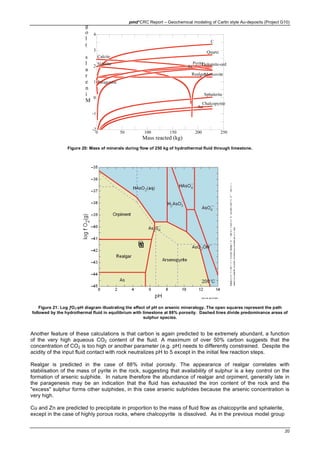
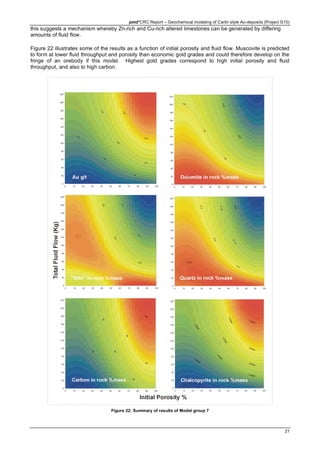
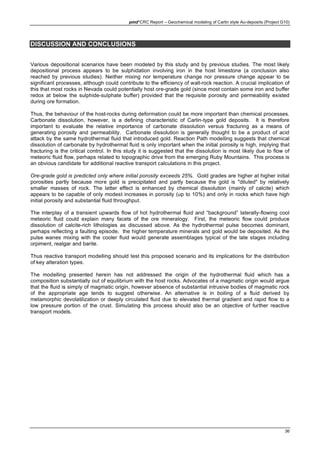
Gold grade in these models is a function of the mass of fluid that has flowed through the rock and the initial
porosity. Ore-grade gold was predicted only where initial porosity exceeded 25%. Gold grades are higher at
higher initial porosities partly because more gold is precipitated and partly because the gold is "diluted" by
relatively smaller masses of rock. The latter effect is enhanced by chemical dissolution (mainly of calcite)
which appears to be capable of only modest increases in porosity (up to 10%) and only in rocks which have
high initial porosity and substantial fluid throughput.
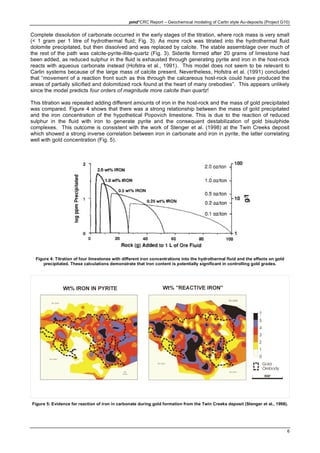
Gold is transported in these models as a bisulphide complex. Sulphidation of the iron present in the
Popovich limestone (as siderite) formed pyrite causing aqueous sulphur activity to drop thereby precipitating
gold. If we consider the case where initial porosity is 62%, gold and pyrite concentration in the rock increase
steadily until 6.5 Kg of fluid have flowed through the rock. At this point the maximum gold grade of over 10
g/t is attained. Beyond this point no further pyrite is formed (equilibrium is reached) consequently the sulphur
content of the pore fluid increases dramatically (supplied by incoming fluid) and pH also rises, both
contributing to increased gold solubility. With continuing fluid flow all gold is dissolved away! Thus there
appears to be a limit to the mass of fluid that can be passed through the Popovich Limestone and give rise to
an economic orebody. The implications of this for ore formation could be better investigated with reactive
transport calculations.
The main hydrothermal minerals predicted were albite, tremolite and phlogopite. The models failed to predict
kaolinite although small amounts of muscovite are present. This is because the system pH or temperature, or
both are too high for kaolinite formation. Precipitation of hydrothermal silicates compensates for mass loss
due to calcite dissolution.
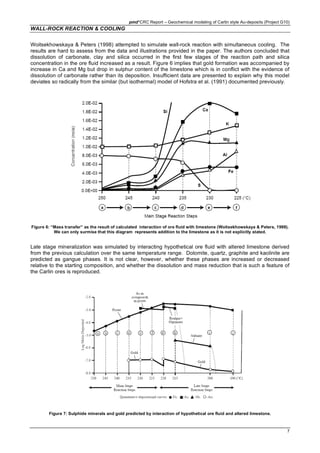
In a second set of models iron was added to the calcite limestone in the form of siderite
1
in order to assess
the relationship between gold grade and iron content. Initial porosity in every case was 62%. This is high,
but simulates fracture porosity due for example to tectonic brecciation. Gold grade in these models was
clearly a function of the iron content of the rock as well as the mass of fluid that has flowed through the rock.
In the Popovich Limestone containing no siderite, no gold precipitates.
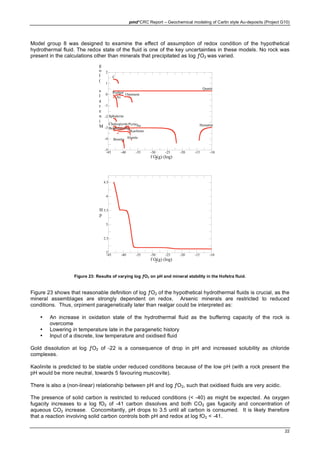
0 2 4 6 8 10 12 14
–45
–40
–35
–30
–25
–20
pH
logfO2(g)
________________________________________________________________________________________________________________________________________________________________________________
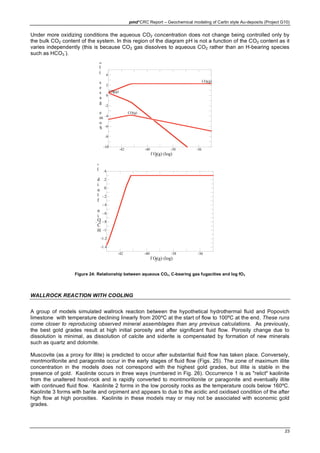
H2AsO4
-
H2AsO3
-
AsO2OH
--
AsO4
---
As2S4
--
HAsO 2(aq)
HAsO4
--
HAs2S4
-
Orpiment
ArsenopyriteAsRealgar
H3AsO4(aq)
200°C
Andy Tue Dec 21 2004
DiagramH2
AsO4
-
,T=200°C,P=15.46bars,a[main]=10
–2.699
,a[H2
O]=1,a[SO4
--
]=10
–1
(speciates),a[Fe
++
]=10
–10.38
;Suppressed:Claudetite,Arsenolite
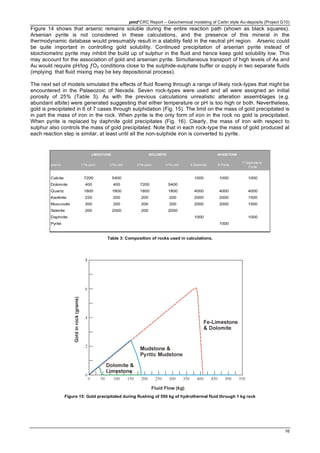
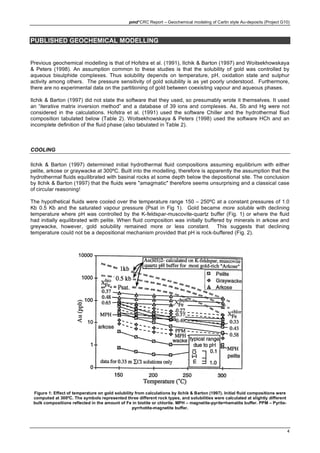
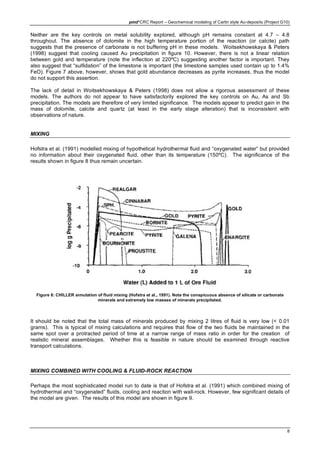
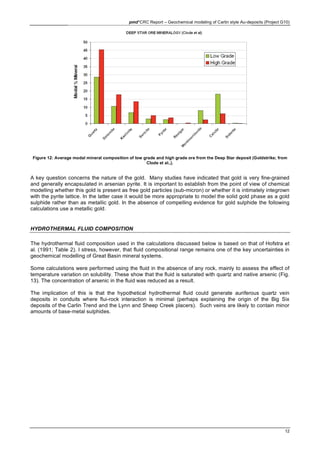
Figure 14: Activity-activity diagram showing the pH-log ƒO2 trajectory of the reaction path involving Popovich Limestone with
600 grams siderite. Note that the dominant arsenic species are aqueous sulphides.
1
The form of the iron-bearing mineral is not crucial as the software calculates a bulk composition based on the sum of mineral inputs.
The choice of siderite means that the bulk carbonate content of the rock is higher than would be the case with chlorite or another ferroan
silicate.](https://image.slidesharecdn.com/9180b6af-afdf-4b2c-85be-849439319660-160308103731/85/Wilde-Carlin-Geochem-Modelling-PMD-CRC-2006-17-320.jpg)