Wikis and Collaborative learningRose-marie Merton
A collaborative ethos acknowledges children’s relationships and uses them to enhance their learning. (Claire and Salmon, 1984)
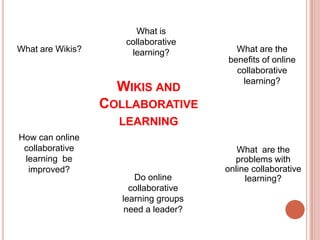
What is collaborative learning?What are Wikis?What are the benefits of online collaborative learning?Wikis and Collaborative learningHow can online collaborative learning  be improved?What  are the problems with online collaborative learning?Do online  collaborative learning groups need a leader?
What are Wikis?Websites that give students :access to resources online opportunities to chat in discussions edit information on the site upload information and resources analyse and give feedback for others. (Carrington, 2009)
What is collaborative learning?Collaborative learning is about teachers and students sharing information, knowledge and authorityTeachers are mediators encouraging students to learn about learning. Heterogeneous groups of students are involved in collaborative learning(this means they respect all contributors and recognise all members of the group as equal members)(McInnerney and Robert, 2004).
What are the benefits of online collaborative learning?improves children’s self-esteem, reduces social anxieties, encourages an understanding of diversity, gives opportunities to build relationships and stimulates critical thinking.(Panitz 1997, cited in Robert, 2004)
…Collaborative work helps children togain further understanding of topics by discussing different perspectives and sharing knowledge in communities.(Brown, Collins and Diguid, 1989; Duffy and Cunningham, 1996; Lave and Wenger, 1991, cited in Bennett, 2004, p.2).
What  are the problems with online collaborative learning?Lack of face-to-face interactions can lead to people giving up or not participating.
The less interesting and appealing the wiki is the less people are likely to use it.
It needs to be accessible to people, they should be able to use it.
technical problems can effect communication.(Bennett, 2004)
…some subjects/topics require more teacher input and guidance.uncontrollable variables in studies prevent some teachers from believing the potential benefits.(Robert, 2004)
Do online  collaborative learning groups need a leader?Kukuluska-Hulme (2004, p.263.) suggests:groups need some guidance but how much guidance they will need depends on how involved they are in the online environment. some learners might not want teachers to get involved and may prefer to have one or more student leaders instead.
…“When online activities are well designed and expectations have been set, students can have some good collaborative learning experiences without a teacher. However online collaborative groups still need leaders”.(Kukuluska-Hulme, 2004, p.277.)

Wikis and collaborative learning

  • 1.
    Wikis and CollaborativelearningRose-marie Merton
  • 2.
    A collaborative ethosacknowledges children’s relationships and uses them to enhance their learning. (Claire and Salmon, 1984)
  • 3.
    What is collaborativelearning?What are Wikis?What are the benefits of online collaborative learning?Wikis and Collaborative learningHow can online collaborative learning be improved?What are the problems with online collaborative learning?Do online collaborative learning groups need a leader?
  • 4.
    What are Wikis?Websitesthat give students :access to resources online opportunities to chat in discussions edit information on the site upload information and resources analyse and give feedback for others. (Carrington, 2009)
  • 5.
    What is collaborativelearning?Collaborative learning is about teachers and students sharing information, knowledge and authorityTeachers are mediators encouraging students to learn about learning. Heterogeneous groups of students are involved in collaborative learning(this means they respect all contributors and recognise all members of the group as equal members)(McInnerney and Robert, 2004).
  • 6.
    What are thebenefits of online collaborative learning?improves children’s self-esteem, reduces social anxieties, encourages an understanding of diversity, gives opportunities to build relationships and stimulates critical thinking.(Panitz 1997, cited in Robert, 2004)
  • 7.
    …Collaborative work helpschildren togain further understanding of topics by discussing different perspectives and sharing knowledge in communities.(Brown, Collins and Diguid, 1989; Duffy and Cunningham, 1996; Lave and Wenger, 1991, cited in Bennett, 2004, p.2).
  • 8.
    What arethe problems with online collaborative learning?Lack of face-to-face interactions can lead to people giving up or not participating.
  • 9.
    The less interestingand appealing the wiki is the less people are likely to use it.
  • 10.
    It needs tobe accessible to people, they should be able to use it.
  • 11.
    technical problems caneffect communication.(Bennett, 2004)
  • 12.
    …some subjects/topics requiremore teacher input and guidance.uncontrollable variables in studies prevent some teachers from believing the potential benefits.(Robert, 2004)
  • 13.
    Do online collaborative learning groups need a leader?Kukuluska-Hulme (2004, p.263.) suggests:groups need some guidance but how much guidance they will need depends on how involved they are in the online environment. some learners might not want teachers to get involved and may prefer to have one or more student leaders instead.
  • 14.
    …“When online activitiesare well designed and expectations have been set, students can have some good collaborative learning experiences without a teacher. However online collaborative groups still need leaders”.(Kukuluska-Hulme, 2004, p.277.)

Editor's Notes