Wikimedia Content API:
A Cassandra Use-case
Eric Evans <eevans@wikimedia.org>
@jericevans
Apache Bigdata | May 10, 2016
Our Vision:
A world in which every single human can freely
share in the sum of all knowledge.
About:
● Global movement
● Largest collection of free, collaborative knowledge in human history
● 16 projects
● 16.5 billion total page views per month
● 58.9 million unique devices per day
● More than 13k new editors each month
● More than 75k active editors month-to-month
About: Wikipedia
● More than 38 million articles in 290 languages
● Over 10k new articles added per day
● 13 million edits per month
● Ranked #6 globally in web traffic
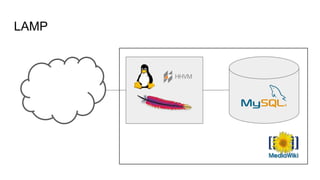
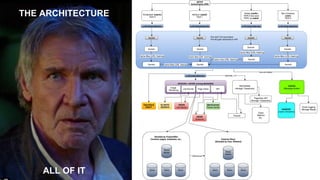
Wikimedia Architecture
LAMP
THE ARCHITECTURE
ALL OF IT
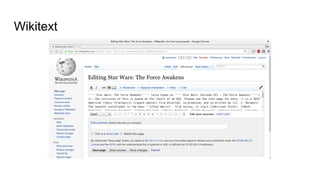
Wikitext
= Star Wars: The Force Awakens =
Star Wars: The Force Awakens is a 2015 American epic space opera
film directed, co-produced, and co-written by [[J. J. Abrams]].
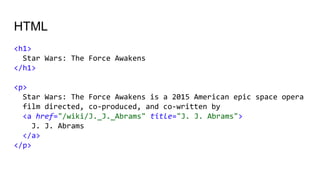
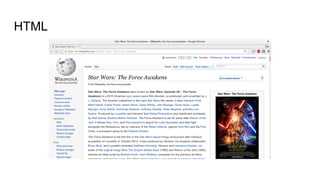
HTML
<h1>
Star Wars: The Force Awakens
</h1>
<p>
Star Wars: The Force Awakens is a 2015 American epic space opera
film directed, co-produced, and co-written by
<a href="/wiki/J._J._Abrams" title="J. J. Abrams">
J. J. Abrams
</a>
</p>
Wikitext
HTML
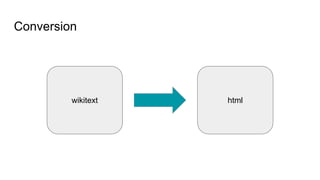
Conversion
wikitext html
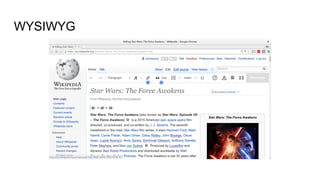
WYSIWYG
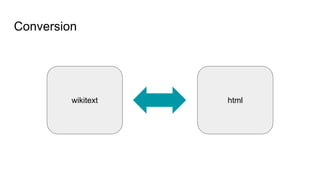
Conversion
wikitext html
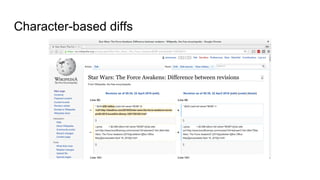
Character-based diffs
Metadata
[[Foo|bar]]
<a rel="mw:WikiLink" href="./Foo">bar</a>
Metadata
[[Foo|{{echo|bar}}]]
<a rel="mw:WikiLink" href="./Foo">
<span about="#mwt1" typeof="mw:Object/Template"
data-parsoid="{...}" >bar</span>
</a>
Parsoid
● Node.js service
● Converts wikitext to HTML/RDFa
● Converts HTML/RDFa to wikitext
● Semantics, and syntax (avoid dirty diffs)!
● Expensive (slow)
● Resulting output is large
RESTBase
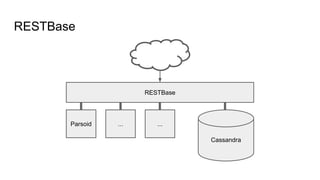
● Services aggregator / proxy (REST)
● Durable cache (Cassandra)
● Wikimedia’s content API (e.g. https://en.wikipedia.org/api/rest_v1?doc)
Cassandra
RESTBase
RESTBase
Parsoid ... ...
Other use-cases
● Mobile content service
● Math formula rendering service
● Dumps
● ...
Cassandra
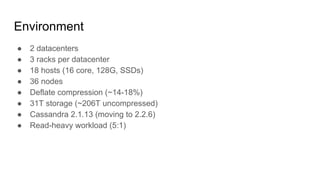
Environment
● 2 datacenters
● 3 racks per datacenter
● 18 hosts (16 core, 128G, SSDs)
● 36 nodes
● Deflate compression (~14-18%)
● 31T storage (~206T uncompressed)
● Cassandra 2.1.13 (moving to 2.2.6)
● Read-heavy workload (5:1)
Data model
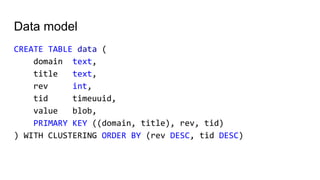
Data model
CREATE TABLE data (
domain text,
title text,
rev int,
tid timeuuid,
value blob,
PRIMARY KEY ((domain, title), rev, tid)
) WITH CLUSTERING ORDER BY (rev DESC, tid DESC)
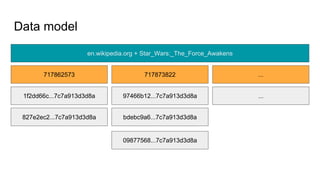
Data model
en.wikipedia.org + Star_Wars:_The_Force_Awakens
717862573 717873822
...97466b12...7c7a913d3d8a1f2dd66c...7c7a913d3d8a
...
09877568...7c7a913d3d8a
bdebc9a6...7c7a913d3d8a827e2ec2...7c7a913d3d8a
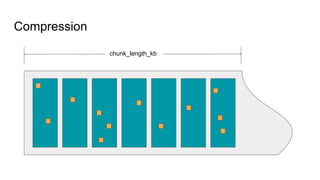
Compression
Compression
chunk_length_kb
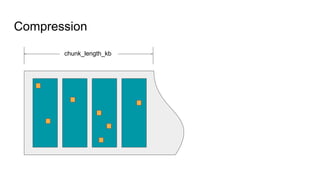
Compression
chunk_length_kb
Brotli compression
● Brought to you by the folks at Google; Successor to deflate
● Cassandra implementation (https://github.com/eevans/cassandra-brotli)
● Initial results very promising
● Better compression, lower cost (apples-apples)
● And, wider windows are possible (apples-oranges)
○ GC/memory permitting
○ Example: level=1, lgblock=4096, chunk_length_kb=4096, yields 1.73% compressed size!
○ https://phabricator.wikimedia.org/T122028
● Stay tuned!
Compaction
Compaction
● The cost of having log-structured storage
● Asynchronously (post-write) optimize data on disk for reads
● At a minimum, reorganize into fewer files
○ Dropping what is obsolete
○ Expiring TTLs
○ Removing deleted (aka tombstoned) data (after a fashion)
● Reorganize data so results are nearer each other
Compaction strategies
● Size-tiered
○ Combines tables of similar size
○ Oblivious to column distribution; Works best for workloads with no overwrites/deletes
○ Needs working space for largest possible compaction (100%)
○ Minimal IO
● Leveled
○ Small, fixed size files in levels of exponentially increasing size
○ Files have non-overlapping ranges within a level
○ Amortized; Lots of continuous compaction
○ Very efficient reads, but also quite IO intensive
● Date-tiered
Date-tiered compaction
● Newest of the bunch; Introduced in 2.1
● For append-only workloads (no overwrites, no deletes)
● Where data is ordered sort-ascending, (and not written out-of-order)
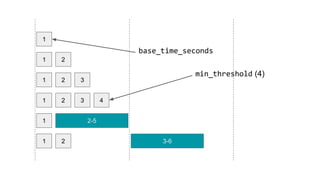
● Windows of time, arranged in tiers
● Avoids mixing “old” data with “new”
● Cold data eventually ceases to be compacted
1
1 2
2 31
2-51
2 3 41
1 2
min_threshold (4)
base_time_seconds
3-6
Date-tiered compaction
● Newest of the bunch; Introduced in 2.1
● For append-only workloads (no overwrites, no deletes)
● Where data is ordered sort-ascending, (and not written out-of-order)
● Windows of time, arranged in tiers
● Avoids mixing “old” data with “new”
● Cold data eventually ceases to be compacted
● Hard to reason about
● Optimizations are easily defeated
● https://phabricator.wikimedia.org/T126221
DTCS: So now what?
● Size-tiered compaction? Might as well.
● TimeWindowCompactionStrategy (https://github.com/jeffjirsa/twcs)?
Maybe...
● Reduce node density?
Garbage Collection
GC
● Early adopters of G1 (Garbage 1st)
● Successor to Concurrent Mark-sweep (CMS)
● Incremental parallel compacting collector
● More predictable than CMS
● Configurable pause-time target
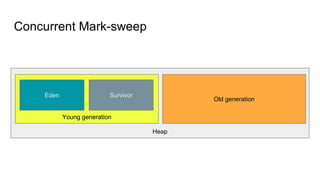
Concurrent Mark-sweep
Heap
Old generation
Young generation
Eden Survivor
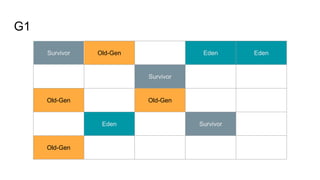
G1
Survivor Old-Gen Eden Eden
Survivor
Old-Gen Old-Gen
Eden Survivor
Old-Gen
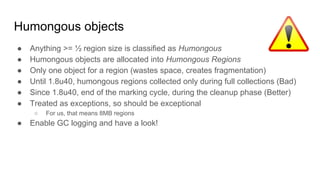
Humongous objects
● Anything >= ½ region size is classified as Humongous
● Humongous objects are allocated into Humongous Regions
● Only one object for a region (wastes space, creates fragmentation)
● Until 1.8u40, humongous regions collected only during full collections (Bad)
● Since 1.8u40, end of the marking cycle, during the cleanup phase (Better)
● Treated as exceptions, so should be exceptional
○ For us, that means 8MB regions
● Enable GC logging and have a look!
Multi-instance
“Many smaller-sized Cassandra nodes is
always better than fewer, dense ones.”
— Everyone
Motivation
● Compaction
● GC
What we do
● Processes (yup)
● Puppetized configuration
○ /etc/cassandra-a/
○ /etc/cassandra-b/
○ systemd units
○ Etc
● Shared RAID-0
What we should have done
● Virtualization
● Containers
● Blades
The Good
● Fault-tolerance
● Availability
● Datacenter / rack awareness
● Nice, helpful people (tickets, IRC, etc)
The Bad
● Usability
○ Compaction
○ Streaming
○ JMX
● Vertical scaling
● JVM
The Ugly
● Release process
● Upgrades
Wikimedia Content API: A Cassandra Use-case

Wikimedia Content API: A Cassandra Use-case

  • 1.
    Wikimedia Content API: ACassandra Use-case Eric Evans <eevans@wikimedia.org> @jericevans Apache Bigdata | May 10, 2016
  • 3.
    Our Vision: A worldin which every single human can freely share in the sum of all knowledge.
  • 4.
    About: ● Global movement ●Largest collection of free, collaborative knowledge in human history ● 16 projects ● 16.5 billion total page views per month ● 58.9 million unique devices per day ● More than 13k new editors each month ● More than 75k active editors month-to-month
  • 5.
    About: Wikipedia ● Morethan 38 million articles in 290 languages ● Over 10k new articles added per day ● 13 million edits per month ● Ranked #6 globally in web traffic
  • 6.
  • 7.
  • 8.
  • 11.
    Wikitext = Star Wars:The Force Awakens = Star Wars: The Force Awakens is a 2015 American epic space opera film directed, co-produced, and co-written by [[J. J. Abrams]].
  • 12.
    HTML <h1> Star Wars: TheForce Awakens </h1> <p> Star Wars: The Force Awakens is a 2015 American epic space opera film directed, co-produced, and co-written by <a href="/wiki/J._J._Abrams" title="J. J. Abrams"> J. J. Abrams </a> </p>
  • 13.
  • 14.
  • 15.
  • 16.
  • 17.
  • 18.
  • 19.
  • 20.
    Metadata [[Foo|{{echo|bar}}]] <a rel="mw:WikiLink" href="./Foo"> <spanabout="#mwt1" typeof="mw:Object/Template" data-parsoid="{...}" >bar</span> </a>
  • 21.
    Parsoid ● Node.js service ●Converts wikitext to HTML/RDFa ● Converts HTML/RDFa to wikitext ● Semantics, and syntax (avoid dirty diffs)! ● Expensive (slow) ● Resulting output is large
  • 22.
    RESTBase ● Services aggregator/ proxy (REST) ● Durable cache (Cassandra) ● Wikimedia’s content API (e.g. https://en.wikipedia.org/api/rest_v1?doc)
  • 23.
  • 24.
    Other use-cases ● Mobilecontent service ● Math formula rendering service ● Dumps ● ...
  • 25.
  • 26.
    Environment ● 2 datacenters ●3 racks per datacenter ● 18 hosts (16 core, 128G, SSDs) ● 36 nodes ● Deflate compression (~14-18%) ● 31T storage (~206T uncompressed) ● Cassandra 2.1.13 (moving to 2.2.6) ● Read-heavy workload (5:1)
  • 27.
  • 28.
    Data model CREATE TABLEdata ( domain text, title text, rev int, tid timeuuid, value blob, PRIMARY KEY ((domain, title), rev, tid) ) WITH CLUSTERING ORDER BY (rev DESC, tid DESC)
  • 29.
    Data model en.wikipedia.org +Star_Wars:_The_Force_Awakens 717862573 717873822 ...97466b12...7c7a913d3d8a1f2dd66c...7c7a913d3d8a ... 09877568...7c7a913d3d8a bdebc9a6...7c7a913d3d8a827e2ec2...7c7a913d3d8a
  • 30.
  • 31.
  • 32.
  • 33.
    Brotli compression ● Broughtto you by the folks at Google; Successor to deflate ● Cassandra implementation (https://github.com/eevans/cassandra-brotli) ● Initial results very promising ● Better compression, lower cost (apples-apples) ● And, wider windows are possible (apples-oranges) ○ GC/memory permitting ○ Example: level=1, lgblock=4096, chunk_length_kb=4096, yields 1.73% compressed size! ○ https://phabricator.wikimedia.org/T122028 ● Stay tuned!
  • 34.
  • 35.
    Compaction ● The costof having log-structured storage ● Asynchronously (post-write) optimize data on disk for reads ● At a minimum, reorganize into fewer files ○ Dropping what is obsolete ○ Expiring TTLs ○ Removing deleted (aka tombstoned) data (after a fashion) ● Reorganize data so results are nearer each other
  • 36.
    Compaction strategies ● Size-tiered ○Combines tables of similar size ○ Oblivious to column distribution; Works best for workloads with no overwrites/deletes ○ Needs working space for largest possible compaction (100%) ○ Minimal IO ● Leveled ○ Small, fixed size files in levels of exponentially increasing size ○ Files have non-overlapping ranges within a level ○ Amortized; Lots of continuous compaction ○ Very efficient reads, but also quite IO intensive ● Date-tiered
  • 37.
    Date-tiered compaction ● Newestof the bunch; Introduced in 2.1 ● For append-only workloads (no overwrites, no deletes) ● Where data is ordered sort-ascending, (and not written out-of-order) ● Windows of time, arranged in tiers ● Avoids mixing “old” data with “new” ● Cold data eventually ceases to be compacted
  • 38.
    1 1 2 2 31 2-51 23 41 1 2 min_threshold (4) base_time_seconds 3-6
  • 39.
    Date-tiered compaction ● Newestof the bunch; Introduced in 2.1 ● For append-only workloads (no overwrites, no deletes) ● Where data is ordered sort-ascending, (and not written out-of-order) ● Windows of time, arranged in tiers ● Avoids mixing “old” data with “new” ● Cold data eventually ceases to be compacted ● Hard to reason about ● Optimizations are easily defeated ● https://phabricator.wikimedia.org/T126221
  • 41.
    DTCS: So nowwhat? ● Size-tiered compaction? Might as well. ● TimeWindowCompactionStrategy (https://github.com/jeffjirsa/twcs)? Maybe... ● Reduce node density?
  • 42.
  • 43.
    GC ● Early adoptersof G1 (Garbage 1st) ● Successor to Concurrent Mark-sweep (CMS) ● Incremental parallel compacting collector ● More predictable than CMS ● Configurable pause-time target
  • 44.
  • 45.
    G1 Survivor Old-Gen EdenEden Survivor Old-Gen Old-Gen Eden Survivor Old-Gen
  • 46.
    Humongous objects ● Anything>= ½ region size is classified as Humongous ● Humongous objects are allocated into Humongous Regions ● Only one object for a region (wastes space, creates fragmentation) ● Until 1.8u40, humongous regions collected only during full collections (Bad) ● Since 1.8u40, end of the marking cycle, during the cleanup phase (Better) ● Treated as exceptions, so should be exceptional ○ For us, that means 8MB regions ● Enable GC logging and have a look!
  • 47.
  • 48.
    “Many smaller-sized Cassandranodes is always better than fewer, dense ones.” — Everyone
  • 49.
  • 50.
    What we do ●Processes (yup) ● Puppetized configuration ○ /etc/cassandra-a/ ○ /etc/cassandra-b/ ○ systemd units ○ Etc ● Shared RAID-0
  • 51.
    What we shouldhave done ● Virtualization ● Containers ● Blades
  • 52.
    The Good ● Fault-tolerance ●Availability ● Datacenter / rack awareness ● Nice, helpful people (tickets, IRC, etc)
  • 53.
    The Bad ● Usability ○Compaction ○ Streaming ○ JMX ● Vertical scaling ● JVM
  • 54.
    The Ugly ● Releaseprocess ● Upgrades