Wiki Mind Mapping
Harshit Mittal (IIT-B)
h.mittal83@gmail.com
Aditya Tiwari (IIT-B)
adi.tiwari27@gmail.com
Akhil Bhiwal (VIT University)
bhiwalakhil@gmail.com
1
Project Idea
Represent

the textual information in
graphical form which is easier to
understand and more intuitive to read. The
visual representation should be able to
summarize the text.

2
Research Goal
Use

of phrases to represent semantic
information.

Hierarchical

representation of
information of a given text

3
Mind maps
A mind

map is
a diagram used
to
represent words, ideas, tasks, or other items
linked to and arranged around a central key
word or idea.
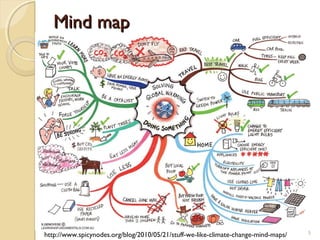
Example Mind map in the next slide.

http://en.wikipedia.org/wiki/Mind_maps

4
Mind map

http://www.spicynodes.org/blog/2010/05/21/stuff-we-like-climate-change-mind-maps/

5
What’s the difficult part?
We

can’t represent information from any
article in mind-map as it is. That would
make it incoherent and clumsy.

Phrase

extraction

General

here.

rules of grammar don’t apply

6
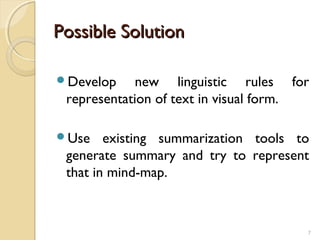
Possible Solution
Develop

new linguistic rules for
representation of text in visual form.

Use

existing summarization tools to
generate summary and try to represent
that in mind-map.

7
How we did it.
Pulling

out the article section wise from the
Wikipedia page.

Parsing

each section sentence wise using the
Stanford parser.

Extracting

“relevant” phrases using Tregex
(another Stanford tool).

Putting

these phrases into a mind map,
section wise.

http://nlp.stanford.edu/software/tregex.shtml

8
Extraction of relevant information
Identifying

subtrees from the parse tree of a
sentence that are important.

This

was done using a few heuristics like:

◦ Presence of a superlative adjective in a noun phrase

http://nlp.stanford.edu/software/tregex.shtml

9
Extraction of relevant information
Presence

of a cardinal number in a noun

phrase

http://nlp.stanford.edu/software/tregex.shtml

10
Extraction of relevant information
 Matching

of a particular verb to the bag of verbs
that were considered relevant for a particular
article. For example : for the history section, verbs
like find , discover, settle, decline were considered
“more useful”, as compared to words like derive,
deduce etc. which were considered useful for some
other section.

11
Extraction of relevant information
Ex : The name India is derived from Indus.

http://nlp.stanford.edu/software/tregex.shtml

12
Code Generated Mind Map

13
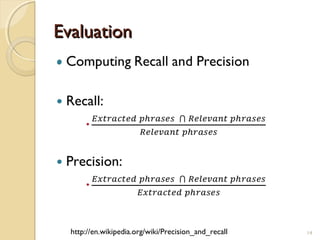
Evaluation

http://en.wikipedia.org/wiki/Precision_and_recall

14
Evaluation
Survey

based:

Asking

a person to generate 10 questions
from given article.

Asking

another person to answer those
question with the help of mind-map.

Repeating

the same exercise in reverse
manner for another article.
15
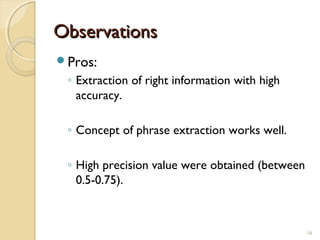
Observations
Pros:

◦ Extraction of right information with high
accuracy.
◦ Concept of phrase extraction works well.
◦ High precision value were obtained (between
0.5-0.75).

16
Observations
Cons

◦ Information presented in mindmap of low depth
is clumsy.
◦ Low recall value (0.2 – 0.4)
◦ Linking of node phrases with their apt
description.
◦ Heuristics defining “important phrases” need to
be refined.
17
Limitations
Bag

of words and Tregex expressions is
hand-coded instead of machine learned.

Garbage

Level

phrases are being generated.

of hierarchy is limited to 3.

18
Future work
Using

machine learning to determine the
important keywords for a given sentence.

We

want to explore the possibility of
finding patterns in subtree expressions
using machine learned approach.

Refinement

of generated phrases.
19
References
http://en.wikipedia.org/wiki/Mind_maps
http://en.wikipedia.org/wiki/Precision_and_recall
Tool

: Stanford Parser and Stanford Tregex Match
http://nlp.stanford.edu/software/tregex.shtml

20

Wiki Mind Mapping