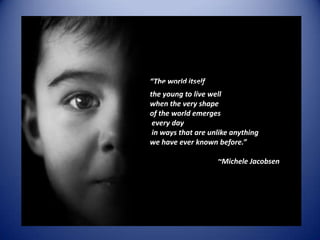
The world itself holds a different lesson for us: a lesson about the importance of teaching the young to live well when the very shape of the world emerges every day in ways that are unlike anything we have ever known before.”                                     ~Michele Jacobsen“The world itself
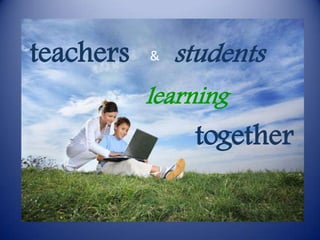
teachersstudents&learningtogether
Wherewe’ve been
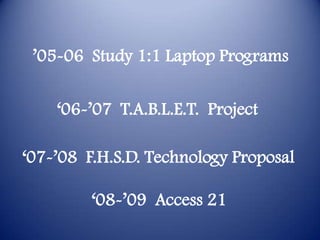
’05-06  Study 1:1 Laptop Programs‘06-’07  T.A.B.L.E.T.  Project‘07-’08  F.H.S.D. Technology Proposal‘08-’09  Access 21
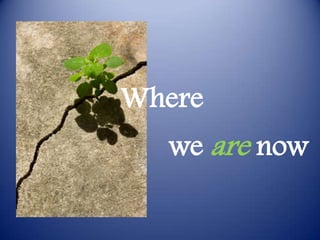
Where we arenow
WhereWe need to go
How Do WeGet There?
“The most promising strategyfor sustained, substantive school improvement is building the capacity  of school personnel to function as a professional learning community.The path to change  in the classroom lies within and through professional learning  communities.”
Wikes presentation

Wikes presentation

  • 2.
    The world itselfholds a different lesson for us: a lesson about the importance of teaching the young to live well when the very shape of the world emerges every day in ways that are unlike anything we have ever known before.” ~Michele Jacobsen“The world itself
  • 3.
  • 4.
  • 5.
    ’05-06 Study1:1 Laptop Programs‘06-’07 T.A.B.L.E.T. Project‘07-’08 F.H.S.D. Technology Proposal‘08-’09 Access 21
  • 6.
  • 7.
  • 8.
  • 9.
    “The most promisingstrategyfor sustained, substantive school improvement is building the capacity of school personnel to function as a professional learning community.The path to change in the classroom lies within and through professional learning communities.”

Editor's Notes

  • #3 IntroductionContext—QuoteThese words by Michele Jacobsen beautifully reflect a truth…and she goes on to say…We no longer live in a world in which information is scarce, and the teacher's role is to hand deliver content to children. Overwhelmed by information from a wealth of sources, students desperately need the skills to create new knowledge, not just consume the old. Problems never come neatly packaged, defined-in-advance, and amenable to the rote application of familiar strategies—except in school. As our world learned on September 11, 2001 real problems erupt unexpectedly, demanding careful and creative attention in chaotic environments that had once seemed stable and unshakable. The old certainties of a world defined by four classroom walls and impermeable boundaries have disappeared forever, replaced by global interdependencies and complex systems that require flexibility, responsiveness, and imagination. Without a doubt, the world is changing…swiftly and dramatically… and we will be called on to wrap our brains around what those changes mean for the way in which we educate children.
  • #4 All along our mission has been:To help teachers become more comfortable and fluent with the technology; to begin to help them discover the ways in which it can support and enhance learning.And also to increase student access to the tools of learning, providing experiences for students that we've never been able to offer before. 
  • #5 Where we’ve Been
  • #6 2005-2006 Committee is formed to study 1:1 Laptop Programs at the behest of the Board of Education2006-2007 T.A.B.L.E.T. 2007-2008 F.H.S.D. Technology Proposal2008-2009 Access 21
  • #7 CaryT.A.B.L.E.T. Project UpdateArticleBy the end of this school year, 380 staff members will have participated in the T.A.B.L.E.T. ProjectStaff has become more fluent and comfortable…more aware of toolsMultiple opportunities for PD-technology workshops both in the summer and during the school year, book studiesBut there is something even more exciting happening…staff beginning to see the potential for these tools to provide all of our students with access to learningBut with this awareness comes a need for increased access to the tools…and not just next Tuesday when I check out the laptop cartSo, where do we go next?
  • #8 Where we need to goOver the past four and a half years, we have continued to build our understanding of the potential of emergent technologies to amplify the learning. And what we know with absolute certainty is that it isn’t a question of “if” anymore…it is “how” and “when”. How do we increase access to the tools so students can learn in a world vastly different from the past and WHEN do we do this…particularly in light of these rapid changes? How do we continue to professionally develop our staff, so they can gain a deeper understanding of the pedagogial shifts required with increased technology use? Being realistic--We’re also sensitive and realistic aboutthe financial picture for our district.What we know for sure, is that we cannot simply stop moving forward. Our next steps will require calculated planning and yes, some creative thinking.
  • #9 How do we get there?Many schools are confronting the need to increase student access to technology, but discovering that reaching the ultimate goal of a 1:1 environment is simply cost prohibitive. One way to address this issue is to allow students to bring their own laptop to school. This would require the district to open up the network to guest access, capitalizing on the interest of our families in sending their child to school with their own device. We are interested in further exploration of this idea. We are thinking of a possible 6-month action research pilot project with seventh grade, in which we would study the effects of student-owned devices on the teaching and learning environment.
  • #10 What is it going to take? A comprehensive professional development program in which we work together, as a community, to re-imagine what learning looks like in the 21st Century.
  • #11 ConclusionSo now you have a better perspective of the path we’ve been following and where that pathway now seems to be leading our district. What we would like to know is whether there is an interest on your part in fully exploring this concept. If so, we would like to present a formal proposal at the March board meeting.You notice that we have taken the words out of the picture, because we are at the point of needing to find our own way forward, using our own words.What should this slide say about our future?