A Professional
Development
Plan for
Implementing
WIDA’s15
Essential Actions
Tom Wiglesworth
DoDEA ESOL Community 2019
Organizational
Demographics
● 4 Main Communities
● 6 Distinct Locations (2 satellite locations – NY/Cuba)
● Time Zone Difference 1-hour during fall semester
● 1 main instructor – Tom Wiglesworth
● 3 adjunct instructors – Seval Gomez, Loretta Eng, and
Angelica Jordan
● Open to DoDEA Teachers worldwide
● WIDA Implementation Required
● Course run in Schoology for one semester August to
December 2019
Program
Background
● DoDEA adoption of WIDA Standards
● ESOL Teachers trained on WIDA Screener
● Focus on Co-planning, Co-teaching and differentiation
for student success
● WIDA Standards aligned to CCRS
● Textbooks eliminated, Support Materials on WIDA
Secure Website
● This courses use open educational resources (OERs)
and authentic materials
● Course supports DoDEA Focused Collaboration
Initiative and the DoDEA Blueprint for student
excellence
WIDA
Essential
Elements:
Course
description
WIDA 15 Essential Actions – “Essential Actions is a response to three
frequently asked questions about WIDA’s Framework for language
development standards: ‘Why are there so many components?,’ ‘What is the
reasoning behind each component?,’ and ‘What is important to consider in
implementing English language development standards?’”
– Essential Actions Handbook by Margo Gottlieb, 2013
Key features
of the
course
● No purchased textbook, Handbook available on internet
● Modular-based
● Course Content is authentic and application oriented
● Course reference sources are published by WIDA
● Content applies cross-content (ELA, social studies,
science, mathematics, and electives).
● Created by ESOL ISSs
● Approach is task-based.
● Contains detailed lesson plans for 1 semester 3-credits
● Course is housed 100% in the DoDEA Schoology
learning management system (online).
● Course is taught in blended format with opportunities for
face-to-face collaboration and modeling.
Audience
for the PD
Plan
● School level ESOL Teachers, Classroom Teachers,
School Administrators
Target audience for trainees
● All DodEA ESOL Teachers
An online-
based PD
plan
An online based Schoology-based LMS plan is suitable
because we anticipate ESOL teachers in DoDEA worldwide to
participate. Implementation should be consistent throughout
DoDEA.
Characteristics
● Master ESOL ISS trainers
● Immediately relevant to faculty
● Encourages an ESOL Professional community of
learning
● Promotes Focused Collaboration with classroom
teachers
Phase I:
Providing a
rationale
and
background
This part will be done prior to starting the Course in
August 2019
● Provide ESOL ISSs with resources and activities
● Focus on implementation of WIDA with fidelity across
DoDEA
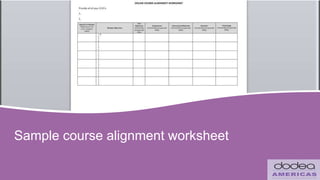
● Provide ESOL ISSs with Course Alignment Worksheet
● Provide ESOL ISSs with access to the template course
in the LMS.
● Encourage ESOL ISS to take the online asynchronous
WIDA-provided Training of Trainers for 16 1 hour
trainings using the Essential Actions.
Sample course alignment worksheet
Phase 2:
Train the
Instructors
● Course Instructors will come from ESOL ISSs who took
the WIDA Train the Trainers Course and who
participated in the 3-credit course development.
● Training will consist of
○ A checklist for Instructors
○ Minimum requirements for communicating with course
participants
○ Parameters of coaching teachers
○ Technology to use in coaching such as Google Hangouts,
Zoom, or VTC for online meetings
Phase 2:
Hands-on
workshop
Participants will have access to WIDA site resources and the
Course Syllabus/materials in the DoDEA Schoology LMS. The
training takes place online and in blended format coaching.
● Course Instructors will be guided to connect with ESOL
teachers in their regions/districts and establish
discussion blogs.
● Course Instructors will receive instructions (written and
spoken) on how to conduct the coaching elements.
● Course Instructors will collaborate on issues arising from
various regional discussions and implementation issues.
● Course Instructors will meet regularly online throughout
the course from August to December.
Phase 3:
Peer
collaboration
Course Instructors will be provided with opportunities to
collaborate with each other and provide input into the new
course.
● Course Instructors will meet each other at the initial
online implementation meeting.
● Course Instructors will regularly share in the LMS and
discuss whether each region should run a separate
version of the course in the LMS.
● Course Instructors will be encouraged to visit each
other’s LMS forums with an ‘open classroom’ mindset.
(Burns, 2014).
● Course Instructors will communicate via previously
established online meetings, emails, and Lync chats.
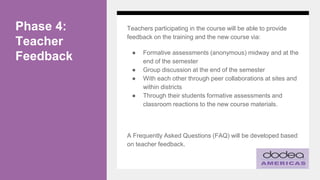
Phase 4:
Teacher
Feedback
Teachers participating in the course will be able to provide
feedback on the training and the new course via:
● Formative assessments (anonymous) midway and at the
end of the semester
● Group discussion at the end of the semester
● With each other through peer collaborations at sites and
within districts
● Through their students formative assessments and
classroom reactions to the new course materials.
A Frequently Asked Questions (FAQ) will be developed based
on teacher feedback.
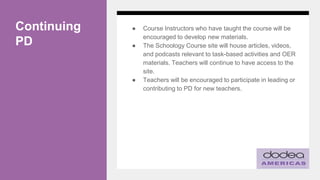
Continuing
PD
● Course Instructors who have taught the course will be
encouraged to develop new materials.
● The Schoology Course site will house articles, videos,
and podcasts relevant to task-based activities and OER
materials. Teachers will continue to have access to the
site.
● Teachers will be encouraged to participate in leading or
contributing to PD for new teachers.
References Burns, M. (2014). Five models of teacher
professional development. Retrieved from
https://www.globalpartnership.org/blog/five-models-
teacher-centered-professional-development
Guskey, T. (2002). Does it make a difference?
Evaluating professional development. Educational
Leadership 59 (6), 45-51.
Whiting, K. (2016). Three models of PD. Retrieved
from https://prezi.com/er7znexv2hnm/3-models-of-
pd/

Wiglesworth training plan wida 3-credit course

  • 1.
    A Professional Development Plan for Implementing WIDA’s15 EssentialActions Tom Wiglesworth DoDEA ESOL Community 2019
  • 2.
    Organizational Demographics ● 4 MainCommunities ● 6 Distinct Locations (2 satellite locations – NY/Cuba) ● Time Zone Difference 1-hour during fall semester ● 1 main instructor – Tom Wiglesworth ● 3 adjunct instructors – Seval Gomez, Loretta Eng, and Angelica Jordan ● Open to DoDEA Teachers worldwide ● WIDA Implementation Required ● Course run in Schoology for one semester August to December 2019
  • 3.
    Program Background ● DoDEA adoptionof WIDA Standards ● ESOL Teachers trained on WIDA Screener ● Focus on Co-planning, Co-teaching and differentiation for student success ● WIDA Standards aligned to CCRS ● Textbooks eliminated, Support Materials on WIDA Secure Website ● This courses use open educational resources (OERs) and authentic materials ● Course supports DoDEA Focused Collaboration Initiative and the DoDEA Blueprint for student excellence
  • 4.
    WIDA Essential Elements: Course description WIDA 15 EssentialActions – “Essential Actions is a response to three frequently asked questions about WIDA’s Framework for language development standards: ‘Why are there so many components?,’ ‘What is the reasoning behind each component?,’ and ‘What is important to consider in implementing English language development standards?’” – Essential Actions Handbook by Margo Gottlieb, 2013
  • 5.
    Key features of the course ●No purchased textbook, Handbook available on internet ● Modular-based ● Course Content is authentic and application oriented ● Course reference sources are published by WIDA ● Content applies cross-content (ELA, social studies, science, mathematics, and electives). ● Created by ESOL ISSs ● Approach is task-based. ● Contains detailed lesson plans for 1 semester 3-credits ● Course is housed 100% in the DoDEA Schoology learning management system (online). ● Course is taught in blended format with opportunities for face-to-face collaboration and modeling.
  • 6.
    Audience for the PD Plan ●School level ESOL Teachers, Classroom Teachers, School Administrators Target audience for trainees ● All DodEA ESOL Teachers
  • 7.
    An online- based PD plan Anonline based Schoology-based LMS plan is suitable because we anticipate ESOL teachers in DoDEA worldwide to participate. Implementation should be consistent throughout DoDEA. Characteristics ● Master ESOL ISS trainers ● Immediately relevant to faculty ● Encourages an ESOL Professional community of learning ● Promotes Focused Collaboration with classroom teachers
  • 8.
    Phase I: Providing a rationale and background Thispart will be done prior to starting the Course in August 2019 ● Provide ESOL ISSs with resources and activities ● Focus on implementation of WIDA with fidelity across DoDEA ● Provide ESOL ISSs with Course Alignment Worksheet ● Provide ESOL ISSs with access to the template course in the LMS. ● Encourage ESOL ISS to take the online asynchronous WIDA-provided Training of Trainers for 16 1 hour trainings using the Essential Actions.
  • 9.
  • 10.
    Phase 2: Train the Instructors ●Course Instructors will come from ESOL ISSs who took the WIDA Train the Trainers Course and who participated in the 3-credit course development. ● Training will consist of ○ A checklist for Instructors ○ Minimum requirements for communicating with course participants ○ Parameters of coaching teachers ○ Technology to use in coaching such as Google Hangouts, Zoom, or VTC for online meetings
  • 11.
    Phase 2: Hands-on workshop Participants willhave access to WIDA site resources and the Course Syllabus/materials in the DoDEA Schoology LMS. The training takes place online and in blended format coaching. ● Course Instructors will be guided to connect with ESOL teachers in their regions/districts and establish discussion blogs. ● Course Instructors will receive instructions (written and spoken) on how to conduct the coaching elements. ● Course Instructors will collaborate on issues arising from various regional discussions and implementation issues. ● Course Instructors will meet regularly online throughout the course from August to December.
  • 12.
    Phase 3: Peer collaboration Course Instructorswill be provided with opportunities to collaborate with each other and provide input into the new course. ● Course Instructors will meet each other at the initial online implementation meeting. ● Course Instructors will regularly share in the LMS and discuss whether each region should run a separate version of the course in the LMS. ● Course Instructors will be encouraged to visit each other’s LMS forums with an ‘open classroom’ mindset. (Burns, 2014). ● Course Instructors will communicate via previously established online meetings, emails, and Lync chats.
  • 13.
    Phase 4: Teacher Feedback Teachers participatingin the course will be able to provide feedback on the training and the new course via: ● Formative assessments (anonymous) midway and at the end of the semester ● Group discussion at the end of the semester ● With each other through peer collaborations at sites and within districts ● Through their students formative assessments and classroom reactions to the new course materials. A Frequently Asked Questions (FAQ) will be developed based on teacher feedback.
  • 14.
    Continuing PD ● Course Instructorswho have taught the course will be encouraged to develop new materials. ● The Schoology Course site will house articles, videos, and podcasts relevant to task-based activities and OER materials. Teachers will continue to have access to the site. ● Teachers will be encouraged to participate in leading or contributing to PD for new teachers.
  • 15.
    References Burns, M.(2014). Five models of teacher professional development. Retrieved from https://www.globalpartnership.org/blog/five-models- teacher-centered-professional-development Guskey, T. (2002). Does it make a difference? Evaluating professional development. Educational Leadership 59 (6), 45-51. Whiting, K. (2016). Three models of PD. Retrieved from https://prezi.com/er7znexv2hnm/3-models-of- pd/