WIELICZKA
Group 2
Wieliczka
salt mine
■ “The historic Wieliczka Salt Mine is the only
mining facility in the world that has been
operating continuously from the Middle Ages to
the present. Its original excavations
(walkways, slipways, mining chambers, lakes,
shafts, shafts) with a total length of about
300 km are located on 9 levels, reaching a
depth of 327 m, illustrating all stages of the
development of mining technology in particular
historical epochs.
■ On September 8, 1978, the Wieliczka Salt Mine
was inscribed on the first UNESCO World
Cultural and Natural Heritage List among the
first 12 sites from around the world. Indeed,
the history of Wieliczka, dating back to the
Middle Ages, is a mirror of the development of
mining techniques, the shaping management.
Position
■ Wieliczka is a town located in the Lesser Poland Voivodeship, in
the western part of the Wieliczka County. Wieliczka is located
within Lesser Poland as a historical land. The city lies in a
valley between two ridges of hills stretching from west to east:
the Wielickie Foothills in the south and Piaski Bogucickie in
the north. Currently, the city has a typical tourist function.
Wieliczka is known for its unique salt mine, which is visited by
over a million tourists a year.
history
■ Salt was the most important mineral in the Polish state and, according to
the applicable law, it was the property of the ruler. It is estimated that
in the times of King Casimir the Great (14th century) the income from its
sale accounted for 1/3 of the proceeds to the state treasury. At that time,
the mining crew numbered about 1,000 people, achieving a production of more
than 1,000 tons. Long-lasting wars, accompanying plagues and elemental
disasters shook the salt economy in the second half of the 17th century,
and the lessees who managed the saltworks neglected the protective works,
leading the mine to ruin. It was only in the next century that specialists
from Saxony arrived who managed to improve the company's operations in
organizational and technical terms.
Geology
■ The Wieliczka mine is located in the western part of the Podkarpacie salt
deposits, whose age is estimated at about 15 million years. The deposit was
formed in the Miocene period, the Baden age during the disappearance of the
Miocene Sea, which became a closed sea with a high degree of salinity.
■ The hot climate and the constantly rising bottom created favorable conditions for
sedimentation. First, carbonates began to be deposited, then sulphates, and
finally rock salts, with the formation of a lump deposit in the southern part of
the basin, and a seam deposit in its northern and central part. The duration of
the sedimentation process is estimated at thousands of years, followed by the
process of filling the reservoir with layers of clay and mud. During the last
orogenic movements of the Carpathians, the lump deposit was pushed over the
bedrock. Currently, the salt deposit in Wieliczka is about 10 km long, 1 m wide
and from a few to about 400 m thick.
Legend
■ On the tourist route there are several chambers, numerous sculptures and bas-
reliefs made of salt, brine lakes, and chapels. The life-size salt sculptures
in the Janowice Chamber deserve special attention from the youngest visitors
to the underground tourist route. They illustrate one of the most beautiful
Wieliczka legends, telling about the discovery of rock salt in Poland.
According to this legend, Kinga, the daughter of the Hungarian king Béla IV,
threw her engagement ring into a mine shaft in Maramures before getting
married. This ring miraculously arrived with rock salt deposits to Wieliczka.
After arriving in Poland, the Duchess ordered to dig in the place indicated by
her. Miners obedient to her will, digging a shaft, found Kinga's engagement
ring in the first lump of salt extracted.
Chapel of
St. Kinga
■ St. George's Chapel Kingi is the most
magnificent and richest underground temple in
its form. The chapel, called the underground
church, deserves to be called a sanctuary,
because the relics of St. Kinga. This one of
the greatest attractions of the Wieliczka mine
is the world's largest underground temple.
■ Hollowed out in a block of salt, it has been
serving religious functions since 1896. The
interior of the chapel has been created for
over 100 years. From the end of the 19th
century to 1963, self-taught miners: Józef and
Tomasz Markowski and Antoni Wyrodek performed
sculpture works. The contemporary generation of
Wieliczka miners carries out subsequent
sculptural projects inside it.
■ Sculptural works decorating the sides of the
chapel, i.e. its walls, illustrate scenes from
the New Testament
The role of salt
■ Since ancient times, salt has been the economic basis
of the state. It served as a means of payment in the
form of "salt crumbs" - replacing metal money.
■ Originally, salt was obtained from salty springs by the
brewing method, which involved the evaporation of
water. The beginnings of the exploitation of rock salt
are not known. Most likely, during the deepening of
brine wells, a salt deposit was found, which began to
be extracted with the use of primitive tools. The
rulers of Poland at that time quickly realized the
value of the white metal. Therefore, a monopoly on the
exploitation and even distribution of salt was
introduced. It was realized that salt is a basic
necessities necessary for human life. Large amounts of
it were used to preserve meat, butter, fish, tanning
leather, and producing gunpowder.
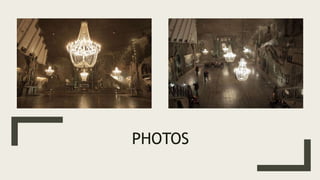
■ Visiting the mine is an extraordinary experience
that stays in your memory for a long time. The
tourist route of the salt mine in Wieliczka
provides a great opportunity to do so. It is the
longest underground trail not only in Poland,
but also throughout Europe. It is about 2.5 km
long and it takes an average of two hours to
complete it. The entire tourist route consists
of numerous chambers and chapels, each of which
has its own unique legend. Sidewalks, ramps,
underground lakes, shafts - all this still bears
the hallmarks of former mining works. Despite
the passage of many years, we can still see
well-preserved excavation security systems,
unique sacral art created by miners, and
underground mining corridors. All this makes up
an underground open-air museum. Every day, the
described route is traversed by tourists as well
as people coming here, to the only underground
healing center in Poland.
Tourist
Route
PHOTOS
Our opinion
about the
Wieliczka
Salt Mine
■ We think that the Wieliczka
Salt Mine is very interesting
and there is a lot to see in
it. We recommend everyone to
visit this beautiful place.

Wieliczka by Group 2

  • 1.
  • 2.
    Wieliczka salt mine ■ “Thehistoric Wieliczka Salt Mine is the only mining facility in the world that has been operating continuously from the Middle Ages to the present. Its original excavations (walkways, slipways, mining chambers, lakes, shafts, shafts) with a total length of about 300 km are located on 9 levels, reaching a depth of 327 m, illustrating all stages of the development of mining technology in particular historical epochs. ■ On September 8, 1978, the Wieliczka Salt Mine was inscribed on the first UNESCO World Cultural and Natural Heritage List among the first 12 sites from around the world. Indeed, the history of Wieliczka, dating back to the Middle Ages, is a mirror of the development of mining techniques, the shaping management.
  • 3.
    Position ■ Wieliczka isa town located in the Lesser Poland Voivodeship, in the western part of the Wieliczka County. Wieliczka is located within Lesser Poland as a historical land. The city lies in a valley between two ridges of hills stretching from west to east: the Wielickie Foothills in the south and Piaski Bogucickie in the north. Currently, the city has a typical tourist function. Wieliczka is known for its unique salt mine, which is visited by over a million tourists a year.
  • 4.
    history ■ Salt wasthe most important mineral in the Polish state and, according to the applicable law, it was the property of the ruler. It is estimated that in the times of King Casimir the Great (14th century) the income from its sale accounted for 1/3 of the proceeds to the state treasury. At that time, the mining crew numbered about 1,000 people, achieving a production of more than 1,000 tons. Long-lasting wars, accompanying plagues and elemental disasters shook the salt economy in the second half of the 17th century, and the lessees who managed the saltworks neglected the protective works, leading the mine to ruin. It was only in the next century that specialists from Saxony arrived who managed to improve the company's operations in organizational and technical terms.
  • 5.
    Geology ■ The Wieliczkamine is located in the western part of the Podkarpacie salt deposits, whose age is estimated at about 15 million years. The deposit was formed in the Miocene period, the Baden age during the disappearance of the Miocene Sea, which became a closed sea with a high degree of salinity. ■ The hot climate and the constantly rising bottom created favorable conditions for sedimentation. First, carbonates began to be deposited, then sulphates, and finally rock salts, with the formation of a lump deposit in the southern part of the basin, and a seam deposit in its northern and central part. The duration of the sedimentation process is estimated at thousands of years, followed by the process of filling the reservoir with layers of clay and mud. During the last orogenic movements of the Carpathians, the lump deposit was pushed over the bedrock. Currently, the salt deposit in Wieliczka is about 10 km long, 1 m wide and from a few to about 400 m thick.
  • 6.
    Legend ■ On thetourist route there are several chambers, numerous sculptures and bas- reliefs made of salt, brine lakes, and chapels. The life-size salt sculptures in the Janowice Chamber deserve special attention from the youngest visitors to the underground tourist route. They illustrate one of the most beautiful Wieliczka legends, telling about the discovery of rock salt in Poland. According to this legend, Kinga, the daughter of the Hungarian king Béla IV, threw her engagement ring into a mine shaft in Maramures before getting married. This ring miraculously arrived with rock salt deposits to Wieliczka. After arriving in Poland, the Duchess ordered to dig in the place indicated by her. Miners obedient to her will, digging a shaft, found Kinga's engagement ring in the first lump of salt extracted.
  • 7.
    Chapel of St. Kinga ■St. George's Chapel Kingi is the most magnificent and richest underground temple in its form. The chapel, called the underground church, deserves to be called a sanctuary, because the relics of St. Kinga. This one of the greatest attractions of the Wieliczka mine is the world's largest underground temple. ■ Hollowed out in a block of salt, it has been serving religious functions since 1896. The interior of the chapel has been created for over 100 years. From the end of the 19th century to 1963, self-taught miners: Józef and Tomasz Markowski and Antoni Wyrodek performed sculpture works. The contemporary generation of Wieliczka miners carries out subsequent sculptural projects inside it. ■ Sculptural works decorating the sides of the chapel, i.e. its walls, illustrate scenes from the New Testament
  • 8.
    The role ofsalt ■ Since ancient times, salt has been the economic basis of the state. It served as a means of payment in the form of "salt crumbs" - replacing metal money. ■ Originally, salt was obtained from salty springs by the brewing method, which involved the evaporation of water. The beginnings of the exploitation of rock salt are not known. Most likely, during the deepening of brine wells, a salt deposit was found, which began to be extracted with the use of primitive tools. The rulers of Poland at that time quickly realized the value of the white metal. Therefore, a monopoly on the exploitation and even distribution of salt was introduced. It was realized that salt is a basic necessities necessary for human life. Large amounts of it were used to preserve meat, butter, fish, tanning leather, and producing gunpowder.
  • 9.
    ■ Visiting themine is an extraordinary experience that stays in your memory for a long time. The tourist route of the salt mine in Wieliczka provides a great opportunity to do so. It is the longest underground trail not only in Poland, but also throughout Europe. It is about 2.5 km long and it takes an average of two hours to complete it. The entire tourist route consists of numerous chambers and chapels, each of which has its own unique legend. Sidewalks, ramps, underground lakes, shafts - all this still bears the hallmarks of former mining works. Despite the passage of many years, we can still see well-preserved excavation security systems, unique sacral art created by miners, and underground mining corridors. All this makes up an underground open-air museum. Every day, the described route is traversed by tourists as well as people coming here, to the only underground healing center in Poland. Tourist Route
  • 10.
  • 11.
    Our opinion about the Wieliczka SaltMine ■ We think that the Wieliczka Salt Mine is very interesting and there is a lot to see in it. We recommend everyone to visit this beautiful place.