z
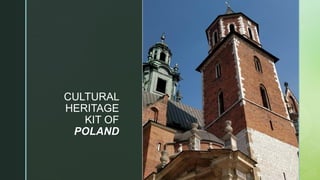
CULTURAL
HERITAGE
KIT OF
POLAND
z
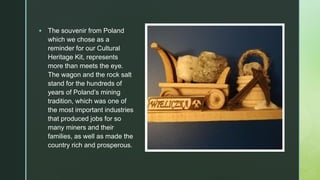
▪ The souvenir from Poland
which we chose as a
reminder for our Cultural
Heritage Kit, represents
more than meets the eye.
The wagon and the rock salt
stand for the hundreds of
years of Poland’s mining
tradition, which was one of
the most important industries
that produced jobs for so
many miners and their
families, as well as made the
country rich and prosperous.
z
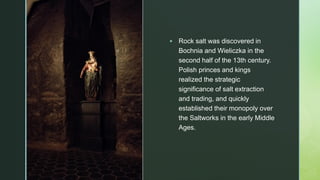
▪ Rock salt was discovered in
Bochnia and Wieliczka in the
second half of the 13th century.
Polish princes and kings
realized the strategic
significance of salt extraction
and trading, and quickly
established their monopoly over
the Saltworks in the early Middle
Ages.
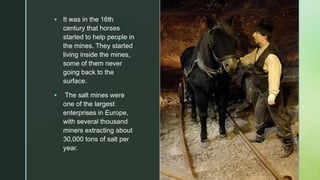
z▪ It was in the 16th
century that horses
started to help people in
the mines. They started
living inside the mines,
some of them never
going back to the
surface.
▪ The salt mines were
one of the largest
enterprises in Europe,
with several thousand
miners extracting about
30,000 tons of salt per
year.
z
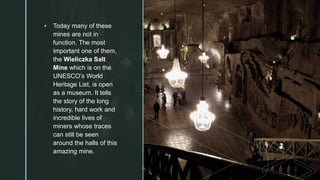
▪ Today many of these
mines are not in
function. The most
important one of them,
the Wieliczka Salt
Mine which is on the
UNESCO’s World
Heritage List, is open
as a museum. It tells
the story of the long
history, hard work and
incredible lives of
miners whose traces
can still be seen
around the halls of this
amazing mine.

Cultural heritage-kit-poland

  • 1.
  • 2.
    z ▪ The souvenirfrom Poland which we chose as a reminder for our Cultural Heritage Kit, represents more than meets the eye. The wagon and the rock salt stand for the hundreds of years of Poland’s mining tradition, which was one of the most important industries that produced jobs for so many miners and their families, as well as made the country rich and prosperous.
  • 3.
    z ▪ Rock saltwas discovered in Bochnia and Wieliczka in the second half of the 13th century. Polish princes and kings realized the strategic significance of salt extraction and trading, and quickly established their monopoly over the Saltworks in the early Middle Ages.
  • 4.
    z▪ It wasin the 16th century that horses started to help people in the mines. They started living inside the mines, some of them never going back to the surface. ▪ The salt mines were one of the largest enterprises in Europe, with several thousand miners extracting about 30,000 tons of salt per year.
  • 5.
    z ▪ Today manyof these mines are not in function. The most important one of them, the Wieliczka Salt Mine which is on the UNESCO’s World Heritage List, is open as a museum. It tells the story of the long history, hard work and incredible lives of miners whose traces can still be seen around the halls of this amazing mine.